IPE Exam 3
 Call Kai
 Learn
Learn Practice Test
 Spaced Repetition
 Match
Match Flashcards
 Knowt Play
1/203

There's no tags or description
Looks like no tags are added yet.
Name | Mastery | Learn | Test | Matching | Spaced | Call with Kai | Chat |
|---|
No analytics yet
Send a link to your students to track their progress
204 Terms
culture
Values, beliefs, knowledge, art, morals, laws and customs acquired by individuals and groups
culture redefined
the integrated pattern of thoughts, communications, actions, customs, beliefs, values, and institutions associated, wholly or partially, with racial, ethnic, or linguistic groups, as well as with religious, spiritual, biological, geographical, or sociological characteristics. Culture is dynamic in nature, and individuals may identify with multiple cultures over the course of their lifetimes.
Acculturation
Transfer of values and customs; move from culture to another
• Multicultural environments
• Categories include: language spoken, culture orientation, religious affiliation
• References made about United States as melting pot vs. salad bowl
Communication Effectiveness
Health care providers and organizations recognize and bridge cultural
differences that can contribute to miscommunication
• Reasons given based on IOM report titled “Unequal Treatment:
Confronting Racial and Ethnic Disparities in Health Care”
Cultural Competence Continuum
cultural destructiveness, cultural incapacity, cultural blindness, cultural percompentence, cultural competence, cultural proficiency
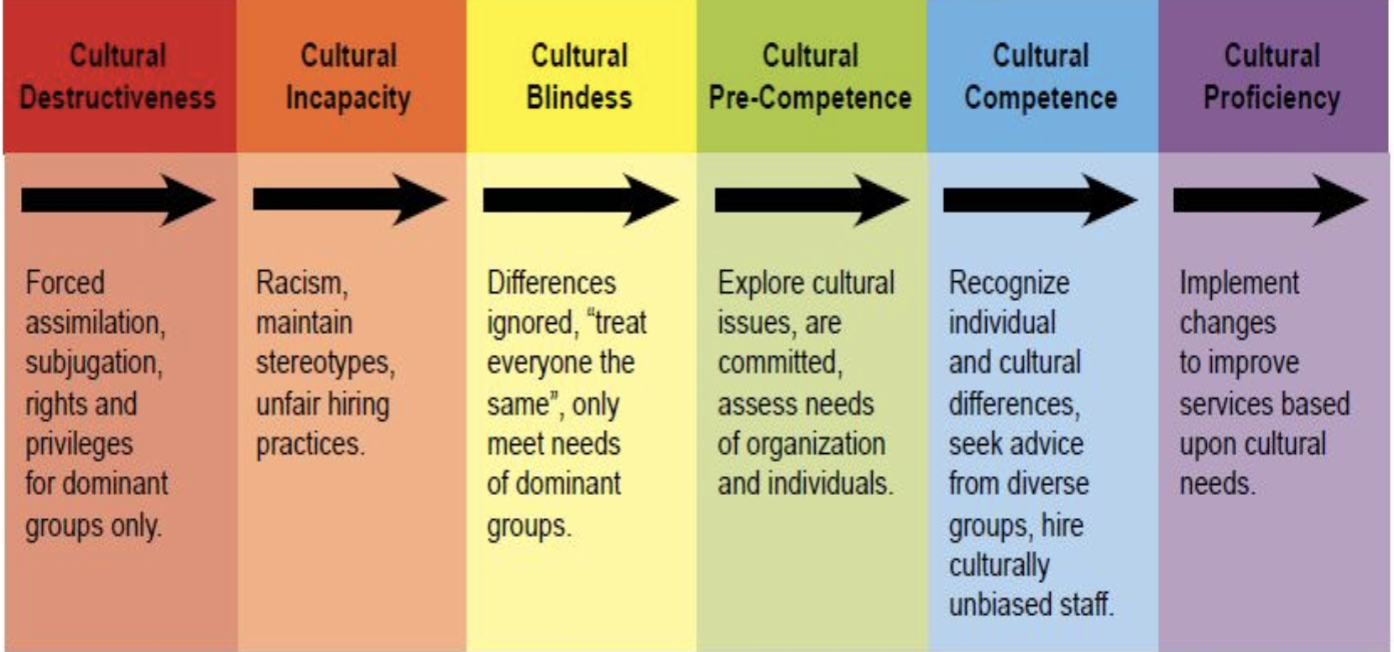
continuum of cultural competency
aspects of culture
values and norms
beliefs and attitudes
relationship patterns
communication and language
daily actives
Movement on Continuum
• 1 – valuing differences, awareness, self-assessment
• 2 – understanding cross-cultural dynamic
• 3 – building cultural knowledge
• 4 – adapting practice to reflect patient cultural context
Culturally Competent
• Value individuals in own right
• Hold few fixed judgements about any individuals/groups
• Have multiple exposures to differences of others
• Have reference groups which value cultural differences
Culturally Sensitive Communication
• Demonstrates understanding and respect
• Providers need to be able to reflect upon their own values, beliefs,
preferences, assumptions & cultures as well as understand others
• More education is needed at all levels
National Standards for Culturally and
Linguistically Appropriate Services in Health and
Health Care
Office of Minority Health – U.S. Department of Health and Human
Services 2011 developed blueprint standards of care to be
implemented in order to improve health care in the US and decrease
health disparities
CLAS Standards
• Standard 1 – provide effective, equitable, understandable, and
respectful quality care and services
• Standard 2 – advance and sustain governance and leadership that
promotes CLAS and health equity
• Standard 3 – recruit, promote, and support a diverse governance,
leadership, and workforce
• Standard 4 – Educate and train governance, leadership, and
workforce in CLAS
• Standard 5 – offer communication and language assistance
• Standard 6 – inform individuals of the availability of language
assistance
• Standard 7 – ensure the competence of individuals providing language
assistance
• Standard 8 – provide easy-to-understand materials and signage
• Standard 9 – infuse CLAS goals, policies, and management
accountability throughout the organization’s planning and operations
• Standard 10 – Conduct organizational assessments
• Standard 11 – collect and maintain demographic data
• Standard 12 – conduct assessments of community health assets and
needs
• Standard 13 – partner with community
• Standard 14 – create conflict and grievance resolution processes
• Standard 15 – communicate the organization’s progress in
implementing and sustaining CLAS
Ethics in Health Care
• The field of applied ethics that is concerned with the moral decision-
making situations that arise in the practice and policy of healthcare
• Promotes the consideration of values in the prioritization and
justification of actions by health professionals, researchers and
policymakers that may impact the health and well-being of patients,
families and communities
Ethical Communication
• Involves all the relevant information, true and accurate
• Avoids language that manipulates, discriminates or exaggerates
• Accuracy of information
• Avoid withholding crucial information
• Conveying the point without offending
Unethical Communication
• Plagiarism – stealing someone else’s work and claiming it as your own
• Selective Misquoting – deliberately omitting damaging or unflattering
comments to paint a better (but untruthful) picture
• Misrepresenting numbers – increasing or decreasing numbers, altering
statistics or omitting numerical data
• Distorting visuals – making a product look bigger or changing the scale
of graphs and charts to exaggerate or conceal the differences
Health Communication
• Should adhere to the principles of beneficence, non-maleficence,
respect for personal autonomy, and justice
• The exchange between health professional and patients should
involved informed consent regarding the purpose and nature of the
intervention and possible alternatives.
• There should be respect, freedom from intimidation and suitable
language understandable to patients
Beneficence
• Obligation to produce benefit
• Act of doing good; kindness
• Active contribution towards welfare of others
Non-maleficence
• Do no harm
• Omission of harmful action
• Do not kill
• Do not cause pain or suffering
• Do not incapacitate
• Do not cause offense
Respect for Autonomy
Free to make choices and
act voluntarily according to
their values, beliefs and
preferences
Justice
Treated in a manner that is
equitable and fair
Code of Ethics
• All associations and societies
• AMA Code of Medical Ethics
• ANA Code of Ethics
• Hospitals and Health Care Organizations Code of Ethics
Ethics Committee
• Gives advice on moral questions in clinical care, educates staff and
public on issues in medical ethics
• Develops policies related to patient care in regards to ethics
• Provide consultations to resolve ethical conflicts
• Protocols related to research studies
• Regulatory requirement
Confidential communication
Personal or private matters that are revealed to a provider who cannot by
compelled by law to repeat communication or be a witness against the patient.
HIPPA
Health Insurance Portability and Accountability Act privacy
rule
Anonymity
Right of the patients to have their identity
protected from is being known to others.
Privacy
Right of patients to limit any knowledge
about themselves to become known to
others.
Legal and Ethical
Perspective
Patient safety, Liability, Incident reports and Malpractice litigation
Communication
PerspectivePatients
Patients to maximize their privileges of
choice and execute our responsibilities.
Truth-Telling
Patient Self-Determination Act (PSDA)
• Federal law that informs patients of their rights regarding
decisions surrounding their medical care.
• Includes protection from deception
Provider Discomfort in Truth-Telling
don’t want to give patients a diagnosis and prognosis if they are not 100% sure
they do not know the patient’s emotional stability
there has not been a conversation with the patient in terms of what they wanted to know or even when for that matter
Exception to Truth-Telling
Patient has explicitly said they do not want to know their diagnosis or
prognosis.
Patient cannot handle cognitively, emotionally, or mentally the
information.
not all health care team members are authorized to give information
Informed Choice and Informed Consent
• Truth-telling is linked to patient’s informed choice and consent
• Health care providers are ethically and morally obligated to respect the
individuality of all patients who are recipients of their care
• Same goes for health care leaders and their employees
Advance Care Directives
the PSDA gives us
• The right to participate in and direct their own health care decisions.
• The right to accept or refuse medical or surgical treatment.
• The right to prepare an advance directive
• Information on the provider’s policies that govern the utilization of these rights.
Legal Duty to Provide Care
• Consumer rights outlined by American Hospital Association (AHA)
• Right to safety
• Right to be informed
• Right to choose
• Right to be heard
Providers Who Refuse to Provide Care
why providers can refuse care:
personally held moral or religious belief
physical risk
care to be given violates patient autonomy and rights to self determination
religious and /or moral issue that causes provider to objec
encounters
routines, ceremonies and drams
family
Definition of family today is much different than what it looked like in the past
A group of one or more parents and their children living together as a
unit
Group of two or more persons related by birth, marriage or adoption who live together
Family can be made up of anyone a person considers their family
Family shares emotional bonds, common values, goals and responsibilities
Family Stress Theory
Views the family in evolving stressful situations where stressors occur and resolve throughout the life of the family
Developed by sociologist Reuben Hill in 1949 – interested in how families were impacted by World War II and looked into how war- induced separations and reunifications shifted families
Stressors affect how a family will adapt to illness and disease
The kind of stress and amount of time a family takes to process that event can directly influence the relationships the family members share
Overall dynamics are shaken after being in a highly challenging situation
Hill’s Family Stress Theory Model
ABC-X Model for family stress theory – many variations of the
family stress model but this one is the most used, accepted, and understood
A: The Event that has put the family under stress
B: Resources available that act as stress buffers
Internal – stress and anger management skills, conflict resolution skills, communication skills, ability to self-regulate, mindfulness, self-awareness
External – financial, access to food and medical care, social and communal support,
physical or practical assistance, emotional and psychological support including therapy
C: Perception of the stressor; different kinds of stressors and each one is understood as either dangerous or challenging or constructive hurdle
X: Outcome – stands for the result or outcome/likelihood of the family crisis
Duvall’s Family Development Theory
Families move through stages in a particular order across time
Theory is based on the traditional, nuclear, intact family
Stages:
Married couple without children
Childbearing families with the oldest child between birth and 30 months
Families with preschool children
Families with school-age children
Families with adolescents
Launching families (first to last child is leaving home)
Middle-age families (“empty nest” to retirement)
Aging families (retirement to death of both spouses)
Classic Resiliency Model
Premise is by intervening to help families, providers can
have a positive impact on the resilience of the family,
enabling an opportunity for balance to be achieved while
decreasing the buildup of unresolved stress
Perspectives on the Family
Family as a resource (protective)
Family as a deficit (contributor or threat to illness)
Family and the course of illness (adaptive or
maladaptive)
Family and the impact of illness (burden and
stress)
Family Adaptation to Injury and Illness
Any health condition that threatens the functioning
and well-being of the patient also threatens the
family
Family’s response to patient’s condition highly
influenced by previous experiences
Assessing Family Health and Family
Relationships
Information can come from:
1. Family’s previous experience and beliefs about
patient’s condition
2. Their knowledge and understanding of the health
condition
3. Actual health and medical concerns of other family
members (families are informants of current and past
medical conditions)
4. Family relationship and roles
Areas Needing Clarity
Quality and communication between the patient and specific
designated responsible parties
Patient’s role in the family and alterations in role functioning as a
result of the onset or progression of illness
Factors that may inhibit communication in the family
Patients define their own family unit:
This can include what information is said or not said
Legal responsible could be someone completely different
The Chaotic Family
Structuring communication:
1. Structure the topics, direction, and duration of the
interview
2. Speak clearly and gain and maintain control of the
flow of communication and discussion
3. Appeal to the designated leader(s) of the family to
follow-up on recommendations
4. Establish definite timelines for follow-up
crsis
Defined as “a time of intense stress or difficulty”
False assumptions:
People in crisis area always incapacitated
People in crisis is that people experience crisis alone
Leads to a long lasting psychological breakdown
Crisis is the same as the stressor or stimulus-provoking
response
Dysfunctional Aspects
Crisis is usually accompanied by anxiety
Physical signs and symptoms:
Restlessness
Shortness of breath
Trembling
Shaking
Facial expressions and gestures
Struggle with communication
Family in Crisis
Experiencing incapacitating trauma
Providers have trouble communicating with family
Responses may include: anger, rage, fear, panic, blame, guilt,
despair
Level of cooperation is a concern
Lives disrupted by mental health or acute or chronic
physical illness
Equilibrium that potentially renders them unable to fulfill their roles
and make informed decisions, at least temporarily
Primary therapeutic response – allow them time to express
their emotions
Disturbances
In Perception
Happen as a result of overstimulation
Rapid or excessive barrage of stimuli that exceeds one’s particular
tolerance
In Expression
Individual’s capacities to express thoughts, ideas and feelings
in a complete & coherent manner affected
In Processing Stimuli
Inability to process stimuli
Stress Theories and Understanding
Crisis
Lazarus and Folkman (1984)
Stress Definition
“the demands placed on us from either internal or external sources that are perceived as
taxing or as exceeding the resources of the individual”
Stress and stressors studies as well as coping and adaptation skills
Holmes and Rahe (1967)
Stress results from change
Any change (large or small) that requires readjustment in a person’s life causes
stress
Demand impact of events accumulates over time (how many stressful events occur
to a person in a specific timeframe)
maladaptive coping responcses
emotionally based; strategies in which further
problems are created without addressing the problems causing the stressful life event
adaptive
problem-solving based
Stress-resistance resources
both the internal and external elements a person employs to deal with and resolve the problems that are creating stress
Situational crisis
Situations that have affected in either a negative or
positive way
Existential crisis
Where you are questioning your everyday existence
Developmental Crisis
1. trust vs mistrust
2. autonomy vs shame and
doubt
3. initiative vs guilt
4. industry vs inferiority
5. identity vs role confusion
6. intimacy and solidarity vs
isolation
7. generativity vs self-
absorption or stagnation
8. integrity vs despair
Phases of Crisis Resolution
Initial sign = anxiety
Then, accompanied by physical signs of distress –
restlessness, muscle tension, trembling, swaying,
dizziness, headaches, and palpitations
Sleep deprivation
Could progress where person is a threat to themselves
Managing Crisis Behaviors
Clarify the patient’s problems and needs
Foster supportive interpersonal encounters
Encourage patients to seek additional support
Refer patients to therapists that can address and
monitor coping mechanisms
General Guidelines
Crisis victims should not be revictimized in the
process of being helped
An emotional or psychological connection with the
patient is critical
Crises are responses to real or imagined threats
Crisis is not merely a single event
Communicating with Agitated and/or Confused Patients
Agitation and confusion commonly occur with
patients in crisis
Disturbances in orientation and intellectual
impairment
Stages of Adaptation to Illness or Injury: discovery
Carries with it emotional reactions of denial & disbelief.
Stages of Adaptation to Illness or Injury: acute and chronic
Anger, depression, beginning resolution
Stages of Adaptation to Illness or Injury: terminal
Ultimate resolution and acceptance
Principles to Guide Observations
Patients do have emotional reactions to their illnesses and
injuries
These reactions change over time
The process is not as linear as we thought
Fear, Anxiety and Disorganization
Emotions and Reactions
Anger and Hostility
Anger is a reaction to stress and a statement of protest
Depression
Most patients will experience sometime during their illness
Depression + hopelessness = prime candidates for suicide
Resolution and Acceptance
most talked about when facing end of life
behavior and cognitive control
Helplessness
Condition that is both perceived
any and induced in patients who
are experiencing illness
Powerlessness
Patients’ recognition that they
have no control to affect a
specific outcome.
Hopelessness
Being without hope - can result in
declining physical and mental
status
Therapeutic Responses to Chronically Ill
Patients
Types of Coping Functions:
Problem-focused coping
Those that manage or alter the problem or source of
stress
Emotion-focused coping
Those that regulate the stressful emotions that are
brought on by stress
Cognitive Appraisal
Patients’ perceptions of and processing of
health-related problems will determine their
emotional reactions
Impact of familial, cultural and religious beliefs
Levels of Denial- first
denial of the facts
Levels of Denial- second
denial of the implications of the facts
Levels of Denial- third
Denial of the ultimate outcome of the illness or prognosis.
Approaches to Truth Telling
Provider-patient-family relationship is
based on mutual respect and trust.
Provider’s concern about telling bad
news is that it will lead to more fear and
stress.
Tips for Communicating with Mental
Health Patients
Avoid speaking on their behalf. If pause or delay, wait for them to respond.
Avoid talking about complex emotional topics in their presence, especially in
times of crisis
Use non-verbal communication such as silence and listening to give patient
acknowledgement and sense of control
Leaning forward, facing the patient and maintaining eye contact are ways to
actively listen
Stay calm and be patient
Listen but respect personal space and be cautious
Avoid assuming what they are thinking about, their wants or needs
Talk with the person with mental illness, not about them
Be warm and empathetic
Positive regard and appreciation for little efforts
5 Things to NEVER Say to Someone with
Mental Illness
1. Stop acting crazy! Don’t be insane! You are seriously unhinged!
2. Just don’t worry about it! Calm down! Don’t sweat the small stuff!
3. This makes me want to kill myself! I wish I were dead! This makes me want
to commit suicide!
4. Therapy is for people who are weak! I just don’t see the point of therapy!
Can’t people just solve things on their own?
5. Things will be better in the morning. Tomorrow is another day. Cheer up!
Expressed Emotion
The style of communication that the family follows when talking to the person
with mental illness.
It involves five components, any or multiples of which could be reflected in the
communication styles of the family members:
Criticality
Hostility
Over-involvement
Positive regard
Warmth
First 3 are negative expressed emotions
Last 2 are positive expressed emotions
End-of-life & Decision-making
Conversations
Terminal illness and discussions about type of care desired
at end of life
Range of issues – DNR, do not hospitalize, nutrition,
hydration, discontinuing all care, comfort measures, pain
management)
Advance directives, Living Will, Physician Orders for Life-
sustaining Treatment (POLST), Medical Orders for Life-
sustaining Treatment (MOLST)
Comfort care, palliative care, hospice care, transitional care
Decisional Conflict
State of uncertainty about a course of action more
likely when person and/or family confronted with
decisions – conflicts within the family or with the
patient
Emotional
Depression
Chronic Illness
Healthy People 2020 addresses
Along with hopelessness –
prime candidate for suicide
Negatively affects how you feel,
the way you think and how you
act
Feelings of sadness and/or loss
of interest in activities
Symptoms of Depression
Feeling sad
Lost of interest or pleasure
Changes in appetite
Changes in sleep
Loss of energy and/or increased
fatigue
Increase in purposeless physical
activity or slowed movements/speech
Feeling worthless or guilty
Difficulty thinking, concentrating, or
making decisions
Thoughts of death and suicide
Caregiver Burden
Physically and emotionally drained from caring for the patient
Angry and frustrated by the prospect of endless caregiving responsibilities
Frustrated about the program of caregiving and the numerous demands without
clear signs of patient improvement or progress
Powerlessness over the disease, its course, and the ability to make changes for
the better
Angry at the patient for significantly altering their personal independence and
autonomy and, therefore, quality of life
Functional Health Literacy
Defined as the skills and knowledge necessary to
understand illness and treatment, and the ability to
navigate the health care system
Low literacy associated with:
Poor understanding of medical advice
Adverse patient outcomes
Negative effects on health
= Substandard care
Health literacy is not necessarily related to years of
education
Healthy People 2010
the degree to which individuals have the capacity to obtain,
process and understand basic health information and
services needed to make appropriate health decisions
healthy people 2030
increase the proportion of adults who’s health care provider checked their understanding
decrease the proportion of adults who report poor communication ith their health care provider
increase the proportion of people who say their online medical record is easy to understand
increase the proportion of people who say their online medical record is easy to understand
increase the proportion of adults which limiter English proficiency who say their providers explain things clearly
increase health literacy of the population
Barriers to Health Literacy
Individual-level patient barriers
Demographic
Health status
Complexity of illness and treatment
Illness experience
Health care system exposure
Provider-patient-family relationship barriers
Number and length and quality of encounters
System-level barriers
Mission of institution
Organization of services
Proportion of providers and patients
Time and schedule of care activities
population most at risk for health illiteracy
Youth
Elderly
Low Income
Minority
Vulnerable Populations
Medically and Cognitively Impaired
Underserved
Deficits in Patients’ Understanding Health
Conditions
Patients do not
recognize what
they do not
know.
Patients think
they know but
do not know.
Communication Interventions
Time to construct reading
materials using plain
language and
illustrations.
Opportunity to test and
evaluate all written
materials and medical
instruction info sheets.
Provider-patient time to
communicate to exceed
6-10 mins.
Advocacy for health
literacy in the
organization and
recognition of the value of
assessing health literacy.
Providers knowledgeable
and skilled in concepts of
and assessment of
limited literacy.
Opportunity to conduct
feedback loop.
Development of
population-based health
literacy best practices.
Assessing Health Literacy
test of Functional Health
Literacy in Adults
REALM-R
Short assessment of health literacy for Spanish speaking adults
newest vital sign
Use of “Plain Language”
Presenting important points first
Organizing complex thoughts and ideas into
understandable parts
Using simple terminology and language, defining
technical terms
Using the active voice when making statements to
patients
patients should be able to state
what are you going to day?
what is your problem?
what am I supposed to do?
why is it important for me to do this?
CONFRONTATION
Deliberate use of statements or questions with patients to point out discrepancies
• Motivates patients to change what they are or are not doing
• Differences between what is said versus what is done
• Differences in statements or behaviors observed over time
• Differences between what patients should do and what they are actually doing
• Offers providers’ and patients’ alternative views about what is really going on
levels of confrontation
Firsthand experience of behavior or Present factual data that provides patients with info and feedback
before using confrontation
establish relationship built on trust and caring
use empathy, postive regard,respect, warmpth, active listening and genuinesess
lay the foundation for the poupose for adressing unique concerns
avoid appering overly critical when no emergent threats are present
identify obvious discerpancies and plan approach to communicate them
define provider role and level of commitment
orders and commands as explicit
• Directives are absolute statements made to patients about a preferred
course of action
• Expected to be followed
• Orders and commands elicit change by insistence and should not be perceived
as a choice
• Orders are a directive that patients must follow, does not have to be
immediate
• Commands are also directives that must be followed, but they demand
immediate action
advice
• Can frequently appear as a directive
• The less direct the advice, the less likely pts will resist taking it
• Providers must be an open style – a willingness for their advice to be rejected
• Advice that MUST be followed is not advice, but a command or directive
SUMMARIZING DIRECTIVES
assess what has been understood and how it was interpreted
use teach-back method
focus on shared understanding and plans raising from discussions
summarize important points and directives given
make patients aware session is ending so they can ask questions or clarify points
note gains ir progress made in attempt to patients following directives