Deck #2: Cells of the Immune system + their role
 Call Kai
 Learn
Learn Practice Test
 Spaced Repetition
 Match
Match Flashcards
 Knowt Play
1/27

There's no tags or description
Looks like no tags are added yet.
Name | Mastery | Learn | Test | Matching | Spaced | Call with Kai | Chat |
|---|
No analytics yet
Send a link to your students to track their progress
28 Terms
What is MHC? List its roles.
→ encodes transplantation antigens needed for the rapid rejection of tissue grafts b/w genetically nonidentical individuals
Role: Bind peptide antigens + present them to
T-cells
What is the role of T-cell receptor?
Recognizes transplantation antigens and peptide antigens presented by MHC on APCs
Specific for antigen & particular MHC
needs the antigen to be presented on a "self-MHC" molecule
What peptides do MHC class I and class II molecules associate with?
MHC class I - associate with endogenously synthesized peptides, which are produced by the degradation of a cell's internal molecules
MHC class II - bind to peptides produced by the breakdown of proteins after endocytosis (exogenous antigens)
How are endogenous peptides generated?
via the degradation of internal molecules through a process carried out by proteasomes
Give the specificity of binding of T cells to MHC molecule type.
CD8+ T cells bind to MHC class 1
CD4+ T cells bind to MHC class 2
What does T cell activation lead to?
Induces an enzymatic cascade leading to IL-2 and a high-affinity IL-2 receptor on the T cell
IL-2 drives T cell division
Clonal proliferation and differentiation into effector cells
Identify the 4 major classes of antigen-presenting cells. Which are the classes that are involved in phagocytosis?
Phagocytes (monocyte/macrophage lineage)
Non-phagocytic constitutive APCs (dendritic cells and Langerhans' cells)
Lymphocytes (B cells and T cells)
Facultative APCs (astrocytes, endothelium, fibroblasts)
What is antigen processing?
involves the association of antigens with self-MHC molecules so they can be presented to T cells with appropriate receptors
Outline the various steps involved in antigen processing by MHC I and II pathways.
MHC I Pathway (Endogenous)
Cytosolic proteins are broken down by proteasomes
Resulting peptides enter the RER via peptide transporter systems (TAPs), where they complex with nascent MHC class 1 proteins
stable complex is transported to the cell surface via the Golgi for display to CD8 T cells
MHC II Pathway (Exogenous)
Proteins from exogenous antigens are internalized via endocytic vesicles + exposed to cellular proteases
Peptides are generated in endosomal vesicles, which fuse with exocytic vesicles containing MHC 2 molecules
MHC 2 molecules are initially protected by an invariant chain (Ii chain)
Low pH causes the Ii chain to dissociate, allowing the peptide to bind
MHC II–peptide complex is transported to the surface for recognition by CD4 T cells
How do HIV virus interfere in antigen processing pathways?
HIV Tat protein inhibits class 1 MHC molecule expression
How do Herpes virus interfere in antigen processing pathways?
Herpes virus protein binds to TAP → preventing transport of viral peptides into the ER → stops the formation of MHC class 1 complexes with those peptides
Where do hematopoietic stem cells reside before and after birth?
Before birth (embryonic) - fetal liver
After birth (postnatal) - bone marrow
What are the 2 series of cells given rise by stem cells?
Stem cells differentiate into
Myeloid series
Lymphoid series
What do lymphoid progenitor cells give rise to?
B-cells
T-cells
Briefly explain the stages involved in differentiation of B cells.
B cells develop in the bone marrow
they rearrange their immunoglobulin genes and express a unique antigen receptor on their surface
Migrate to 2er lymphoid organs (spleen)
Activate to become antibody-secreting plasma cells once they encounter an antigen
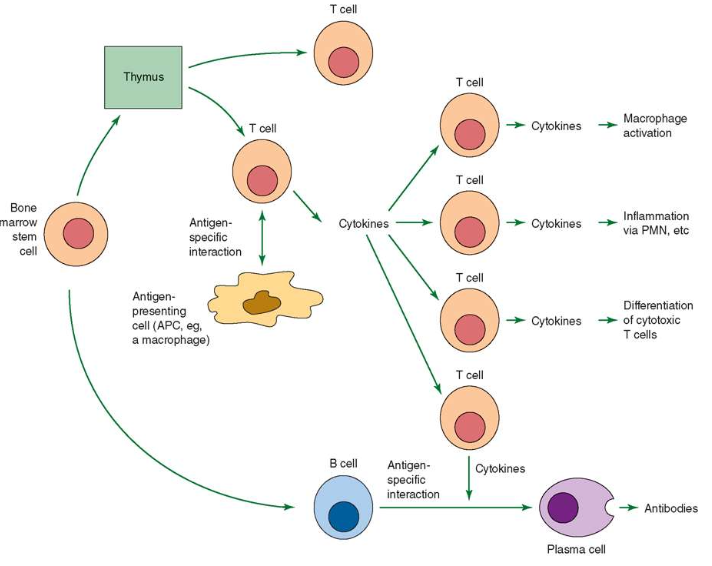
Where are T cells produced and how do they mature?
Produced in bone marrow
Travel to the thymus to mature
List the 2 main subclasses of T-cells.
CD4 T cells (Helper)
CD8 T cells (Cytotoxic)
Briefly explain the events involved in antibody-mediated arm of adaptive immunity.
Helper (CD4) T lymphocytes recognize pathogen antigens complexed with MHC class II on an APC
T cells produce cytokines that activate B cells
B cells undergo clonal proliferation + differentiate into plasma cells
Plasma cells produce specific antibodies (Igs) to match the antigen
What are the 2 categories of pathogens against which antibody-mediated defense is useful?
produce toxins (e.g., Clostridium tetani)
polysaccharide capsules that interfere with phagocytosis (e.g., pneumococci)
Name the cells involved in recognizing the 2 types of MHC complexes.
MHC class 1 - recognized by cytotoxic (CD8) T-cells
MHC class 2 - recognized by helper (CD4) T-cell
Briefly explain the steps involved in cell-mediated arm of adaptive immunity.
Antigen-MHC complexes are recognized by appropriate T-cells (CD4 for MHC 2; CD8 for MHC 1)
T cells produce cytokiness, become activated, & expand through clonal proliferation
Differentiate into effector cells to carry out immune functions
What role does Helper (CD4) play?
Stimulate B cells to produce antibodies
promote delayed hypersensitivity
defend against intracellular bacteria and viruses
What role does cytotoxic (CD8) play?
Destroy cells in tissue grafts, tumor cells, or cells infected by viruses
What are the major phagocytic cells of immune system? Give the functions/role of each cell type
1) Monocytes and Macrophages - engulf and kill pathogens, process and present antigens, and regulate immunity by producing cytokines and chemokines.
2) Granulocytes (PMNs, eosinophils, and basophils)
PMNs - destroy pathogens within intracellular vesicles
Eosinophils and basophils - important in defense against parasites and have granules with toxic proteins
3) Dendritic cells - phagocytic, degrade pathogens, act as APCs to activate T cells, produce regulatory cytokines
What are killer cells? What is their role in immune defense? What do they contain?
→ large, granular lymphocytes related to T-cells
provide protection against viruses and intracellular pathogens by recognizing and killing infected cells and tumor cells
have large amounts of granzyme and perforin, which mediate their cytotoxic actions
What are the 2 kinds of surface receptors of killer cells and their role?
Lectin-like NK-cell receptors - bind proteins (but not carbohydrates)
Killer immunoglobulin-like receptors (KIRs) - recognize MHC class 1 molecules + activate/inhibit NK cell
What is ADCC? Give the mechanism of ADCC involving killer cells.
ADCC = antibody-dependent cellular cytotoxicity
A specific antibody binds to the surface of a target cell
NK cell uses its Fc receptors to bind to that attached antibody + kills the target cell
What cytokines does NK cell produce? What cytokines promote its lytic activity?
IFN-γ
IFN-α, IFN-β (Type 1 IFNs)