Chemistry - Chapter 15 - Carboxylic Acids, Carboxylic Salts, and Esters
 Studied by 1 person
 Call with Kai
 Learn
Learn Practice Test
 Spaced Repetition
 Match
Match Flashcards
 Knowt Play
1/29

There's no tags or description
Looks like no tags are added yet.
Name | Mastery | Learn | Test | Matching | Spaced | Call with Kai |
|---|
No study sessions yet.
30 Terms
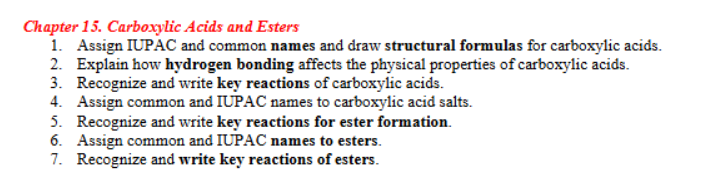
OBJ: Course Objectives for Chapter 15:
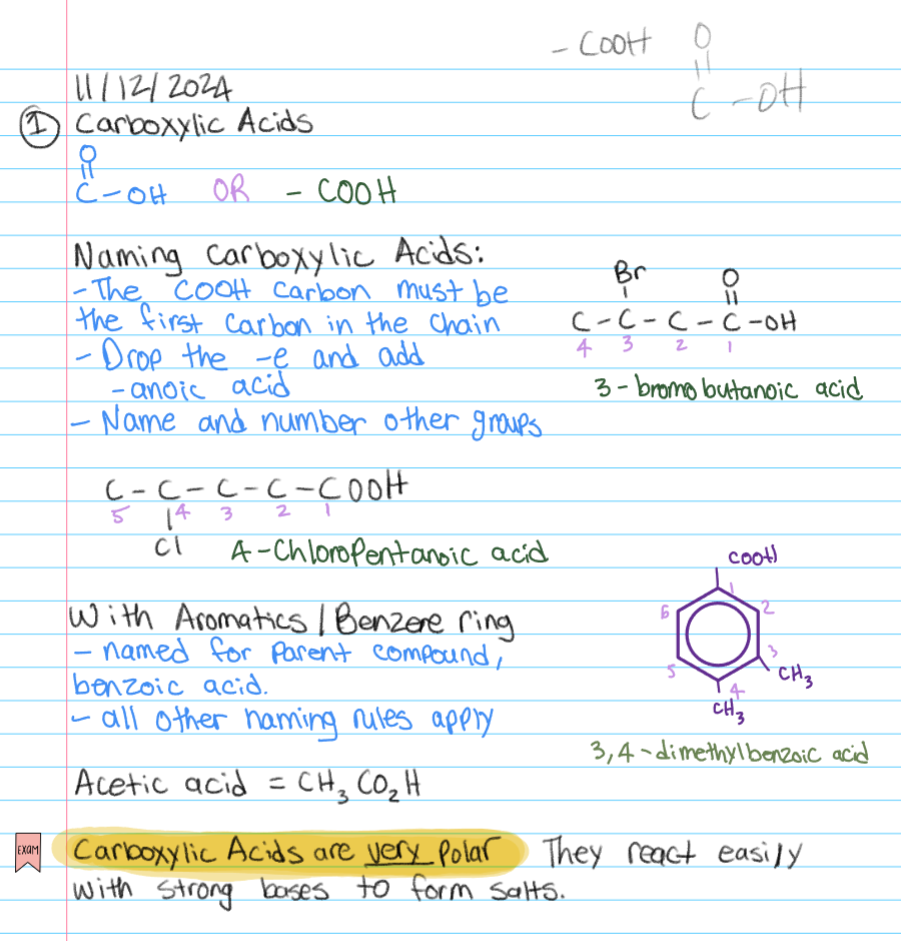
INFO: Carboxylic Acids Rundown
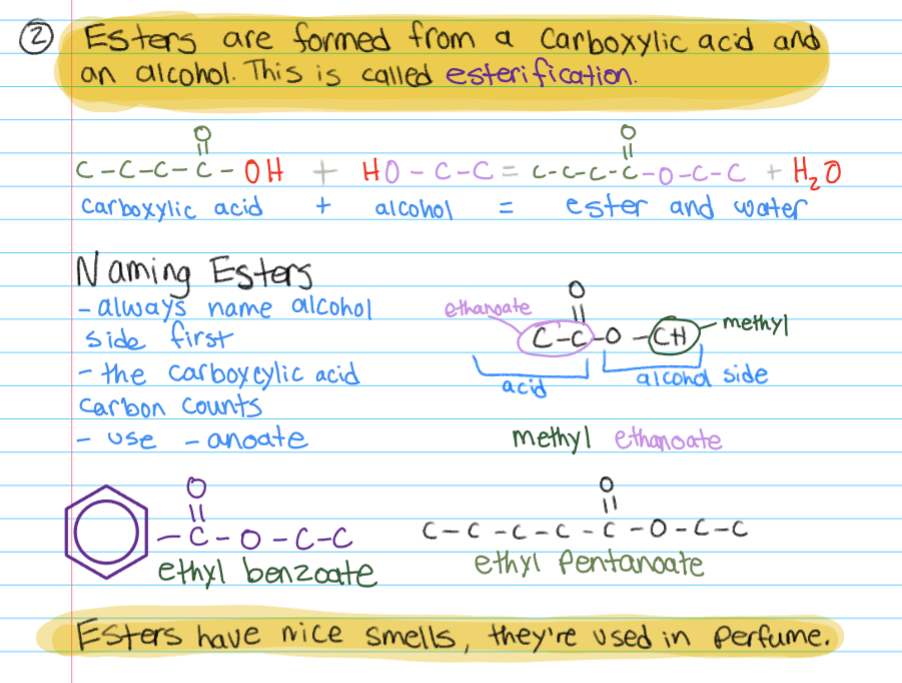
INFO: Ester Rundown
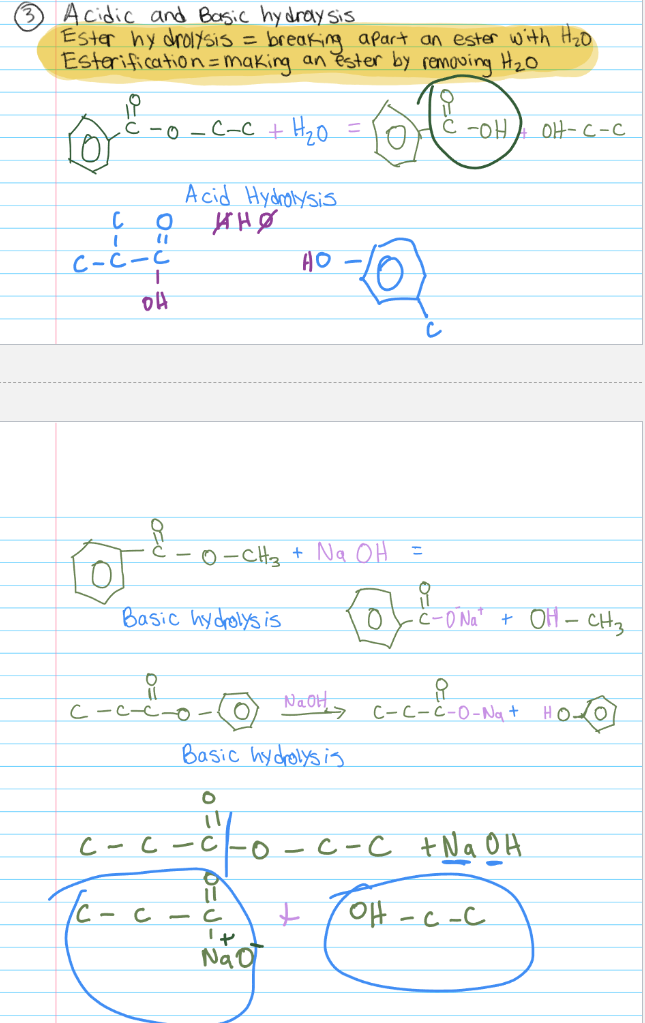
INFO: Acidic and Basic Hydrolysis Rundown
Basic hydroylsis is known as Saponification
Acidic Hydrolysis = “undoing” esterification
0: What is an ester?
Esters are organic compounds characterized by a carboxyl group in which the acidic hydrogen atom is replaced by an alkyl or aryl group.
Acid + Alcohol = ester + water
Which of the following Carboxylic acids is most soluble in water?
A. Hexanoic acid
B. Propanoic acid
C. Octanoic acid
D. Decanoic acid
B. Propanoic acid
Solubility is the INVERSE of polarity in carboxylic acids
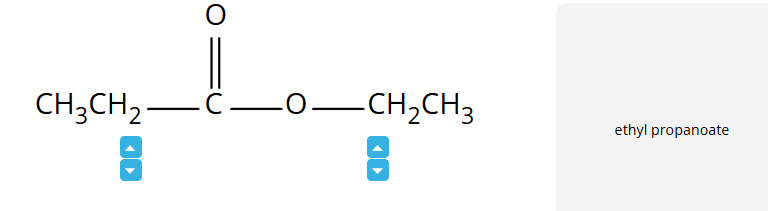
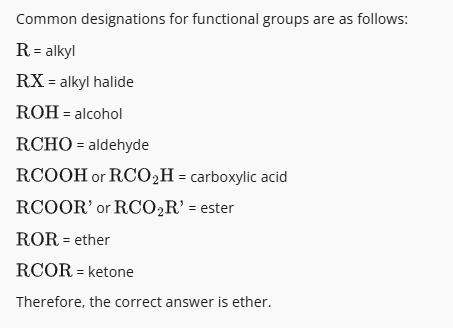
0: Identify the functional group designated by RCOOR’
Ester
Need to know:
ROH = Alcohol
RCOOH = carboxylic acid
RCOOR’ = ester
for carboxylic acid, ester
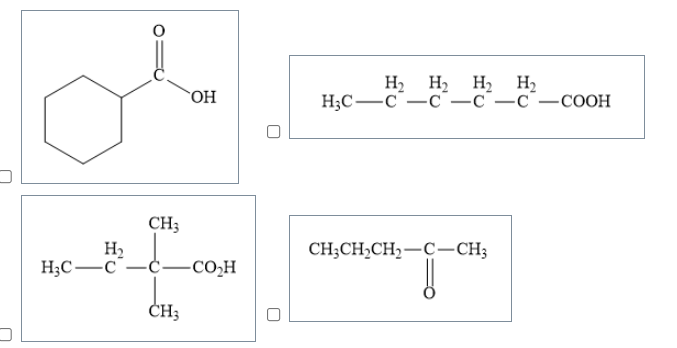
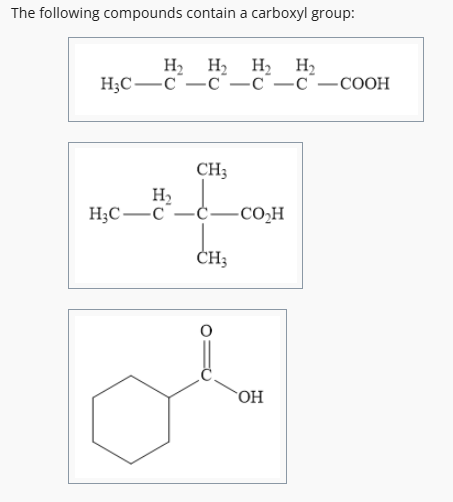
0: Indicate which of the following structures contain a carboxyl group.
Structures with a -COOH group, characterized by a carbon atom double-bonded to an oxygen atom and single-bonded to a hydroxyl group. Needs to have OH
0: What structural features are characteristic of fatty acids?
Carboxylic acids with long hydrocarbon chains, generally 12 to 20 carbon atoms, are called fatty acids because they were first isolated from natural fats.
Long hydrocarbon chain
Carboxylic acid functional group
0: What is the most important chemical property of carboxylic acids?
The most important chemical property of carboxylic acids is the acidic behavior implied by their name.
1: What are some common names for Carboxylic Acids given their IUPAC names?
IUPAC Names:
Methanoic acid
Ethanoic acid
Propanoic acid
Butanoic acid
IUPAC Name | Common Name | Structure |
|---|---|---|
methanoic acid | formic acid | H–COOH |
ethanoic acid | acetic acid | CH₃–COOH |
propanoic acid | propionic acid | CH₃–CH₂–COOH |
butanoic acid | butyric acid | CH₃–CH₂–CH₂–COOH |
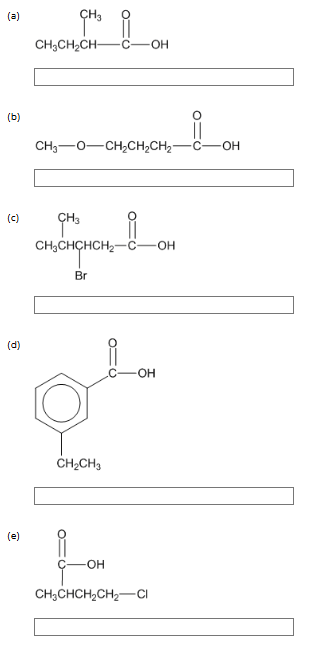
1: Write the correct IUPAC name for each of the following.
To name a carboxylic acid using the IUPAC system, the longest carbon chain including the carboxyl group is found and numbered. The numbering begins with the carboxyl carbon, so in monocarboxylic acids it is always located at the beginning of the chain, and no number is needed to locate it. The final -e of the parent hydrocarbon is dropped, and the ending -oic is added, followed by the word acid.
a) IUPAC name is 2-methylbutanoic acid.
b) IUPAC name is 4-methoxybutanoic acid. (methoxy because of the oxygen before the methyl)
c) IUPAC name is 3-bromo-4-methylpentanoic acid.
d) IUPAC name is 3-ethylbenzoic acid.
e) IUPAC name is 4-chloro-2-methylbutanoic acid.
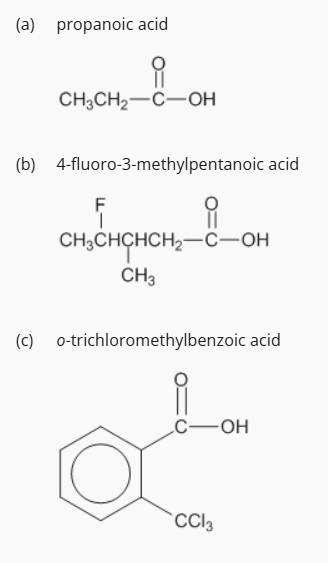
1: Draw a structural formula for each of the following chemical names
a) propanoic acid
b) 4-fluoro-3-methylpentanoic acid
c) o-trichloromethylbenzoic acid
Remember
In relation to Benzoic rings placement:
O: 1,2 positions (oh, mah, ha (p))
m- 1,3 positions
p: 1,4 positions
How does Hydrogen bonding affect the physical properties of carboxylic acids?
Carboxylic acids can form two hydrogen bonds at once because they contain:
a carbonyl oxygen (H-bond acceptor)
a hydroxyl hydrogen (H-bond donor)
This causes:
✔ High boiling points
✔ High water solubility (small acids)
✔ Strong smells (vinegar-like)
Compare:
• Carboxylic acids boil higher than alcohols
• Alcohols boil higher than ketones/aldehydes
• Ketones boil higher than alkanes

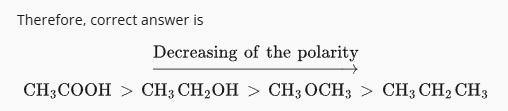
2: Rank the following compounds from the one containing the greatest polarity to the one with the least polarity
For compounds with different functional groups, but similar molecular weights, the polarity of the functional group will determine the polarity of the compound. Compounds that are capable of hydrogen bonding, such as carboxylic acids and alcohols, are more polar than compounds that cannot form hydrogen bonds. Carboxylic acids are more polar than alcohols for compounds with one functional group. Alkanes are the least polar compounds.
Also, look at number of oxygens that can hydrogen bond as that determines polarity. Examples of ranking include: 1) Carboxylic acids, 2) Alcohols, 3) Ketones/Aldehydes, 4) Alkanes.
2: The following compounds all have approximately the same molecular weight: hexanoic acid, hexanal, and hexanol.
Arrange them in order of increasing boiling point.
Molecules of aldehyde (hexanal) cannot form hydrogen bonds with each other because there are no hydrogen atoms bonded to oxygen atoms.
Hexanal has a significantly lower boiling point than the corresponding alcohol or carboxylic acid.
Carboxylic acids can form hydrogen bonded "dimers," and therefore have especially strong intermolecular interactions.
The order of boiling points is:: hexanal < hexanol < hexanoic acid.
3: What are Key Reactions of Carboxylic Acids?
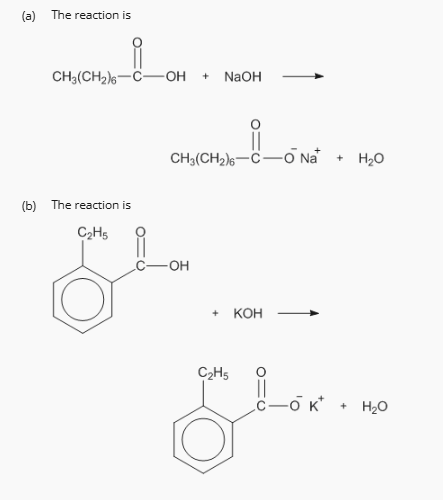
Acid-Base Reaction: Carboxylic acids can react with bases to form salts and water.
CH3COOH + NaOH → CH3COO– Na+ + H2O
Esterification: Carboxylic acids react with alcohols to form esters and water.
CH3COOH + CH3OH → CH3COOCH3 + H2O
Reduction: Carboxylic acids can be reduced to primary alcohols using reducing agents like lithium aluminum hydride or sodium borohydride.
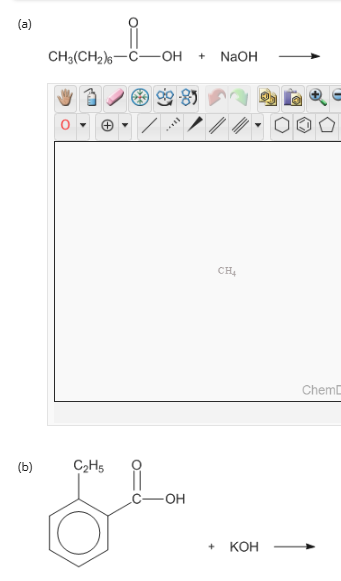
3: Complete each of the following reactions.
4: Given Carboxylic acid salts
assign common and/or IUPAC names
IUPAC Parent Acids:
Methanoic acid
Ethanoic acid
Propanoic acid
Butanoic acid
Pentaonic acid
Basically, salt adds “ate over ic” to the acids for IUPAC
Parent Acid (IUPAC) | Parent Acid (Common) | Salt (IUPAC) | Salt (Common) |
|---|---|---|---|
Methanoic acid | Formic acid | Methanoate | Formate |
Ethanoic acid | Acetic acid | Ethanoate | Acetate |
Propanoic acid | Propionic acid | Propanoate | Propionate |
Butanoic acid | Butyric acid | Butanoate | Butyrate |
Pentanoic acid | Valeric acid | Pentanoate | Valerate |
4: Naming Carboxylic Acids Salts
Replace “ic acid” with “ate.”
Acid | Salt (with Na⁺) |
|---|---|
acetic acid | sodium acetate |
butanoic acid | sodium butanoate |
propionic acid | potassium propionate |
5: Ester Naming
O
||
R–C–O–R'
Where are the alochol and acid parts?
R' (alcohol part) → named first as an alkyl group
R–C=O (acid part) → drop “-ic acid”, replace with -ate
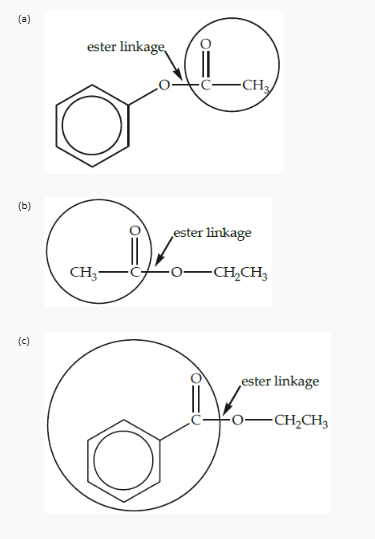
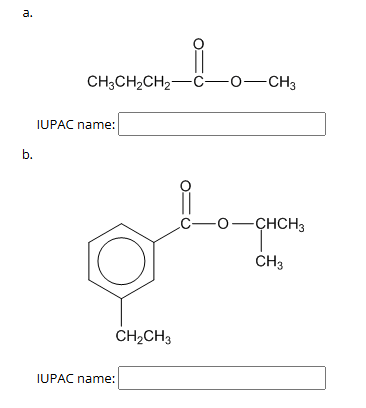
5: For each ester below, identify the portion that came from the acid and point out the ester linkage.
The portion from the acid is the alkyl group, while the ester linkage is the -COO- bond connecting the alkyl group to the remainder of the molecule.
6: Give the IUPAC name for each of the following:
IUPAC naming for esters involves identifying the alkyl group from the alcohol and the acid, and naming them accordingly, typically in the form "alkyl-alkanoate." Jump and name the O first
Naming starts when 1 on ring
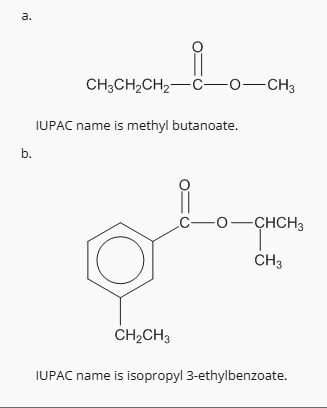
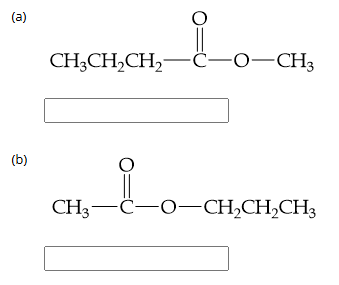
6: Give the IUPAC name for each of the following esters.
a) methyl butanoate
b) propyl ethanoate (ethyl is two!)
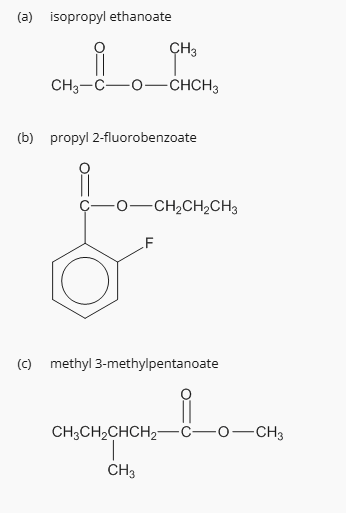
6: Write a structural formula for each of the following chemical names.
a) isopropyl ethanoate
b) propyl 2-fluorobenzoate
c) methyl 3-methylpentanoate
The name of an ester is derived from the name of the group bonded to the ester oxygen followed by the name of the acid in which the "-oic acid" ending has been replaced with "-oate", for example, ethyl butanoate. Esters derived from cycloalkanecarboxylic acids are named as carboxylates, for example, methyl cyclopentanecarboxylate
7: Key reactions of esters?
1. Esterification
Acid + Alochol → Ester + water
Ester Hydrolysis
a) Acidic hydroylysis (reverse of esterification)
Ester + water → Acid + Alochol
b) Basic hydroylysis (Saponification)
Ester + Base → carboxylate salt + alochol
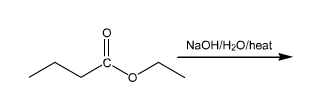
7: What product may form when saponification of ethyl butanoate occurs?
Saponification is the basic cleavage of an ester linkage that produces the sale of a carboxylic acid and an alcohol. The products are:

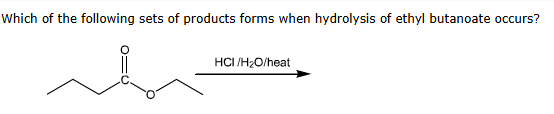
7:

Which product is formed from ethanoic acid + NaOH?
This is a carboxylic acid + base. Therefore forming a carboxylic salt.
Carboxylic acid salts are ionic compounds formed when a carboxylic acid reacts with a base, replacing the acidic hydrogen with a metal or organic cation. These salts, also known as carboxylates, are often water-soluble
(carboxyl salt)
acid + base = salt + water
Note:
1. Acid + Base → Salt + Water (NOT an ester)
NaOH, KOH, Ca(OH)₂ = base → makes SALTS
Products are always:
carboxylate salt + H₂O
This is neutralization.
How to name a carboxylic acid salt
Metal + acidname-oate
Carboxylic acids example:
Sodium ethanoate
potassium butanoate
lithium propoate
Esters Come ONLY from:
Acid + Alcohol (H⁺ catalyst)
NOT from:
acid + base
acid + salts
base + alcohol
Also, carboxylic salts are more water soluble
Shorter chain = more polar = more soluble
(propanoic > decanoic) for example in water solubility and polarity
Opposite of boiling point