Diseases, Disorders, and Treatments (CCMA Chapters 1-15)
 Call Kai
 Learn
Learn Practice Test
 Spaced Repetition
 Match
Match Flashcards
 Knowt Play
1/250

There's no tags or description
Looks like no tags are added yet.
Name | Mastery | Learn | Test | Matching | Spaced | Call with Kai | Chat |
|---|
No analytics yet
Send a link to your students to track their progress
251 Terms
osteoporosis
musculoskeletal disorder in which a decrease in calcium deposits and bone strength, resulting in weak/fragile bones
post-menopausal women
men over 50 with low testosterone
people with a family history of osteoporosis
people with anorexia nervosa
people with long term use of anti-seizure drugs, corticosteroids, and heparin
what groups are at risk for osteoporosis?
dietary: increased intake of calcium and vitamin D.
physical: performing weight-bearing exercises.
pharmacological: bisphosphonates (residronate and zoledronic acid) as well as hormone replacement therapy with estrogen
how is osteoporosis treated?
osteoarthritis
thinning and degeneration of cartilage, which exposes roughened surfaces of bone, causing bones to rub against each other. commonly affected joints are the fingers, spine, hips, knees, and feet.
analgesics, nonsteroidal anti-inflammatory drugs (NSAIDs), and intra-articular steroid injections.
in severe conditions, joint prosthesis may be necessary.
how is osteoarthritis treated?
osteomalacia
condition in which bone softens due to deficiency of calcium and vitamin D. decrease in calcium makes the bone flexible.
causes muscle weakness, bone tenderness, partial fractures, and malaise.
rickets
condition in which the bones of children are softened and weakened and may fracture easily, caused by deficiency of calcium and vitamin D
dietary interventions; increased intake of vitamin D, calcium, and phosphorus supplements.
how is osteomalacia treated?
scoliosis
abnormal curvature of the spine to the left or right, commonly seen in adolescents
in severe cases, may cause back pain and heart or lung problems.
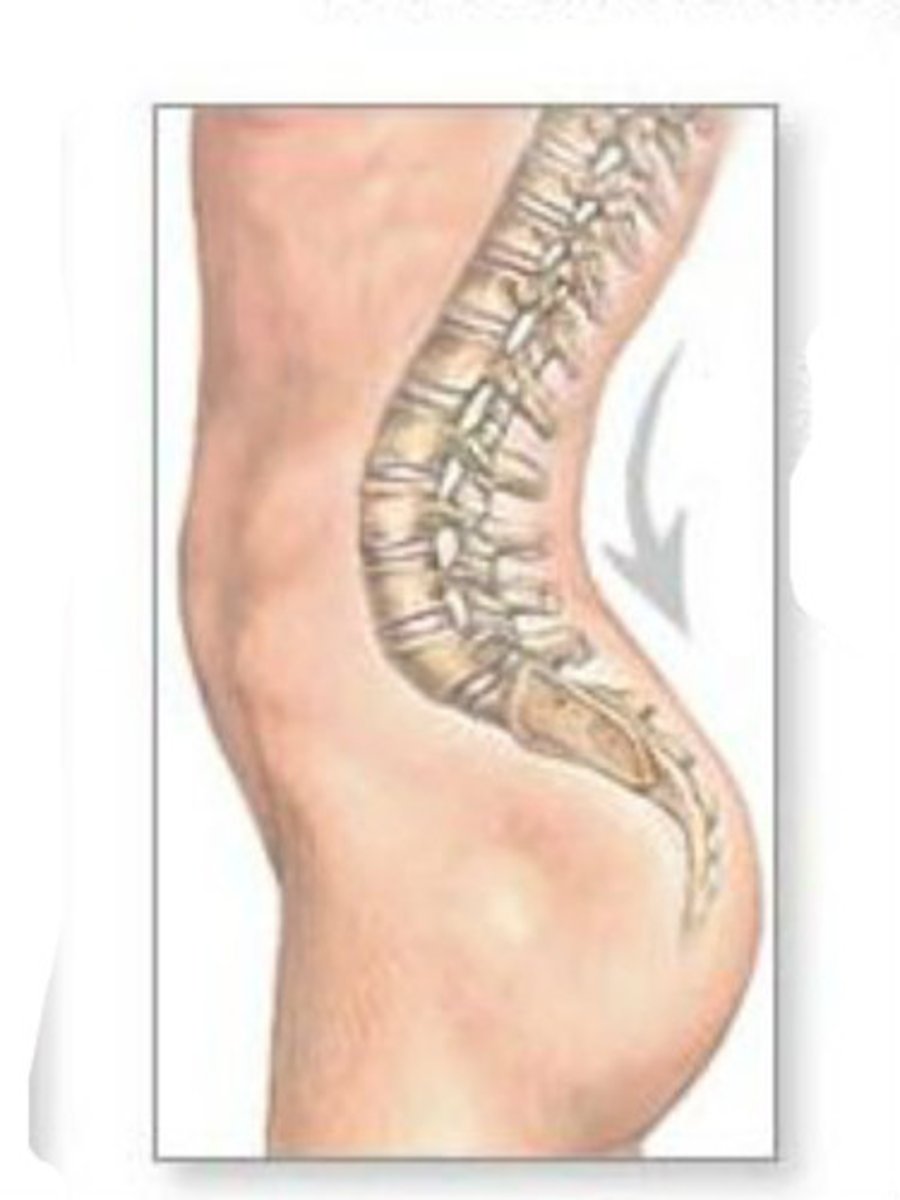
lordosis
abnormal curvature of the spine in which the lower back is more pronounced than the upper back (also called "swayback")
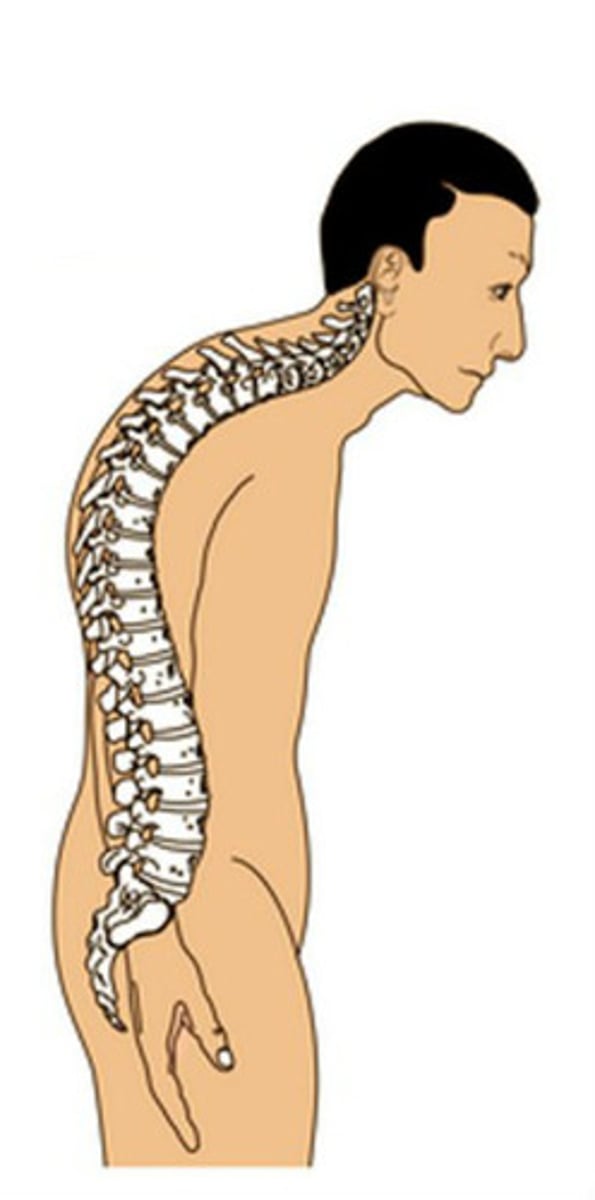
kyphosis
abnormal curvature of the spine in which the upper part of the back is more pronounced than the lower back (also called "hunchback")
herniated disc
protrusion of the soft nucleus of the intervertebral disk into the outer cartilaginous covering. caused by improper lifting, smoking, excessive body weight, and repetitive strenuous activities.
NSAIDs or analgesics for the pain
physical therapy
chiropractic adjustments
epidural steroid injections
how are herniated discs treated?
rheumatoid arthritis
chronic autoimmune inflammatory disorder which causes malaise, fever, weight loss, and morning stiffness of the affected joints.
NSAIDs
corticosteroids
disease-modifying antirheumatic drugs (DMARDs), such as methotrexate and leflunomide
biologics (etanercept and infliximab)
how is rheumatoid arthritis treated?
fibromyalgia
chronic condition of muscle pain and tenderness due to unknown causes
prescribed medications, such as pregabalin (Lyrica), milnacipran (Savella), zolpidem (Ambien), tramadol (Ultram), duloxetine (Cymbalta), and fluoxetine (Prozac)
how is fibromyalgia treated?
myasthenia gravis
autoimmune neuromuscular disease of the voluntary muscles that leads to profound muscular weakness.
mostly affects muscles that control the movement of the eyes and eyelids, facial expressions, and swallowing.
medications that inhibit acetylcholinesterase and surgical removal of the thymus gland (thymectomy).
how is myasthenia gravis treated?
bursitis
painful joints with reduced range of motion caused by overuse of the knee, shoulder, or elbow joints.
rest, NSAIDs, and corticosteroids
how is bursitis treated?
lupus
painful and swollen joints accompanied by fever, chest and muscle pains, and other manifestations that are associated with autoimmune dysfunction.
gout
metabolic disease that involves increased production or decreased elimination of uric acid. This is often seen in the lower extremities, especially the foot and the big toe.
kidney disease, alcohol consumption, obesity, untreated hypertension, and a family history of gout
what are risk factors for gout?
NSAIDs, colchicine, allopurinol, and probenecid
how is gout treated?
lyme disease
a tick-borne infection caused by Borrelia burgdorferi. The disease is manifested by flu-like symptoms and a "bull's-eye" lesion, called erythema migrans, that surrounds the area of the tick bite.
doxycycline, amoxicillin, and IV ceftriaxone
how is lyme disease treated?
strain
a condition resulting from damaging a muscle or tendon
sprain
an injury in which the ligaments holding bones together are stretched too far and tear
closed (simple) fracture
bone break that does not penetrate the skin
open (compound) fracture
broken bone that penetrates through the skin
longitudinal fracture
a fracture that runs parallel to the long axis of the bone
impacted fracture
fracture in which one bone fragment is pushed into another
communited fracture
bone is splintered or crushed into several pieces
pathologic fracture
a break in the bone due to weakening of the bones caused by a disease, such as osteoporosis
greenstick fracture
bending and incomplete break of a bone; most often seen in children
avulsion fracture
fracture caused by forceful contractions of a muscle against resistance
compression fracture
a break which occurs when the bone is pressed together on itself
typically seen in vertebrae
depression fracture
normally a skull fracture where a cranial bone is pushed inward
non-displaced fracture
occurs when a bone end remains in alignment, but other parts of the bone are fractured
primary lesions
lesions arising from previously normal skin
macule
papule
nodule
vesicle
bulla
pustule
tumor
plaque
wheal
types of primary lesions include
macule
a flat area of color change and a non-palpable skin lesion
ex. freckles
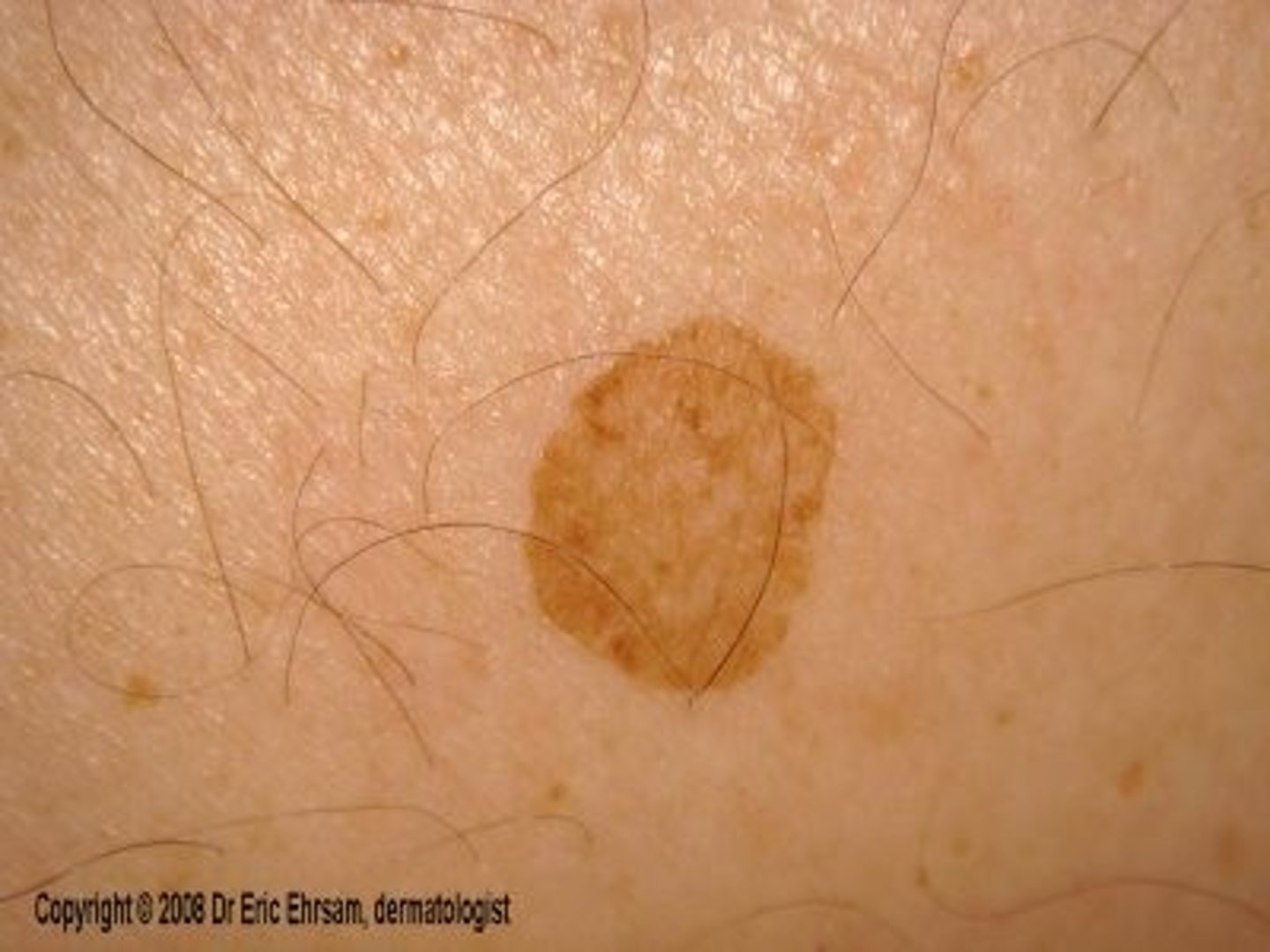
papule
a solid elevation of less than 1 cm in diameter and has distinct borders
ex. small, raised pimple
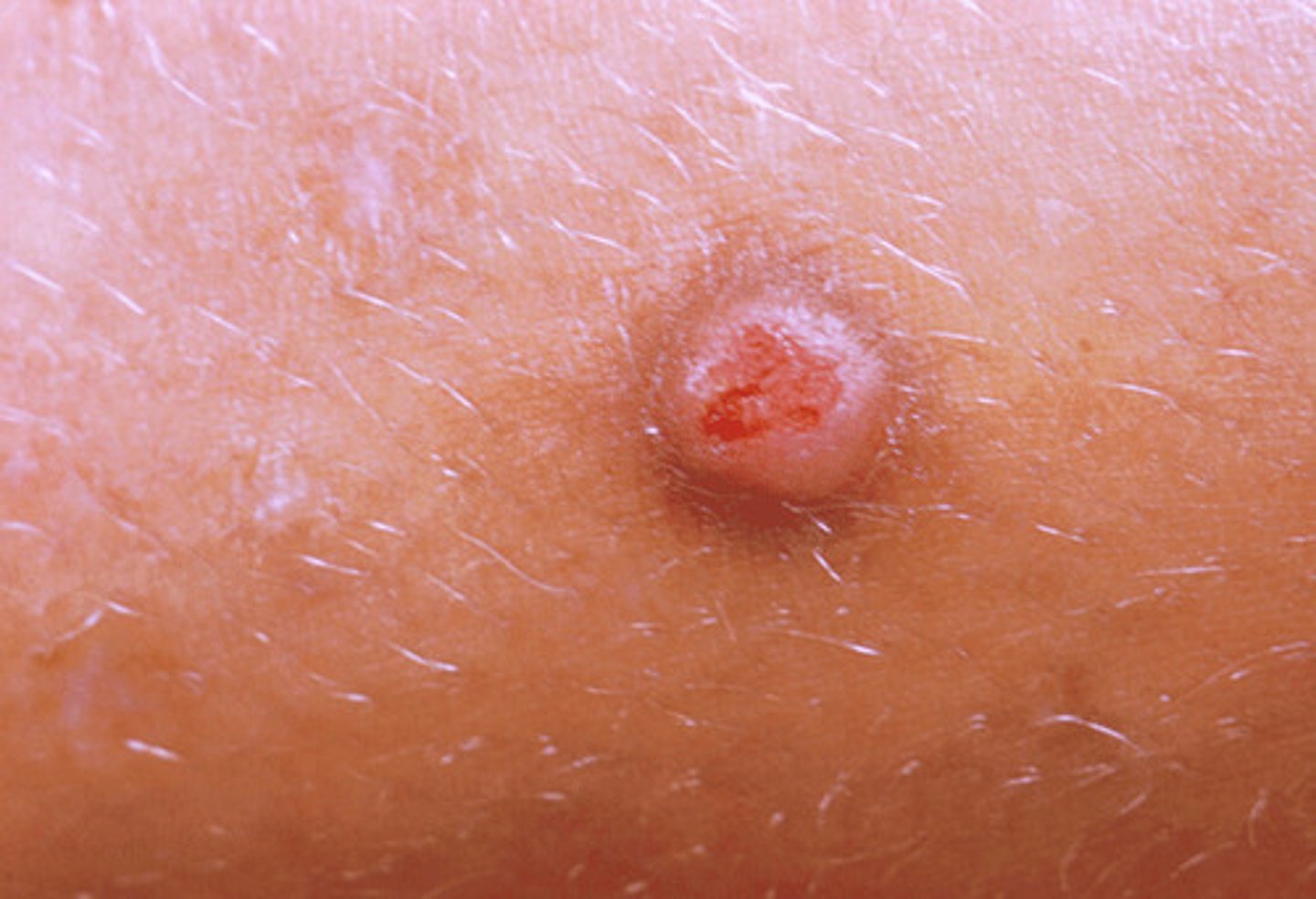
nodule
a firm and movable solid elevation, 0.5-1 cm in diameter, which extends deeper into the dermis than a papule.
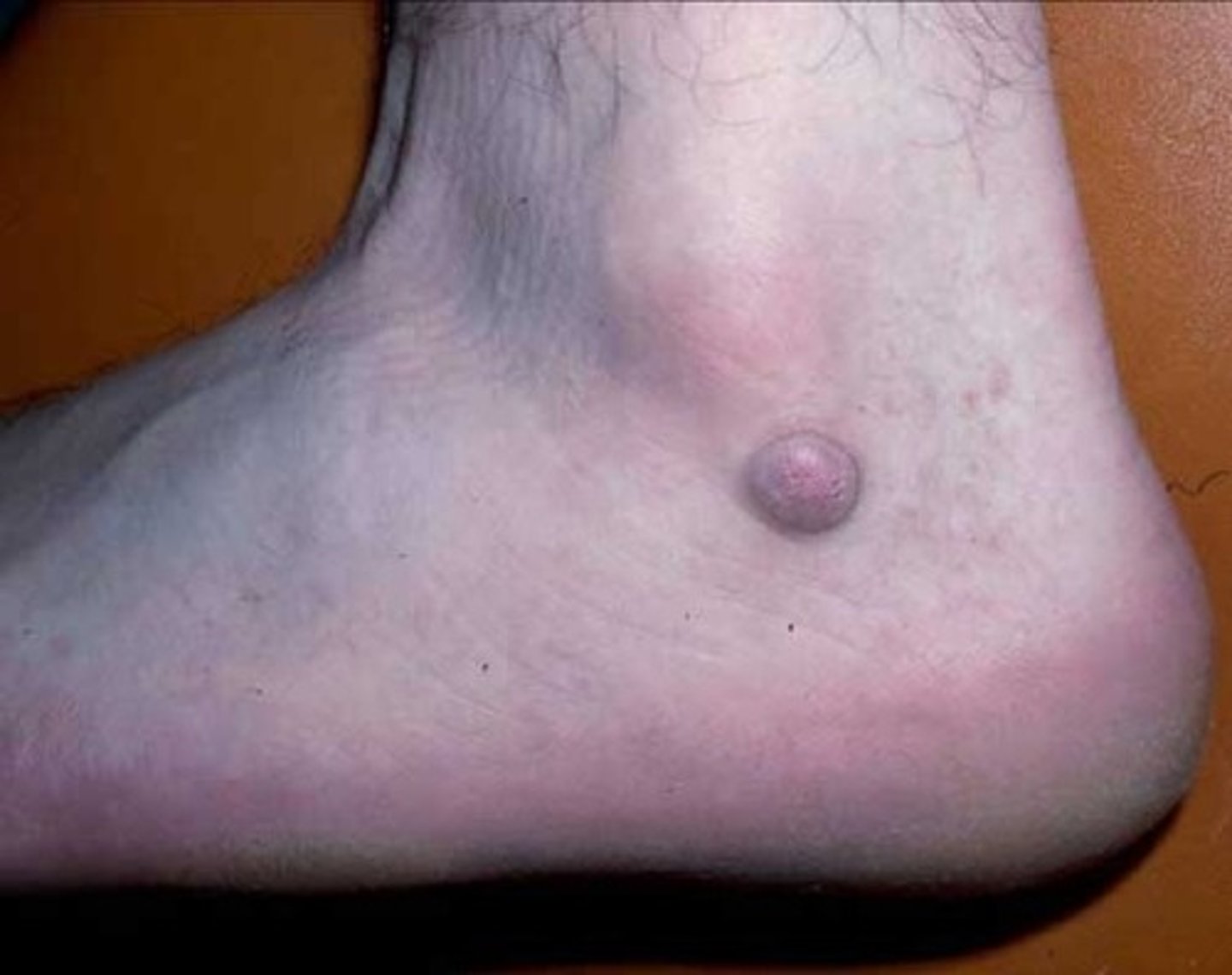
vesicle
a small, raised blister that contains clear fluid inside or under the epidermis
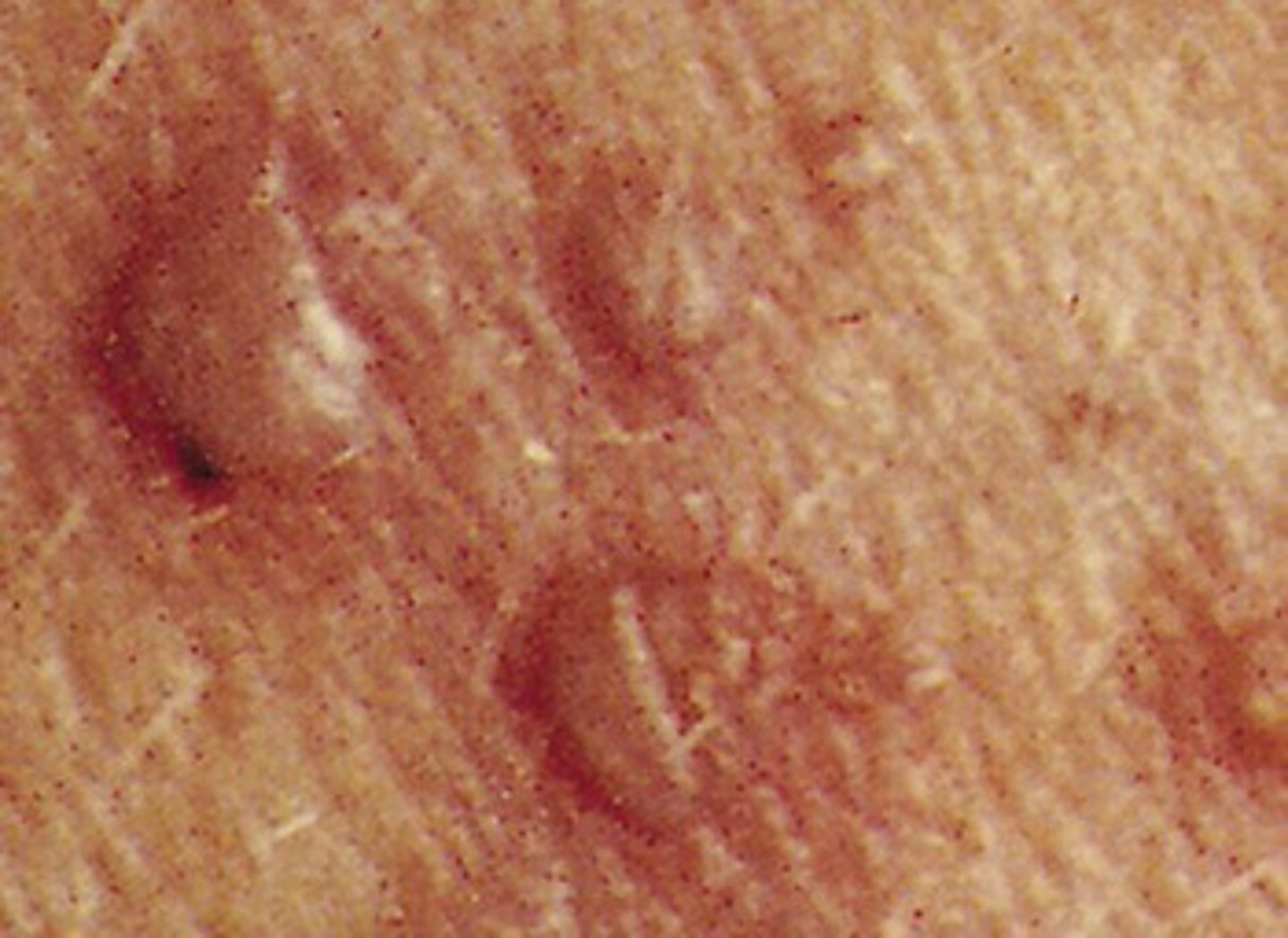
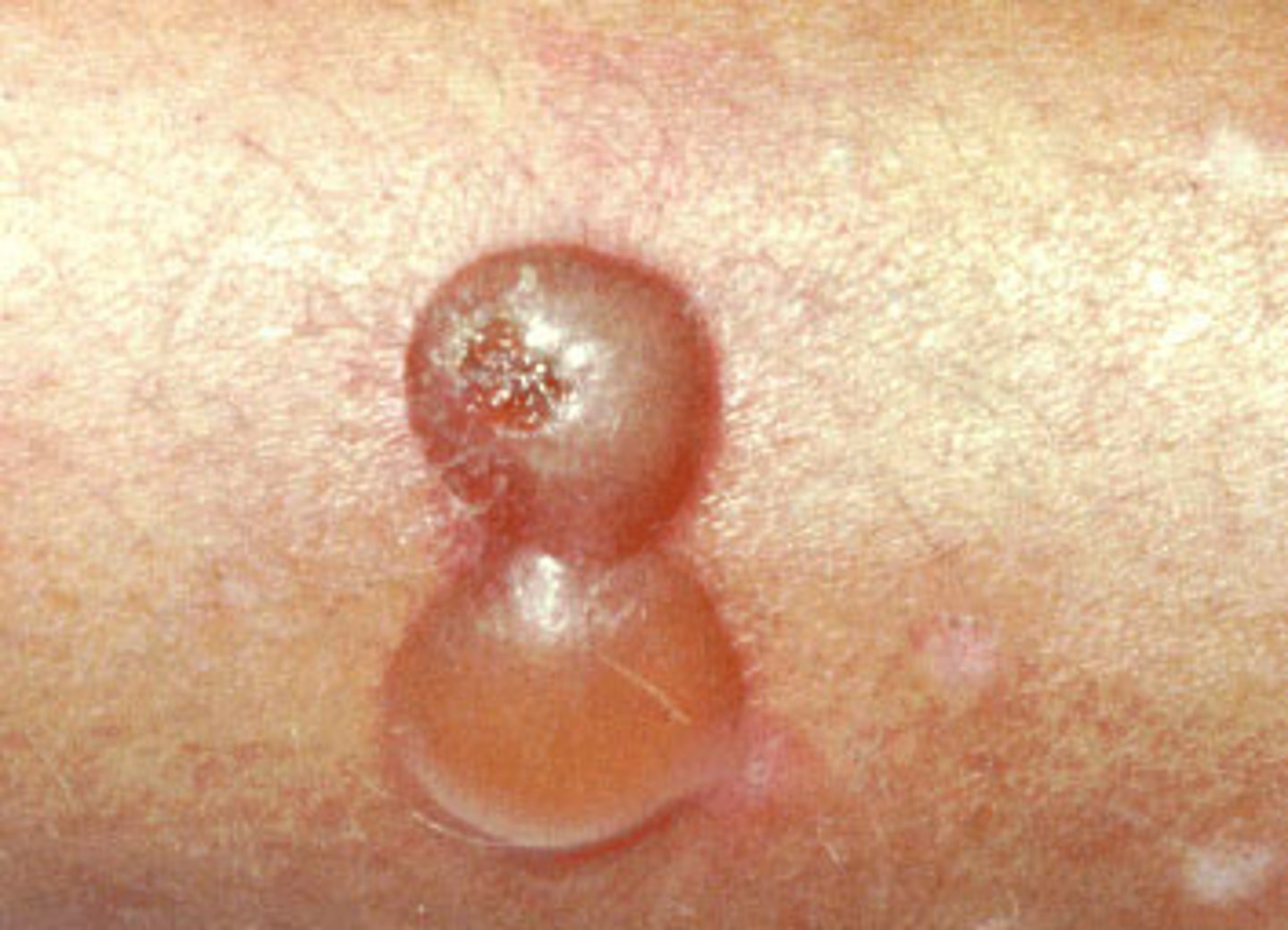
bulla
a large vesicle greater than 1 cm
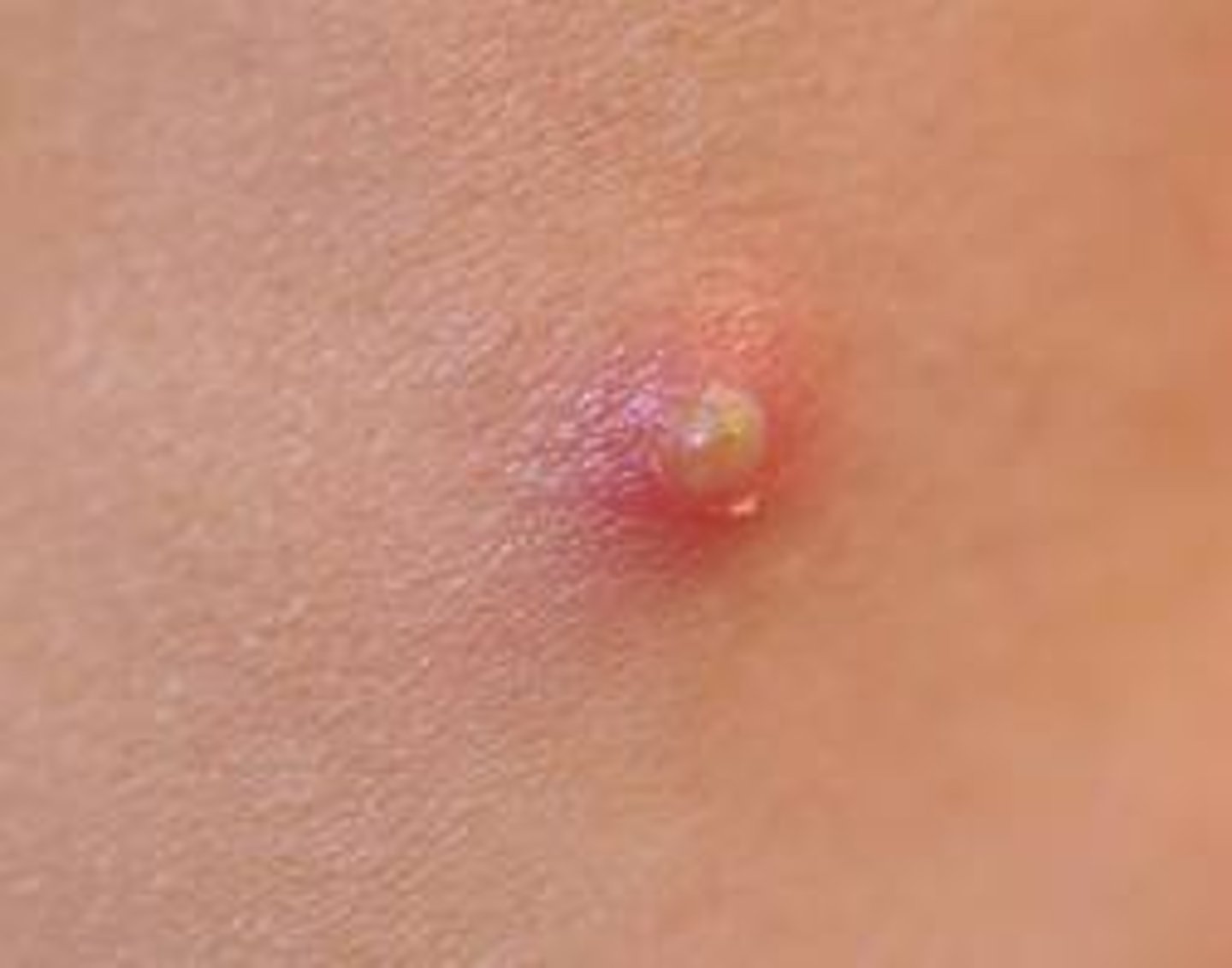
pustule
a vesicle with white cellular debris; it may be sterile or infected
ex. acne
tumor
a large solid mass that may be benign or malignant. it is a large nodule and may be firm or soft
plaque
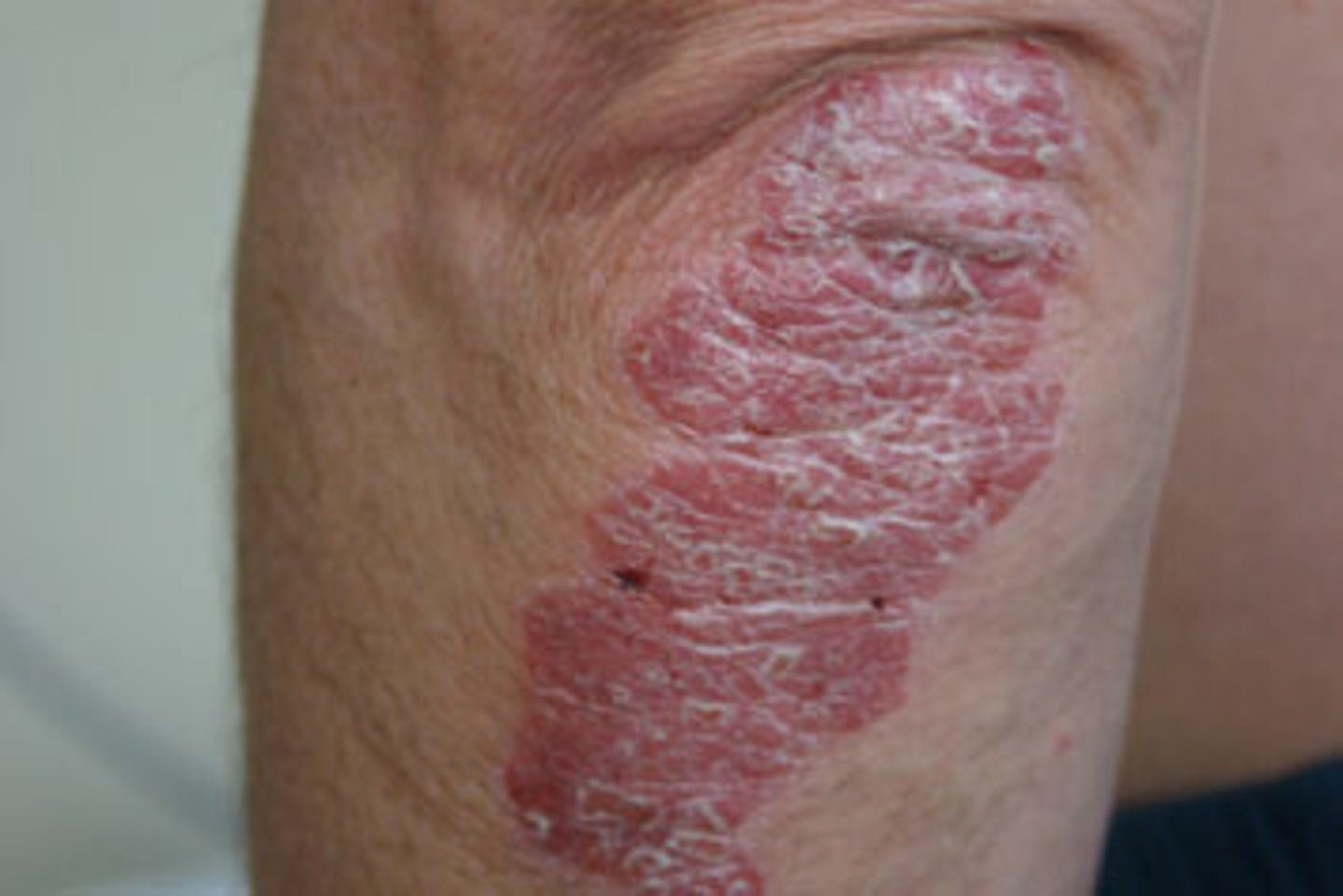
a solid, elevated, flat-top lesion with indistinct borders. It is found on the skin or mucous membrane
ex. psoriasis
wheal
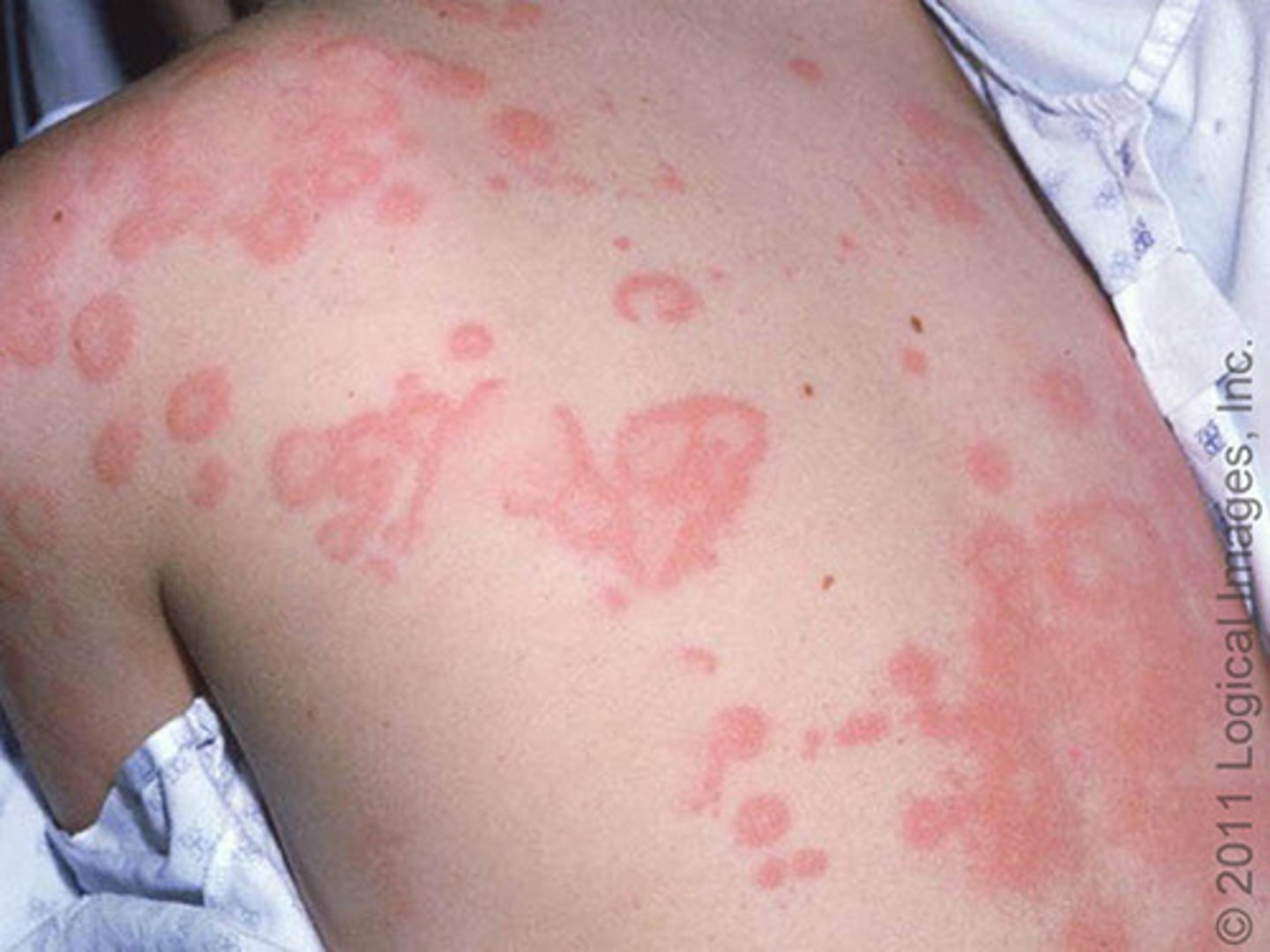
a transient (short-lived), raised, swollen lesion caused by fluid accumulation in the dermis. It is a palpable, red, circumscribed swelling.
can be caused by intradermal skin tests
secondary lesions
lesions evolves from primary lesions, often due to irritation/infection
scar tissue, fissure, ulceration, scales, atrophy, crusts
types of secondary lesions include
impetigo
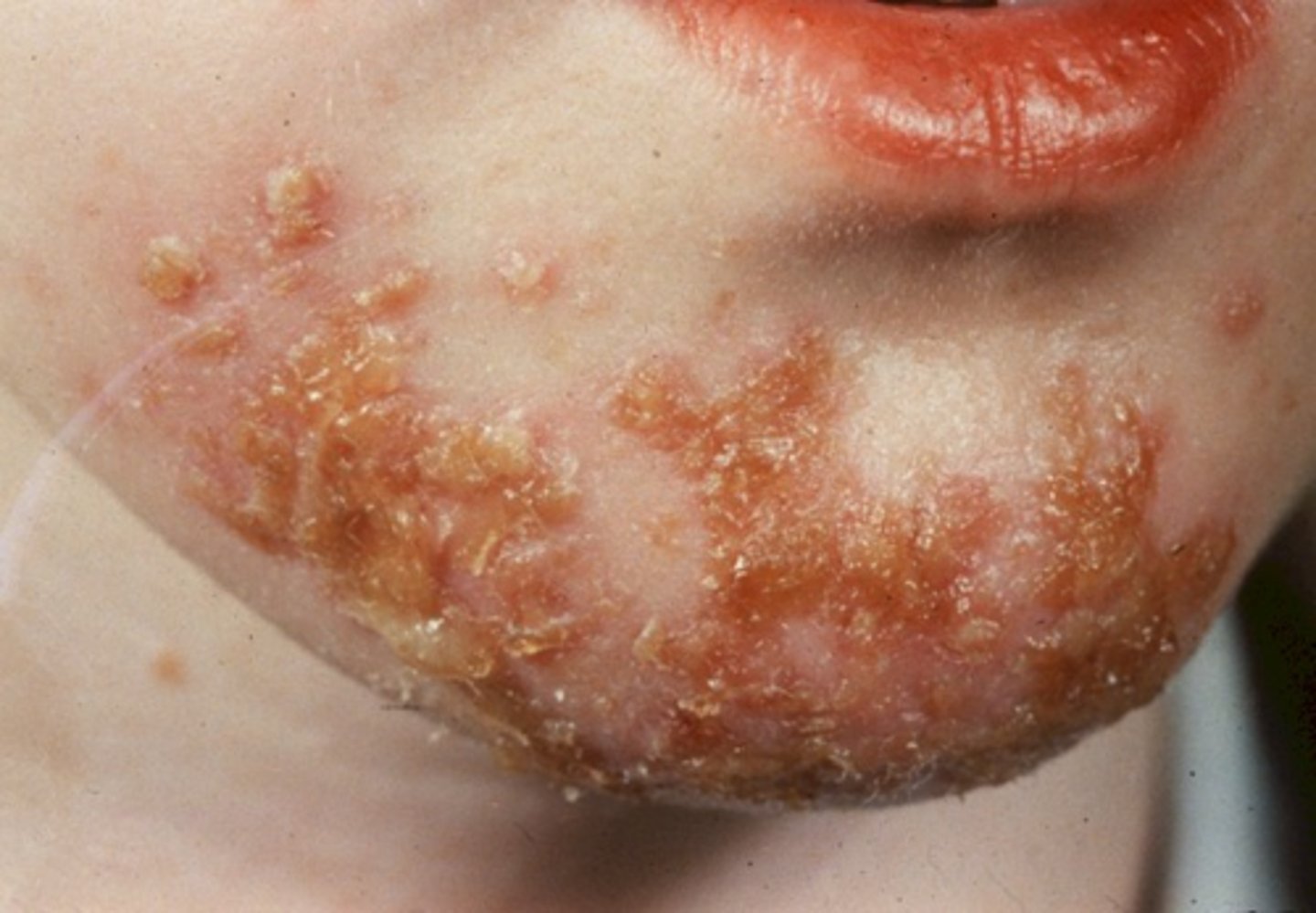
highly contagious skin infection caused by streptococcus or staphylococcus aureus. Causes formation of crusty lesions and small vesicles around the nose and mouth (often be across the entire face). Honey-colored exudate is excreted from areas
oral antibiotics, topical antibiotic cream
how is impetigo treated?
acne
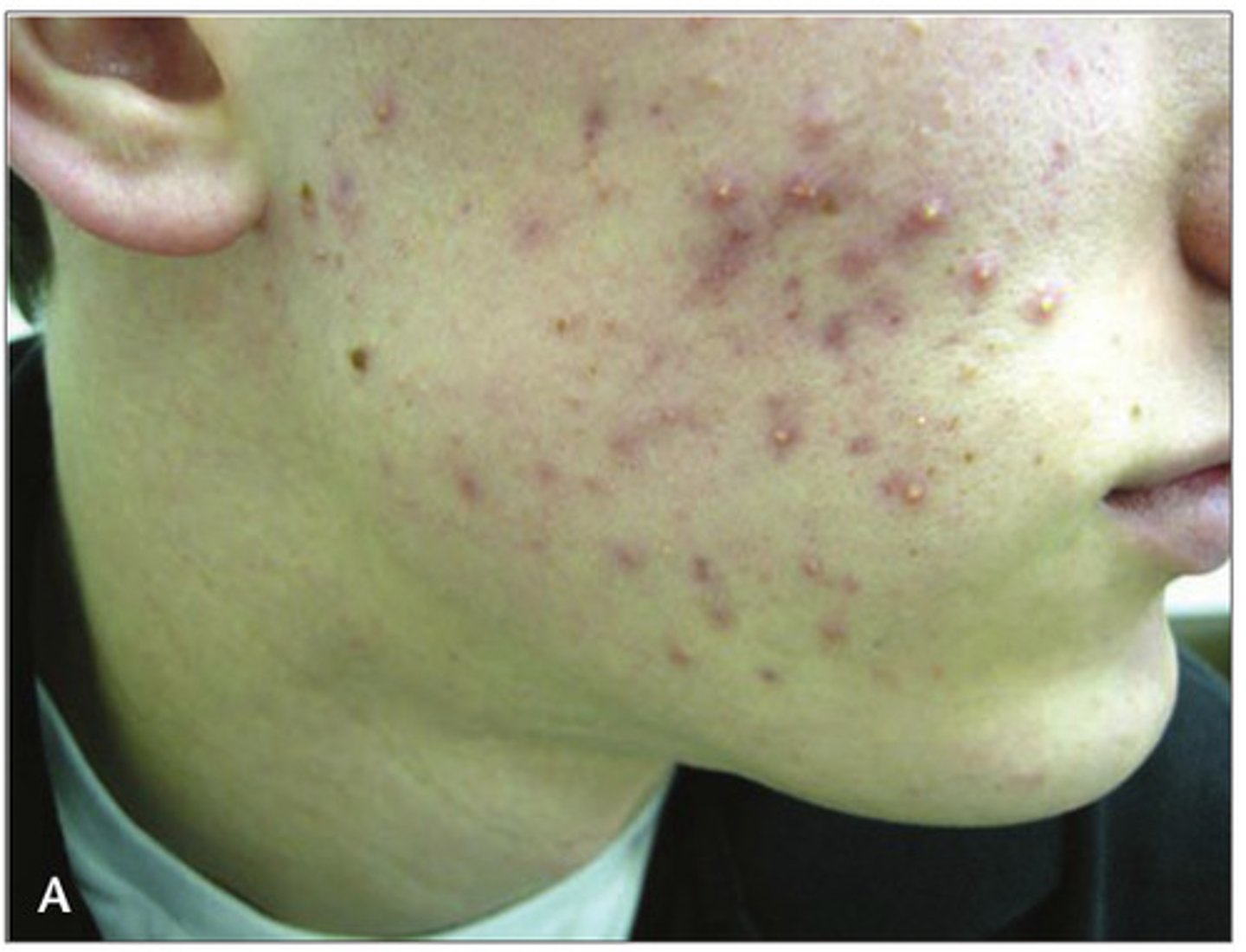
skin infection which occurs when hair follicles are blocked with dead skin and oil from the skin. Causes formation of blackheads, pimples, pustules, or larger abscesses. Also affects sebaceous glands.
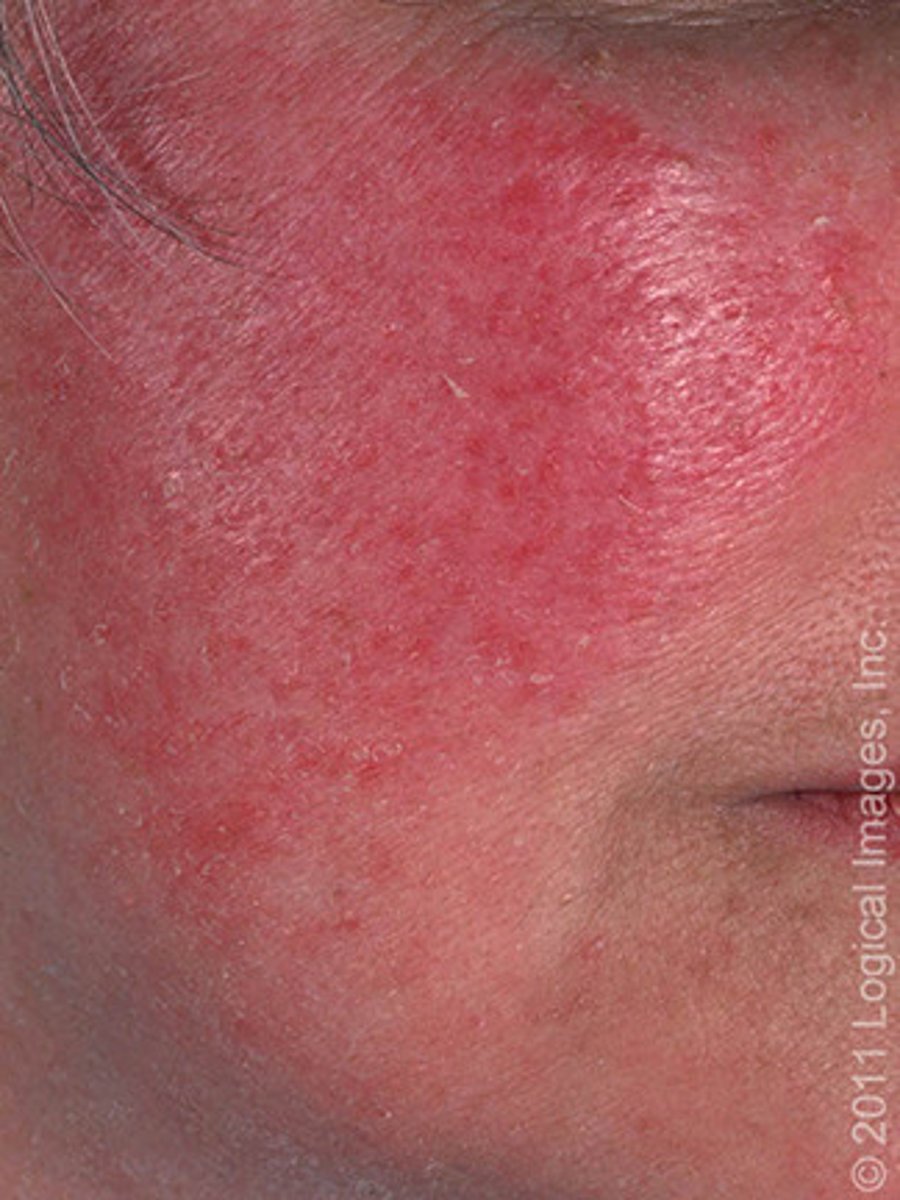
rosacea
skin infection that causes inflammation, pustule formation, and visible dilated blood vessels (telangiectasia) and facial redness. presents as frequently flushed skin on the face, particularly the nose, forehead, cheeks, and chin.
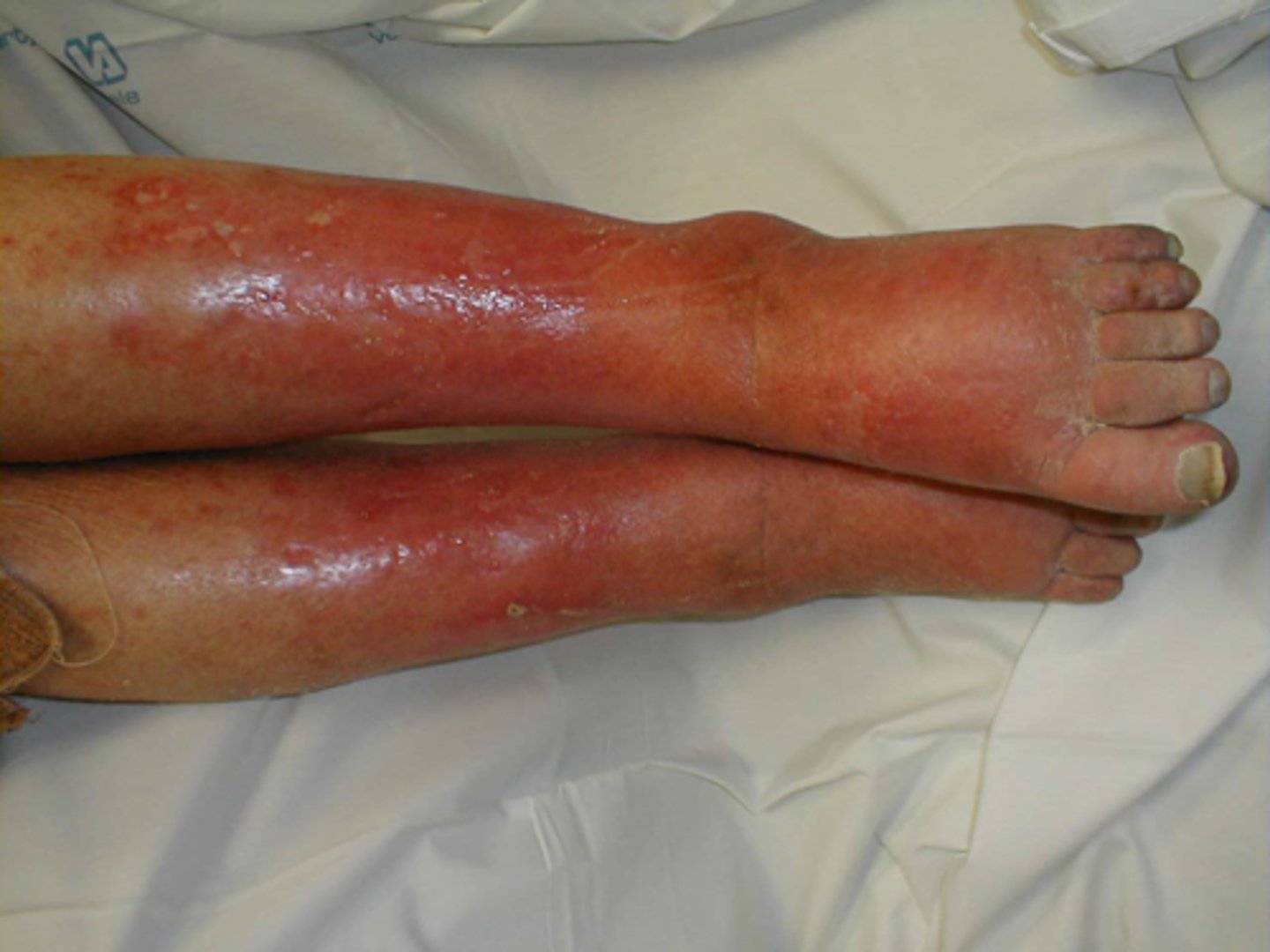
cellulitis
acute bacterial infection that involves the subcutaneous tissue and manifests as redness, tenderness, swelling, and warmth at the site. can progress from a small cut or any kind of skin injury, may require hospitalization
fungal infection
infections such as tinea pedis (athlete's foot), tinea cruris (jock itch), tinea corporis (ringworm), commonly cause by fungi that grow on keratinized tissues.
topical antifungal agents, such as clotrimazole (Lotrimin), ketoconazole (Nizoral), econazole, or nystatin (Mycostatin).
how are fungal infections treated?
warts
cold sores
shingles
viral skin infections include
scabies
pediculosis
parasitic skin infections include
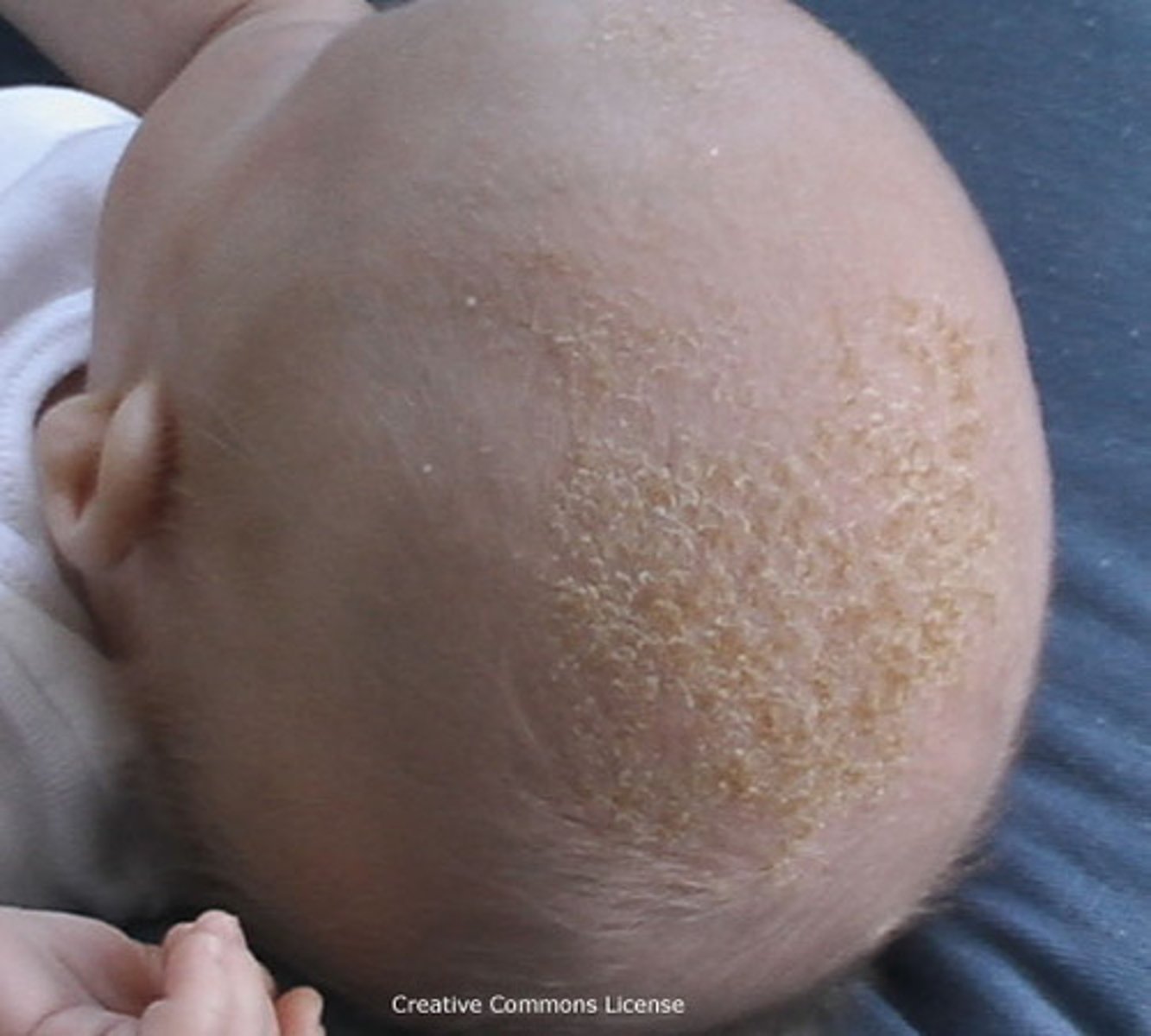
Seborrheic Dermatitis
dry or moist, greasy-appearing scales, and yellowish crusts on the scalp, eyebrows, eyelids, and sides of the nose, behind the ears, and in the middle of the chest. Affects the sebaceous glands by altering the amount/quality of sebum
called cradle cap in infants
called dandruff in adults
tar/sulfur based shampoos, topical corticosteroids
how is seborrheic dermatitis treated?
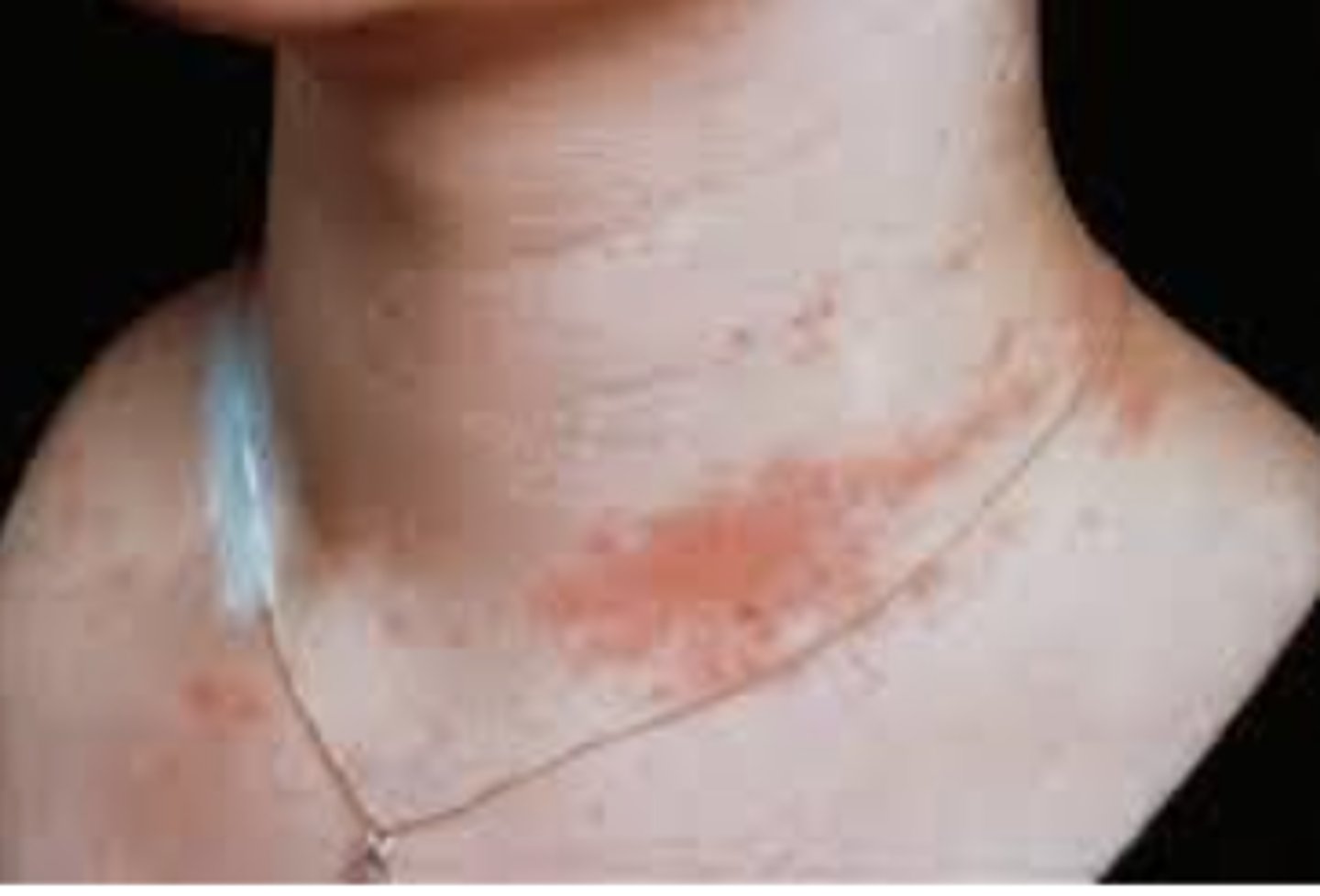
contact dermatitis
accute inflammation of the skin due to irritants or allergens found in lotions, latex, and poison ivy.
oral corticosteroid medications (prednisone, methyl prednisolone)
how is contact dermatitis treated?
eczema
noninfectious, inflammatory skin disease characterized by redness, blisters, scabs, and itching
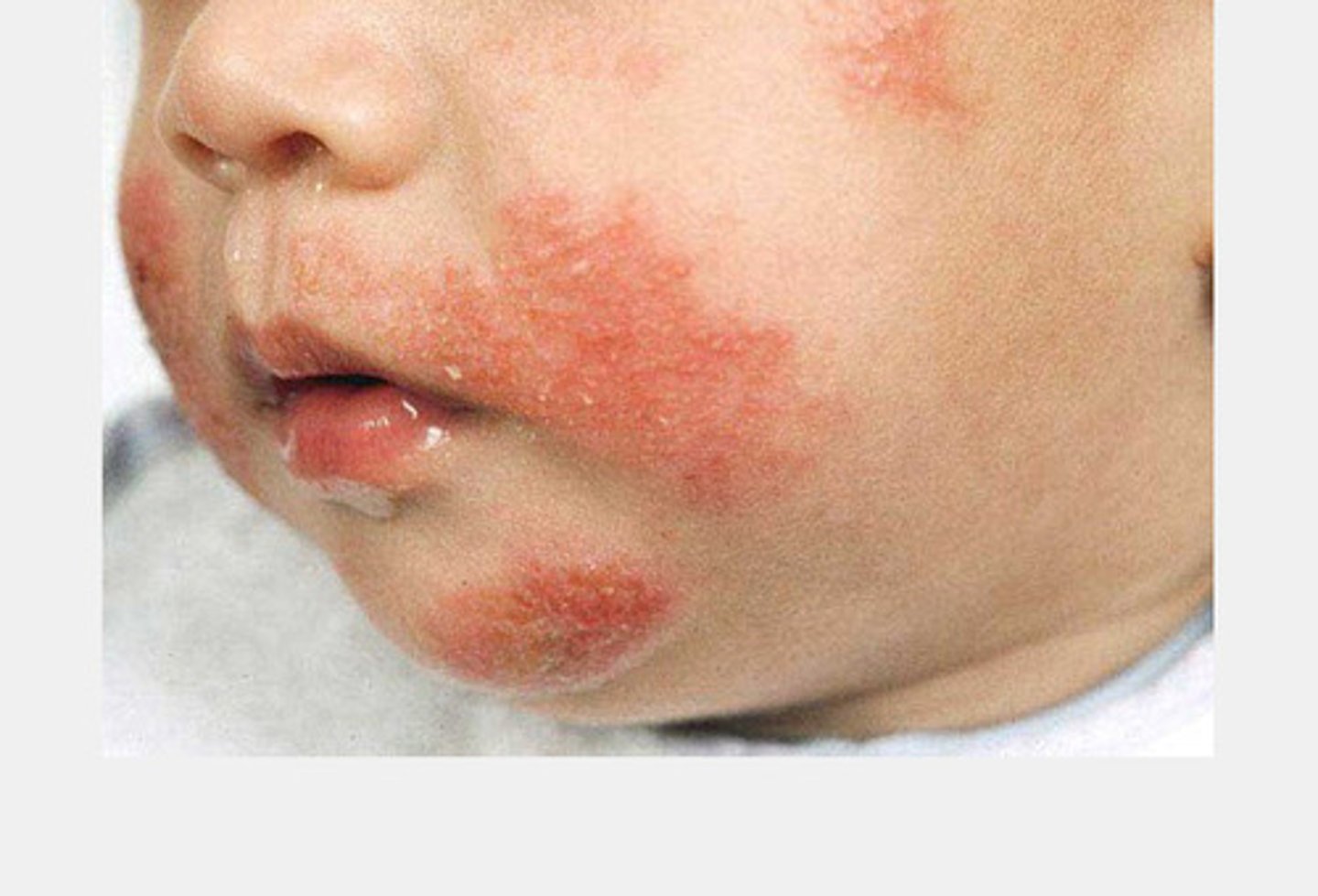
topical corticosteroids and antihistamines (diphenhydramine, cetirizine, and fexofenadine)
how is eczema treated?
psoriasis
a chronic autoimmune disease characterized by discrete pink or red lesions covered with silvery scales. Results from an autoimmune reaction that leads to rapid cell maturation and stimulates a build-up of scaly patches on the skin
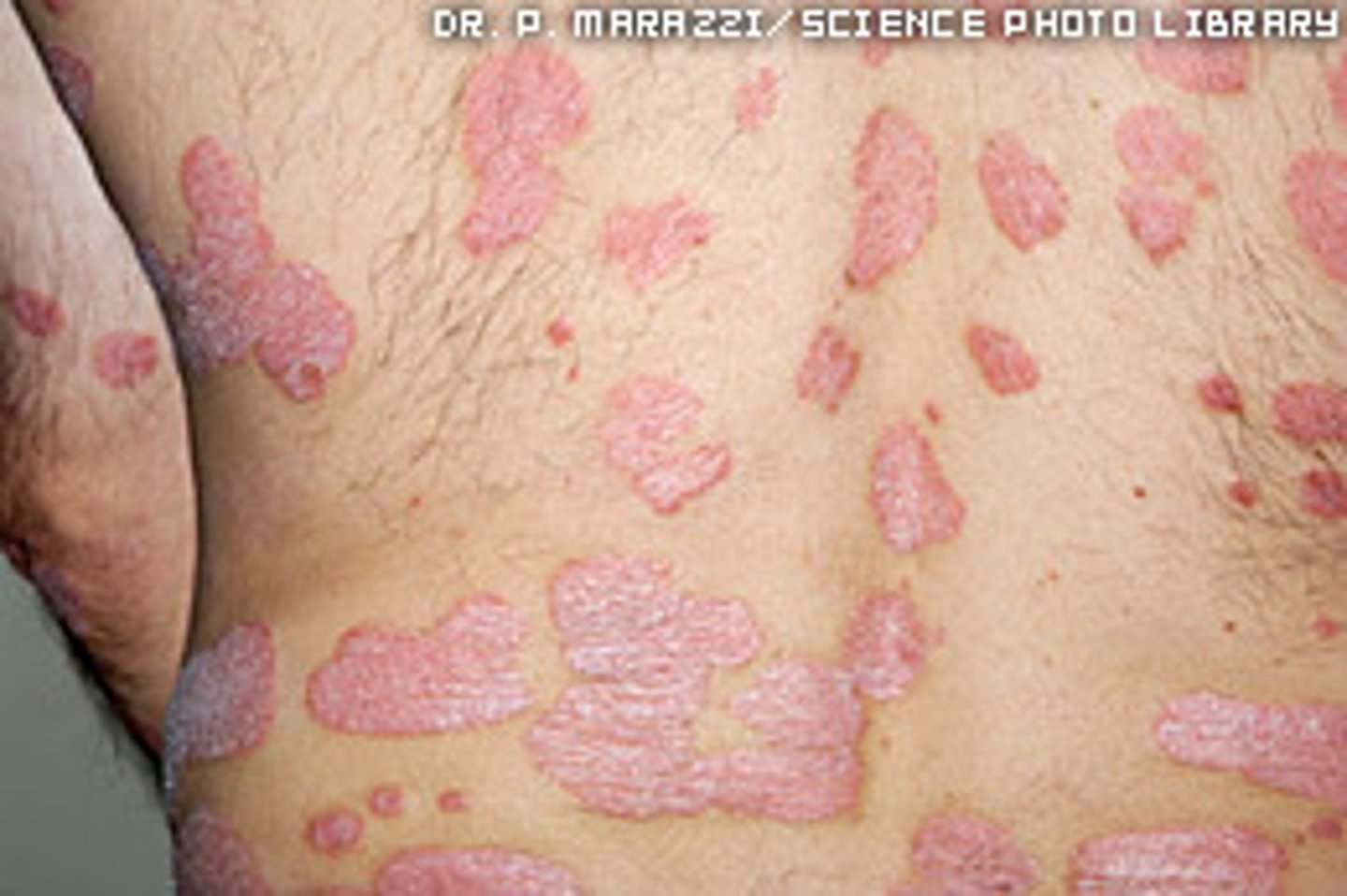
palliative exposure to UV light to slow down the cell proliferation, as well as coal tar application to relieve irritation.
Methotrexate, retinoids, immunosuppressants, low-dose antihistamines, and biologic medications.
how is psoriasis treated?
systemic lupus erythematosus (SLE)
a chronic autoimmune inflammatory skin disorder. It may affect any connective tissue in the body, resulting in inflammatory changes in the skin, joints, muscles, and kidneys.
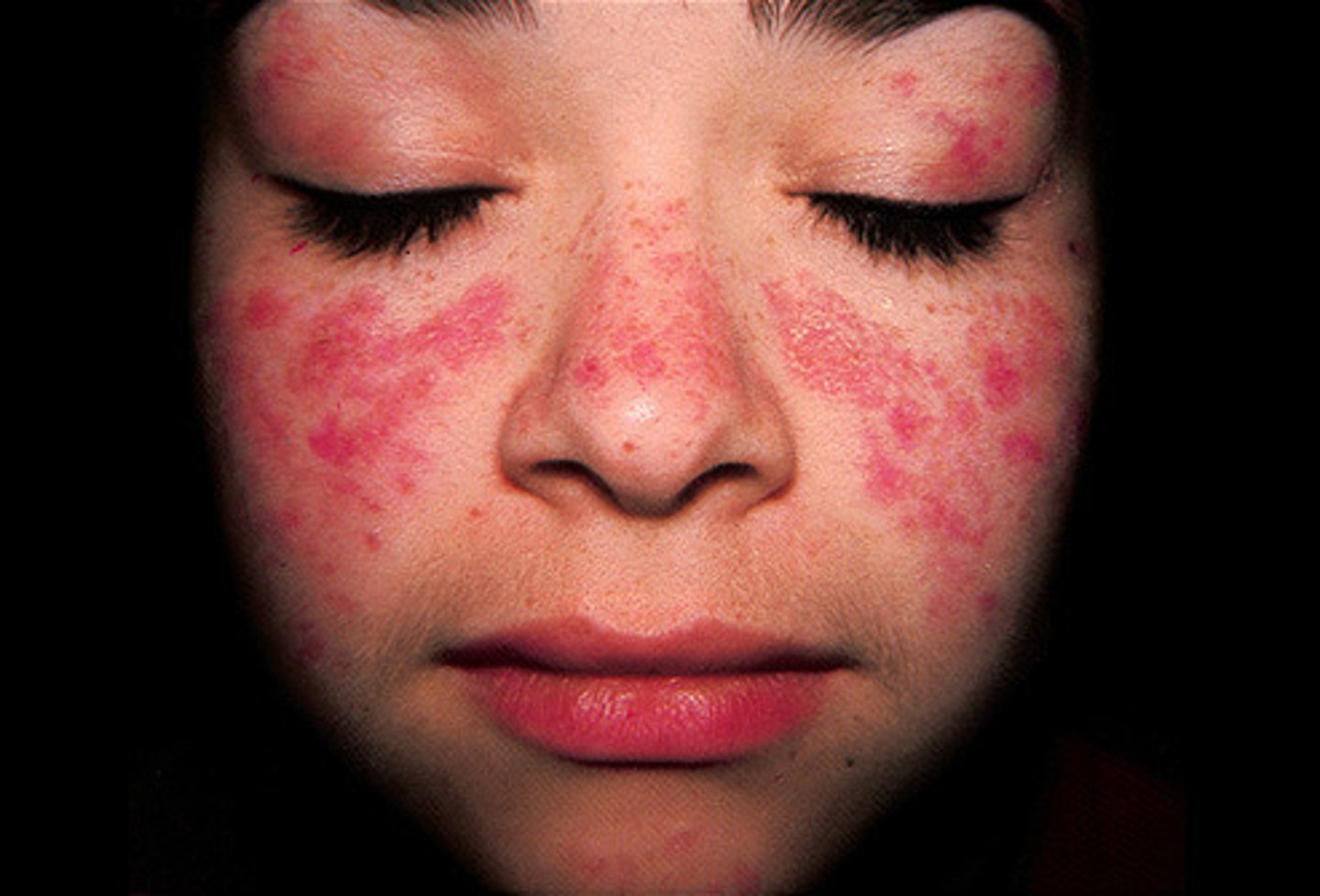
nonsteroidal anti-inflammatory drugs (NSAIDs), low doses of corticosteroids, and cytotoxic drugs.
how is systemic lupus erythematosus (SLE) treated?
frostbite
a cold injury caused by exposure to subfreezing temperatures. Blood vessels constrict, reducing blood flow to the affected area, which can lead to tissue damage and cell death.
1. superficial thickness (1st degree)
2. partial thickness (2nd degree)
3. full thickness (3rd degree)
burn injuries are classified by depth of burn. what are the 3 classifications?
superficial thickness (1st degree)
burn injury by minor sunburns, steam burns w/o blister formation
discomfort usually lasts 48 hrs, desquamation in 3-7 days
partial thickness (2nd degree)
burn injury by splashes of boiling water, quick exposure to flames
superficial heals in 10-14 days
deep heals in 21-28 days
full thickness (3rd degree)
burn injury by prolonged exposure to heat, contact with corrosive chemicals
Tissue disruption occurs, involving the epidermis and dermis and potentially extending into subcutaneous tissue.
rule of nines
an assessment tool that helps assess the total body surface area burned.
The major sections of the body are assigned a numerical value of multiples of nine, and the total burned area is calculated as a percentage.
This number helps guide the treatment decision in terms of fluid resuscitation and further course of action.
neoplasm
an abnormal growth that can be benign/malignant
benign tumors
noncancerous tumors that do not show asymmetry or border irregularity.
encapsulated, which helps prevent spreading.
Though these tumors increase in size, they remain within the shell.
malignant tumors
cancerous tumors characterized by asymmetry, border irregularity, and elevation of the mole
A-Asymmetry: Unequal halves of mole
B-Border: Edges or border irregularity
C-Color: Appearance of different shades such as tan, brown, black, or white throughout the mole
D-Diameter: Increase in the size of the mole to more than 6 mm
E-Elevation: Raised and elevated mole
what is the ABCDE rule dermatologists use to examine malignant melanome?
cerebrovascular disease (CVD)
disorders of the blood vessels supplying the brain, such as blockage or rupture, which can impair blood flow.
transient ischemic attack (TIA)
a type of CVD in which there is a temporary reduction in blood supply to a part of the brain without permanent damage.
causes numbness in the face, arm, or leg or on one side of the body. patients may also experience difficulty while communicating or understanding others, diplopia, difficulty in walking, and vertigo.
called a 'mini-stroke'
cerebrovascular accident (CVA)
a rupture or occlusion of a blood vessel in the brain.
causes slurred speech, unexplained confusion, sudden and severe headaches, and difficulty swallowing. can also cause paralysis on one side of the body.
called a 'stroke'
migraine
sudden, recurrent episodes of headache causing nausea/vomiting, increased sensitivity to light and sound, and throbbing pain on one side of the head
underlying cause is still unknown, but researchers believe it's connected to a combination of trigeminal nerve issues along with brain chemical imbalances (neurotransmitter serotonin).
dementia
a chronic disorder of the mental processes caused by brain disease, resulting in progressive memory loss, disorientation (person/time/place), personality changes, inability to follow simple directions, and neglect of hygiene, nutrition, and safety.
Alzheimer's disease
a common disorder categorized under dementia which mainly affects the older population, in which there is slow and progressive loss of recent memory; inability to recognize people, places, and events; and disorientation.
epilepsy
chronic brain disorder characterized by recurrent seizure activity, when abnormal electrical impulses occur
partial seizure
seizure involving only limited areas of the brain with localized symptoms
do not cause loss of consciousness, may cause repeated actions such as tremors/twitches/shaking
generalized seizure
a seizure that affects both sides of the brain
absence epilepsy
a form of epilepsy in which the patient stares with the eyes open, while being unconscious.
encephalitis and meningitis
what are examples of CNS infections?
encephalitis
inflammation of the brain, most commonly caused by viral infections.
causes stiff neck, headache, muscle aches, malaise, and flu in the mild stage. severe conditions bring about fever, delirium, seizures, and coma.
meningitis
inflammation of the meninges (membranes that line the brain) that may be due to bacterial, viral, or fungal infections.
causes headache, flu-like symptoms, nuchal rigidity, and seizures.
concussion
a mild brain injury caused by jarring of the brain, associated with loss of consciousness that can last from seconds up to several minutes. This may be followed by disorientation.
contusion
a more severe brain injury causing headache, nausea, vomiting, vision disturbances, and sensitivity to light.
In closed injury, there is an internal brain injury without fracture to the skull.
In open brain injury, the skull is fractured or displaced; an object may penetrate into the skull, resulting in the fractured skull.
multiple sclerosis (MS)
an autoimmune disease affecting the myelin sheath, resulting in inflammation and deterioration leaving nerve fibers exposed and scattering the nervous system message as it travels down the axon
causes damage to nerve cell bodies and axons in the brain, spinal cord, and optic nerve. results in numbness, paresthesia, diplopia, ataxia, and bladder control problems
parkinson's disease
a chronic, progressive, and debilitating condition in which a deficiency of the neurotransmitter dopamine in the brain, caused by a combination of genetic and environmental factors, leads to tremors, slow movements, and impaired coordination.
amyotrophic lateral sclerosis (ALS)
degenerative disorder of motor neurons in the spinal cord and brainstem, causing small, local, involuntary muscle contraction in the forearm and hands.