Behavioral, Cognitive-Behavioral, and Sensory Modulation Approaches
 Call Kai
 Learn
Learn Practice Test
 Spaced Repetition
 Match
Match Flashcards
 Knowt Play
1/67

There's no tags or description
Looks like no tags are added yet.
Name | Mastery | Learn | Test | Matching | Spaced | Call with Kai | Chat |
|---|
No analytics yet
Send a link to your students to track their progress
68 Terms
Behavioral FOR
The frequency of a behavior depends on its reinforcement contingencies, analyzed as an A-B-C sequence (antecedent, behavior, and consequence)
OT’s Role: To organize the factors that influence behavior so the client learns and maintains adaptive behavior.
Behavioral Intervention: behavior management and skill building.
Goal: Relevant, observable, understandable, measurable, behavioral, and attainable within a reasonable length of time
The Four Quadrants of Operant Conditioning

Behavioral Strategies and Techniques
Behavior-Management Techniques
Skill-Building Techniques
Behavioral-Management Techniques
Forms of Reinforcement
Reinforcement Schedules
Positive Reinforcement and the Premack Principle
Token Economy, Contact Setting, and Response Cost
Differential Reinforcement of an Alternative Behavior
Planned Ignoring (extinction)
Satiation
Overcorrection
Systematic Desensitization
BMT: Forms of Reinforcement
Primary Reinforcers: Meet a physiological need
Secondary Reinforcers: Learned and take their value from buying access to primary ones
Social Reinforcers: Attention, praise, and gesture
BMT: Reinforcement Schedule
Set how often reinforcement follows the behavior.
Continuous establishes a new behavior
Intermittent (ratio or interval, fixed or variable) maintains it.
BMT: Positive Reinforcement and the Premack Principle
Strengthens a behavior by following it with something that person values.
First do low-probability [non-preferred], then high-probability
BMT: Token Economy, Contact Setting, and Response Cost
Make the contingency explicit, visible, and negotiable. Response cost removes an agreed number of tokens when the problem behavior occurs.
BMT: Differential Reinforcement of an Alternative Behavior
Builds a replacement that cannot happen at the same time as the problem behavior.
BMT: Planned Ignoring (extinction)
Withholds the reinforcer that is maintaining an attention-maintained behavior.
Note: If not productive → don’t acknowledge
BMT: Satiation
Removes the motivation for a behavior by allowing it until it stops being rewarding.
BMT: Overcorrection
Follows the behavior with effortful correction:
Restitutional (restore the situation)
Nagkalat ka → ikaw maglinis
Positive practice (rehearse the correct behavior repeatedly).
Hand-to-hand (won’t flick, will wash hand)
BMT: Systematic Desensitization
Pairs relaxation with graded exposure so the anxiety response is inhibited.
Note: Gradual involvement (nood sa malayo → nasa gilid → nagkuha na ng gamit)
Least to most-anxiety response is inhibited.
Skill-Building Techniques
Shaping
Modelling
Forward Chaining
Backward Chaining
Prompting and Fading
SBT: Shaping
Reinforces successive approximations until the terminal behavior is reached.
Every step may reinforcement
SBT: Modelling
Teaches through observation of a competent performance before the client attempts it.
SBT: Forward Chaining
Teaches the first step first and adds steps in order, each learned step cueing the next.
E.g., Pagluluto ng itlog: Step 1: buksan kalan, Step 2: lagay kawali, Step 3: lagay mantika. Master muna step 1, then add step 2, etc. Mahaba ang task kaya step-by-step forward.
SBT: Backward Chaining
Teaches a multi-step routine from the last step, so the finished product is the natural reinforcer.
E.g., Same pagluluto itlog — OT na gagawa ng lahat, si client ang maglalagay ng itlog sa plato [last step]. Next session, siya na magpiprito + mag-plate. Nafi-feel niya agad yung success: "Ako nakatapos!"
SBT: Prompting and Fading
Supplies the least intrusive cue that will produce the behavior: verbal → gestural → visual/modeling → physical [hand-over-hand]
Withdrawing the prompt in steps until the client can perform the skill independently.
Cognitive-Behavior FOR
Cognition affects behavior; cognition can be monitored and altered; and behavior change is mediated by cognitive change.
Cognitive change is evidenced by what the client does.
Goal: Name the occupation the belief is affecting, not the belief on its own.
Five Aspects of Experience Interact
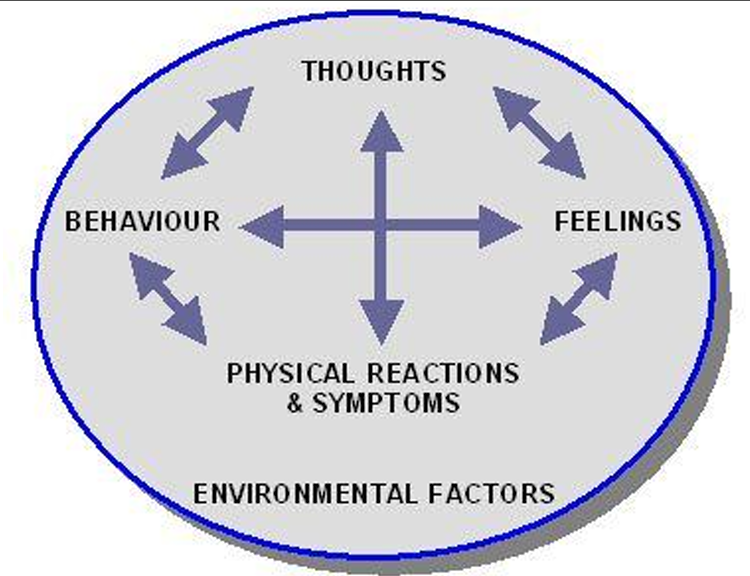
Three Levels of Cognition
Automatic Thoughts
Intermediate Beliefs
Core Schemas
Automatic Thoughts
Superficial, habitual, and situation-specific; the thought that arrives unconsciously in the middle of the task.
Intermediate Beliefs
Unarticulated rules, attitudes, and assumptions, usually taking an “if–then” or “should/must” form.
Core Schemas
Global, rigid, early-formed beliefs about the self, others, the world, and the future; the least accessible of the three, and the level that requires specialist training to change.
Common Distortion in Mental Health Practice
Filtering
Polarized (All-or-Nothing) Thinking
Overgeneralization
Mind Reading
Catastrophizing
Personalization
Shoulds
Emotional Reasoning
Global Labeling
Blaming
Distortion: Filtering
Magnifying the negative details of a situation while screening out the positives.
Distortion: Polarized (All-or-Nothing) Thinking
No middle ground: perfect or a failure, good or bad.
Distortion: Overgeneralization
A sweeping conclusion drawn from a single incident.
Distortion: Mind Reading
Assuming you know what others are thinking and why, without any evidence.
Distortion: Catastrophizing
Expecting disaster; hearing of a problem and going straight to the worst outcome.
Distortion: Personalization
Taking everything others say or do as a reaction to you, or comparing yourself to everyone.
Distortion: Shoulds
Rigid rules about how you and others ought to act; anger when others break them, guilt when you do.
Distortion: Emotional Reasoning
Treating what you feel as proof of what is true: “I feel useless, so I am.”
Distortion: Global Labeling
Turning one quality or one event into a total judgment of the person.
Distortion: Blaming
Holding others responsible for your pain, or yourself responsible for every problem.
Cognitive-behavioral Strategies and Techniques
Core Cognitive-Behavioral Methods
Techniques Integrated into Occupation
CBM:Thought Record and Self-Monitoring
Captures the situation, thought, emotion rating, behavior, and outcome as data the client collects themselves.
CBM: Socratic Questioning and Guided Discovery
Leads the client to re-evaluate a belief using their own evidence, without the therapist supplying the conclusion.
CBM: Behavioral Experiment
Turns a belief into a testable prediction and runs it in a real activity.
E.g., Social Phobia > 7/11 > list ilan tumingin > compare & contrast > who are them & bakit ka tinignan
CBM: Graded Task Assignment
Rebuilds engagement through a stepwise series from simple to complex.
CBM: Activity Scheduling with Mastery and Pleasure Ratings
Increases positive reinforcement and removes decision-making as an obstacle.
E.g., Pumunta sa dentist to visit and assess how it felt
CBM: Cognitive Rehearsal
Runs the task in imagination first, surfacing the detail that would otherwise cause failure.
CBM: Relaxation and Arousal Control
Contains physiological arousal so the cognitive work is possible at all.
Decrease the arousal before CBT work
CBM: Distress Tolerance Practice (DBT)
Builds the capacity to sit with a negative state without acting on the impulse.
Goal: Distress wont go away that easily but they are capable to not react impulsively
Note: Cx won’t be impulsive to respond with sensory technique
Techniques Integrated into Occupation
Integrate techniques into occupation rather than conducting pure talk therapy.
The following are delivered inside self-care activities, pleasurable or motivating activities, and goal-oriented activities:
Benefit-Finding
Fast-Forwarding
Positive Imagery
Responsibility Jigsaw
Distraction and Medication
Thought Stopping
Problem Solving
Self-Advocacy Training
Planning
Stress Management Coaching
TIO: Benefit-Finding
Locating positive change that has come with the impairment
TIO: Fast-Forwarding
Picturing oneself at a future point that differs from now.
TIO: Positive Imagery
Imagining the self coping effectively
E.G., You inside the circle and circle as the things or people that you consider as protectors — paano papasok kung may circles or maraming circles (“malayo naman sila”)
TIO: Responsibility Jigsaw
Separating what the client is and is not responsible for
TIO: Distraction and Medication
Reducing rumination and physiological arousal
E.g., When worrying, incorporate with highly engaging occupation
TIO: Thought Stopping
Actively clearing negative verbal messages or images.
TIO: Problem Solving
Handling the practical consequences of the condition
Pick, try, and evaluate (while doing ADLs)
TIO: Self-Advocacy Training
Acting in one’s own interests with staff, employers, family
Teach how to talk for themselves without being aggressive and passive.
TIO: Planning
Anticipating change in the condition and preparing for it.
TIO: Stress Management Coaching
Listing and then adjusting stress-promoting and stress-reducing situations, people, and environments
Sensory Integration
“The neurological process that organizes sensations from one’s body and from the environment and makes it possible to use the body effectively in the environment.”
“The Organization of Sensation for Use”

Sensory Processing
The coordinated activity of sensory receptors and neurological centers that receive and conduct, register (unconscious noticing), recognize (conscious awareness), discriminate (attention to qualities), and modulate the sensation and its effects.
Occupational performance is polysensorial.
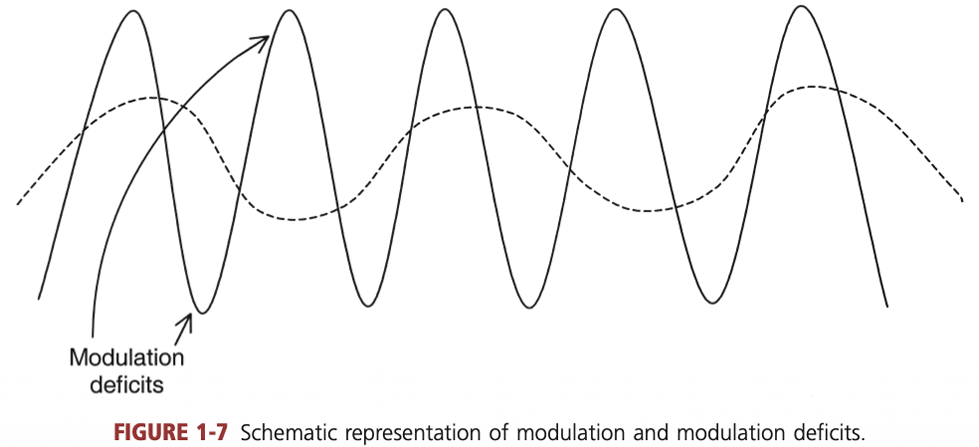
Sensory Modulation
The ability to comfort, calm, or alert oneself and to regulate responses to sensory stimuli in order to engage in goal-directed behavior.
Sensory Modulation Disorder
“Sensory Reactivity or Responsivity”
Atypical sensory reactivity occurs when the child routinely shows dysregulated responses to typical sensory experiences
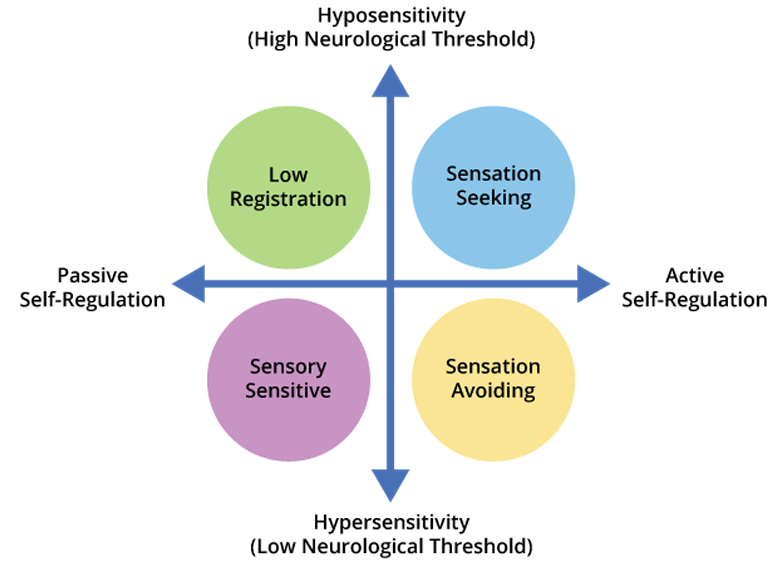
Dunn’s Framework
It crosses a neurological threshold continuum with a self-regulation continuum, producing four patterns that vary by sensory system and by context and are relatively stable over time.
Sensory Processing and Modulation Approaches: Function
Taking in sensory information, modulating it, and using it to support participation.
Sensory Processing and Modulation Approaches: Dysfunction
It appears as over-responsivity, under-responsivity, or craving, which translate into arousal

Sensory Processing and Modulation Approaches: Hypoarousal
Flat affect, detachment, withdrawal, passivity
Relevant environmental stimuli is not noticed or does not “register”
Interferes with the child’s ability to attach meaning to an activity or situation
Child may lack the inner drive to master ordinary childhood occupations
Consider underlying perceptual or cognitive ability
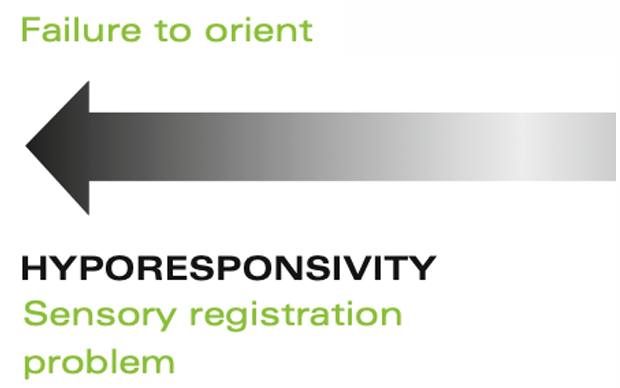

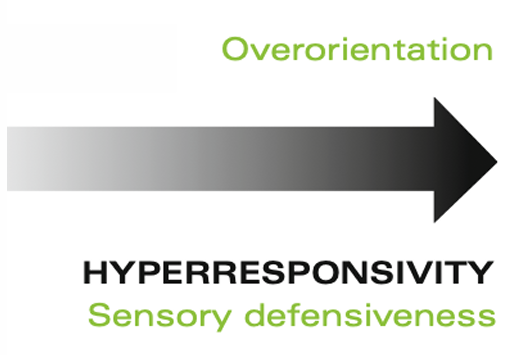
Sensory Processing and Modulation Approaches: Hyperarousal
Meltdowns, hypervigilance, anxiety, overreaction to perceived threat)
May be to all sensory input, few, or one
Common examples:
Tactile Defensiveness – tendency to overreact to ordinary touch sensations
Auditory Defensiveness
Gravitational Insecurity – a form of over responsiveness to vestibular sensations characterized by excessive fear during ordinary movement activities
Modulation
It is the means while participation is the outcome.
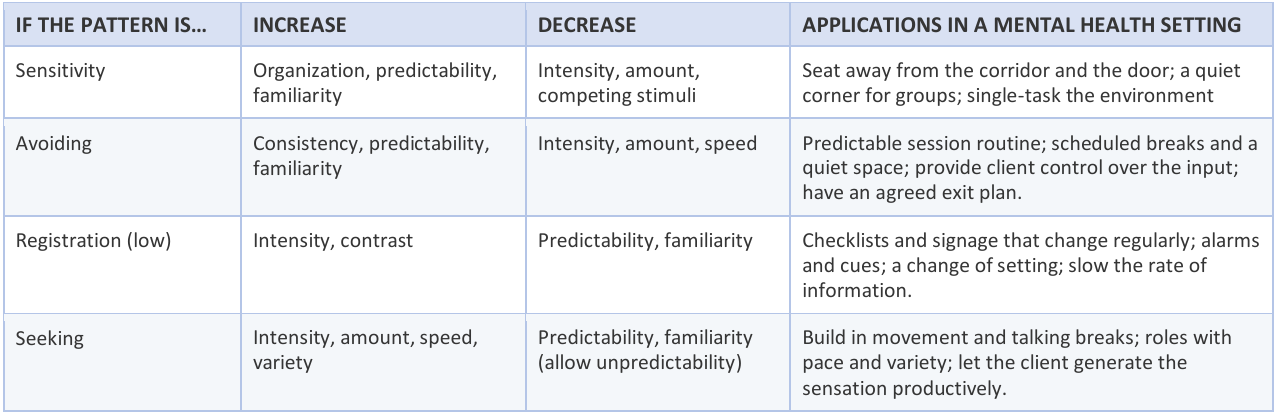
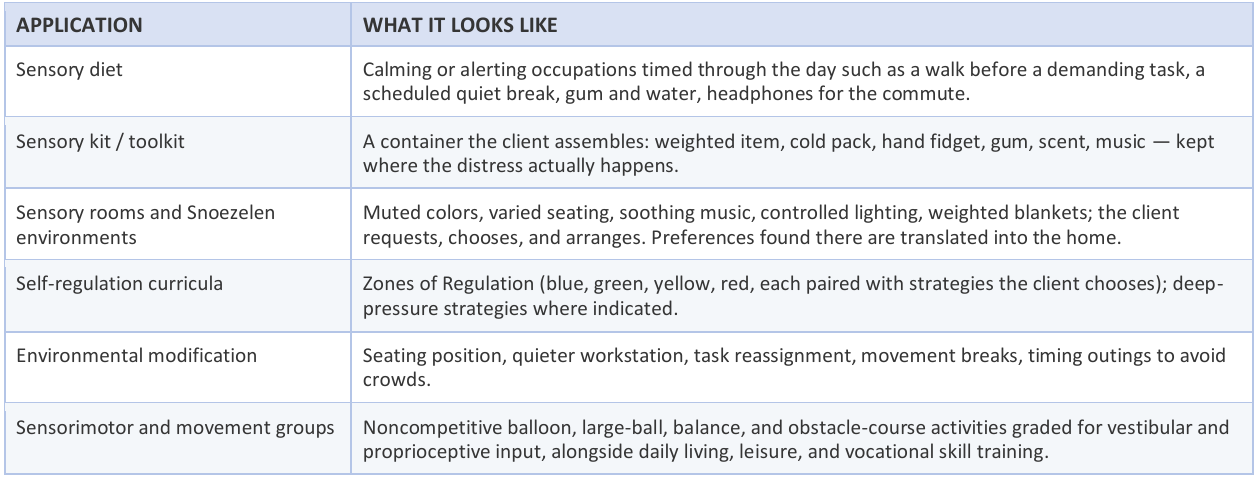
Sensory Strategies & Techniques

Sensory Strategies & Techniques: Applications