Prop 231 - Module 1-6
 Call Kai
 Learn
Learn Practice Test
 Spaced Repetition
 Match
Match Flashcards
 Knowt Play
1/22

There's no tags or description
Looks like no tags are added yet.
Name | Mastery | Learn | Test | Matching | Spaced | Call with Kai |
|---|
No analytics yet
Send a link to your students to track their progress
23 Terms
Property as an asset
Heterogeneous - All properties are different
Real estate - Physical assets
Maintenance - Obsolescence
Large values
Leverage - Borrowing against property
Inelastic supply - Cannot immediately respond to changes in demand
Illiquid - Time is required to convert to cash
Property Investment strategies
Core (Income)
Competitively generate income from tenants
Focus: Low-risk, high-quality, fully leased properties with reliable cash flow CoreCast Blog.
Target: Conservative investors seeking long-term passive income, often in premium locations.
Management: Typically low, with few operational tweaks needed.
Key Benefit: High stability and liquidity, providing a hedge against volatile markets.
Value Add (Growth)
Invest by adding to building value
Focus: Moderate to high-risk projects requiring significant renovations, repositioning, or active management to boost building value.
Target: Investors seeking higher returns through forced appreciation (equity growth), rather than just market appreciation.
Examples: Upgrading units to increase rent, refurbishing common areas, or restructuring tenant mix.
Key Benefit: Potential for significant, rapid capital growth and higher rental yields.
Development
Focus: High-risk, hands-on creation of new built space or land subdivision, according to Property Brokers.
Target: Investors with substantial capital and the ability to manage construction risks.
Key Benefit: Substantial potential returns by building new assets rather than upgrading existing ones.
Role of a property manager
Planning - Market research, Best location for use
Acquisition - Reading terms
Design and fit out
Lease management - Facilities management
Disposal - Reinstatment
Residential
Legal framework
Health and Safety at Work Act 2015
Human Rights Act 1993
Unit titles 2010
Residential tenancies Act 1986
Privacy Act 1993
Real Estate Agents Act 2008
Fair trading Act 1986
Building Act 2004
Resource Management Act 1991
Residential tenancy termination periods
Landlord notice
90 days notice for any reason
42 days for other reasons
Eg use by family members, sold with vacant possession, use by employees* (strict)
Tenant notice
21 days notice for any reason
Residential tenancy cycles
Vacancy
Marketing/ viewings
Tenant screening
Tenancy agreement
Tenancy management
Termination
Inspection Process
Preparation
Inspection
Documentation
Response
Rent increase and Bonds
Rent
60 days written notice and every 12 months
Bonds
Up to 4 weeks and 2 weeks pet bond
Residential - Termination by tribunal
21 days in rent arrears
14 days after for payment
Commerical
What is lease distortion
Affects value of property from income valuation
Income/ capitalisation rate
Lease types and explain
Rental and outgoings
Gross rent - nominal and outgoings included
Net rent - nominal and outgoings extra
Turnover - Based on turnover and outgoings included or Extra
Rent + % of revenue Incentivizes landlords to invest in the building, which helps revenue
Types of rent reviews
Market rent review
Hard ratchet - real cannot decrease
Soft ratchet - rent cannot decrease below commencement rent
No ratchet - rent can decrease
Cap - rent has a maximum
Collar - rent has a minimum on review
Fixed/indexed growth
Fixed growth
Inflation indexed (CPI)
Rent will grow x% every year
Every x years rent is increased by inflation
Alterations and reinstatement
Tenant is required to replace the fittings back to original condition
The fixtures and sitting must not be removed before the end of the termination date
Or
Settlement - Tenant pays amount quoted by Landlord
Macro risks and micro risks
Macro risks (Market level)
High inflation rate - mortgage payments
Market rates
Market oversupply
Economic recession - COVID
Micro risks (Property specific)
Physical
Wear and tear
Maintenance
Natural disasters - accidents
Chemicals
Flooding and Leakage
Security -theft
Large upgrades required - regulations
Tenancy
Unsuccessful business
Health and Safety
Vacancy
High tenant turnover
How does a property manager create value?
Increase revenue
Minimise vacancy
Minimise expenses
Outperform competition
Unit titles
What are the terms for areas in unit
Principal Unit
Primary property, exclusive - unit apartment
Accessory Unit
Carpark, storage lockers
Common Property
Lifts, garden, amenities, lobby,
Commercial - driveways, footpath, stairwell, fire escape
Body Corporate Roles:
Own and manage the common property (incl insurance)
Establish long-term maintenance plan - Develop an uplook and 10 year plan
Administer body corporate (AGMs)
Levying unit owners
Provide docs to unit owners
Enforce body corporate rules
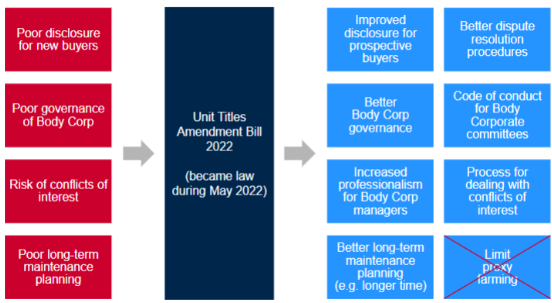
How did the unit titles act amendment bill 2022 change the industry
Unit title rights/ responsibilities
Rights:
AGM meetings
Having a vote on matters
Election for chairperson
Access
Responsibilities:
Playing levies to fund operation and maintenance of the property
Complying with BC operational rules and legal requirements
Disagreement
Self solution with other parties
Check body corporate rules
Ask for an EGM, requiring 25% of owners to request
Apply to Tenanct tribunal