Ortho 8 - Biology of Ortho Movement (Dr. Suri) - edited up to page 52
 Call Kai
 Learn
Learn Practice Test
 Spaced Repetition
 Match
Match Flashcards
 Knowt Play
1/133

There's no tags or description
Looks like no tags are added yet.
Name | Mastery | Learn | Test | Matching | Spaced | Call with Kai |
|---|
No analytics yet
Send a link to your students to track their progress
134 Terms
Periodontal support/ PDL
Most critical aspect of orthodontic tooth movement, all ortho requires _______
Diphyodont
Which characteristic of human dentition refers to having two successive sets of teeth during a lifetime?
Gomphosis
What type of joint is the tooth to alveolar bone articulation?
No they are fixed in place (no PDL)
Once implants are place, can they move?
- Cementum
- Alveolar bone proper
- Alveolar crestal fibers
- Horizontal fibers
- Oblique fibers
- Apical fibers
What are the 6 components of the periodontal support?
Alveolar crestal fibres
ID the components of the periodontal support at 1:
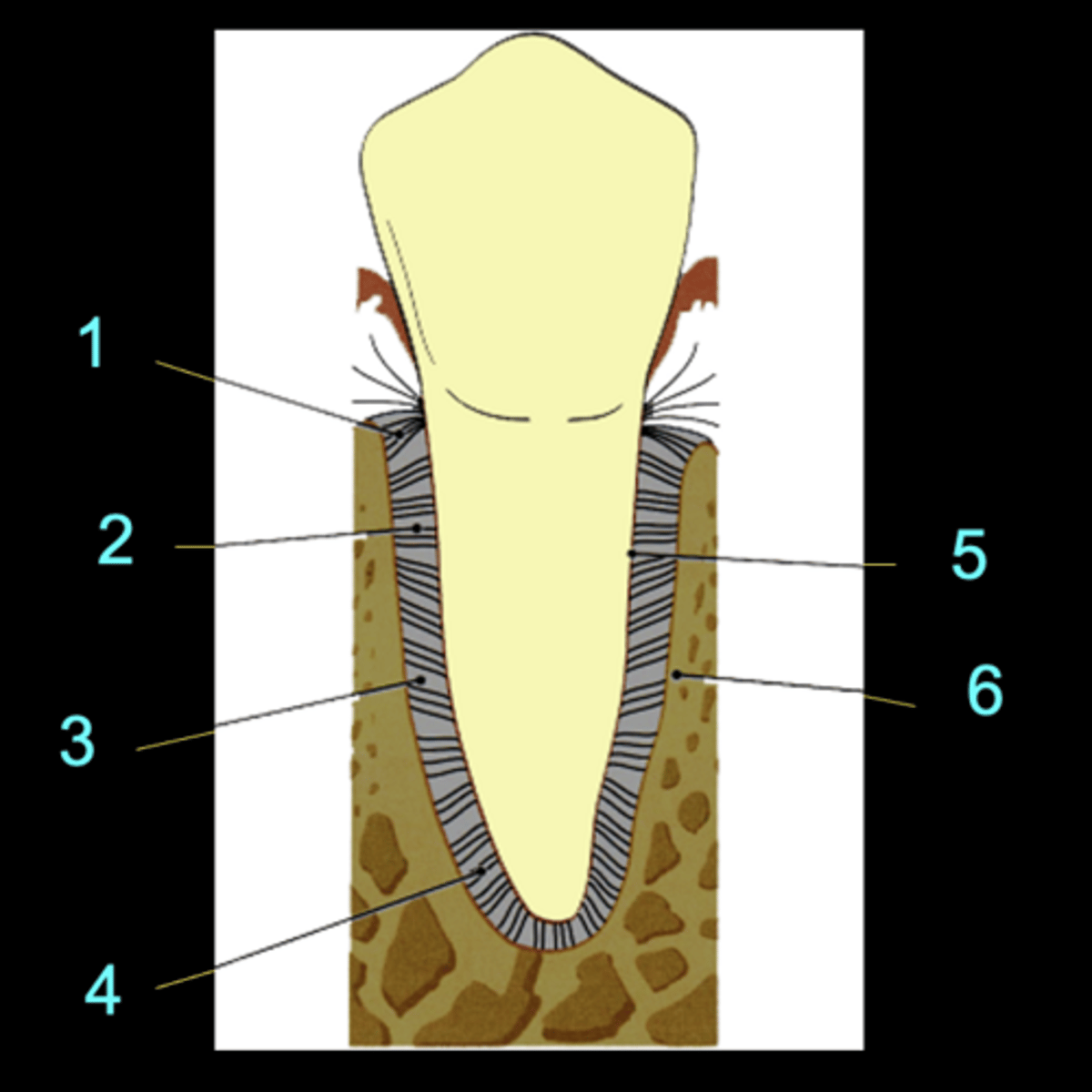
Horizontal fibres
ID the components of the periodontal support at 2:
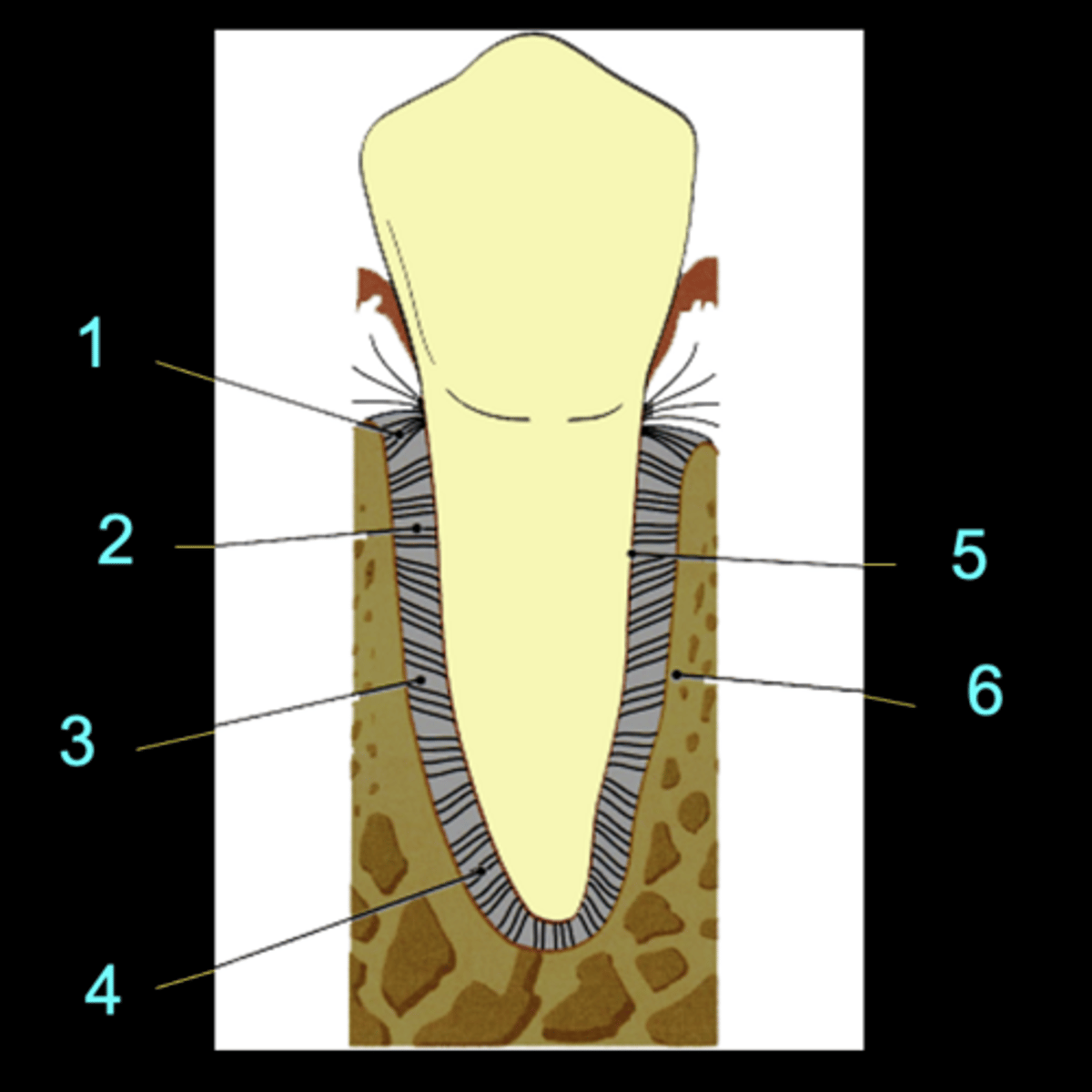
Oblique fibres
ID the components of the periodontal support at 3:
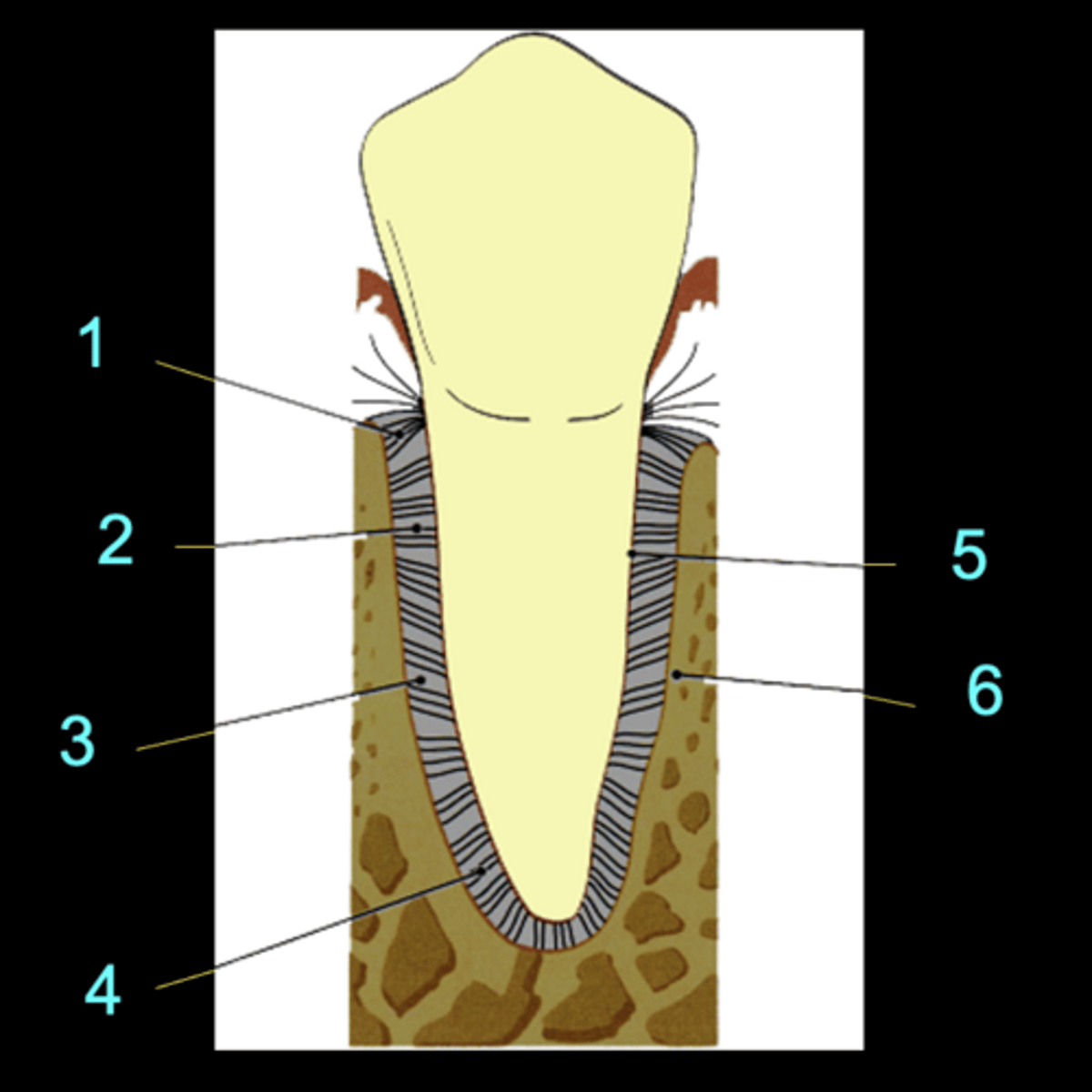
Apical fibres
ID the components of the periodontal support at 4:
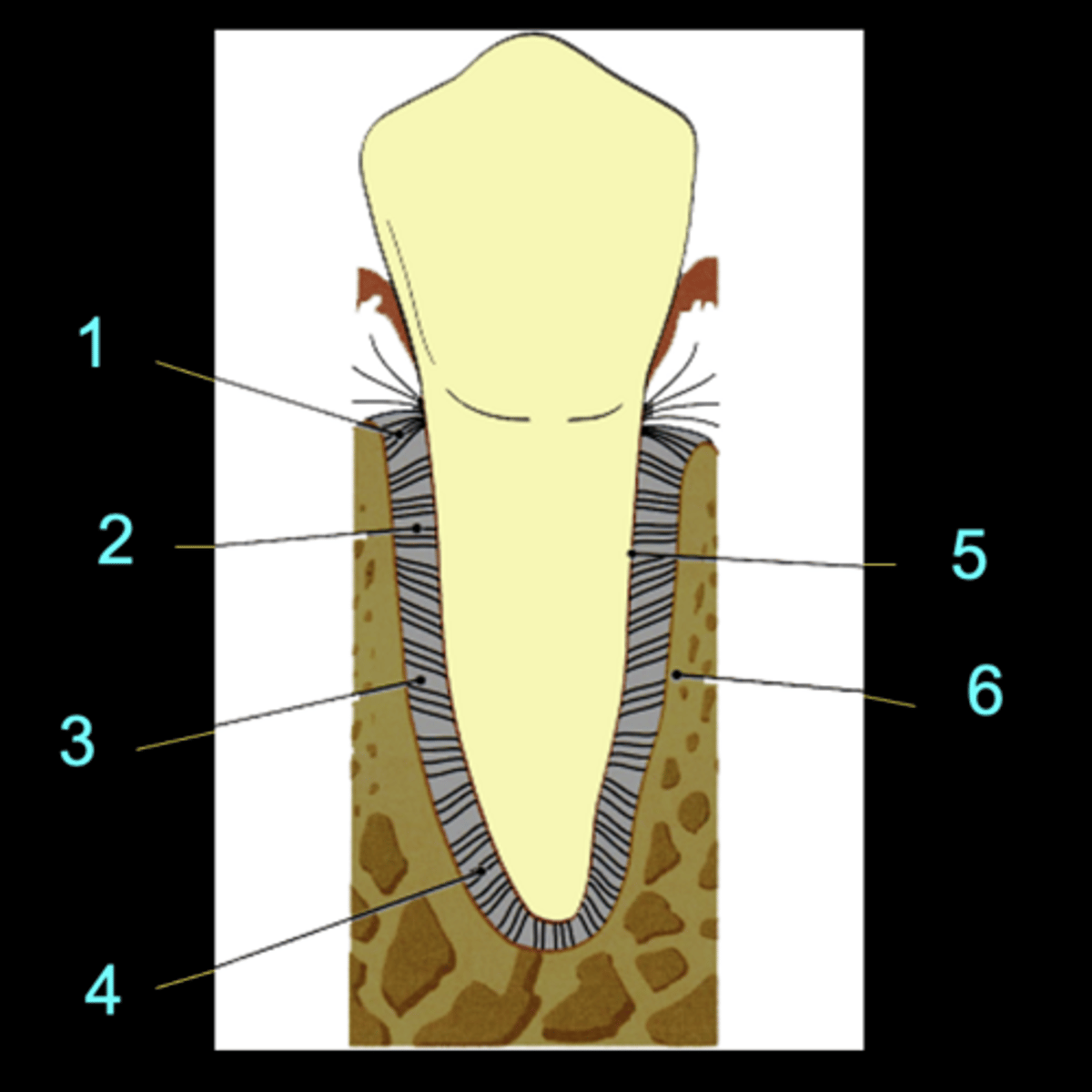
Cementum
ID the components of the periodontal support at 5:
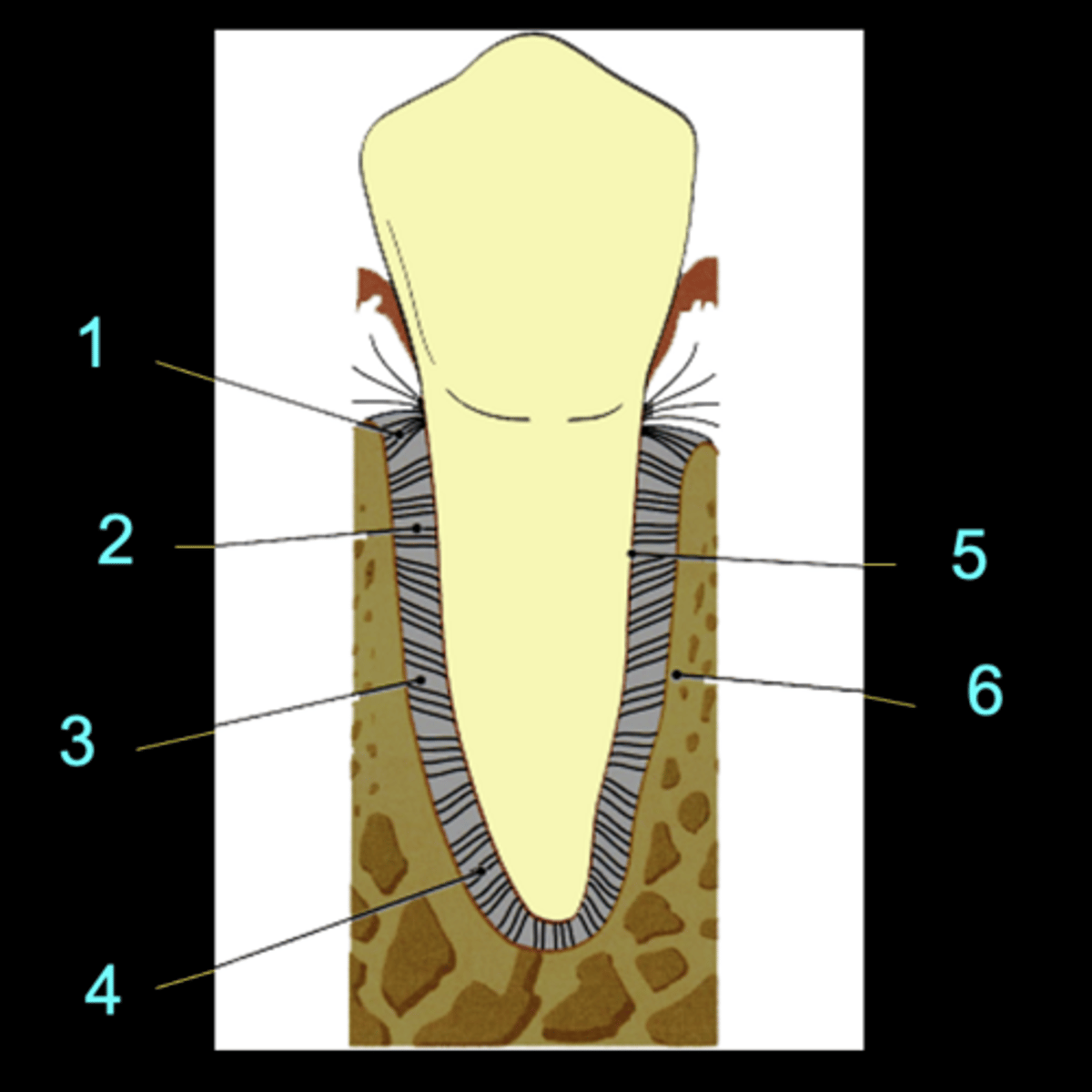
Alveolar bone proper
ID the components of the periodontal support at 6:
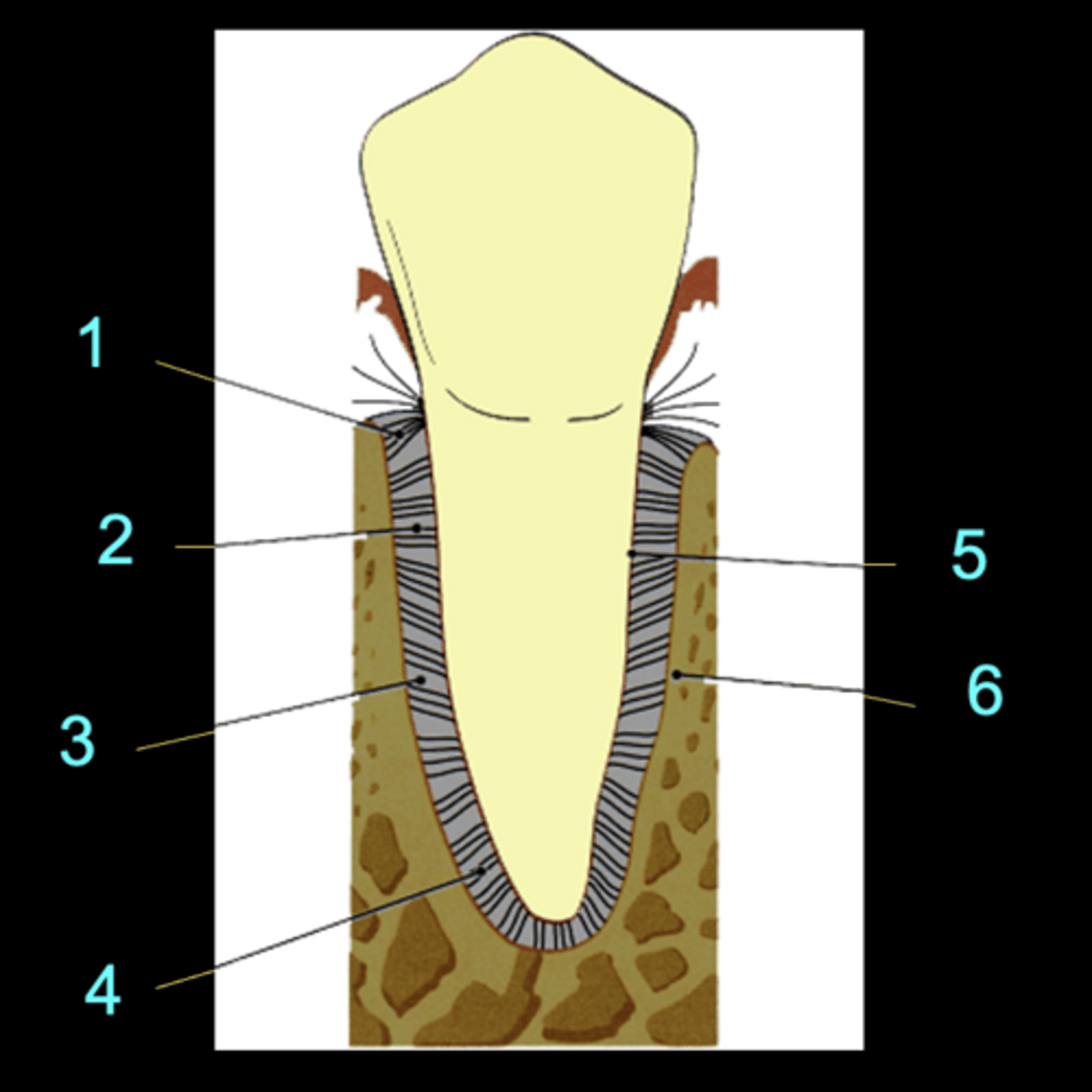
Apical towards tooth, Coronal towards alveolar bone
In what direction are the oblique fibers of the PDL oriented?
Oblique fibers
Which type of fiber is most predominant in PDL?
- Alveolar crestal fibers
- Apical fibers
Which PDL fibers resist extrustion?
Horizontal fibers
Which PDL fibers resist lateral movements?
Oblique fibers
Which PDL fibers resist chewing forces?
Principal PDL fibers (via Sharpey's fibers)
What anchors the tooth to the alveolar bone?
0.2-0.4mm
What is the average width of the PDL?
- Tooth eruption
- Migration or drift of teeth
- Changes in tooth position during mastication
What are three types of physiologic tooth movement?
Alveolar crest
Where is periodontal space the widest?
All of the above!
Which of the following are tooth eruption theories?
A) Blood pressure
B) Pulp theory
C) Alveolar bone growth
D) Dental Follicle theory
E) Root growth theory
F) Hammock ligament theory
G) Periodontal ligament traction
Blood pressure theory
Which tooth eruption theory?
Vascular pressure beneath the tooth pushes it occlusally.
Pulp theory
Which tooth eruption theory?
Growth and proliferation of pulp tissue generates eruptive force.
Alveolar bone growth theory
Which tooth eruption theory?
Bone deposition beneath the tooth pushes it into the oral cavity.
Dental Follicle theory
Which tooth eruption theory?
The dental follicle coordinates bone resorption above and bone formation below the tooth, directing eruption.
Root growth theory
Which tooth eruption theory?
Elongating roots push the crown occlusally.
Hammock ligament theory
Which tooth eruption theory?
A ligament beneath the root acts like a sling and contracts to pull the tooth upward.
No - disproven as an artifact during H&E staining
Does the hammock ligament exist?
Periodontal ligament traction theory
Which tooth eruption theory?
PDL fibroblasts contract and collagen fibers remodel, generating eruptive force.
Periodontal ligament traction theory
Which eruption theory is most widely accepted today?
Tooth movement
Loss of bone, leads to loss of tooth support and loss of equilibrium, which results in what?
Less than 1 second
During mastication, contact with force lasts for how long?
1-2 kg, 50 kg (≈110 lb of force)
The force during chewing/biting forces can range from about ___-___kg for light contact up to ___ kg during heavy biting/clenching.
- Masseter
- Temporalis
- Medial pterygoid
- Lateral pterygoid
What are the muscles of mastication?
- Mastication: High force, short duration → generally physiologic.
- Orthodontics: Low force, long duration → tooth movement.
- Bruxism: High force, prolonged/repeated duration → can be traumatic to the periodontium.
What is the difference between mastication forces, orthodontics forces, and bruxism?
<1 sec
What is the duration of heavy pressure that results in the following physiologic response?
- PDL fluid incompressible
- Alveolar bone bends
- Piezoelectric signals generated
1-2 secs
What is the duration of heavy pressure that results in the following physiologic response:
- PDL fluid expressed
- Tooth moves within PDL space
3-5 seconds
What is the duration of heavy pressure that results in the following physiologic response:
- PDL fluid squeezed out
- Tissues compresse
- Immediate pain if pressure is heavy
Orthodontic
Tooth movement is corrected based on _________ force
Orthopedic
Growth modifications are corrected based on _________ force
Orthognathic
Dentofacial deformities are corrected based on _________ force
G. Compliance
All of the following are factors affecting Tooth Movement EXCEPT:
A. Manner of force application (Continuous, Interrupted, Intermittent)
B. Amount of force (Light, Heavy)
C. Duration of force
D. Direction of force
E. Occlusal function
F. Age
G. Compliance
Continuous
What type of force application?
Force never drops to zero between appointments. It gradually decreases but is always present.
Interrupted
What type of force application?
Force decreases over time and eventually reaches zero, but the appliance remains in place.
Intermittent (ex: headgear)
What type of force application?
Force is present only when the appliance is worn; when removed, force immediately becomes zero.
Interrupted
What type of force application are elastics?
Beyond 4-6 hours
What is the time threshold, or how long is the duration of force needed to see tooth movement?
duration
The greater the ________ of force, the greater efficiency of tooth movement
B - Tooth movement is a function of PDL!!!!!
All of the following are the fundamental principles of tooth movement EXCEPT:
a. If force is applied over threshold duration tooth movement will occur
b. Tooth movement is a function of alveolar bone
c. Bone removed in some areas and deposited in others
d. Tooth moves through bone carrying its attachment apparatus with it
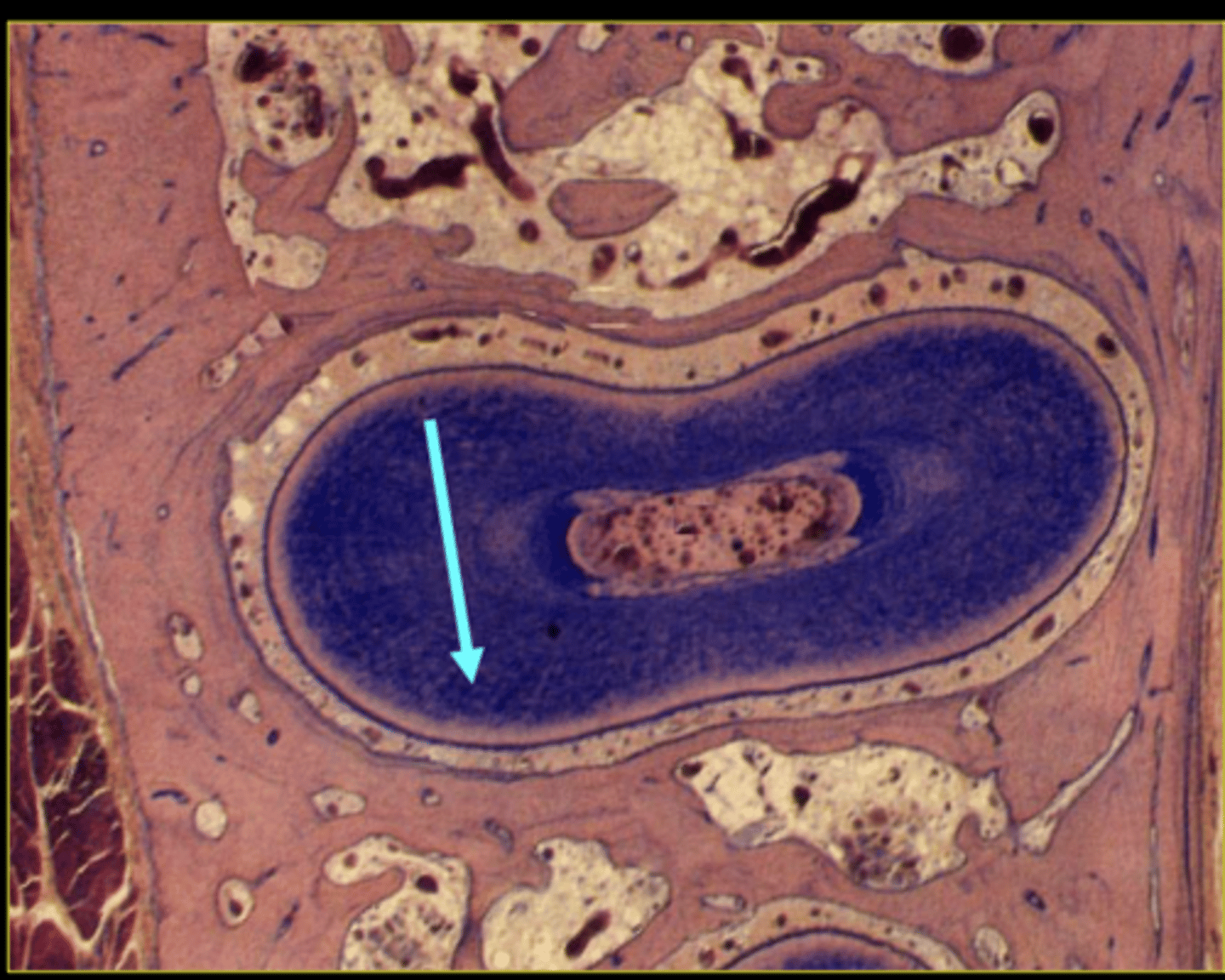
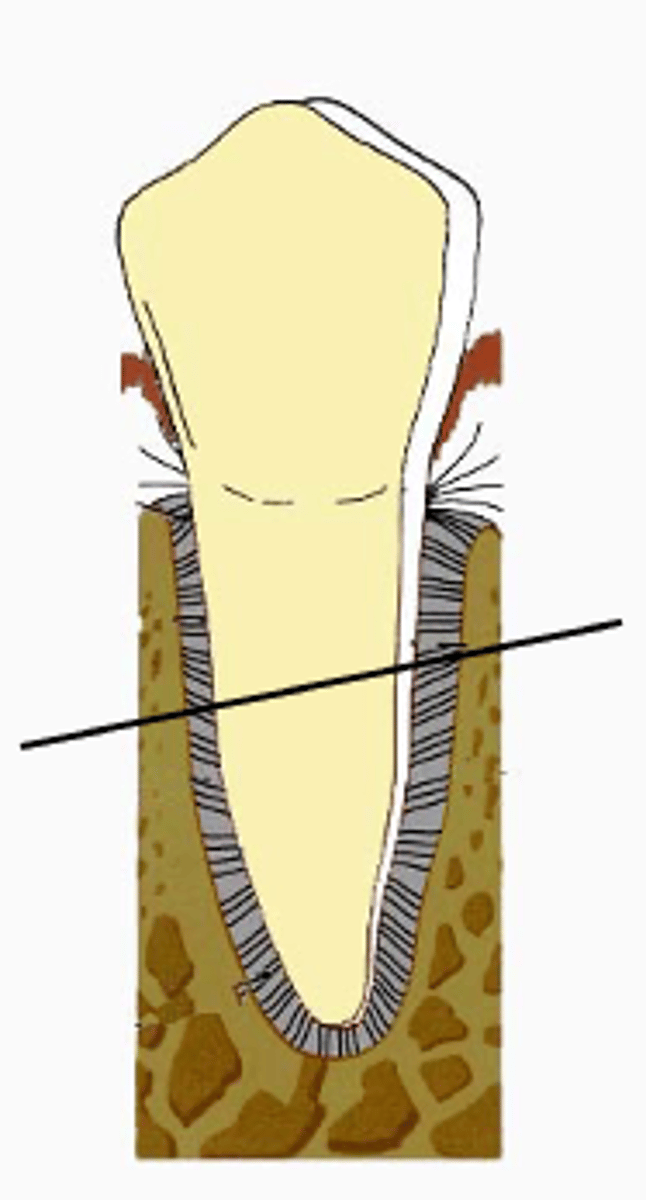
Initial strain/primary displacement phase
ID phase of tooth movement:
- Compression of the PDL (w/ fluid moving out)
- The alveolar bone bends
1-3 days
How long is the Initial strain/primary displacement phase?
At the tissue level
During tooth movement, creation of areas of pressure and tension occur where?
Lag phase
ID phase of tooth movement:
- Hyalinization
- Cellular recruitment
- Neovascularization
- Cell differentiation
- PDL reorganization
2-10 weeks
How long is the lag phase?
Initial strain/primary displacement phase
ID phase of tooth movement:
Controlled tipping
What is movement of the tooth without the apex moving in the opposite direction?
Uncontrolled tipping
What is movement of the tooth while the apex moves in the opposite direction?
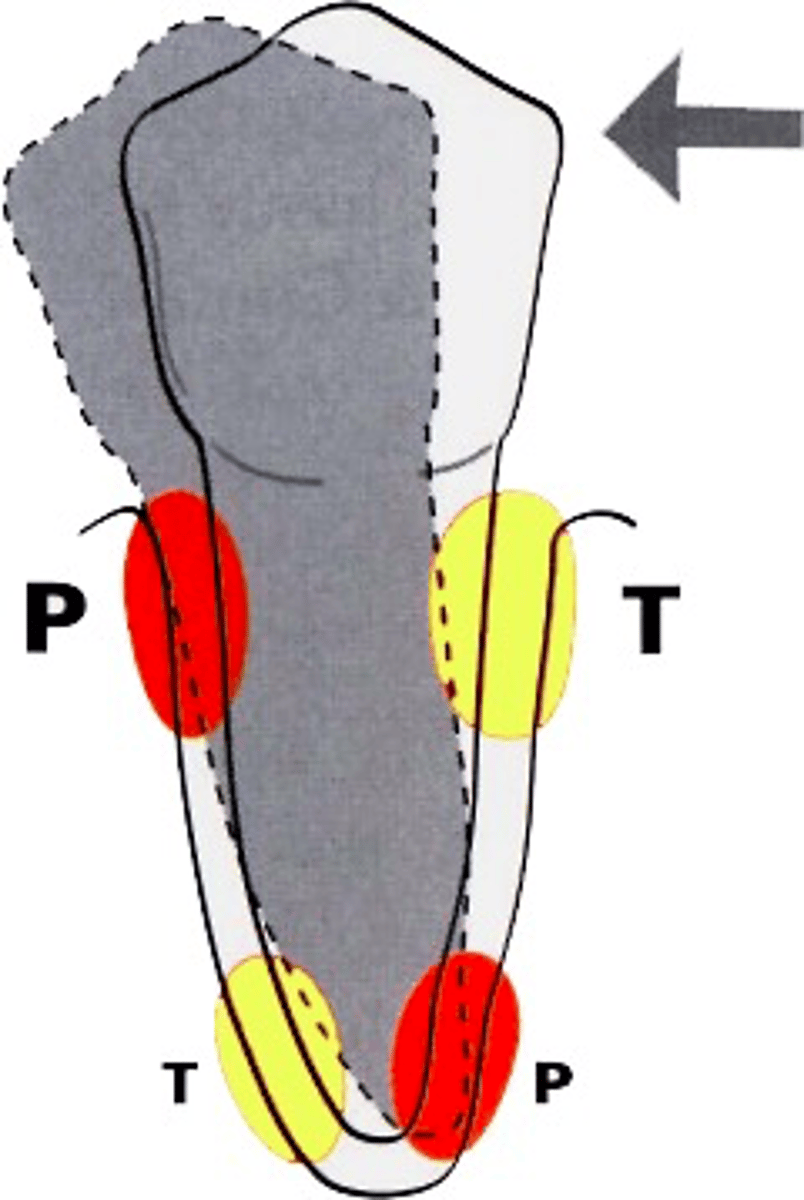
True
T/F: Under a higher force magnitude on a tooth, histologically we can observe...
- Width of ligament
- Effects blood flow
-Changes number and type of cells at site
Left - light force
Right - heavy force
What type of force is on the left vs the right?
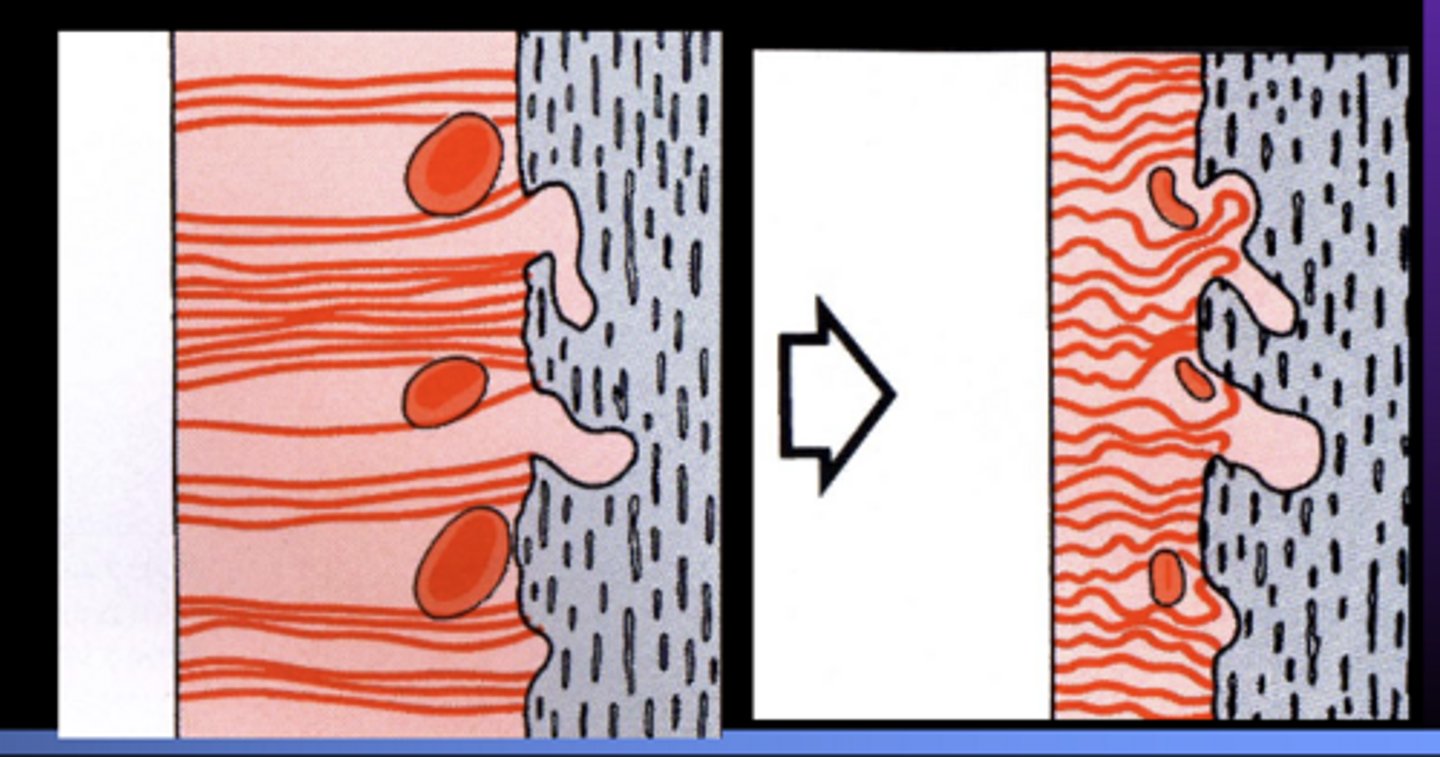
D - A vertical reduction of approximal alveolar bone may occur
All of the following are consequences of heavy forces on the tooth EXCEPT:
A. Cell destruction and decreased vascular supply in the PDL
B. Hyalinization
C. Undermining Resorption
D. Horizontal reduction of approximal alveolar bone may occur
Osteoclasts
(areas of pressure = resorption of bone)
At areas of pressure, what type of cells are found?
Osteoblasts
(areas of tension = bone deposition)
At areas of tension, what type of cells are found?
Frontal resorption
What type of resorption is observed during Light Pressure?
Frontal resorption
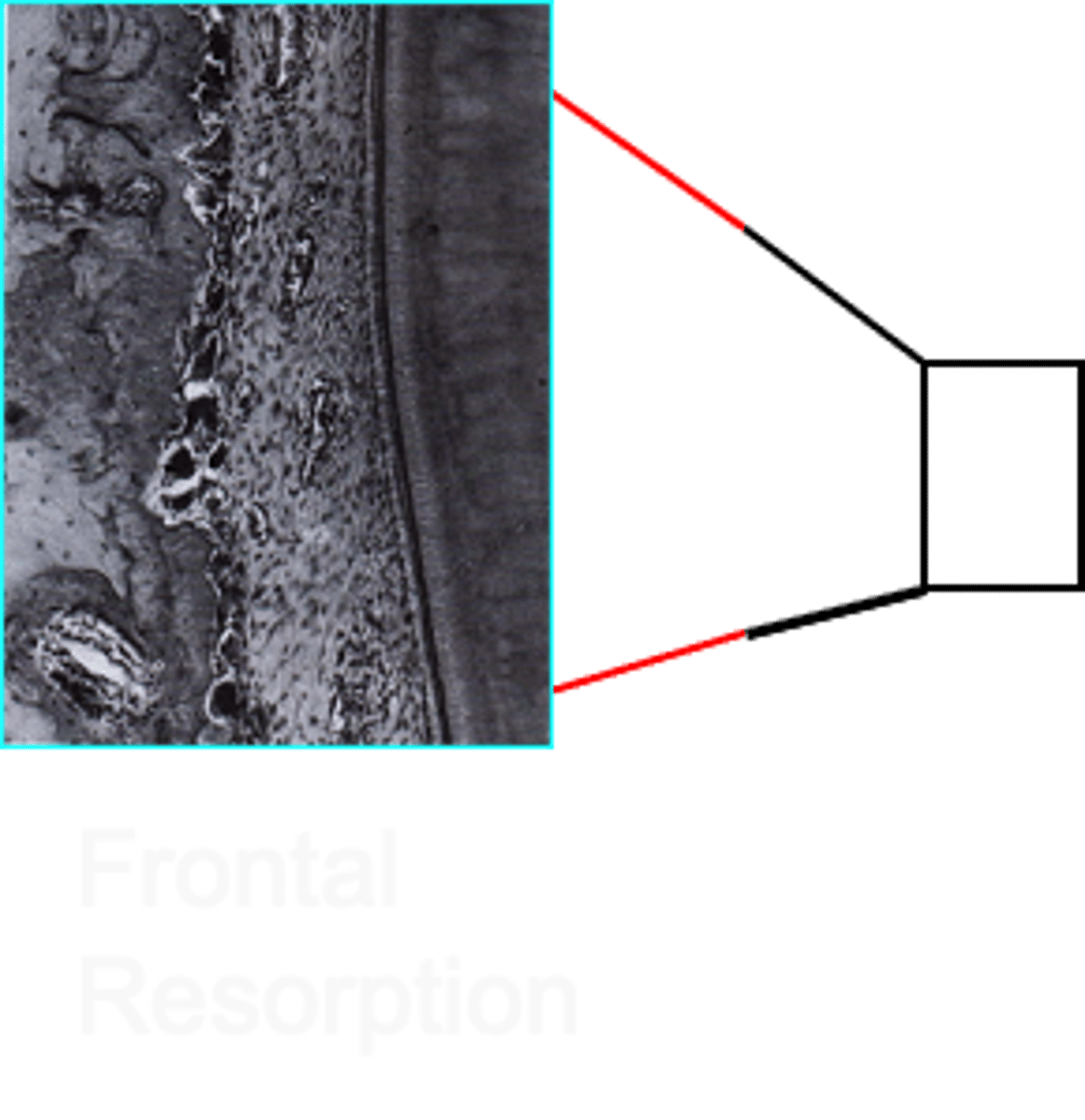
What type of resorption?
- The generation of osteoclasts in the PDL space
- Resorption of the front of the alveolar bone (in the direction of pressure)
Undermining resorption
What type of resorption is observed during Heavy Pressure?
Undermining resorption
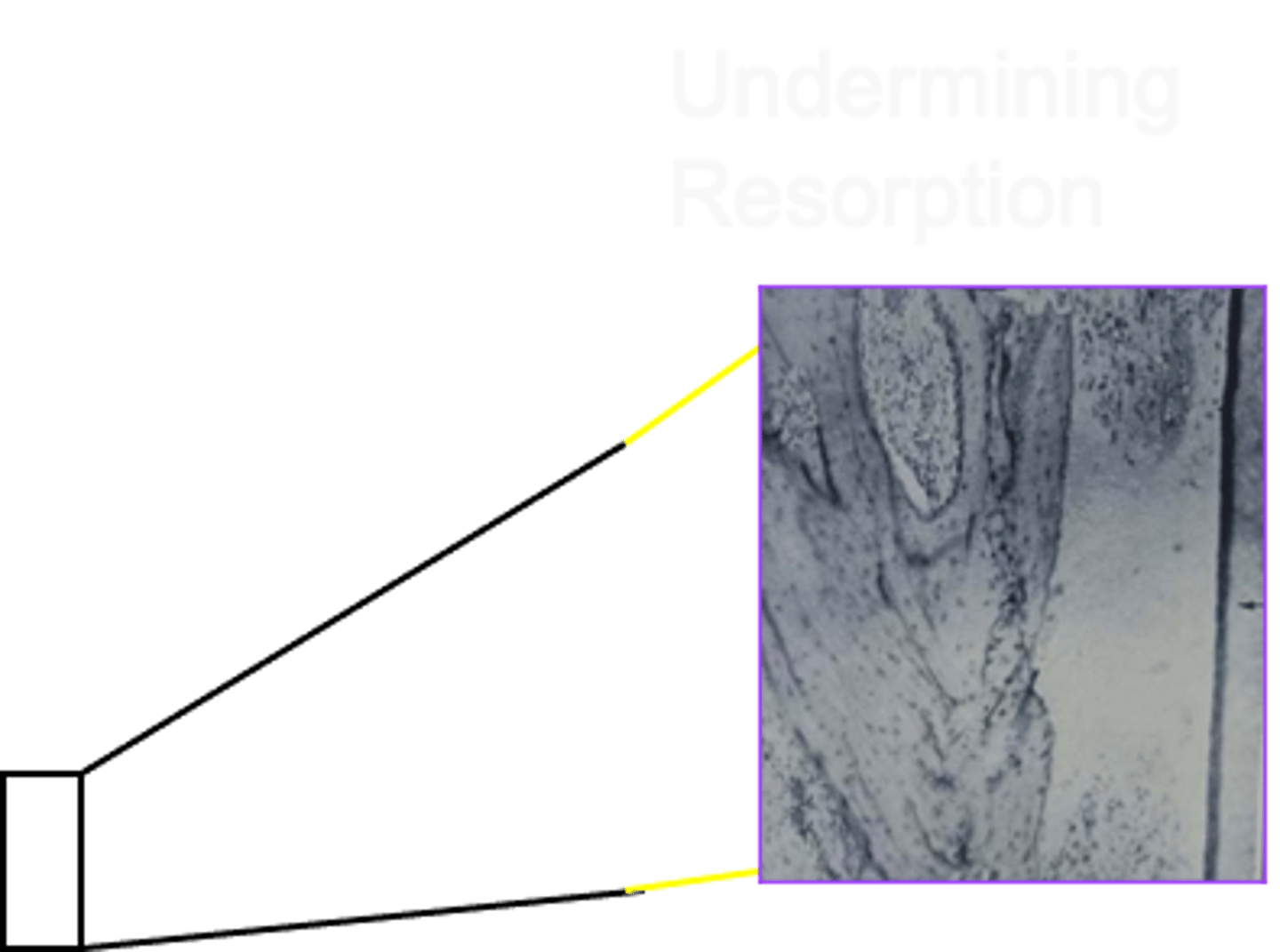
What type of resorption?
- The generation of osteoclasts within the marrow/medullary spaces to resorb bone, undermining it
Frontal resorption
ID the type of resorption:
Undermining resorption
ID the type of resorption:
Osteoblasts
Define the following:
Cells derived from paravascular connective tissue
Osteoclasts
Define the following:
Cells derived from bone marrow
D - INCREASED
All of the following are ways to ID an osteoclast EXCEPT:
A. Multinucleated giant cells
B. Sit in Howship's lacuna
C. Have ruffled border
D. Decreased acid phosphatase
Osteoclasts
Acid phosphatase is a marker for ________ activity
Osteoblasts
Alkaline phosphatase is a marker for ________ activity
Pressure side (bone resorption)
During orthodontic movement, what side would you expect to see acid phosphatase?
Tension side (bone formation)
During orthodontic movement, what side would you expect to see alkaline phosphatase?
Red line
Which line represents light forces on tooth movement?
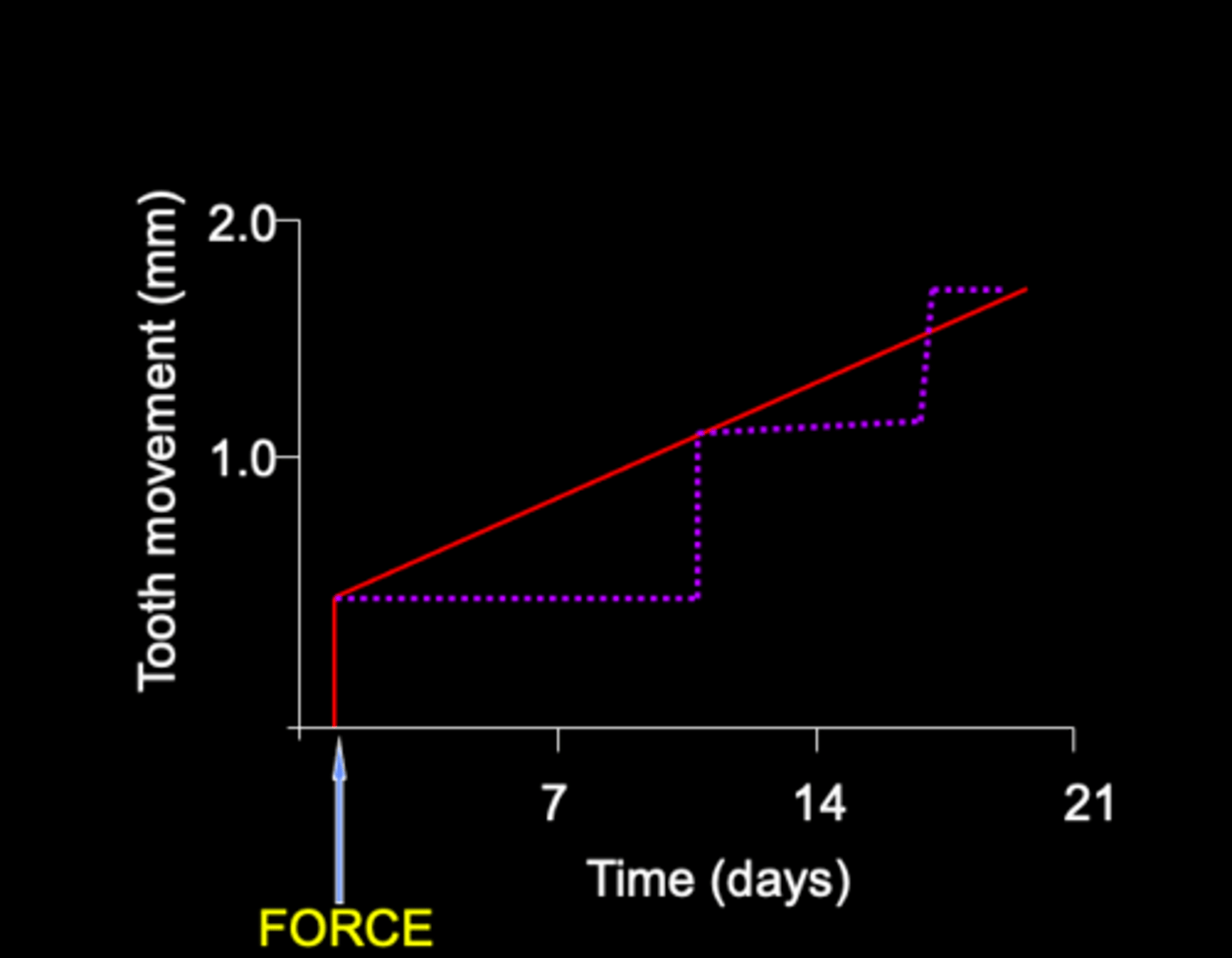
Purple line
Which line represents heavy forces on tooth movement?
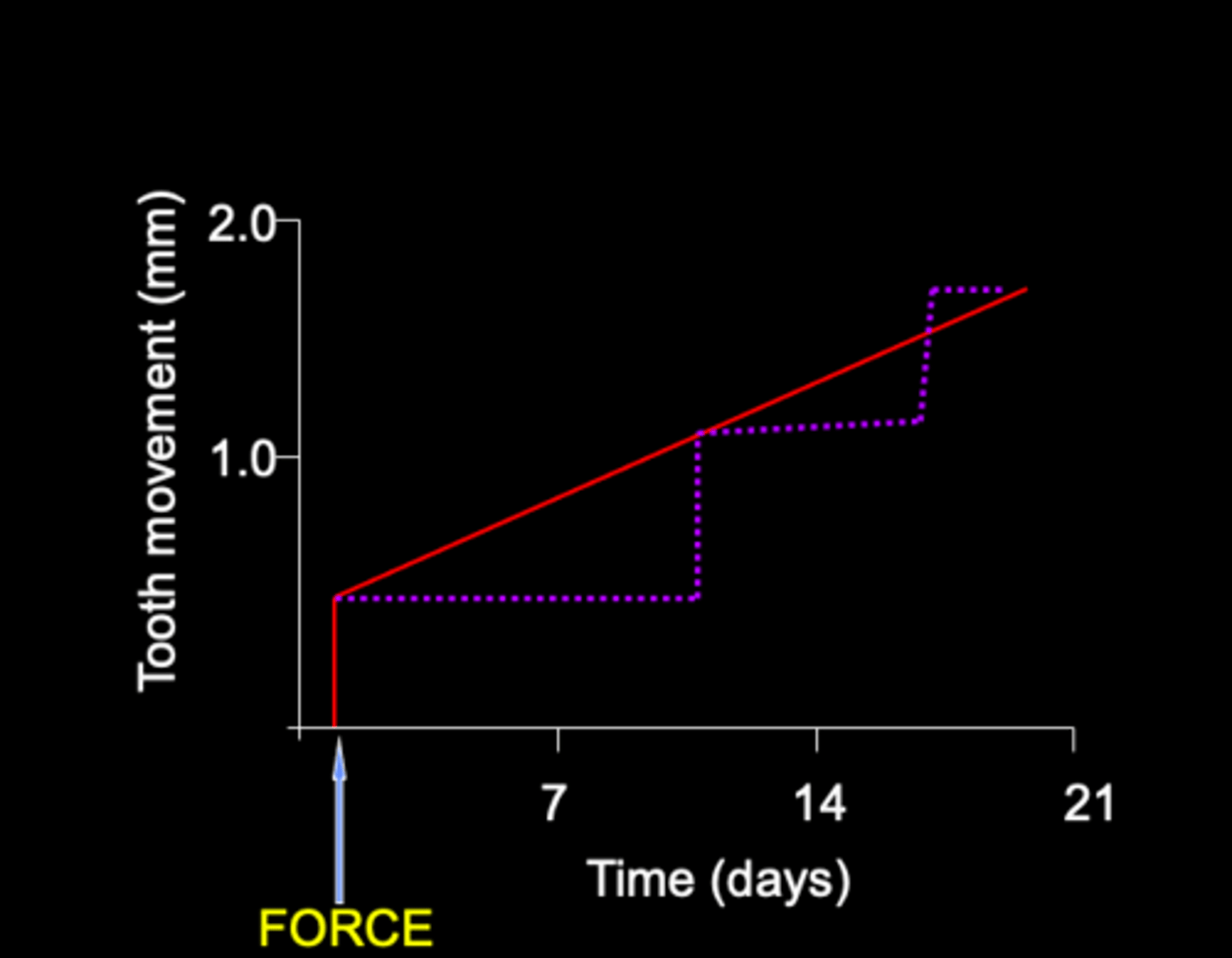
Shorter
Under light forces, the lag phase is expected to be ______
24 hrs/day
What is the maximum efficiency of tooth movement?
Longer
Under heavy forces, the lag phase is expected to be ______
A) Plateau and then decrease
There is an optimal force that can be placed on a tooth for movement. Once that pressure is exceeded, tooth movement will:
A) Plateau and then decrease
B) Decrease
C) Increase
D - NO marked mobility of teeth
All of the following are clinical characteristics of optimal orthodontic force EXCEPT:
A. Produces rapid tooth movement
B. Minimal patient discomfort
C. Lag phase of tooth movement minimal
D. Marked mobility of teeth
C. Produces FRONTAL resorption
All of the following are the histological characteristics of optimal orthodontic force EXCEPT?
A. Maintained vitality of teeth
B. Initiates maximal cellular response
C. Produces undermining resorption
B) Bodily movement (translation)
Which type of movement requires the most amount of force (70-120gm) :
A) Tipping
B) Bodily movement (translation)
C) Root uprighting
D) Rotation
E) Extrusion
F) Intrusion
F) Intrusion
Which type of movement requires the least amount of force (10-20gm):
A) Tipping
B) Bodily movement (translation)
C) Root uprighting
D) Rotation
E) Extrusion
F) Intrusion
A) Tipping
D) Rotation
E) Extrusion
Which 3 movements require about the same amount of force (35-60gm):
A) Tipping
B) Bodily movement (translation)
C) Root uprighting
D) Rotation
E) Extrusion
F) Intrusion
50-100 gm
Root uprighting requires an optimal amount of force of what?
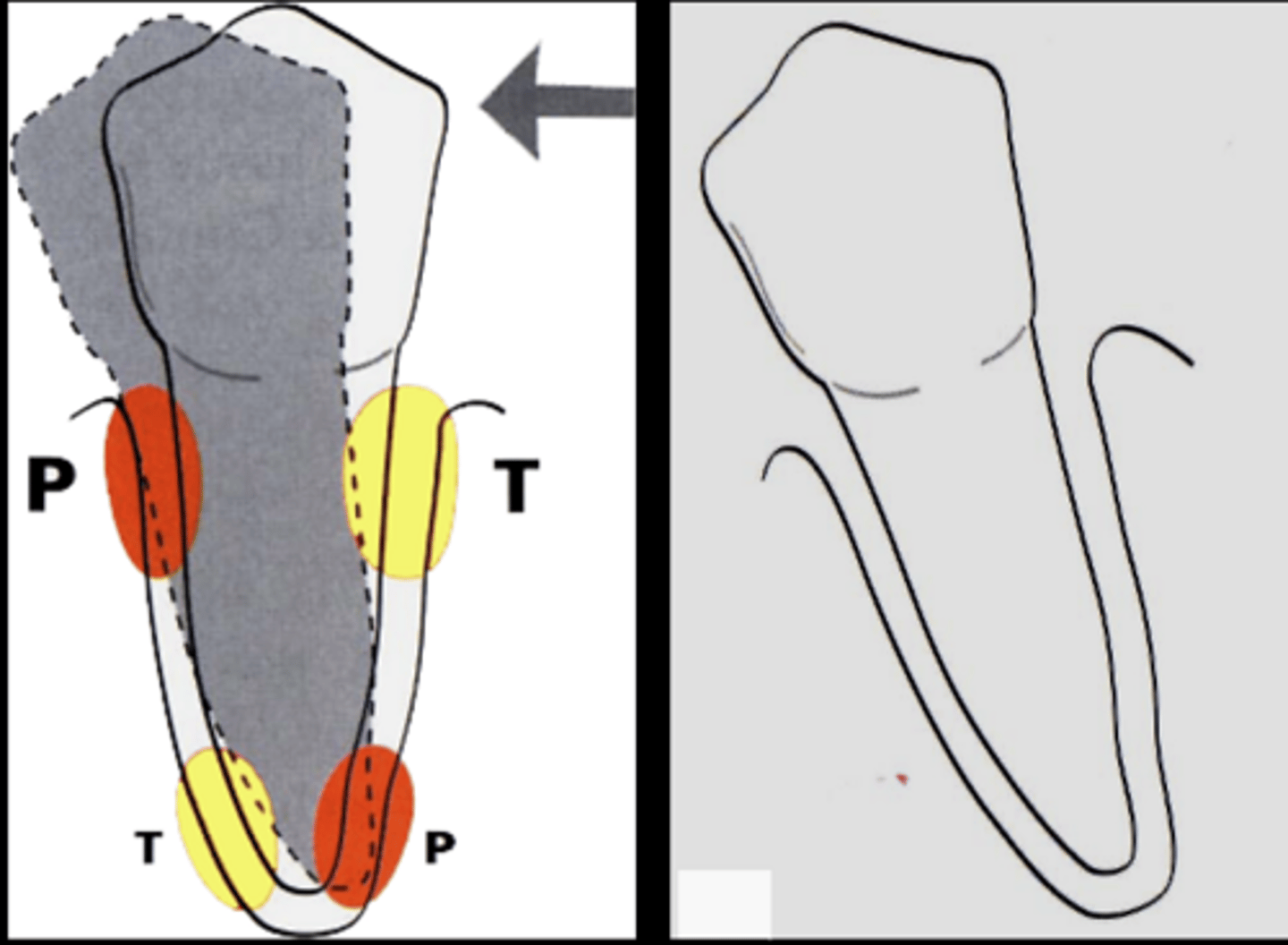
Tipping movement
What type of movement is shown here?
Bodily movement
What type of movement is shown here?
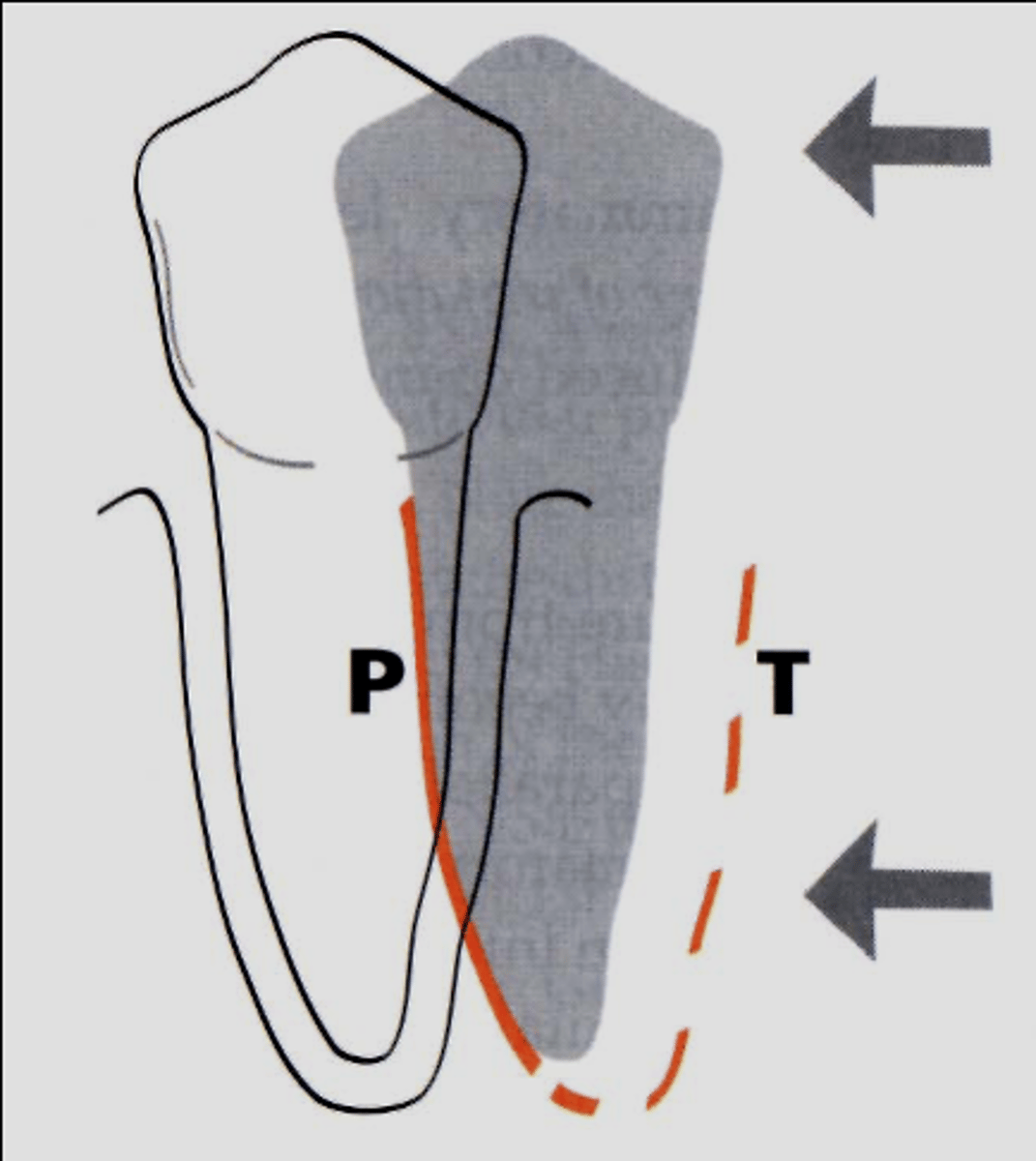
Osteoclasts
On a tooth experiencing force, what type of cells do we expect to see at pressure spots?
Osteoblasts
On a tooth experiencing force, what type of cells do we expect to see at tension spots?
Extrusion
What type of tooth movement ideally produce no areas of compression?
Risk of extraction
What should you expect if you put a tooth under heavy extrusive forces?
Alveolar bone will follow root
(Periodic radiographic examination is desirable)
What should you expect if you put a tooth under light extrusive forces?
Rotation
What type of tooth movement works around the long axis of the tooth?
- Forces distributed over the entire PDL
- Coupling forces: equal forces in opposite directions
Coupling forces
what type of force is needed to rotate a tooth?
Rotation (1st to relapse because of supracrestal fibers)
What is one of the hardest positions to hold in place for orthodontic movement?
2nd order bends
What order of orthodontic bends would result in root uprighting?
Intrusion
What type of tooth movement requires careful control of force magnitude?
- Apical root resorption risk!
Pressure-Tension theory
ID the Theory of Tooth Movement:
- Movement occurs due to osteoclastic activity at pressure spots and osteoblastic activity at tension spots