GNRS 555: exam 1 by M.H
 Call Kai
 Learn
Learn Practice Test
 Spaced Repetition
 Match
Match Flashcards
 Knowt Play
1/282

There's no tags or description
Looks like no tags are added yet.
Name | Mastery | Learn | Test | Matching | Spaced | Call with Kai | Chat |
|---|
No analytics yet
Send a link to your students to track their progress
283 Terms
Obesity places patients at an increased surgical risk because of which of the following factors?
1. Risk for bleeding is increased.
2. Ventilatory capacity is reduced.
3. Fatty tissue has a poor blood supply.
4. Metabolic demands are increased.
5. Physical mobility is often impaired.
2, 3, 5
CH. 50
The primary reason that you need to include family members when you teach a patient preoperative exercises is so they can:
1. Coach and encourage the patient after surgery.
2. Demonstrate to the patient at home.
3. Relieve the nurse by getting the patient to do the exercises every 2 hours.
4. Practice with the patient while he or she is waiting to be taken to the operating room.
1
CH. 50
In the postanesthesia care unit (PACU) a nurse notes that a patient is having difficulty breathing and suspects an upper-airway obstruction. The nurse's priority intervention at this time is:
1. Suction the pharynx and bronchial tree.
2. Give oxygen through a mask at 4 L/min.
3. Ask the patient to use an incentive spirometer.
4. Position the patient on one side with the face down and the neck slightly extended so the tongue falls forward.
4
CH. 50
Because an older adult is at increased risk for respiratory complications after surgery, the nurse needs to:
1. Withhold pain medications and ambulate the patient every 2 hours.
2. Monitor fluid and electrolyte status every shift and vital signs with temperature every 4 hours.
3. Orient the patient to the surrounding environment frequently and ambulate him or her every 2 hours.
4. Encourage the patient to turn, deep breathe, and cough frequently and ensure adequate pain control.
4
CH. 50
You are caring for a patient after surgery who had a liver resection. His prothrombin time (PT) is greater than normal. He has low blood pressure; tachycardia; thready pulse; and cool, clammy, pale skin, and he is restless. You assess his surgical wound, and the dressing is saturated with blood. Which immediate interventions do you perform? (Select all that apply.)
1. Notify the surgeon.
2. Maintain intravenous (IV) fluid infusion and prepare to give volume replacement.
3. Monitor the patient's vital signs every 15 minutes or more frequently until his condition stabilizes.
4. Wean oxygen therapy.
5. Provide comfort through bathing.
1, 2, 3
CH. 50
You are a nurse in the postanesthesia care unit (PACU), and you note that your patient has a heart rate of 130 beats/min and a respiratory rate of 32 breaths/min; you also assess jaw muscle rigidity and rigidity of limbs, abdomen, and chest. What do you suspect, and which intervention is indicated?
1. Infection: Notify surgeon and anticipate administration of antibiotics.
2. Pneumonia: Listen to breath sounds, notify surgeon, and anticipate order for chest radiography.
3. Hypertension: Check blood pressure, notify surgeon, and anticipate administration of antihypertensives.
4. Malignant hyperthermia: Notify surgeon/anesthesia provider immediately, prepare to administer dantrolene sodium (Dantrium), and monitor vital signs frequently.
4
CH. 50
After a patient has been given preoperative sedatives, which safety precaution do you take?
1. Reinforce to patient to remain in bed or on the stretcher
2. Raise the side rails and keep the bed or stretcher in the high position
3. Determine if patient has any allergies to latex
4. Obtain informed consent immediately after sedative administration
1
CH. 50
The operating room (OR) and postanesthesia care unit (PACU) are high-risk environments for patients with a latex allergy. Which safety measures do nurses in these areas implement to prevent a latex reaction? (Select all that apply.)
1. Screen patients about food allergies known to have cross-reactivity to latex.
2. Have a latex allergy cart available at all times.
3. Communicate with the operating room (OR) team as soon as 24 to 48 hours in advance of the surgery when a patient with latex sensitivity is identified.
4. Schedule the patient with a latex allergy for the last operative case of the day.
5. Plan for the patient to be admitted to a private room after surgery.
1, 2, 3
CH. 50
A nurse is recovering a patient who received conscious sedation for cosmetic surgery. Which of the following is an advantage that conscious sedation has over general anesthesia? (Select all that apply.)
1. Loss of sensation at the surgical site
2. Reduction of fear and anxiety
3. Amnesia about procedure
4. Monitoring in phase I recovery
5. Close monitoring for airway patency
2, 3
CH. 50
You are assigned to care for the following patients on your surgical unit. On the basis of the information provided, which patient do you need to see first?
1. A 75-year-old following hip replacement surgery who is complaining of moderate pain in the surgical site, with a heart rate of 92
2. A 57-year-old following hip replacement 6 hours earlier who is receiving intravenous patient-controlled analgesia (PCA) with a history of obstructive sleep apnea (OSA) (The pulse oximeter has been alarming and reading 85%.)
3. A 36-year-old following bladder neck suspension who is 30 minutes late to receive her postoperative dose of antibiotic
4. A 48-year-old following total knee replacement who needs help repositioning in bed
2
CH. 50
Hand-off communications that occur between the postanesthesia care unit (PACU) nurse and the nurse on the postoperative nursing unit need to be done when a patient returns to the nursing unit. Which are appropriate components of a safe and effective hand-off? (Select all that apply.)
1. Vital signs, type of anesthesia provided, blood loss, and level of consciousness
2. Uninterrupted time to review the recent pertinent events and ask questions
3. Verification of the patient using one identifier and the type of surgery performed
4. Review of pertinent events occurring in the operating room (OR) while at the nurses' station
5. Location of patient's family members
1, 2, 5
CH. 50
A nurse is working in the preoperative holding area and is assigned to care for a patient who is having a prosthetic aortic valve placed. The nurse inserts an intravenous (IV) line and obtains vital signs. The patient has a temperature of 39° C (102° F), heart rate of 120, blood pressure (BP) of 84/50, and an elevated white blood cell (WBC) count. The nurse immediately notifies the surgeon of the patient's vital signs because:
1. He or she needs to get the patient into the operating room (OR) quickly to start the surgery because of the low BP.
2. The surgery may need to be delayed to recheck the patient's WBC count and investigate the source of fever before surgery.
3. The nurse anticipates the need for a fluid bolus to increase the patient's BP.
4. The nurse anticipates an order for a sedative to help calm the patient and decrease the heart rate.
2
CH. 50
A nurse is preparing to provide a patient with instructions for how to perform incentive spirometry. The patient will likely have incisional pain after returning from an elective colon resection. Which of the following steps for incentive spirometry is the patient likely to have the most difficulty performing? (Select all that apply.)
1. Assuming semi-Fowler's or high-Fowler's position
2. Setting the incentive spirometer device scale at the volume level to be attained
3. Placing the mouthpiece of the incentive spirometer so lips completely cover the mouthpiece
4. Inhaling slowly while maintaining constant flow through unit until it reaches goal volume
5. Breathing normally for a short period between each of the 10 breaths on incentive spirometry
6. Ending with two coughs after the end of 10 incentive spirometry breaths hourly
1, 4, 6
CH. 50
A patient is admitted through the emergency department following a motorcycle crash with multiple orthopedic injuries. He goes to surgery for repair of fractures. He is postoperative day 3 from an open-reduction internal fixation of bilateral femur fractures and external fixator to his unstable pelvic fracture. Interventions that are necessary for prevention of venous thromboembolism in this patient include: (Select all that apply.)
1. Intermittent pneumatic compression stockings.
2. Vitamin K therapy.
3. Passive range-of-motion exercises every 4 hours.
4. Subcutaneous heparin or enoxaparin (Lovenox).
5. Continuous heparin drip with a goal of an international normalized ratio (INR) 5 times higher than baseline.
1, 4
Ch. 50
You are caring for a 65-year-old patient 2 days after surgery and helping him ambulate down the hallway. The surgeon ordered exercise as tolerated. Your assessment indicates that the patient's heart rate at baseline is 88. After walking approximately 30 yards down the hallway, his heart rate is 110. What is your next action?
1. Stop exercise immediately and have him sit in a nearby chair.
2. Ask him how he feels; determine if there is any discomfort or shortness of breath; and, if not, continue exercise.
3. Tell him that he needs to walk further to reach a heart rate of 120.
4. Have him walk slower; he has reached his maximum.
2
Ch. 50
When repositioning an immobile patient, the nurse notices redness over the hip bone. What is indicated when a reddened area blanches on fingertip touch?
1. A local skin infection requiring antibiotics
2. Sensitive skin that requires special bed linen
3. A stage III pressure ulcer needing the appropriate dressing
4. Blanching hyperemia, indicating the attempt by the body to overcome the ischemic episode
4
CH. 48
Match the pressure ulcer categories/stages with the correct definition.
1. Category/stage I
2. Category/stage II
3. Category/stage III
4. Category/stage IV
a. Nonblanchable redness of intact skin. Discoloration, warmth, edema, or pain may also be present.
b. Full-thickness skin loss; subcutaneous fat may be visible. May include undermining.
c. Full thickness tissue loss; muscle and bone visible. May include undermining.
d. Partial-thickness skin loss or intact blister with serosanguinous fluid.
1=a
2=d
3=b
4=c
CH. 48
When obtaining a wound culture to determine the presence of a wound infection, from where should the specimen be taken?
1. Necrotic tissue
2. Wound drainage
3. Wound circumference
4. Cleansed wound
4
CH. 48
After surgery the patient with a closed abdominal wound reports a sudden "pop" after coughing. When the nurse examines the surgical wound site, the sutures are open, and pieces of small bowel are noted at the bottom of the now-opened wound. Which are the priority nursing interventions? (Select all that apply.)
1. Notify the surgeon.
2. Allow the area to be exposed to air until all drainage has stopped.
3. Place several cold packs over the area, protecting the skin around the wound
4. Cover the area with sterile, saline-soaked towels immediately.
5. Cover the area with sterile gauze and apply an abdominal binder.
1, 4
CH. 48
What is the correct sequence of steps when performing wound irrigation to a large open wound?
1. Use slow, continuous pressure to irrigate wound.
2. Attach 19-gauge angiocatheter to syringe.
3. Fill syringe with irrigation fluid.
4. Place waterproof bag near bed.
5. Position angiocatheter over wound.
4, 3, 2, 5, 1
CH. 48
For a patient who has a muscle sprain, localized hemorrhage, or hematoma, which wound-care product helps prevent edema formation, control bleeding, and anesthetize the body part?
1. Binder
2. Ice bag
3. Elastic bandage
4. Absorptive dressing
2
CH. 48
Which skin-care measures are used to manage a patient who is experiencing fecal and/or urinary incontinence? (Select all that apply.)
1. Frequent position changes
2. Keeping the buttocks exposed to air at all times
3. Using a large absorbent diaper, changing when saturated
4. Using an incontinence cleaner
5. Frequent cleaning, applying an ointment, and covering the areas with a thick absorbent towel
6. Applying a moisture barrier ointment
1, 4, 6
CH. 48
Which of the following describes a hydrocolloid dressing?
1. A seaweed derivative that is highly absorptive
2. Premoistened gauze placed over a granulating wound
3. A debriding enzyme that is used to remove necrotic tissue
4. A dressing that forms a gel that interacts with the wound surface
4
CH. 48
Which of the following is an indication for a binder to be placed around a surgical patient with a new abdominal wound? (Select all that apply.)
1. Collection of wound drainage
2. Providing support to abdominal tissues when coughing or walking
3. Reduction of abdominal swelling
4. Reduction of stress on the abdominal incision
5. Stimulation of peristalsis (return of bowel function) from direct pressure
2, 4
CH. 48
When is an application of a warm compress to an ankle muscle sprain indicated? (Select all that apply.)
1. To relieve edema
2. To reduce shivering
3. To improve blood flow to an injured part
4. To protect bony prominences from pressure ulcers
5. To immobilize area
1, 3
Ch. 48
What is the removal of devitalized tissue from a wound called?
1. Debridement
2. Pressure reduction
3. Negative pressure wound therapy
4. Sanitization
1
CH. 48
Name the three important dimensions to consistently measure to determine wound healing.
width, length, depth
CH. 48
What does the Braden Scale evaluate?
1. Skin integrity at bony prominences, including any wounds
2. Risk factors that place the patient at risk for skin breakdown
3. The amount of repositioning that the patient can tolerate
4. The factors that place the patient at risk for poor healing
2
CH. 48
On assessing your patient's sacral pressure ulcer, you note that the tissue over the sacrum is dark, hard, and adherent to the wound edge. What is the correct category/stage for this patient's pressure ulcer?
1. Category/stage II
2. Category/stage IV
3. Unstageable
4. Suspected deep-tissue damage
3
CH. 48
Which of the following are measures to reduce tissue damage from shear? (Select all that apply.)
1. Use a transfer device (e.g., transfer board)
2. Have head of bed elevated when transferring patient
3. Have head of bed flat when repositioning patient
4. Raise head of bed 60 degrees when patient positioned supine
5. Raise head of bed 30 degrees when patient positioned supine
1, 3, 5
CH. 48
What is the most effective way to control transmission of infection?
1. Isolation precautions
2. Identifying the infectious agent
3. Hand hygiene practices
4. Vaccinations
3
CH. 29
A patient who has been isolated for Clostridium difficile (C. difficile) asks you to explain what he should know about this organism. What is the most appropriate information to include in patient teaching? (Select all that apply.)
1. The organism is usually transmitted through the fecal-oral route.
2. Hands should always be cleaned with soap and water versus alcohol-based hand sanitizer.
3. Everyone coming into the room must be wearing a gown and gloves.
4. While the patient is in contact precautions, he cannot leave the room.
5. C. difficile dies quickly once outside the body.
1, 2, 3
CH. 29
Your assigned patient has a leg ulcer that has a dressing on it. During your assessment you find that the dressing is saturated with purulent drainage. Which action would be best on your part?
1. Reinforce dressing with a clean, dry dressing and call the health care provider.
2. Remove wet dressing and apply new dressing using sterile procedure.
3. Put on gloves before removing the old dressing; then obtain a wound culture.
4. Remove saturated dressing with gloves, remove gloves, then perform hand hygiene and apply new gloves before putting on a clean dressing.
4
CH. 29
A patient is diagnosed with methicillin-resistant Staphylococcus aureus (MRSA) pneumonia. Which type of isolation precaution is most appropriate for this patient?
1. Reverse isolation
2. Droplet precautions
3. Standard precautions
4. Contact precautions
2
CH. 29
A family member is providing care to a loved one who has an infected leg wound. What should the nurse instruct the family member to do after providing care and handling contaminated equipment or organic material?
1. Wear gloves before eating or handling food.
2. Place any soiled materials into a bag and double bag it.
3. Have the family member check with the health care provider about need for immunization.
4. Perform hand hygiene after care and/or handling contaminated equipment or material.
4
CH. 29
A patient is isolated for pulmonary tuberculosis. The nurse notes that the patient seems to be angry, but he knows that this is a normal response to isolation. Which is the best intervention?
1. Provide a dark, quiet room to calm the patient.
2. Reduce the level of precautions to keep the patient from becoming angry.
3. Explain the reasons for isolation procedures and provide meaningful stimulation.
4. Limit family and other caregiver visits to reduce the risk of spreading the infection.
3
CH. 29
When should a nurse wear a mask? (Select all that apply.)
1. The patient's dental hygiene is poor.
2. The nurse is assisting with an aerosolizing respiratory procedure such as suctioning.
3. The patient has acquired immunodeficiency syndrome (AIDS) and a congested cough.
4. The patient is in droplet precautions.
5. The nurse is assisting a health care provider in the insertion of a central line catheter.
2, 4, 5
CH. 29
Which type of personal protective equipment are staff required to wear when caring for a pediatric patient who is placed into airborne precautions for confirmed chickenpox/herpes zoster? (Select all that apply.)
1. Disposable gown
2. N 95 respirator mask
3. Face shield or goggles
4. Surgical mask
5. Gloves
1, 2, 5
CH. 29
The infection control nurse has asked the staff to work on reducing the number of iatrogenic infections on the unit. Which of the following actions on your part would contribute to reducing health care-acquired infections? (Select all that apply.)
1. Teaching correct handwashing to assigned patients
2. Using correct procedures in starting and caring for an intravenous infusion
3. Providing perineal care to a patient with an indwelling urinary catheter
4. Isolating a patient who has just been diagnosed as having tuberculosis
5. Decreasing a patient's environmental stimuli to decrease nausea
1, 2, 3
CH. 29
Which of the following actions by the nurse comply with core principles of surgical asepsis? (Select all that apply.)
1. Set up sterile field before patient and other staff come to the operating suite.
2. Keep the sterile field in view at all times.
3. Consider the outer 2.5 cm (1 inch) of the sterile field as contaminated.
4. Only health care personnel within the sterile field must wear personal protective equipment.
5. The sterile gown must be put on before the surgical scrub is performed.
2, 3
CH. 29
A patient has an indwelling urinary catheter. Why does an indwelling urinary catheter present a risk for urinary tract infection? (Select all that apply.)
1. It allows migration of organisms into the bladder.
2. The insertion procedure is not done under sterile conditions.
3. It obstructs the normal flushing action of urine flow.
4. It keeps an incontinent patient's skin dry.
5. The outer surface of the catheter is not considered sterile.
1, 3
CH. 29
Put the following steps for removal of protective barriers after leaving an isolation room in order.
1. Remove gloves.
2. Perform hand hygiene.
3. Remove eyewear or goggles.
4. Untie top and then bottom mask strings and remove from face.
5. Untie waist and neck strings of gown. Remove gown, rolling it onto itself without touching the contaminated side.
1, 3, 5, 4, 2
CH. 29
What does it mean when a patient is diagnosed with a multidrug-resistant organism in his or her surgical wound? (Select all that apply.)
1. There is more than one organism in the wound that is causing the infection.
2. The antibiotics the patient has received are not strong enough to kill the organism.
3. The patient will need more than one type of antibiotic to kill the organism.
4. The organism has developed a resistance to one or more broad-spectrum antibiotics, indicating that the organism will be hard to treat effectively.
5. There are no longer any antibiotic options available to treat the patient's infection.
2, 4
CH. 29
A patient's surgical wound has become swollen, red, and tender. The nurse notes that the patient has a new fever, purulent wound drainage, and leukocytosis. Which interventions would be appropriate and in what order?
1. Notify the health care provider of the patient's status.
2. Reassure the patient and recheck the wound later.
3. Support the patient's fluid and nutritional needs.
4. Use aseptic technique to change the dressing.
4, 2, 1, 3
CH. 29
Which of these statements are true regarding disinfection and cleaning? (Select all that apply.)
1. Proper cleaning requires mechanical removal of all soil from an object or area.
2. General environmental cleaning is an example of medical asepsis.
3. When cleaning a wound, wipe around the wound edge first and then clean inward toward the center of the wound.
4. Cleaning in a direction from the least to the most contaminated area helps reduce infections.
5. Disinfecting and sterilizing medical devices and equipment involve the same procedures.
1, 2, 4
CH. 29
A 52-year-old woman is admitted with dyspnea and discomfort in her left chest with deep breaths. She has smoked for 35 years and recently lost over 10 lbs. Her vital signs on admission are: HR 112, BP 138/82, RR 22, tympanic temperature 36.8° C (98.2° F), and oxygen saturation 94%. She is receiving oxygen at 2 L via a nasal cannula. Which vital sign reflects a positive outcome of the oxygen therapy?
1. Temperature: 37° C (98.6° F)
2. Radial pulse: 112
3. Respiratory rate: 24
4. Oxygen saturation: 96%
5. Blood pressure: 134/78
4
CH. 30
The licensed practical nurse (LPN) provides you with the change-of-shift vital signs on four of your patients. Which patient do you need to assess first?
1. 84-year-old man recently admitted with pneumonia, RR 28, SpO2 89%
2. 54-year-old woman admitted after surgery for fractured arm, BP 160/86 mm Hg, HR 72
3. 63-year-old man with venous ulcers from diabetes, temperature 37.3° C (99.1° F), HR 84
4. 77-year-old woman with left mastectomy 2 days ago, RR 22, BP 148/62
1
CH. 30
A 55-year-old female patient was in a motor vehicle accident and is admitted to a surgical unit after repair of a fractured left arm and left leg. She also has a laceration on her forehead. An intravenous (IV) line is infusing in the right antecubital fossa, and pneumatic compression stockings are on the right lower leg. She is receiving oxygen via a simple face mask. Which sites do you instruct the nursing assistant to use for obtaining the patient's blood pressure and temperature?
1. Right antecubital and tympanic membrane
2. Right popliteal and rectal
3. Left antecubital and oral
4. Left popliteal and temporal artery
1
CH. 30
The nurse observes a nursing student taking a blood pressure (BP) on a patient. The nurse notes that the student very slowly deflates the cuff in an attempt to hear the sounds. The patient's BP range over the past 24 hours is 132/64 to 126/72 mm Hg. Which of the following BP readings made by the student is most likely caused by an incorrect technique?
1. 96/40 mm Hg
2. 110/66 mm Hg
3. 130/90 mm Hg
4. 156/82 mm Hg
3
CH. 30
As you are obtaining the oxygen saturation on a 19-year-old college student with severe asthma, you note that she has black nail polish on her nails. You remove the polish from one nail, and she asks you why her nail polish had to be removed. What is the best response?
1. Nail polish attracts microorganisms and contaminates the finger sensor.
2. Nail polish increases oxygen saturation.
3. Nail polish interferes with sensor function.
4. Nail polish creates excessive heat in sensor probe.
3
CH. 30
A patient has been hospitalized for the past 48 hours with a fever of unknown origin. His medical record indicates tympanic temperatures of 38.7° C (101.6° F) (0400), 36.6° C (97.9° F) (0800), 36.9° C (98.4° F) (1200), 37.6° C (99.6° F) (1600), and 38.3° C (100.9° F) (2000). How would you describe this pattern of temperature measurements?
1. Usual range of circadian rhythm measurements
2. Sustained fever pattern
3. Intermittent fever pattern
4. Resolving fever pattern
3
CH. 30
A patient presents in the clinic with dizziness and fatigue. The nursing assistant reports a slow but regular radial pulse of 44. What is your priority intervention?
1. Request that the nursing assistant repeat the pulse check
2. Call for a stat electrocardiogram (ECG)
3. Assess the patient's apical pulse and evidence of a pulse deficit
4. Prepare to administer cardiac-stimulating medications
3
CH. 30
Which patient is at highest risk for tachycardia?
1. A healthy basketball player during warmup exercises
2. A patient admitted with hypothermia
3. A patient with a fever of 39.4° C (103° F)
4. A 90-year-old male taking beta blockers
3
CH. 30
Which of the following patients are at most risk for tachypnea? (Select all that apply.)
1. Patient just admitted with four rib fractures
2. Woman who is 9 months' pregnant
3. Adult who has consumed alcoholic beverages
4. Adolescent waking from sleep
5. Three-pack-per-day smoker with pneumonia
1, 2, 5
CH. 30
Which number marks the location where you would auscultate the point of maximal impulse (PMI)?
5 (see image)
CH. 30
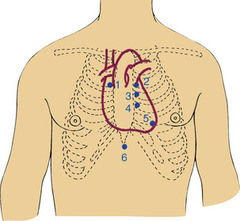
A patient has been admitted for a cerebrovascular accident (stroke). She cannot move her right arm, and she has a right-sided facial droop. She is able to eat with her dentures in place and swallow safely. The nursing assistive personnel (NAP) reports to you that the patient will not keep the oral thermometer probe in her mouth. What direction do you provide to the NAP?
1. Direct the NAP to hold the thermometer in place with her gloved hand
2. Direct the NAP to switch the thermometer probe to the left sublingual pocket
3. Direct the NAP to obtain a right tympanic temperature
4. Direct the NAP to use a temporal artery thermometer from right to left
4
CH. 30
The nursing assistive personnel (NAP) reports to you that the blood pressure (BP) of the patient in Question 11 is 140/76 on the left arm and 128/72 on the right arm. What actions do you take on the basis of this information? (Select all that apply.)
1. Notify the health care provider immediately
2. Repeat the measurements on both arms using a stethoscope
3. Ask the patient if she has taken her blood pressure medications recently
4. Obtain blood pressure measurements on lower extremities
5. Verify that the correct cuff size was used during the measurements
6. Review the patient's record for her baseline vital signs
7. Compare right and left radial pulses for strength
2, 6
CH. 30
The nursing assistive personnel (NAP) informs you that the electronic blood pressure machine on the patient who has recently returned from surgery following removal of her gallbladder is flashing a blood pressure of 65/46 and alarming. Place your care activities in priority order.
1. Press the start button of the electronic blood pressure machine to obtain a new reading.
2. Obtain a manual blood pressure with a stethoscope.
3. Check the patient's pulse distal to the blood pressure cuff.
4. Assess the patient's mental status.
5. Remind the patient not to bend her arm with the blood pressure cuff.
4, 1, 3, 2, 5
CH. 30
A healthy adult patient tells the nurse that he obtained his blood pressure in "one of those quick machines in the mall" and was alarmed that it was 152/72 when his normal value ranges from 114/72 to 118/78. The nurse obtains a blood pressure of 116/76. What would account for the blood pressure of 152/92? (Select all that apply.)
1. Cuff too small
2. Arm positioned above heart level
3. Slow inflation of the cuff by the machine
4. Patient did not remove his long-sleeved shirt
5. Insufficient time between measurements
1, 5
CH. 30
A patient is admitted for dehydration caused by pneumonia and shortness of breath. He has a history of heart disease and cardiac dysrhythmias. The nursing assistant reports his admitting vital signs to the nurse. Which measurements should the nurse reassess? (Select all that apply.)
1. Right arm BP: 118/72
2. Radial pulse rate: 72 and irregular
3. Temporal temperature: 37.4° C (99.3° F)
4. Respiratory rate: 28
5. Oxygen saturation: 99%
2, 4, 5
CH. 30
What is the proper position to use for an unresponsive patient during oral care to prevent aspiration? (Select all that apply.)
1. Prone position
2. Sims' position
3. Semi-Fowler's position with head to side
4. Trendelenburg position
5. Supine position
2, 3
CH. 40
The student nurse is teaching a family member the importance of foot care for his or her mother, who has diabetes. Which safety precautions are important for the family member to know to prevent infection? (Select all that apply.)
1. Cut nails frequently.
2. Assess skin for redness, abrasions, and open areas daily.
3. Soak feet in water at least 10 minutes before nail care.
4. Apply lotion to feet daily.
5. Clean between toes after bathing.
2, 4, 5
CH. 40
A nurse uses long firm, strokes distal to proximal while bathing a patient's legs because:
1. It promotes venous circulation.
2. It covers a larger area of the leg.
3. It completes care in a timely fashion.
4. It prevents blood clots in legs.
1
CH. 40
Integrity of the oral mucosa depends on salivary secretion. Which of the following factors impairs salivary secretion? (Select all that apply.)
1. Use of cough drops
2. Immunosuppression
3. Radiation therapy
4. Dehydration
5. Presence of oral airway
3, 4
CH. 40
A nurse is assigned to care for the following patients. Which of the patients is most at risk for developing skin problems and thus requiring thorough bathing and skin care?
1. A 44-year-old female who has had removal of a breast lesion and is having her menstrual period
2. A 56-year-old male patient who is homeless and admitted to the emergency department with malnutrition and dehydration and who has an intravenous line
3. A 60-year-old female who experienced a stroke with right-sided paralysis and has an orthopedic brace applied to the left leg.
4. A 70-year-old patient who has diabetes and dementia and has been incontinent of stool
4
CH. 40
When you are assigned to a patient who has a reduced level of consciousness and requires mouth care, which physical assessment techniques should you perform before the procedure? (Select all that apply.)
1. Oxygen saturation
2. Heart rate
3. Respirations
4. Gag reflex
5. Response to painful stimulus
3, 4
CH. 40
A nurse is listening to a student provide instruction to a patient who is having difficulty with activities needed to care for soft contact lenses. Which of the following statements by the nursing student might require some correction by the nurse?
1. Use tap water to clean soft lenses.
2. Follow recommendations of lens manufacturer when inserting the lenses.
3. Keep lenses moist or wet when not worn.
4. Use fresh solution daily when storing and disinfecting lenses.
1
CH. 40
The American Dental Association suggests that patients who are at risk for poor hygiene use the following interventions for oral care: (Select all that apply.)
1. Use antimicrobial toothpaste.
2. Brush teeth 4 times a day.
3. Use 0.12% chlorhexidine gluconate (CHG) oral rinses.
4. Use a soft toothbrush for oral care.
5. Avoid cleaning the gums and tongue.
1, 3, 4
CH. 40
While planning morning care, which of the following patients would have the highest priority to receive his or her bath first?
1. A patient who just returned to the nursing unit from a diagnostic test
2. A patient who prefers a bath in the evening when his wife visits and can help him
3. A patient who is experiencing frequent incontinent diarrheal stools and urine
4. A patient who has been awake all night because of pain 8/10
3
CH. 40
An 88-year-old patient comes to the medical clinic regularly. During a recent visit the nurse noticed that the patient had lost 10 lbs in 6 weeks without being on a special diet. The patient tells the nurse that he has had trouble chewing his food. Which of the following factors are normal aging changes that can affect an older adult's oral health? (Select all that apply.)
1. Dentures do not always fit properly.
2. Most older adults have an increase in saliva secretions.
3. With aging the periodontal membrane becomes tighter and painful.
4. Many older adults are edentulous, and remaining teeth are often decayed.
5. The teeth of elderly patients are more sensitive to hot and cold.
1, 4
CH. 40
A patient with a malignant brain tumor requires oral care. The patient's level of consciousness has declined, with the patient only being able to respond to voice commands. Place the following steps in the correct order for administration of oral care.
1. If patient is uncooperative or having difficulty keeping mouth open, insert an oral airway.
2. Raise bed, lower side rail, and position patient close to side of bed with head of bed raised up to 30 degrees.
3. Using a brush moistened with chlorhexidine paste, clean chewing and inner tooth surfaces first.
4. For patients without teeth, use a toothette moistened in chlorhexidine rinse to clean oral cavity.
5. Remove partial plate or dentures if present.
6. Gently brush tongue but avoid stimulating gag reflex.
2, 5, 1, 3, 6, 4
CH. 40
The nurse delegates needed hygiene care for an elderly stroke patient. Which intervention would be appropriate for the nursing assistive personnel to accomplish during the bath?
1. Checking distal pulses
2. Providing range-of-motion (ROM) exercises to extremities
3. Determining type of treatment for stage 1 pressure ulcer
4. Changing the dressing over an intravenous site
2
CH. 40
The nurse observes an adult Middle Eastern patient attempting to bathe himself with only his left hand. The nurse recognizes that this behavior likely relates to:
1. Obsessive compulsive behavior.
2. Personal preferences.
3. The patient's cultural norm.
4. Controlling behaviors.
3
CH. 40
When a nurse delegates hygiene care for a male patient to a nursing assistive personnel, the NAP must use an electric razor to shave the patient with the following diagnosis:
1. Congestive heart failure
2. Pneumonia
3. Arthritis
4. Thrombocytopenia
4
CH. 40
A patient receiving chemotherapy experiences stomatitis. The nurse advises the patient to use:
1. Community mouthwash.
2. Alcohol-based mouth rinse.
3. Normal saline rinses.
4. Firm toothbrush.
3
CH. 40
Two patient deaths have occurred on a medical unit in the last month. The staff notices that everyone feels pressured and team members are getting into more arguments. As a nurse on the unit, what will best help you manage this stress?
1. Keep a journal
2. Participate in a unit meeting to discuss feelings about the patient deaths
3. Ask the nurse manager to assign you to less difficult patients
4. Review the policy and procedure manual on proper care of patients after death
2
CH. 15
A nurse has seen many cancer patients struggle with pain management because they are afraid of becoming addicted to the medicine. Pain control is a priority for cancer care. By helping patients focus on their values and beliefs about pain control, a nurse can best make clinical decisions. This is an example of:
1. Creativity.
2. Fairness.
3. Clinical reasoning.
4. Applying ethical criteria.
4
CH. 15
A nurse prepares to insert a Foley catheter. The procedure manual calls for the patient to lie in the dorsal recumbent position. The patient complains of having back pain when lying on her back. Despite this, the nurse positions the patient supine with knees flexed as the manual recommends and begins to insert the catheter. This is an example of:
1. Accuracy.
2. Reflection.
3. Risk taking.
4. Basic critical thinking.
4
CH. 15
A nurse is preparing medications for a patient. The nurse checks the name of the medication on the label with the name of the medication on the doctor's order. At the bedside the nurse checks the patient's name against the medication order as well. The nurse is following which critical thinking attitude:
1. Responsible
2. Complete
3. Accurate
4. Broad
1
CH. 15
A nurse on a busy medicine unit is assigned to four patients. It is 10 AM. Two patients have medications due and one of those has a specimen of urine to be collected. One patient is having complications from surgery and is being prepared to return to the operating room. The fourth patient requires instructions about activity restrictions before going home this afternoon. Which of the following should the nurse use in making clinical decisions appropriate for the patient group? (Select all that apply.)
1. Consider availability of assistive personnel to obtain the specimen
2. Combine activities to resolve more than one patient problem
3. Analyze the diagnoses/problems and decide which are most urgent based on patients' needs
4. Plan a family conference for tomorrow to make decisions about resources the patient will need to go home
5. Identify the nursing diagnoses for the patient going home
1, 2, 3
CH. 15
By using known criteria in conducting an assessment such as reviewing with a patient the typical characteristics of pain, a nurse is demonstrating which critical thinking attitude?
1. Curiosity
2. Adequacy
3. Discipline
4. Thinking independently
3
CH. 15
A nurse just started working at a well-baby clinic. One of her recent experiences was to help a mother learn the steps of breastfeeding. During the first clinic visit the mother had difficulty positioning the baby during feeding. After the visit the nurse considers what affected the inability of the mother to breastfeed, including the mother's obesity and inexperience. The nurse's review of the situation is called:
1. Reflection.
2. Perseverance.
3. Intuition.
4. Problem solving.
1
CH. 15
Place the steps of the scientific method in their correct order with number 1 being the first step of the process.
1. Formulate a question or hypothesis.
2. Evaluate results of the study.
3. Collect data.
4. Identify the problem.
5. Test the question or hypothesis.
4, 3, 1, 5, 2
CH. 15
A nurse changed a patient's surgical wound dressing the day before and now prepares for another dressing change. The nurse had difficulty removing the gauze from the wound bed yesterday, causing the patient discomfort. Today he gives the patient an analgesic 30 minutes before the dressing change. Then he adds some sterile saline to loosen the gauze for a few minutes before removing it. The patient reports that the procedure was much more comfortable. Which of the following describes the nurse's approach to the dressing change? (Select all that apply.)
1. Clinical inference
2. Basic critical thinking
3. Complex critical thinking
4. Experience
5. Reflection
3, 4
CH. 15
Which of the following describes a nurse's application of a specific knowledge base during critical thinking? (Select all that apply.)
1. Initiative in reading current evidence from the literature
2. Application of nursing theory
3. Reviewing policy and procedure manual
4. Considering holistic view of patient needs
5. Previous time caring for a specific group of patients
1, 2, 4
CH. 15
When a nurse tries to understand a patient's and family caregiver's perspective of why a patient is falling at home, the nurse applies the intellectual standard of _________________________ to understand all viewpoints.
Broad
CH. 15
An aspect of clinical decision making is knowing the patient. Which of the following is the most critical aspect of developing the ability to know the patient?
1. Working in multiple health care settings
2. Learning good communication skills
3. Spending time establishing relationships with patients
4. Relying on evidence in practice
3
CH. 15
In which of the following examples is a nurse applying critical thinking skills in practice? (Select all that apply.)
1. The nurse thinks back about a personal experience before administering a medication subcutaneously.
2. The nurse uses a pain-rating scale to measure a patient's pain.
3. The nurse explains a procedure step by step for giving an enema to a patient care technician.
4. The nurse gathers data on a patient with a mobility limitation to identify a nursing diagnosis.
5. A nurse offers support to a colleague who has witnessed a stressful event.
1, 2, 4
CH. 15
A nurse enters a 72-year-old patient's home and begins to observe her behaviors and examine her physical condition. The nurse learns that the patient lives alone and notices bruising on the patient's leg. When watching the patient walk, the nurse notes that she has an unsteady gait and leans to one side. The patient admits to having fallen in the past. The nurse identifies the patient as having the nursing diagnosis of Risk for Falls. This scenario is an example of:
1. Inference.
2. Basic critical thinking.
3. Evaluation.
4. Diagnostic reasoning.
4
CH. 15
Match the concepts for a critical thinker below:
a. Anticipate how a patient might respond to a treatment.
b. Organize assessment on the basis of patient priorities.
c. Be objective in asking questions of a patient.
d. Be tolerant of the patient's views and beliefs.
___ 1. Truth seeking
___ 2. Open-mindedness
___ 3. Analyticity
___ 4. Systematicity
1 = c
2 = d
3 = a
4 = b
CH. 15
Which of the following examples are steps of nursing assessment? (Select all that apply.)
1. Collection of information from patient's family members
2. Recognition that further observations are needed to clarify information
3. Comparison of data with another source to determine data accuracy
4. Complete documentation of observational information
5. Determining which medications to administer based on a patient's assessment data
1, 2, 3
CH. 16
A nurse assesses a patient who comes to the pulmonary clinic. "I see that it's been over 6 months since you've been here, but your appointment was for every 2 months. Tell me about that. Also I see from your last visit that the doctor recommended routine exercise. Can you tell me how successful you've been in following his plan?" The nurse's assessment covers which of Gordon's functional health patterns?
1. Value-belief pattern
2. Cognitive-perceptual pattern
3. Coping-stress-tolerance pattern
4. Health perception-health management pattern
4
CH. 16
When a nurse conducts an assessment, data about a patient often comes from which of the following sources? (Select all that apply.)
1. An observation of how a patient turns and moves in bed
2. The unit policy and procedure manual
3. The care recommendations of a physical therapist
4. The results of a diagnostic x-ray film
5. Your experiences in caring for other patients with similar problems
1, 3, 4
CH. 16
The nurse observes a patient walking down the hall with a shuffling gait. When the patient returns to bed, the nurse checks the strength in both of the patient's legs. The nurse applies the information gained to suspect that the patient has a mobility problem. This conclusion is an example of:
1. Cue.
2. Reflection.
3. Clinical inference.
4. Probing.
3
CH. 16
A 72-year-old male patient comes to the health clinic for an annual follow-up. The nurse enters the patient's room and notices him to be diaphoretic, holding his chest and breathing with difficulty. The nurse immediately checks the patient's heart rate and blood pressure and asks him, "Tell me where your pain is." Which of the following assessment approaches does this scenario describe?
1. Review of systems approach
2. Use of a structured database format
3. Back channeling
4. A problem-oriented approach
4
CH. 16
The nurse asks a patient, "Describe for me a typical night's sleep. What do you do to fall asleep? Do you have difficulty falling or staying asleep? This series of questions would likely occur during which phase of a patient-centered interview?
1. Orientation
2. Working phase
3. Data validation
4. Termination
2
CH. 16
A nurse is assigned to a 42-year-old mother of 4 who weighs 136.2 kg (300 lbs), has diabetes, and works part time in the kitchen of a restaurant. The patient is facing surgery for gallbladder disease. Which of the following approaches demonstrates the nurse's cultural competence in assessing the patient's health care problems?
1. "I can tell that your eating habits have led to your diabetes. Is that right?"
2. "It's been difficult for people to find jobs. Is that why you work part time?"
3. "You have four children; do you have any concerns about going home and caring for them?"
4. "I wish patients understood how overeating affects their health."
3
CH. 16
Which type of interview question does the nurse first use when assessing the reason for a patient seeking health care?
1. Probing
2. Open-ended
3. Problem-oriented
4. Confirmation
2
CH. 16
A nurse gathers the following assessment data. Which of the following cues together form(s) a pattern suggesting a problem? (Select all that apply.)
1. The skin around the wound is tender to touch.
2. Fluid intake for 8 hours is 800 mL.
3. Patient has a heart rate of 78 beats/min and regular.
4. Patient has drainage from surgical wound.
5. Body temperature is 38.3° C (101° F).
6. Patient states, "I'm worried that I won't be able to return to work when I planned."
1, 4, 5
CH. 16
A nurse is checking a patient's intravenous line and, while doing so, notices how the patient bathes himself and then sits on the side of the bed independently to put on a new gown. This observation is an example of assessing:
1. Patient's level of function.
2. Patient's willingness to perform self-care.
3. Patient's level of consciousness.
4. Patient's health management values.
1
CH. 16