General Physio: Chapter 1
 Call Kai
 Learn
Learn Practice Test
 Spaced Repetition
 Match
Match Flashcards
 Knowt Play
1/25

There's no tags or description
Looks like no tags are added yet.
Name | Mastery | Learn | Test | Matching | Spaced | Call with Kai | Chat |
|---|
No analytics yet
Send a link to your students to track their progress
26 Terms
What is Physiology?
The study of functions and processes of living organisms
What is Physiology viewed as?
A Point of View
Not just a science or profession
What is the Organization of Life?
Cells, tissues, organs, organ systems, and organisms
What are the ten organ systems?
Integumentary
Musculoskeletal
Respiratory
Digestive
Reproductive
Urinary
Circulatory
Nervous
Endocrine
Immune
What are the two major control systems?
Nervous & Endocrine system
What is the Teleological approach?
Why a process occurs. Keep in mind the big picture
What is the Mechanistic approach?
Understanding how a process occurs and all of the steps involved
What is an example of the teleological approach for the red blood cells?
Carries oxygen throughout the body so that cells can produce energy
What is an example of the mechanistic approach for the red blood cells?
Carries oxygen because hemoglobin inside the cells binds to oxygen in the lungs and releases it to tissues throughout the body
What is an example of the teleological approach for the act of respiration?
We breathe to bring oxygen into the body so our cells can produce energy, and to remove carbon dioxide
What is an example of the mechanistic approach for the act of respiration?
Respiration occurs because the diaphragm contracts and moves downward, causing the lungs to expand and air containing oxygen to enter; when the diaphragm relaxes, air containing carbon dioxide is expelled
What is Homeostasis?
Properties of a system where variables are regulated so the internal environments remain stable and relatively constant
What is the Homeostatic Mechanisms?
It works to maintain levels of key compounds at ideal concentration
What are some examples of Homeostasis?
Blood pressure, temperature, glucose levels, oxygen, & carbon dioxide levels
What is Homeostasis always being challenged by?
External factors & internal factors
Monitoring Homeostasis is:
Usually done by measuring the concentration of key constituents in the blood
What are the two major divisions of internal environment fluids?
Intracellular fluid ICF (inside cells)
Extracellular fluid ECF (outside cells- plasma, interstitial fluid, transcellular fluid)
How much of our body is water?
About 60-65%
How much body water does ECF make up?
1/3 of the total body water by weight
What are the divisions of ECF?
Plasma (5%)
Interstitial fluid (15%)
Transcellular fluid
How much body water does ICF make up?
About 2/3 of the total body water by weight
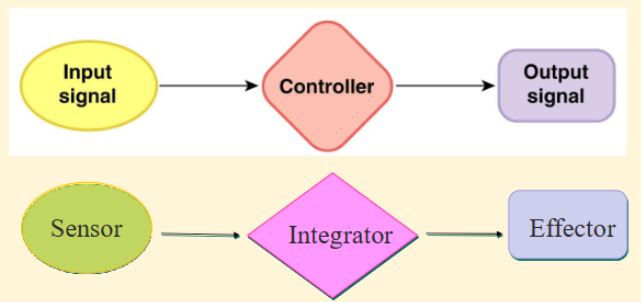
If loss of Homeostasis occurs, the body will attempt to restore to normal values, which involves:
Sensors, integrating center
Effectors
What are sensors, integrating system?
Most are located centrally in the brain, but some are in the periphery
Receives info about critical parameters, plans appropriate response if the present value is different from the set point value
What are effectors?
Cells and organs that are directed by commands from integrating center to return parameters to normal
If there is failure in Homeostasis:
Pathophysiology results, maybe illness or death
What is the circuitry of a simple control system?