gen psych exam 1
 Call Kai
 Learn
Learn Practice Test
 Spaced Repetition
 Match
Match Flashcards
 Knowt Play
1/124

Earn XP
Description and Tags
review for exam 1
Name | Mastery | Learn | Test | Matching | Spaced | Call with Kai | Chat |
|---|
No analytics yet
Send a link to your students to track their progress
125 Terms
what is psychology?
the scientific study of thought, behavior, and emotion
why do people think, behave and feel the way they do?
biological/neuroscientific perspective
how physical systems (e.g. the brain) affect behavior, feelings, and thoughts?
understanding thought process through the brain
evolutionary perspective
natural selection of traits
ex: lack of need for affiliation did not pass (being around other people) due to lack of favorability
behavior genetics perspective
nature vs. nurture - contribution of genes and environment to behavior
psychoanalytic/psychodynamic
unconscious dynamics within the mind; something you don't know of is affecting you
behavioral perspective
learning via reinforcements and punishments
ex: positive reinforcement when you act angry/aggressive causes you to act that way more
cognitive perspective
how people reason, remember, and interpret
how memories and attention affect behaviors (someone getting angry causes you to be sad)
sociocultural perspective
how social and cultural forces shape individual behavior
erroneous conclusions
due to popular wisdom (birds of a feather flock together, opposites attract) and common sense
hindsight bias
overestimation of the ability to have predicted an outcome, finding something and you thought you knew it all along
"I saw this coming"
the scientific method
tests ideas with the use of data and evidence (empiricism - coming to conclusions from evidence and data)
steps in the research process
formulate the research question
formulate the hypothesis
design the study to test the hypothesis
perform the study (test the hypothesis - scanning brain, surveys, etc.)
interpret the data (draw conclusions - make scores of gratitude, check correlations
communicate the findings - publish the study, peer review
hypothesis
a testable prediction; must be something you can collect data on and based on a research question
operational definition
statement about the procedures the researcher used to measure a variable
ex: what do you mean by "gratitude" (the variable) in the experiment context: saying thank you, having a gratitude journal
descriptive methods
tell you something is happening and not why (qualitative)
examples: case study, observation, survey
case study
in-depth analysis of one subject (or more)
usually a small group/one person, and a rare occurrence/finding
CANNOT GENERALIZE FROM A CASE STUDY - do not assume conclusion is true for all people
case study examples
ex 1: Phineas Gage - had rod through his eye and tests were done on him; personality change post-rod as frontal lobe processes personality
ex 2: HM - doctor removed his hippocampus to prevent seizures; side effects were that he couldn't form memories
observation
describe and measure people and/or animals' behavior systematically
watching and listening without interference
observation examples
observing behavior of parents dropping off kids at day care
hawthorne effect
people know they are being watched (possible bias in an observation study)
survey
asking people questions about their thoughts, feelings, desires, and actions and recording their answers
could be paper, online, interview
pros of a survey
gives access to info you wouldn't have access to otherwise (personal)
cons of a survey
wording - people can respond differently if question is worded differently
response bias - pattern of responses that does not accurately reflect the content of the question (laziness, not remembering, trying to look good)
solutions to this: make it anonymous and add paying attention questions
random sampling (aka random selection)
everyone in the population has an equal chance of being in the sample
easy to generalize from this --> if there is a subset of a larger population, you can generalize to that population
cannot generalize gen psych students to all students at Rutgers
correlational method
measures the strength and direction of the relationship between 2 variables
correlation examples
ex 1: highschool gpa correlates with college performance
ex 2: sitting in front of class correlates with grades
positive correlation
variables change in the same direction
ex: high gratitude and happiness
negative correlation
variables change in opposite directions
ex: coffee intake and risk of depression
correlation coefficient (r)
indicator of the strength of the relationship between 2 variables
+1.00 - perfect positive correlation
-1.00 - perfect negative correlation
strength depends on how close to 1/-1
closer to zero, the weaker the r
correlation and causation
correlation does NOT necessarily indicate causation
instead of A causing B, B could cause A
or, there could be a third variable C, causing both B and A
correlation and causation example
ex: low self esteem (A) could cause depression (B) or vice versa
or distressing events (C) could cause A and B
third variable (C) must cause BOTH not just one
experimental method
researcher changes (manipulates) one variable and measures the effects of that change on another variable
ONLY research design in which cause and effect could be inferred
independent variable (IV)
manipulated by experimenter
ex: number of coffee cups
dependent variable (DV)
outcome variable
ex: depression levels
purpose of experimental method
test effects of the IV on the DV
experimental (treatment) condition/group
receives the treatment/stimulus
ex: coffee
control condition/group
does not receive the treatment/stimulus (comparison group)
ex: no coffee
nonexperimental study
IV is not manipulated
Simply measuring a variable would be non-experimental
confounding variable
variable that is potentially responsible for the results, but not the variable of interest (the IV)
example: candy, kind treatment to people writing about gratefulness
cannot tell if IV causes DV if you have confounds
random assignment
method used to place participants into experimental condition where all participants have an equal chance of being in every condition
assigning all people at random to prevent confounds
experimental control
researcher ensures that no factors other than the IV are changing and thus could affect the DV
only difference between experimental and control group is the IV (ex: don't give a scone to coffee drinkers)
placebo effect
observed improvement following an inert treatment
group gets treatment with no interventions but they still feel a difference
placebo control group
participants who receive placebo rather than actual treatment or nothing
regular journal - writing about something meaningless (placebo) vs gratitude journal (experimental)
expectancy effect (experimenter bias)
results when the experimenter's hypothesis (expectation) leads unintentionally to behavior towards the likelihood that participants' behavior will confirm the hypothesis
ex: teacher expectations for students affect performance
bloomers did better on IQ test a second time --> teacher treatment must have affected this (Rosenthal and Jacobson)
single blind procedures
participants do not know if they have been assigned to experimental or control group
double blind procedure
neither participants nor the researchers know who has been assigned to the experimental or control group (eliminates expectancy effect of researchers)
generalizability
is an outcome generalizable to other groups and settings
can the results apply to other situations?
replication
repetition of a study - can other people repeat a study and get the same results?
case studies are not easily replicated
ethical issues
psychological harm, physical harm, deception research
psychological harm
Milgram study of obedience - electric shock given to patients due to authority figures
physical harm
physical activity, painful shocks to induce stress
deception research
any study in which the participant is deceived about the true purpose of the experiment or the experimental procedures --> in an attempt to get authentic results
use of a "cover story" or placebo
deception must be different from independent variable to not confound the experiment
IRB
all studies must be reviewed and approved by the IRB
informed consent
required before all experiments; provide all the information that might influence decision to participate, including all potential risks and free to leave at any time
debriefing
required after an experiment - offer a full discussion of the study and any deceptions if included to remove any negative effects
anonymity
participant info not shared with researcher
confidentiality
participant tied to data but researcher cannot disclose it
why do psychologists study the brain?
thoughts, feelings, and behaviors can be traced to emotional and chemical signals traveling through the brain and body
nervous system
complex communication network made up of neurons
individual nerve cells communicating with other body cells
neuron
specialized cell that transmits neural messages to other neurons, glands, and muscles (receives and sends messages back and forth)
dendrite (tree)
receives neural messages from other neurons (listens)
cell body
also called soma; houses DNA
axon
thin tube that transmits messages (speaks)
also connected to dendrite of next neuron
glial cells (glia)
provide structure for neurons (like packing peanuts around a ceramic mug)
blood-brain barrier
formed by some glial cells; prevents toxins from entering the brain (separates blood from brain tissue)
myelin sheath
formed by some glial cells; specialized cells that are wrapped around the axon to help transmit messages (message goes faster through axon with MS)
express train --> myelinated
local train --> unmyelinated (goes through more stops before message is sent)
how do neurons communicate?
electrical signal within a neuron (action potential)
chemical signal between neurons (neurotransmitters)
action potential
electrical impulse that travels from the cell body down to the end of the axon (neural firing)
threshold
level of electric charge needed to stimulate action potential (just has to meet minimum threshold)
yes or no - happens or not
light switch - either on or off
all-or-none response
once the electric charge of a neuron reaches a certain threshold, it fires an action potential
more intense signal
more neurons have action potentials
more action potentials in neurons
synapse
junction between two neurons; messages are transmitted across the synapse via neurotransmitters
(gets stronger when studying in a class with new and hard material)
neurotransmitters
chemical messages that travel across synapse from sending neuron to receptors on receiving neuron
synapse gets stronger with neurotransmitter sending to other neuron multiple times
reuptake
sending neuron reabsorbs excess neurotransmitters
inhibit reuptake of serotonin via SSRI --> more likely to bind to a receptor
receptor
neurotransmitter binds to receptors which allows or inhibits a new action potential
excitatory signals
increase the likelihood that a neuron will fire
inhibitory signals
decrease the likelihood that a neuron will fire
specific neurotransmitters
acetylcholine, endorphins, dopamine, serotonin, glutamate, gaba, epinephrine/norepinephrine
acetylcholine (ACh)
involved in muscle action, learning, and memory
examples of ACh
botox --> stops ACh --> blocks facial muscle contractions
black widow bite --> causes larger levels of ACh --> causes muscle spasms
alzheimer's: little ACh
endorphins
reduce pain and promote pleasure
examples of endorphins
runner's high: feeling euphoria through pain
brain stops producing endorphins after taking morphine (opioids) --> addiction
laughter, dancing, and singing produces endorphins
morphine --> also drugs bind to endorphin receptors (opioids)
dopamine
involved in voluntary movement, reward, learning, and memory (reinforcement)
dopamine examples
doing something you can enjoy so do it again and again (posting on social media, drugs)
general addiction is attributed to dopamine like gambling, it only increases dopamine and nothing else will
schizophrenia - excessive dopamine
parkinson's - insufficient dopamine
serotonin
involved in sleep, appetite, and mood
serotonin examples
signals sent when you are hungry
awake during the day and sleepy at night
SSRI (block serotonin reuptake) to treat sleep and eating disorders
glutamate
excitatory - learning, memory enhancement
synapses get stronger through action potentials
also potentially causing seizures (excessive glutamate)
GABA
inhibitory - calms
alcohol binds to GABA receptors to calm people
stops action potentials - low levels of GABA indicate anxiety (drugs increase GABA)
epinephrine and norepinephrine
hormones; involved in stress response
cause excitement, fatigue (aka adrenaline)
agonists
increase normal activity of a neurotransmitter (bobby pin in lock)
could 1) pretend to be a neurotransmitter; shapes itself to be a neurotransmitter and binds to receptor
or could 2) increase production of a neurotransmitter
antagonists
decrease activity of a neurotransmitter
blocks receptors so they cannot have an affect
black widow bite
ACh agonist
botox
ACh antagonist
valium/xanax
GABA agonist; calms nervous system (medication used to treat anxiety)
beta blockers for hypertension
epinephrine antagonist
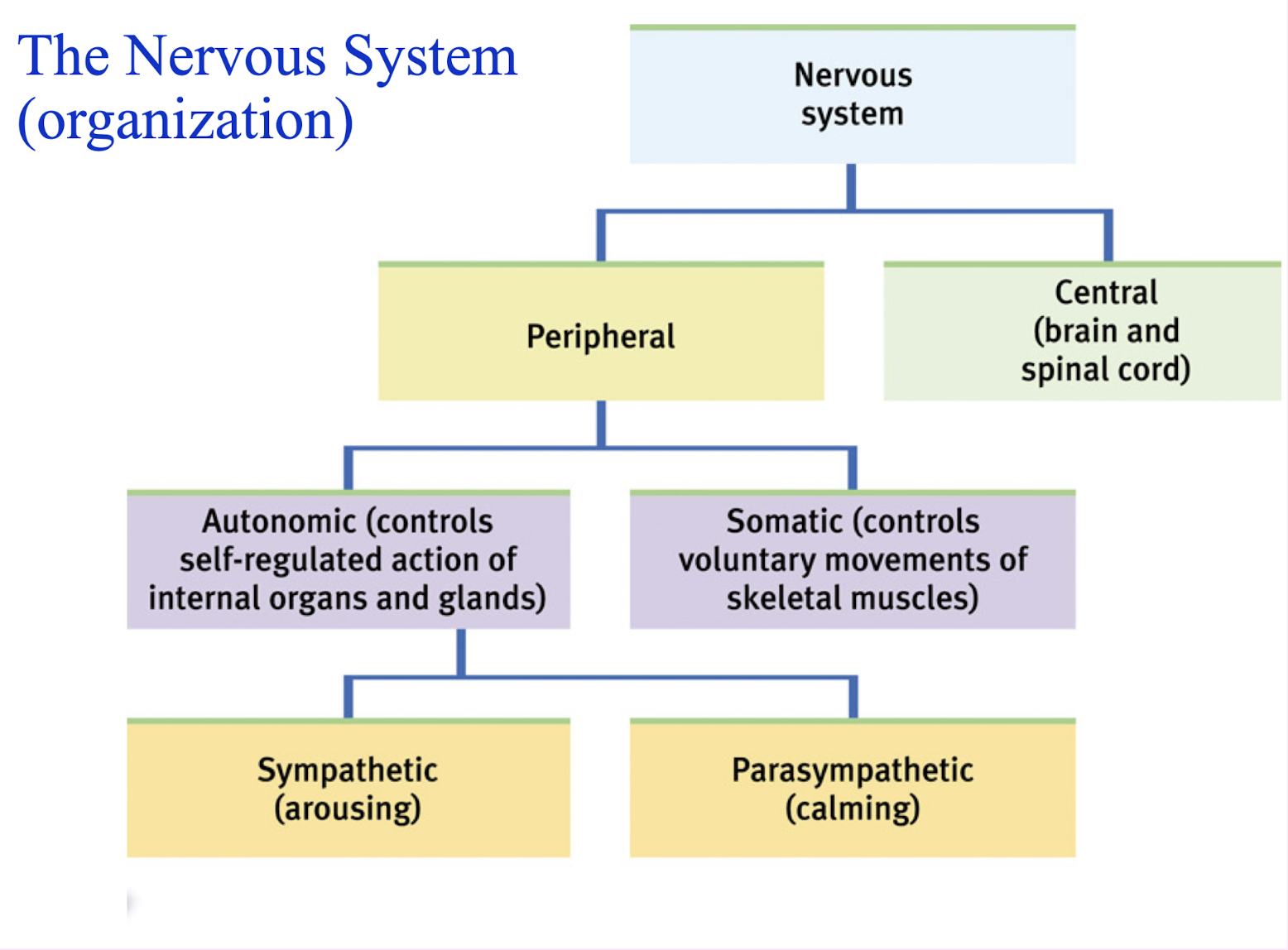
the nervous system organization
types of neurons
motor and sensory neurons
motor neurons
carry signals from brain or spinal cord to muscles, skin, and glands (brain → spinal cord → periphery)
sensory neurons
carry messages from receptors to spinal cord and brain (periphery → spinal cord → brain)
central nervous system
consists of the brain and spinal cord
sends messages to muscles, glands, and organs via motor neurons
responds to sensory information