Flirty, Freaky, Frisky Five
 Call Kai
 Learn
Learn Practice Test
 Spaced Repetition
 Match
Match Flashcards
 Knowt Play
1/588

There's no tags or description
Looks like no tags are added yet.
Name | Mastery | Learn | Test | Matching | Spaced | Call with Kai | Chat |
|---|
No analytics yet
Send a link to your students to track their progress
589 Terms
1. Which organ is not part of the urinary tract?
A. Kidney
B. Ureter
C. Urinary bladder
D. Urethra
E. No exceptions; all of these organs are part of the urinary tract
Kidney
2. The average adult kidney weighs about 100 grams and measures about
A. 12 cm long, 6.5 cm wide, and 2.5 cm thick.
B. 8 cm long, 4 cm wide, and 1.5 cm thick.
C. 15 cm long, 10.5 cm wide, and 4.5 cm thick.
D. 8 cm long, 10.5 cm wide, and 2.5 cm thick.
E. 12 cm long, 2.5 cm wide, and 8 cm thick.
12 cm long, 6.5 cm wide, and 2.5 cm thick.
3. Which is not a function of the urinary system?
A. Regulation of blood volume
B. Excretion of wastes
C. Regulation of erythrocyte production
D. Regulation of lymphocyte production
E. Storage of urine
Regulation of lymphocyte production
4. Which is not correct regarding the kidneys?
A. The kidneys are retroperitoneal.
B. The kidneys are surrounded by a fibrous renal capsule.
C. The kidneys are cushioned and insulated by adipose tissue.
D. The indented medial surface of the kidney is called the renal papilla.
E. The kidney is composed of an inner renal medulla and an outer renal cortex.
The indented medial surface of the kidney is called the renal papilla.
5. From deep to superficial, the protective layers on the kidney are the
A. fibrous capsule, perinephric fat, renal fascia, paranephric fat.
B. renal corpuscle, perinephric fat, renal fascia, paranephric fat.
C. renal fascia, paranephric fat, renal corpuscle, perinephric fat.
D. renal fascia, perinephric fat, fibrous capsule, paranephric fat.
E. fibrous capsule, paranephric fat, renal fascia, perinephric fat.
fibrous capsule, perinephric fat, renal fascia, paranephric fat
6. An adult human kidney typically contains ______ renal pyramid(s).
A. 2 to 5
B. 8 to 15
C. 16 to 24
D. 1
E. 30 to 40
8 to 15
7. Where are the renal pyramids located within the kidney?
A. Renal cortex
B. Renal sinus
C. Renal pelvis
D. Renal papilla
E. Renal medulla
Renal medulla
8. Urine formed in the pyramids must flow within the kidney to the ureter. Which structure is not part of the transport path within the kidney that carries urine to the ureter?
A. Renal sinus
B. Major calyx
C. Renal pelvis
D. Minor calyx
E. No exceptions; all choices transport urine.
Renal sinus
9. The first structure in the kidney to collect newly formed urine is the
A. renal capsule.
B. minor calyx.
C. renal pelvis.
D. renal sinus.
E. renal cortex.
minor calyx.
10. Blood vessels that make their way from the renal hilum to the renal cortex must travel through extensions of the cortex called renal
A. trabeculae.
B. pyramids.
C. sinuses.
D. columns.
E. calyces.
columns.
11. Which is the correct sequence of arteries that a drop of blood would flow through as it entered the kidney and moved toward a glomerulus?
A. Segmental artery - interlobar artery - interlobular artery - renal artery - arcuate artery
B. Interlobar artery - segmental artery - interlobular artery - renal artery - arcuate artery
C. Renal artery - interlobar artery - segmental artery - arcuate artery - interlobular artery
D. Renal artery - segmental artery - interlobar artery - arcuate artery - interlobular artery
E. Arcuate artery - interlobular artery - segmental artery - interlobar artery - renal artery
Renal artery - segmental artery - interlobar artery - arcuate artery - interlobular artery
12. Which is not correct regarding nephrons?
A. The renal corpuscle includes the glomerulus and the glomerular capsule.
B. The renal tubule is composed of the proximal convoluted tubule, nephron loop, and distal convoluted tubule.
C. The nephron is the functional filtration unit in the kidney.
D. Eighty-five percent of nephrons are cortical nephrons.
E. The renal corpuscle may be located in the renal cortex or renal medulla.
The renal corpuscle may be located in the renal cortex or renal medulla.
13. Which step(s) in the process of urine formation occur in the renal tubule?
A. Filtration
B. Secretion
C. Reabsorption
D. Filtration, secretion, and reabsorption
E. Secretion and reabsorption
Secretion and reabsorption
14. The capillaries of the glomerulus differ from other capillary networks in the body because they
A. carry only deoxygenated blood.
B. drain into an arteriole instead of a venule.
C. contain no endothelium.
D. absorb nutrients from the glomerular capsule.
E. secrete mucus.
drain into an arteriole instead of a venule.
15. Place the regions of the nephron in the correct order for the process of urine formation.
a: Capsular space of glomerulus
b: Nephron loop
c: Collecting duct
d: Distal convoluted tubule
e: Proximal convoluted tubule
a, e, b, d, c
16. Which is not true of filtration and the structures that perform the process?
A. The process occurs due to pressure differences across the filtration membrane.
B. Filtrate collects in the capsular space before moving to the renal tubule.
C. The visceral wall of the glomerular capsule consists of specialized cells called pedicels.
D. The capillary endothelium of the glomerulus is fenestrated.
E. Blood to be filtered enters the renal corpuscle at the vascular pole.
The visceral wall of the glomerular capsule consists of specialized cells called pedicels.
17. Filtration occurs because
A. the glomerulus is leaky.
B. the afferent arteriole is wider in diameter than the efferent arteriole.
C. the capillary wall is not completely ensheathed by the visceral layer of the glomerular capsule.
D. the filtration slits allow materials from the blood plasma to enter the capsular space.
E. All of the choices are correct.
All of the choices are correct.
18. An obstruction in the glomerulus would affect the flow of blood into the
A. renal artery.
B. proximal convoluted tubule.
C. efferent arteriole.
D. distal convoluted tubule.
E. afferent arteriole.
efferent arteriole.
19. The active transport of solutes out of the blood and into the tubular fluid is called
A. filtration.
B. tubular reabsorption.
C. tubular secretion.
D. fenestration.
E. diffusion.
tubular secretion.
20. Which portion of the renal tubule is described as having simple cuboidal epithelium with only a sparse brush border of microvilli?
A. Proximal convoluted tubule
B. Distal convoluted tubule
C. Ascending limb of nephron loop
D. Descending limb of nephron loop E. Collecting duct
Distal convoluted tubule
21. Which portion of the renal tubule reabsorbs electrolytes, plasma proteins, nutrients, vitamins, and water?
A. Proximal convoluted tubule
B. Distal convoluted tubule
C. Ascending limb of nephron loop
D. Descending limb of nephron loop
E. Collecting duct
Proximal convoluted tubule
22. Which gives the correct order for the structures through which newly formed urine is transported once it leaves the nephron?
A. Collecting duct - collecting tubule - papillary duct - minor calyx
B. Minor calyx - collecting tubule - collecting duct - papillary duct
C. Papillary duct - collecting tubule - collecting duct - minor calyx
D. Collecting tubule - collecting duct - papillary duct - minor calyx
E. Collecting tubule - papillary duct - minor calyx - collecting duct
Collecting tubule - collecting duct - papillary duct - minor calyx
23. How does aldosterone affect urine formation?
A. Increases the reabsorption of sodium and water by the distal convoluted tubule
B. Increases the secretion of sodium and potassium ions from the nephron loop
C. Decreases the reabsorption of sodium and chloride ions by the distal convoluted tubule
D. Increases the secretion of water by all regions of the renal tubule E. Decreases the reabsorption of electrolytes, glucose, and plasma proteins by the proximal convoluted tubule
Increases the reabsorption of sodium and water by the distal convoluted tubule
24. Which is not correct regarding the juxtaglomerular apparatus?
A. The macula densa cells monitor electrolyte concentrations in tubular fluid.
B. The macula densa cells are modified epithelial cells of the distal convoluted tubule.
C. The juxtaglomerular cells are modified smooth muscle cells of the efferent arteriole.
D. The juxtaglomerular cells release renin.
E. Renin activates the renin-angiotensin pathway, resulting in aldosterone production.
The juxtaglomerular cells are modified smooth muscle cells of the efferent arteriole.
25. Which does not enter or exit the kidney at the hilum?
A. Renal artery
B. Ureter
C. Renal vein
D. Renal plexus
E. No exceptions; all choices enter or exit the kidney at the hilum.
No exceptions; all choices enter or exit the kidney at the hilum.
26. Which is not correct regarding the innervation of the kidney?
A. Parasympathetic innervation is from the vagus nerve.
B. The kidney is served by the renal plexus.
C.Sympathetic innervation is from segments T10-T12 of the spinal cord.
D. Sympathetic stimulation causes vasoconstriction of the renal blood vessels.
E. Parasympathetic stimulation decreases the rate of filtrate formation.
Parasympathetic stimulation decreases the rate of filtrate formation.
27. Urine flow from the renal pelvis to the urinary bladder is produced by
A. ciliary action in the renal pelvis.
B. suction from the urinary bladder.
C. peristalsis of the ureters.
D. hydrostatic pressure from the small intestine.
E. contraction of the detrusor muscle.
peristalsis of the ureters.
28. Which layer is not found in the wall of the ureter?
A. Adventitia
B. Muscularis
C. Mucosa
D. Submucosa
E. No exceptions; all layers are found in the wall of the ureter.
Submucosa
29. The ureters
A. are intraperitoneal.
B. average 12 cm in length.
C. are fibromuscular tubes.
D. extend from the renal hilum to the anterolateral wall of the urinary bladder.
E. All of the choices are correct.
are fibromuscular tubes.
30. What is the value of transitional epithelium in the urinary system?
A. Its cilia help propel the urine.
B. It can contract to produce peristalsis.
C. It allows distension.
D. It protects against trauma.
E. It provides cushioning.
It allows distension.
31. Where in the urinary tract is transitional epithelium found?
A. Urinary bladder
B. Urethra
C. Ureters, urinary bladder, and prostatic urethra
D. Ureters
E. Ureters and urinary bladder
Ureters, urinary bladder, and prostatic urethra
32. Which layer is not found in the wall of the urinary bladder?
A. Adventitia
B. Muscularis
C. Mucosa
D. Submucosa
E. No exceptions; all layers are found in the wall of the urinary bladder.
No exceptions; all layers are found in the wall of the urinary bladder.
33. Which is not correct regarding the urinary bladder?
A. There are two ureteral openings.
B. The inferior portion of the bladder is called the apex.
C. The bladder is held in place by the median umbilical ligament.
D. The mucosa has rugae for distension.
E. The peritoneum covers only the superior surface of the bladder.
The inferior portion of the bladder is called the apex.
34. The muscularis layer of the urinary bladder is commonly called the _____ muscle.
A. detrusor
B. micturition
C. trigone
D. extrusor
E. extrinsic
detrusor
35. Micturition
A. is another name for urination.
B. is a reflex triggered by stretch receptors in the urinary bladder.
C. requires the opening of two sphincters.
D. requires contraction of the muscularis layer of the urinary bladder. E. All of the choices are correct.
All of the choices are correct.
36. Blood is supplied to the urinary bladder by branches of the
A. internal iliac arteries.
B. external iliac arteries.
C. inferior mesenteric arteries.
D. median sacral artery.
E. deep ilial circumflex artery.
internal iliac arteries.
37. Put the portions of the male urethra in the correct order, from the urinary bladder to the exterior.
a: Spongy part
b: Urethral orifice
c: Prostatic part
d: Membranous part
c, d, a, b
38. The external urethral sphincter
A. surrounds the external urethral orifice.
B. is composed of smooth muscle fibers.
C. is controlled by the somatic nervous system.
D. opens before the internal urethral sphincter during the micturition reflex.
E. All of the choices are correct.
is controlled by the somatic nervous system.
(Note: somatic = voluntary).
39. The spongy urethra
A. is found only in males.
B. is the longest portion of the urethra.
C. is encased within the corpus spongiosum.
D. is lined proximally by pseudostratified columnar epithelium and distally by stratified squamous epithelium.
E. All of the choices are correct.
All of the choices are correct.
40. Which is not one of the changes in the urinary system due to aging?
A. Reduced blood flow to the kidneys
B. Decrease in number of functional nephrons
C. Decreased response to aldosterone and ADH
D. Decreased glomerular filtration rate
E. Gradual increase in kidney size due to fluid retention
Gradual increase in kidney size due to fluid retention
41. Of the excretory organs that form during development, which one ultimately forms the adult kidney?
A. Mesonephros
B. Metanephros
C. Pronephros
D. Renanephros
E. Uretonephros
Metanephros
42. Which is not of ureteric bud origin?
A. Renal pelvis
B. Collecting duct
C. Minor calyx
D. Distal convoluted tubule
E. Ureter
Distal convoluted tubule
43. The developing kidneys are able to produce and expel urine by week ______ of development.
A. 5
B. 10
C. 15
D. 20
E. 25
10
44. The urethra and urinary bladder develop from a structure called the
A. allantois.
B. urachus.
C. cloaca.
D. urogenital sinus.
E. urethral bud.
cloaca.
45. The urinary and reproductive systems develop from
A. mesoderm.
B. ectoderm.
C. endoderm.
D. mesoderm and ectoderm.
E. endoderm and ectoderm.
mesoderm.
The _________ inside the bladder is formed by imaginary lines connecting the two ureter openings and the urethral opening.
A. muscularis
B. detrusor
C. mucosa
D. trigone
Trigone.
1. Filtration rate in the glomerulus is increased by
a. Vasodilation of the afferent arteriole only.
b. Vasoconstriction of the efferent arteriole only.
c. Both vasodilation and vasoconstriction of the efferent arteriole.
d. Both vasodilation of the afferent arteriole and vasoconstriction of the efferent arteriole.
d. Both vasodilation of the afferent arteriole and vasoconstriction of the efferent arteriole.
2. Generally, negatively charged plasma proteins are
a. Attracted by the positive charge of the filtration membrane.
b. Moved across the filtration membrane by active transport pumps.
c. Engulfed by endocytosis and reabsorbed at the filtration membrane.
d. Repelled by the negative charge of the filtration membrane.
d. Repelled by the negative charge of the filtration membrane.
3. Autonomic innervation of the kidney includes
a. Cranial nerve V and sympathetic nerves from T1-T2.
b. Cranial nerve X and sympathetic nerves from T10-T12.
c. Cranial nerve X and sympathetic nerves from T1-T2.
d. Cranial nerve V and sympathetic nerves from T10-T12.
b. Cranial nerve X and sympathetic nerves from T10-T12.
4. Which of the following is true concerning the location of the kidneys?
a. The right kidney is usually higher than the left one.
b. They are located behind the parietal peritoneum.
c. Their upper borders are about at the level of the third lumbar vertebrae.
d. They are against the anterior wall of the abdominal cavity.
b. They are located behind the parietal peritoneum.
5. In order to accommodate the large liver,
a. The left kidney is about 2 centimeters lower than the right kidney.
b. The right kidney is about 2 centimeters lower than the left kidney.
b. The right kidney is about 2 centimeters lower than the left kidney.
6. In the process of urine formation, first
a. Filtrate is formed, then tubular fluid, then urine.
b. Tubular fluid is formed, then filtrate, then urine.
a. Filtrate is formed, then tubular fluid, then urine.
7. Which of the following does not enter into the calculation for renal clearance?
a. The volume of the blood filtered.
b. The amount of material added by tubular secretion by tubular reabsorption.
c. Glomerular filtration rate.
d. The rate of urine production.
a. The volume of the blood filtered.
(Note: GFR = UV / P.
U = concentration of inulin in urine.
V = volume of urine produced per minute.
P = concentration of inulin in plasma).
8. Within the urinary system, the storage reflex involves
a. Contraction of both the detrusor muscle and the internal urethral sphincter.
b. Relaxation of both the detrusor muscle and the internal urethral sphincter.
c. Contraction of the detrusor muscle and relaxation of the internal urethral sphincter.
d. Relaxation of the detrusor muscle and contraction of the internal urethral sphincter.
d. Relaxation of the detrusor muscle and contraction of the internal urethral sphincter.
9. What is the correct sequence of organs for the formation and elimination of urine?
a. Kidney, urethra, bladder, ureter.
b. Kidney, bladder, ureter, urethra.
c. Bladder, urethra, kidney, ureter.
d. Urethra, bladder, kidney, ureter.
e. Kidney, ureter, bladder, urethra.
e. Kidney, ureter, bladder, urethra.
10. The endothelium of the glomerulus is made up of _________ capillaries.
a. Continuous.
b. Fenestrated.
b. Fenestrated.
11. A product of the metabolism of certain nucleic acid bases is
a. Uric acid.
b. Ammonia.
c. Urea.
d. Water
e. Adenine.
a. Uric acid.
12. Immediately before blood enters arterioles of the kidney, it travels through small arteries that project peripherally into the renal cortex. These arteries are the
a. Segmental arteries.
b. Peritubular arteries.
c. Lobar arteries.
d. Interlobular arteries.
e. Arcuate arteries.
d. Interlobular arteries.
13. How are the processes of reabsorption and secretion related?
a. They both involve movement of material from the tubular fluid into the blood.
b. They both involve movement of material from the blood into the tubular fluid.
c. Materials move in opposite directions: secretion moves materials into the blood, whereas reabsorption removes them from the blood.
d. Materials move in opposite directions: reabsorption moves materials into the blood, whereas secretion removes them from the blood.
d. Materials move in opposite directions: reabsorption moves materials into the blood, whereas secretion removes them from the blood.
14. A byproduct of amino acid catabolism in the liver is
a. Urea
b. Water.
c. Ammonia.
d. Uric acid.
e. Phenylalanine.
a. Urea
15. Which of the following cells has phagocytic activity to help keep filtration membrane "clean"?
a. Podocytes.
b. Epithelial cells of the glomerular capsule.
c. Endothelial cells of the glomerular capillaries.
d. Intraglomerular mesangial cells
d. Intraglomerular mesangial cells
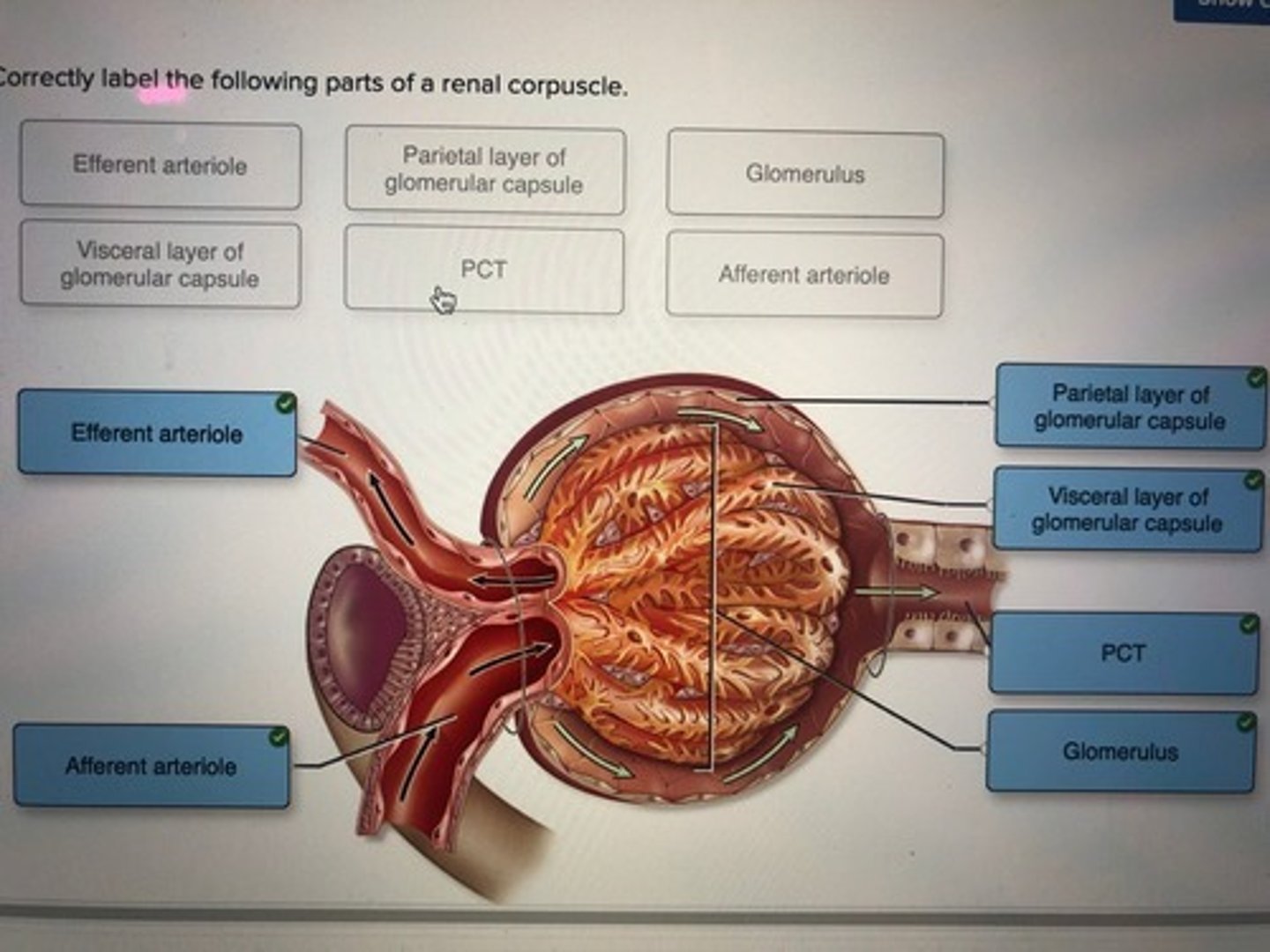
16. Correctly label the following parts of a renal corpuscle.
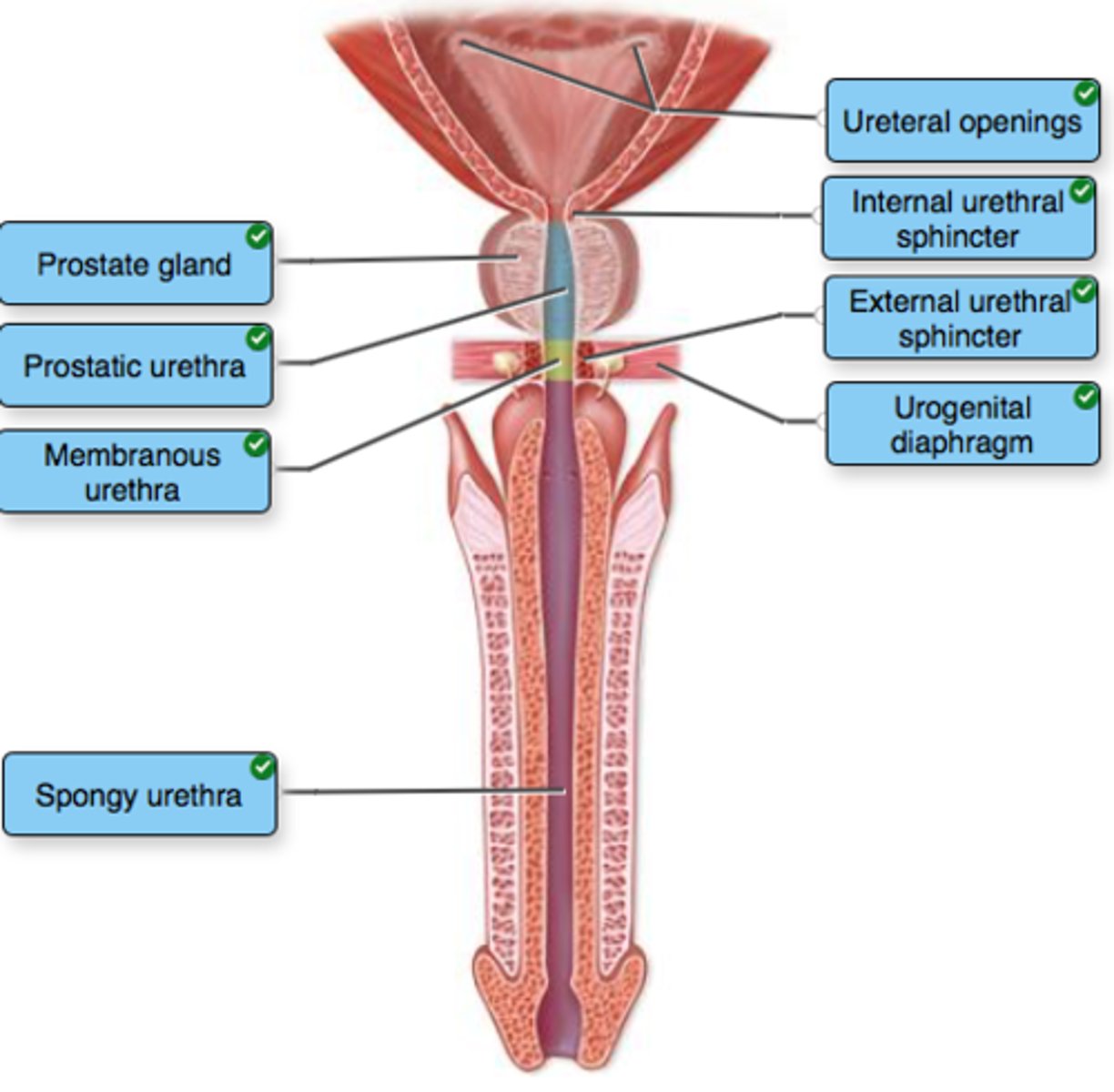
17. Correctly label the following anatomical parts of the male urethra and urinary bladder.
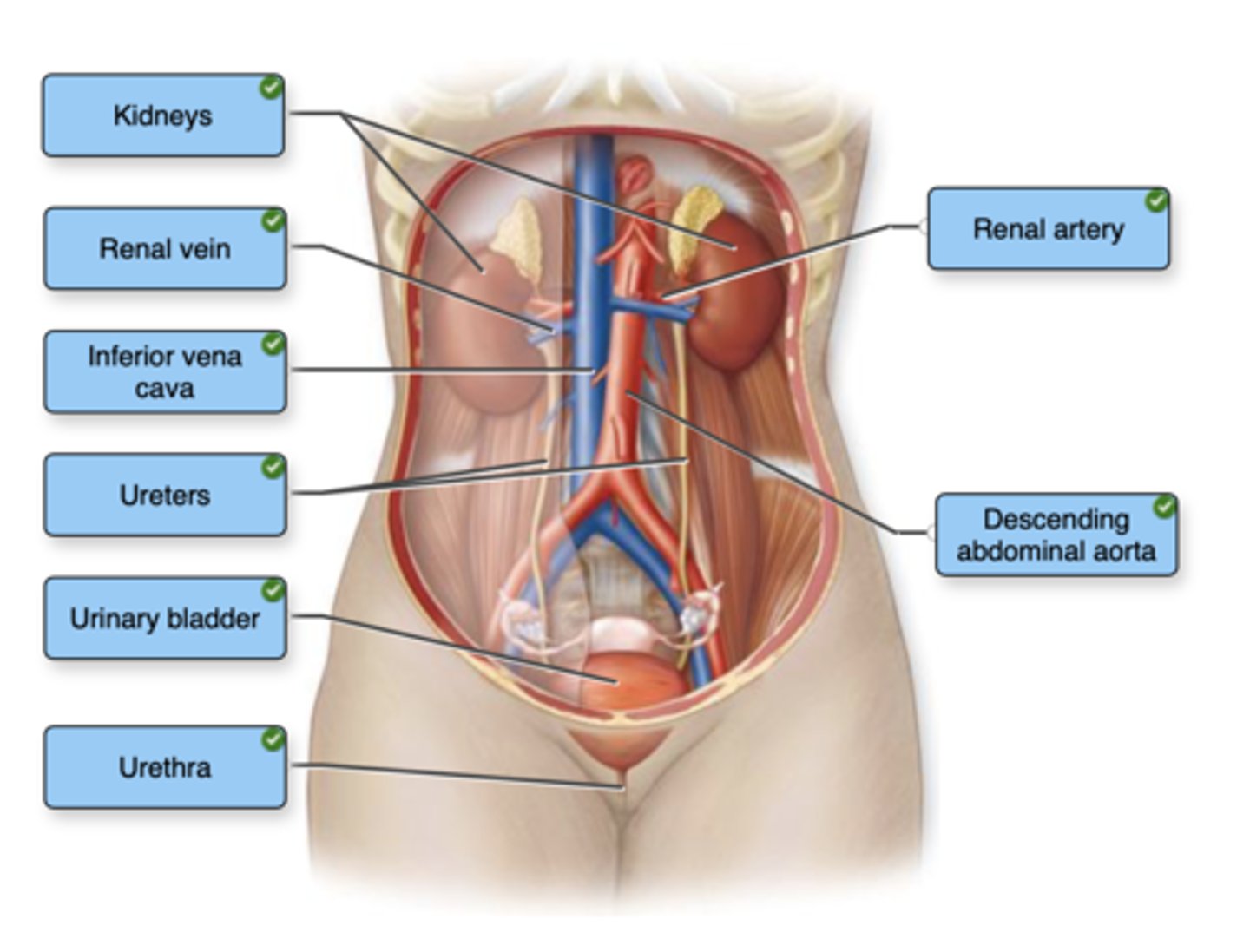
18. Label the parts of the urinary system and surrounding structures.
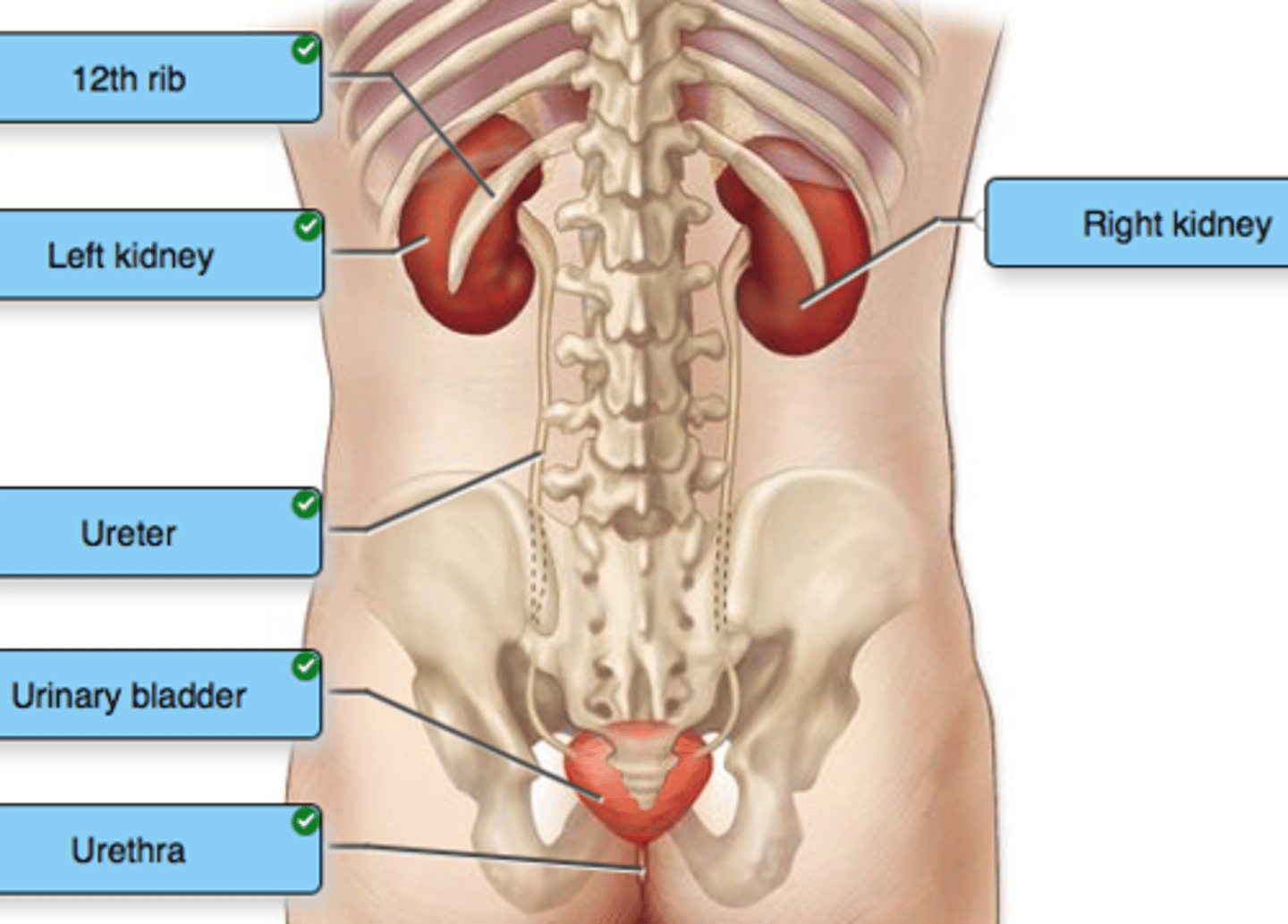
19. Correctly label the following components of the urinary system.
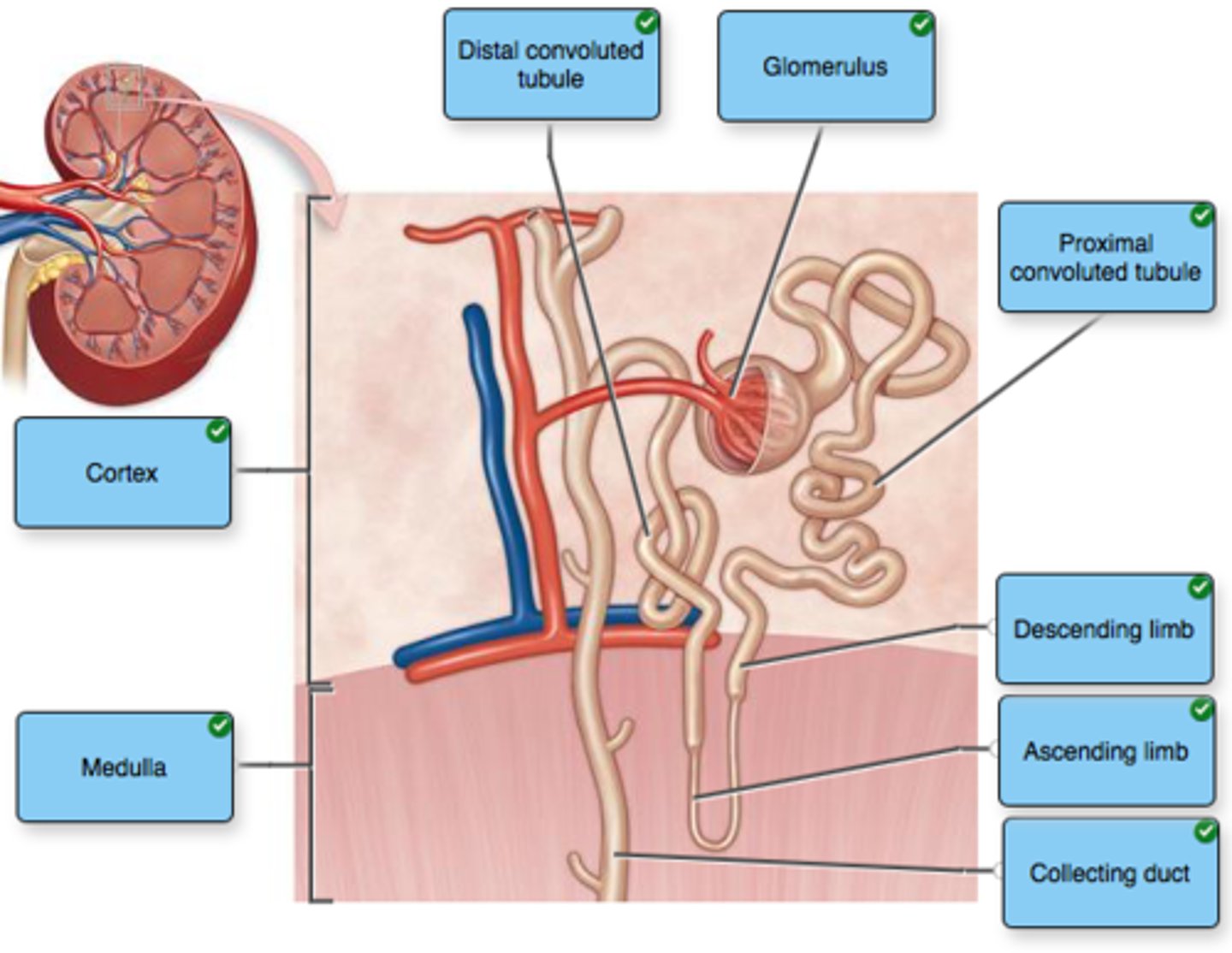
20. Label the structures of a nephron in the figure.
21. The ______ nervous system facilitates increased blood flow to the penis by facilitating local release of _________.
a. Parasympathetic, nitric oxide.
b. Parasympathetic, norepinephrine.
c. Sympathetic, norepinephrine.
d. Somatic, acetylcholine.
e. Sympathetic, nitric oxide.
a. Parasympathetic, nitric oxide.
22. The hymen is located
a. At the external urethral sphincter.
b. At the superior end of the vagina.
c. Near the vaginal orifice.
d. Near the fundus of the uterus.
e. At the cervix.
c. Near the vaginal orifice.
23. The secretory phase of the uterine cycle coincides with
a. Ovulation.
b. The follicular phase of the ovarian cycle.
c. Proliferation.
d. Menstruation.
e. The luteal phase of the ovarian cycle.
e. The luteal phase of the ovarian cycle.
24. Which of the following is true?
a. The three ingredients of ejaculate are sperm, semen, and prostate-specific antigen.
b. Semen is composed of seminal fluid and sperm.
c. Sperm are composed of seminal fluid within a cell membrane.
d. Seminal fluid is composed of semen and sperm.
b. Semen is composed of seminal fluid and sperm.
25. The stages that appear during spermatogenesis are
a. spermatid
b. primary spermatocyte
c. spermatogonium
d. spermatozoon
e. secondary spermatocyte
What is the correct order of appearance of these stages?
a. C, e, d, a, b.
b. A, c, b, e, d.
c. B, e, c, d, a.
d. D, b, c, e, a.
e. C, b, e, a, d.
e. C, b, e, a, d.
26. During orgasm, the ductus deferens undergoes
a. Segmentation, and the external urethral sphincter contracts.
b. Segmentation, and the external urethral sphincter becomes engorged with blood.
c. Peristalsis, and the internal urethral sphincter of the bladder contracts.
d. Peristalsis, and the internal urethral sphincter of the bladder relaxes.
c. Peristalsis, and the internal urethral sphincter of the bladder contracts.
27. The expression of the ________ gene results in the production of proteins that stimulate synthesis of androgens that initiate development of a male phenotype.
a. SRY.
b. MDF.
c. GRH.
d. YXP.
a. SRY.
28. During the excitement phase of the female sexual response, the uterus shifts to a more _______ position.
a. Erect.
b. Anteverted.
a. Erect.
29. The secretory structures that produce milk in a lactating breast are the
a. Alveoli.
b. Areolar glands.
c. Lactiferous sinuses.
d. Bartholin glands.
e. Lactiferous ducts.
a. Alveoli.
30. Ovulation is induced by a peak in the secretion of
a. Estrogen.
b. Ovulin.
c. LH.
d. Inhibin.
e. Progesterone.
c. LH.
31. A cell that contains 23 pairs of chromosomes is
a. Polyploid.
b. Diploid.
c. Haploid.
d. Monoid.
b. Diploid.
32. Which is not considered to be a change associated with aging in genetic males?
a. Prostate enlargement.
b. Decreases testosterone levels.
c. Termination of spermatogenesis.
d. Impotence.
e. Erectile dysfunction.
c. Termination of spermatogenesis.
33. Which structure is not found in both reproductive systems?
a. Corpora cavernosa.
b. Prepuce.
c. Glans.
d. Vestibular gland.
e. Tunica albuginea.
d. Vestibular gland.
34. During development, the _______ ducts form the female duct system.
a. Paramesonephric.
b. Metanephric.
c. Wolffian.
d. Parametanephric.
e. Mesonephric.
a. Paramesonephric.
35. Interphase occurs
a. Between telophase II and cytokinesis.
b. Between prophase I and prophase II.
c. Prior to meiosis.
d. Between meiosis I and meiosis II.
e. Between anaphase I and telophase I.
c. Prior to meiosis.
36. Spermatogenesis: Order of Events
Sequence the events in spermatogenesis. Not all terms will be used.
Word box: Secondary, Seminiferous, Spermatids, Spermatocytes, Spermatogonia.
Germ cells in the testes produce diploid cells called _______. Meiosis begins with primary ______. Meiosis I ends with the production of _______ spermatocytes, which are the first haploid cells in the process. Meiosis II results in the production of 4 haploid ________. Maturation of the sperm occurs in the ____________ tubules and epididymis.
Germ cells in the testes produce diploid cells called Spermatogonia. Meiosis begins with primary Spermatocytes. Meiosis I ends with the production of Secondary spermatocytes, which are the first haploid cells in the process. Meiosis II results in the production of 4 haploid Spermatids. Maturation of the sperm occurs in the Seminiferous tubules and epididymis.
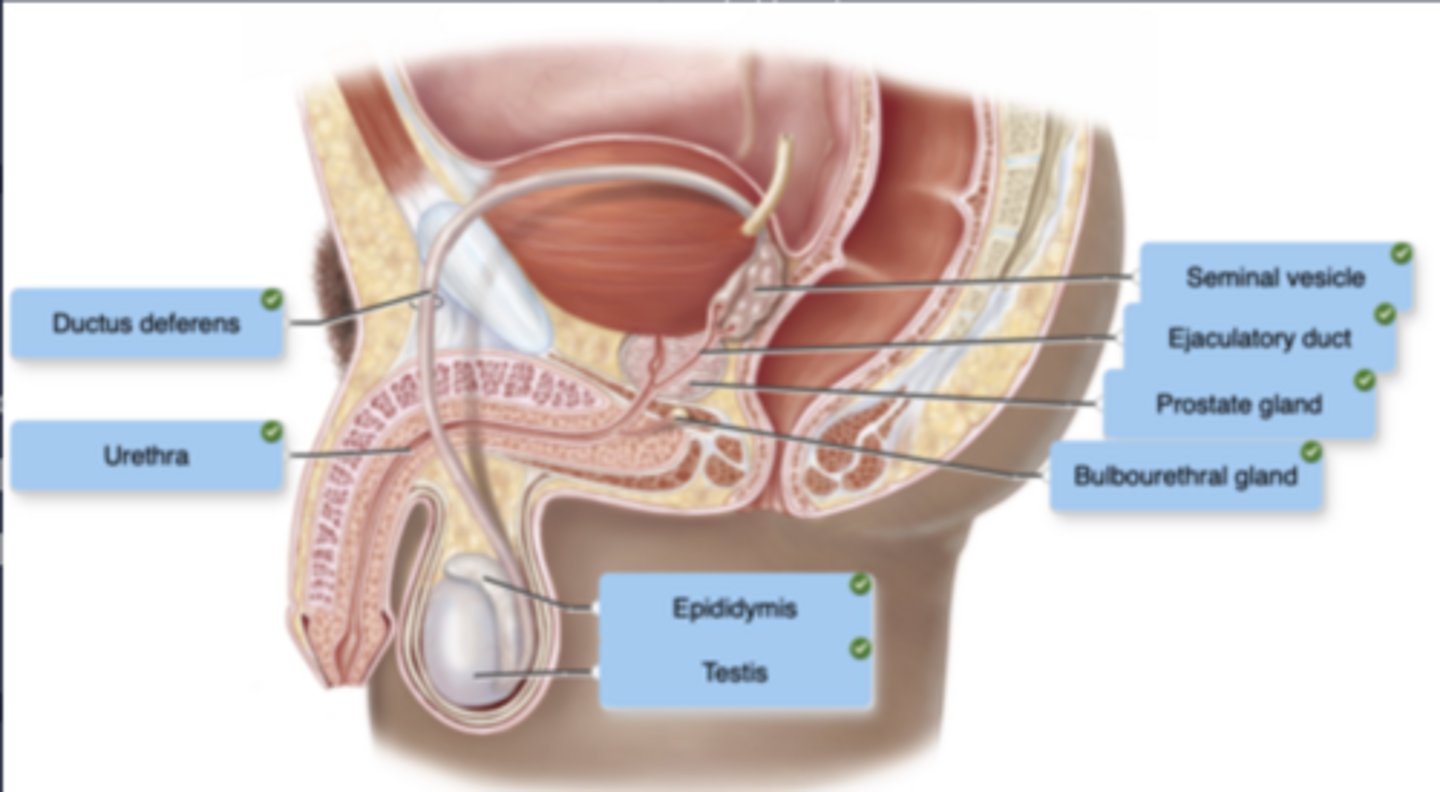
37. Label the following structures of the male reproductive system.
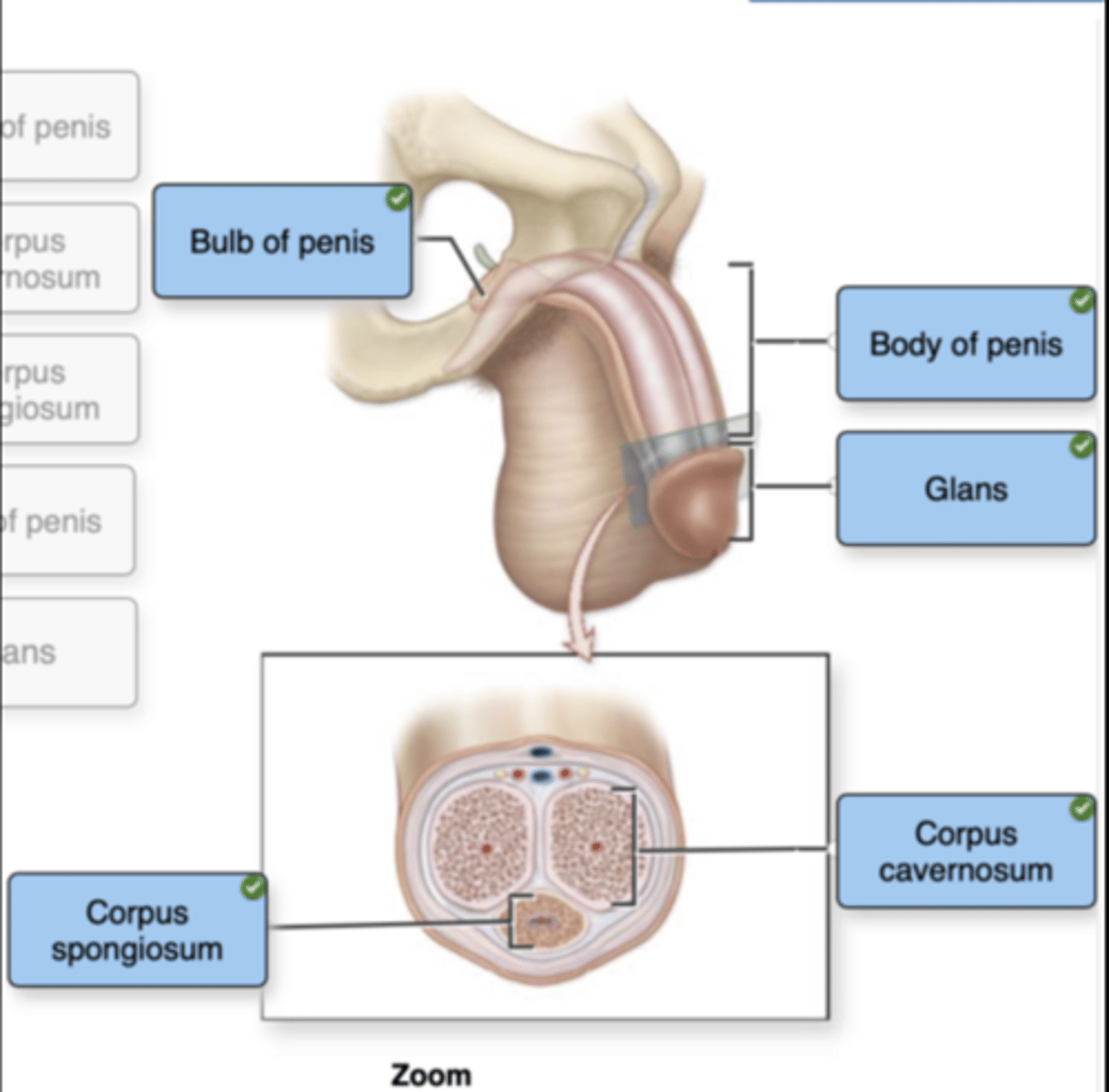
38. Label the structures of the penis in the figure.
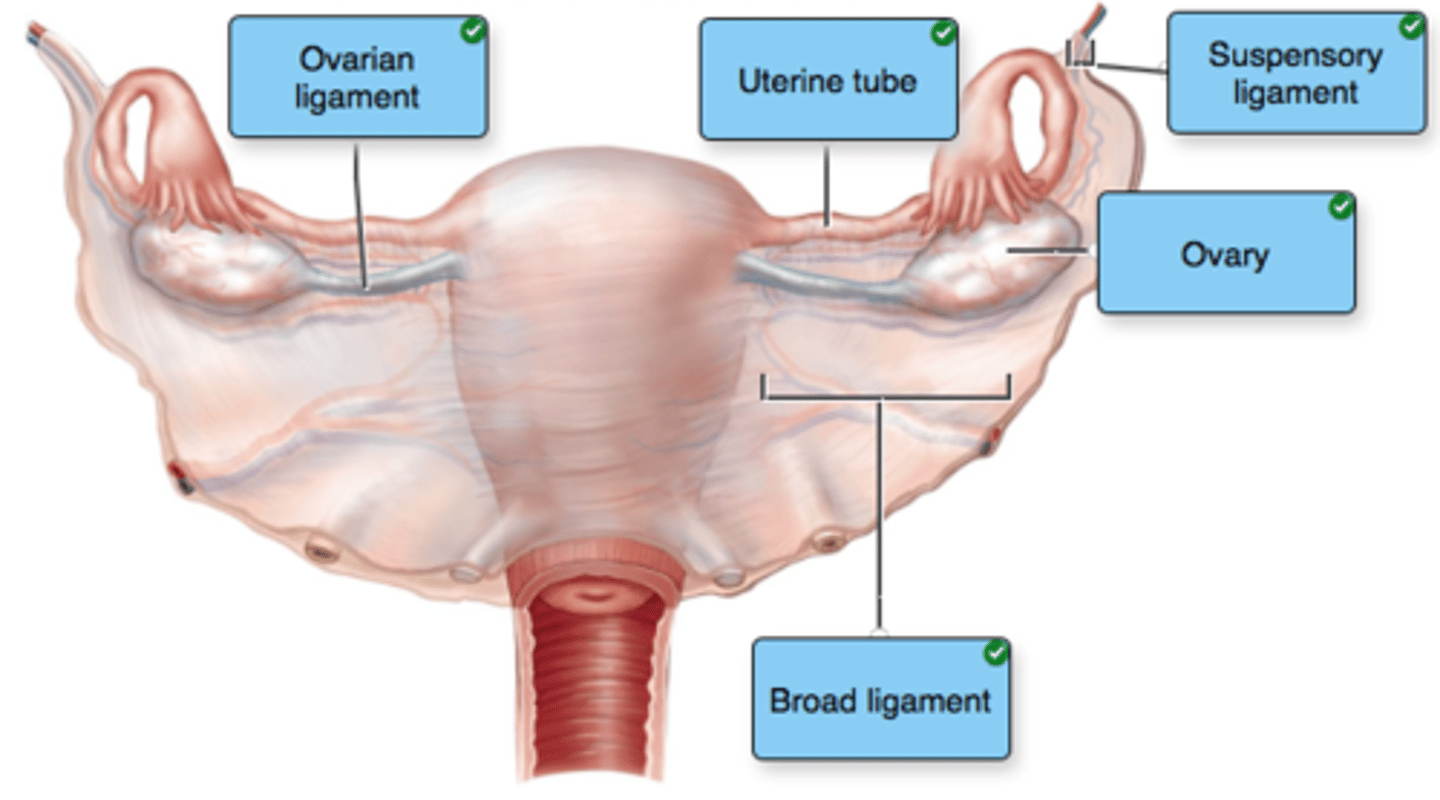
39. Label the structures surrounding the ovary in the figure.
40. Complete the sentences below to describe the human life cycle. Not all terms will be used.
1. There are two types of ____ ______ in the human life cycle.
2. ________ produces gametes with reduced chromosome number of __.
3. ________ produces body cells with a normal chromosome number of __.
4. A fertilized egg produces a(n) _______, the combination of sperm and egg cells producing a normal chromosome number.
5. Because the result of each type of division, mitosis is known as a _________ division, while meiosis is known as a _______ division.
1. There are two types of Cell Division in the human life cycle.
2. Meiosis produces gametes with reduced chromosome number of 23.
3. Mitosis produces body cells with a normal chromosome number of 46.
4. A fertilized egg produces a(n) Zygote, the combination of sperm and egg cells producing a normal chromosome number.
5. Because the result of each type of division, mitosis is known as a Duplication division, while meiosis is known as a Reduction division.
41. What allows sperm to penetrate the corona radiata?
a. Local hormones.
b. The acrosomal reaction.
c. Electrical impulses.
d. Their motility.
d. Their motility.
42. The portion of the trophoblast that first burrows into the endometrial lining is the
a. Syncytiotrophoblast.
b. Germ layer.
c. Morula.
d. Cytotrophoblast.
a. Syncytiotrophoblast.
43. A genetic male carries the allele for red-green colorblindness on the X chromosome. What will be the resulting phenotype.
a. Normal color vision.
b. Red-green colorblind.
c. Partially red-green colorblind.
b. Red-green colorblind.
44. The outermost extraembryonic membrane that will eventually form the placenta is the
a. Chorion.
b. Yolk sac.
c. Amnion.
d. Villus.
a. Chorion.
45. Cleavage occurs during the ______ stage.
a. Embryonic.
b. Neonatal.
c. Pre-embryonic.
d. Fetal.
c. Pre-embryonic.
46. Which of the following statements about lactation is false?
a. High levels of estrogen and progesterone inhibit the effect of prolactin on the mammary glands.
b. Both colostrum and breast milk contain antibodies.
c. Sucking and/or mechanical stimulation of the breasts causes secretion of prolactin-releasing factor.
d. Prolactin stimulates milk production.
e. Other hormones responsible for breast growth during pregnancy include growth hormone, parathyroid hormone, and glucocorticoids.
e. Other hormones responsible for breast growth during pregnancy include growth hormone, parathyroid hormone, and glucocorticoids.
47. The chorion is the _____ and the amnion is the ______
a. Site where an embryo is implanted into the uterus; outer protective membrane around the embryo.
b. Outermost covering of an embryo and helps form the placenta; a membrane that encircles a developing embryo.
c. Site from which primary germ layers develop; site from which secondary germ layers develop.
d. Part of the blastocyst that is not the inner cell mass; inner cell mass.
b. Outermost covering of an embryo and helps form the placenta; a membrane that encircles a developing embryo.
48. Each pronucleus contains a _________ number of chromosomes.
a. Diploid.
b. Haploid.
b. Haploid.
49. The dimples trait exhibits strict dominant-recessive inheritance. Therefore, how many phenotypes are possible for this trait?
a. One.
b. Two.
c. Three.
d. Four.
b. Two.
50. Human placental lactogen
a. Relaxes certain joints in the body.
b. Prevents the corpus luteum from degenerating.
c. Helps conserve maternal glucose for the fetus.
d. Prevents menstruation.
c. Helps conserve maternal glucose for the fetus.
51. The disease osteogenesis imperfecta is caused by a dominant allele. However, not all people with this allele actually suffer from the symptoms of the disease. What is this phenomenon called?
a. Incomplete dominance.
b. Dominance.
c. Recession.
d. Codominance.
e. Incomplete penetrance.
e. Incomplete penetrance.
52. During labor, oxytocin stimulates the uterus to contract. Contraction of the uterus increases pressure on the cervix, causing more oxytocin to be released from the hypothalamus. This is an example of ________ feedback.
a. Negative.
b. Positive.
b. Positive.
53. When does implantation typically begin after fertilization?
a. 2 weeks.
b. 7 days.
c. 1 day.
d. 4 weeks.
b. 7 days.
54. Initially, sperm are not capable of fertilizing the oocyte. They must first undergo
a. Meiosis II.
b. Compaction.
c. Capacitation.
d. Fertilization.
c. Capacitation.