3.3.5 Alcohols
 Call Kai
 Learn
Learn Practice Test
 Spaced Repetition
 Match
Match Flashcards
 Knowt Play
1/32

There's no tags or description
Looks like no tags are added yet.
Name | Mastery | Learn | Test | Matching | Spaced | Call with Kai | Chat |
|---|
No analytics yet
Send a link to your students to track their progress
33 Terms
What is the functional group of an alcohol?
Hydroxyl group -OH

What is the general formula of an alcohol?
CnH2n+1OH
What kind of intermolecular forces do alcohols have & why?
Hydrogen bonding, due to the electronegativity difference in the O-H bond
How do alcohols’ M.P. & B.P. compare to other hydrocarbons of similar carbon chain length?
Higher, as they have hydrogen bonding which is stronger than Van der Waals forces
When are alcohols soluble & insoluble in water?
Soluble when short chain: O-H bonds to the hydrogen bond in water
Insoluble when long chain: non-polarity of C-H bonds takes precedence
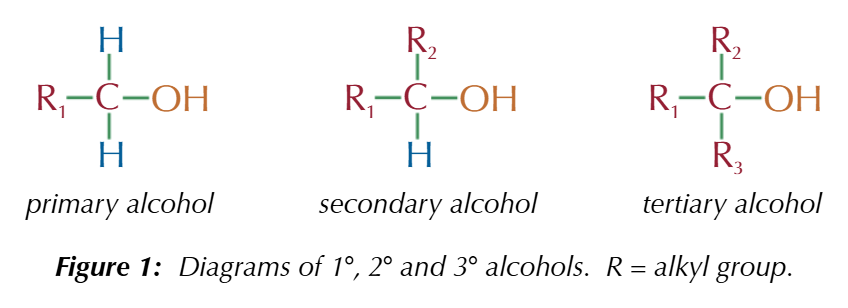
How do you work out whether an alcohol is primary, secondary or tertiary?
Primary alcohols (1º): C bonded to O-H is only bonded to one other C atom
Secondary alcohols (2º): C bonded to O-H is bonded to two other C atoms
Tertiary alcohol (3º): C bonded to O-H is bonded to three other C atoms
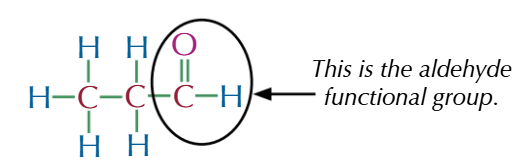
What is the functional group & suffix of aldehydes?
Functional group: -CHO (C=O group at end of carbon chain)
Suffix: -al (e.g. propanal)
What is the functional group & suffix of carboxylic acids?
Functional group: -COOH (at the end of carbon chain)
Suffix: -oic acid (e.g. propanoic acid)

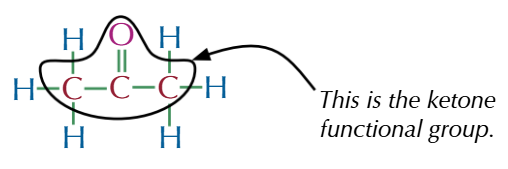
What is the functional group & suffix of ketones?
Functional group: C=O (in the middle of carbon chain)
Suffix: -one (e.g. propanone)
How can alkenes be made from alcohols?
Eliminating water from alcohols in a dehydration reaction
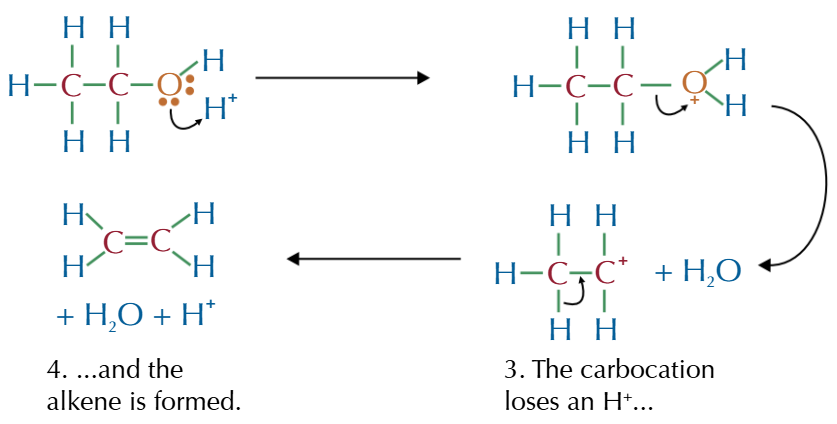
What is the condition for a dehydration reaction?
Hot, concentrated H2SO4 catalyst
What are the two methods used to produce ethanol & other alcohols?
Fermentation of glucose (can get from plants)
Hydrating alkenes
What are the conditions for fermentation?
Enzymes in yeast (catalyst)
35ºC
Anaerobic conditions
What is the word & symbol equation for fermentation?
Glucose → ethanol + carbon dioxide
C6H12O6 → 2C2H5OH + 2CO2
What is the condition for the hydration of alkenes to produce alcohols?
Concentrated H2SO4 catalyst & room temperature
What happens to ethanol produced by fermentation?
It is separated by fractional distillation & can be used as a biofuel
What are the advantages & disadvantages of hydrating alkenes?
Advantage:
very fast & pure
Disadvantages:
ethene from crude oil is a finite resource
continuous process, meaning expensive equipment is needed (but low labour costs)
What are the advantages & disadvantages of fermentation?
Advantages:
sugars (glucose) are a renewable resource
batch process, meaning cheap equipment is needed (but high labour costs)
Disadvantage:
very slow & impure, meaning it needs further processing
Write equations to support the statement that ethanol produced by fermentation is a carbon neutral fuel
6CO2 + 6H2O → C₆H12O6 + 6O2 (photosynthesis)
C6H12O6 → 2C2H5OH + 2CO2
2C2H5OH + 6O2 → 4CO2 + 6H2O
What is a biofuel?
A fuel that is made from recently deceased biological material
What are the advantages of biofuels?
They are a renewable energy source (more sustainable)
They are carbon neutral
What are the disadvantages of biofuels?
Land being used to grow crops for fuel can’t be used to grow food
Trees cut down to create more land to grow crops for biofuels destroys habitats & reduces photosynthesis
Fertilisers can pollute waterways & release nitrous oxide
Define carbon neutral
No net addition of carbon dioxide into the atmosphere
Why is making ethanol using fermentation not entirely carbon neutral?
Fossil fuels need to be burned to power the machinery used to make fertilisers for crops & the machinery to harvest the crops → burning fuels will produce carbon dioxide
What is the oxidising agent [O] used to oxidise alcohols?
Acidified potassium dichromate (K2Cr2O7):
reduces itself & will turn from orange (dichromate ion) to green (chromium ion)
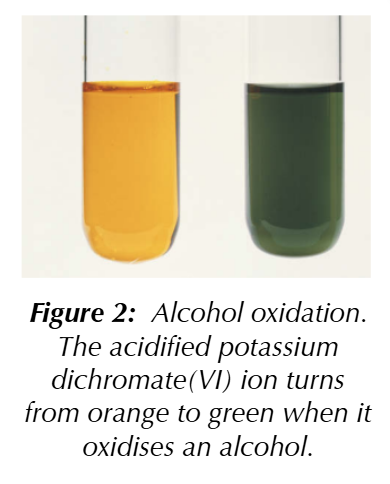
What is the difference between the oxidation of primary & secondary alcohols?
1º alcohols can be partially oxidised to aldehydes & then fully oxidised then to carboxylic acids
2º alcohols can only be oxidised to ketones
What are the conditions needed for oxidation of aldehydes & carboxylic acids?
Aldehydes: heat with acidified potassium dichromate & distil off immediately
Carboxylic acids: heat with excess acidified potassium dichromate & reflux
Why can’t ketones be oxidised further & why can’t tertiary alcohols be oxidised at all?
A C-C bond would have to break
What are the conditions needed for the oxidation of a secondary alcohol?
Acidified potassium dichromate & reflux
How is Fehling’s solution used to test for aldehydes & ketones?
Fehling’s solution is blue, as it contains Cu2+ ions:
if added warm to aldehydes, Fehling’s solution turns from a blue solution to a brick red precipitate
if added warm to ketones, Fehling’s solution remains blue

How is Tollens’ reagent used to test for aldehydes & ketones?
Colourless [Ag(NH3)2]+ complex:
if added warm to aldehydes, Tollens’ is reduced to a silver mirror
if added warm to ketones, Tollens’ remains colourless
![<p><strong>Colourless [Ag(NH<sub>3</sub>)<sub>2</sub>]<sup>+</sup> complex:</strong></p><ul><li><p>if added warm to aldehydes, Tollens’ is reduced to a silver mirror</p></li><li><p>if added warm to ketones, Tollens’ remains colourless</p></li></ul><p></p>](https://assets.knowt.com/user-attachments/fd85d5a6-1ebe-49a7-9559-e14e18c59f76.png)
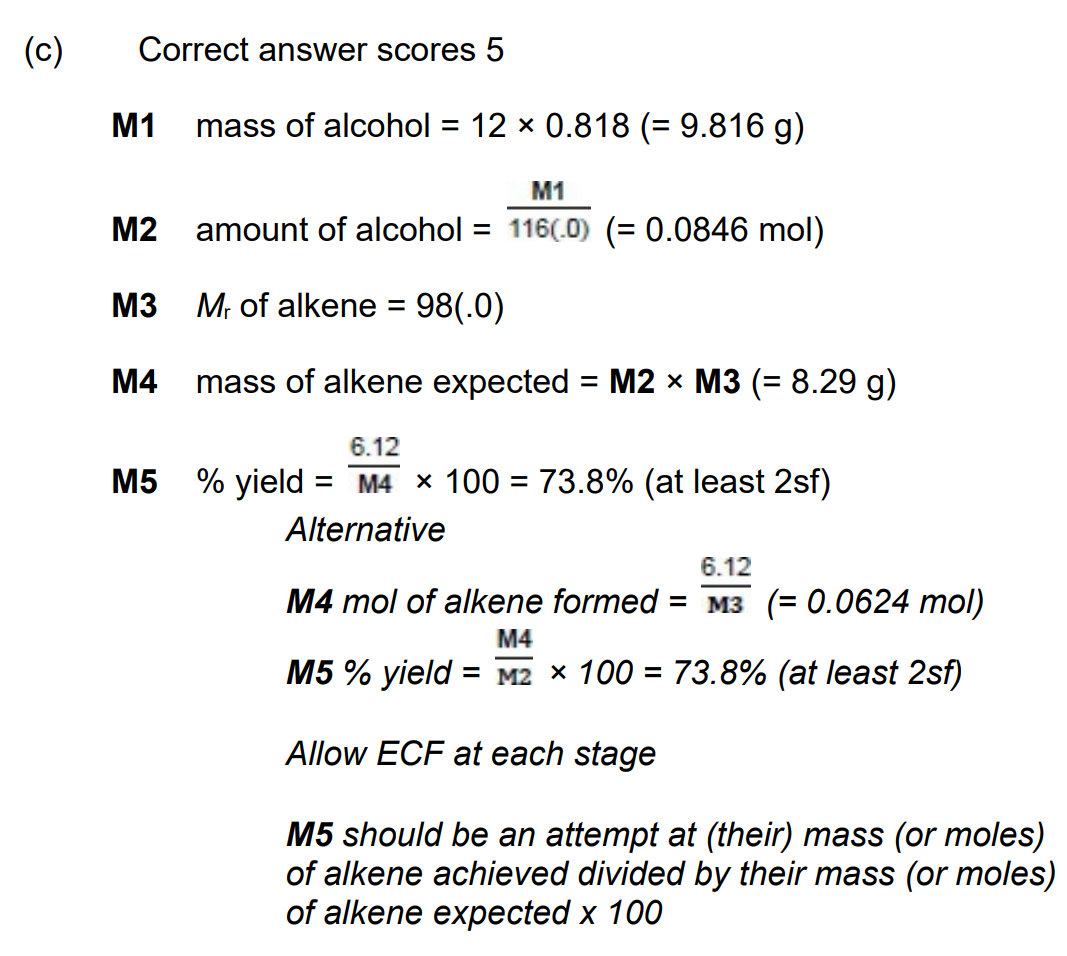
12.0 cm3 of 2,3,3-trimethylbutan-1-ol (Mr = 116.0) produces 6.12g of 2,3,3-trimethylbut-1-ene.
Calculate the percentage yield. (5 marks)
density of 2,3,3-trimethylbutan-1-ol = 0.818 g cm-3
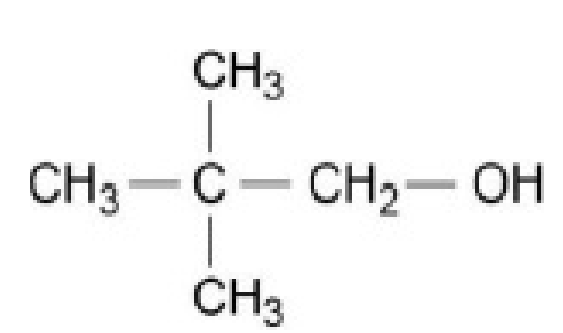
Draw the structure of an alcohol that is an isomer of pentan-2-ol that is not dehydrated when heated with concentrated sulfuric acid