ECON
 Call Kai
 Learn
Learn Practice Test
 Spaced Repetition
 Match
Match Flashcards
 Knowt Play
1/29

There's no tags or description
Looks like no tags are added yet.
Name | Mastery | Learn | Test | Matching | Spaced | Call with Kai | Chat |
|---|
No analytics yet
Send a link to your students to track their progress
30 Terms
9708/22/O/N/24
Assess the extent to which ‘the government increasing its education spending’ may improve the incomes of poorer households in Chile. (adv)-
As the data makes clear, education is considered a merit good that is considered to be beneficial for the individual and society in e.g., raising income levels due to a better educated and skilled workforce.
• Additional spending may increase the availability of education provision and free college tuition fees may make it more affordable to poorer households.
• Increased provision may also reduce other costs of education, again making it more affordable and accessible.
• It may raise awareness of the benefits of education for poorer households.
Assess the extent to which ‘the government increasing its education spending’ may improve the incomes of poorer households in Chile. (dis)
• There may still be a lack of awareness of the benefits of education due to information failure.
• Poorer households may have higher opportunity costs due to the need to start earning an income at an earlier age.
• Government spending may be unsustainable leading to reductions in future spending.
Assess the extent to which ‘the government increasing its education spending’ may improve the incomes of poorer households in Chile. (eval)-
In order to conclude, while increased education spendings can raise incomes for poorer households, its success depends on how well the education system is designed and whether other barriers are addressed (an assessment of the time for the policy to have the desired effect can also be mentioned)
With the help of a diagram(s), briefly explain how the cause of a movement along the demand curve differs from the cause of a shift in the demand curve and consider the impact on the demand for one good of price changes in other goods (AO1)
A movement occurs due to a change in price
and that a shift occurs due to a change in a non-price factor (1).

With the help of a diagram(s), briefly explain how the cause of a movement along the demand curve differs from the cause of a shift in the demand curve and consider the impact on the demand for one good of price changes in other goods.-AO2
• Price changes and the availability of complements (a negative value indicates a complement) e.g. a rise in the price of the complement would be expected to reduce the demand for the ‘other good’. • Price changes and the availability of substitutes (a positive value indicates a substitute) e.g. a rise in the price of the substitute would be expected to increase the demand for the ‘other good’. • For example, an increase in the price of a complement good is likely to reduce the demand of the good (1) due to the nature of the joint demand between both goods (1). • For example, a rise in the price of a substitute good is likely to increase the demand for the other good (1) if the consumer now sees the other good as a direct replacement (1).
With the help of a diagram(s), briefly explain how the cause of a movement along the demand curve differs from the cause of a shift in the demand curve and consider the impact on the demand for one good of price changes in other goods. - eval
to conclude, impact of these two factors depend on the size and sign of XED coefficients, for example, shifts caused by strongly related goods (high XED) >1, tend to have a more significant and lasting impact on demand
Assess whether knowledge of income elasticity of demand or price elasticity of demand for its product is more useful to a business aiming to increase the total expenditure on its product during a period of economic growth. (ped)-
ad-
to maximise total revenue using ped you can do price changes- if ped is elastic (define), slightly decrease price, highly increases quantity and therefore tr increases
if ped inelastic (define), highly increase price, slightly decrease quantity and therefore tr increases
dis-
suffer from the use of historical data which may be inappropriate in a time of economic growth and rising incomes which could affect PED values.

Assess whether knowledge of income elasticity of demand or price elasticity of demand for its product is more useful to a business aiming to increase the total expenditure on its product during a period of economic growth. (xed)-
increase tr by changing the pricing strategy when incomes increase demand for normal goods (define >1), increasing tr
increased income, decreases demand of inferior goods (demand), tr decreases.
inventory management- increase stock of normal goods and increase stock of inferior goods
The measure may be less useful in terms of pricing decisions and may be based on historical data which may be inaccurate.
Assess whether knowledge of income elasticity of demand or price elasticity of demand for its product is more useful to a business aiming to increase the total expenditure on its product during a period of economic growth. (evaL)-
in order to conclude, PED is more useful than YED for a producer because the producer has control over prices and can adjust them according to the ped. in contrast, the producer has no control over the consumer income. A producer selling normal goods will always want incomes to rise, but has no influence over them. Additionally, PED supports bold, independent and proactive decision-making, as it does not rely on any precausions. On the other hand, YED is only useful for reactive business decisions- it is relevant when incomes change, but not before that. therefore PED allows for more flexibility and proactive decision making, whereas YED is reactive and limited to responding to income changes.
However, considering the situation of economic growth, which represents rise in income, YED will be better than PED
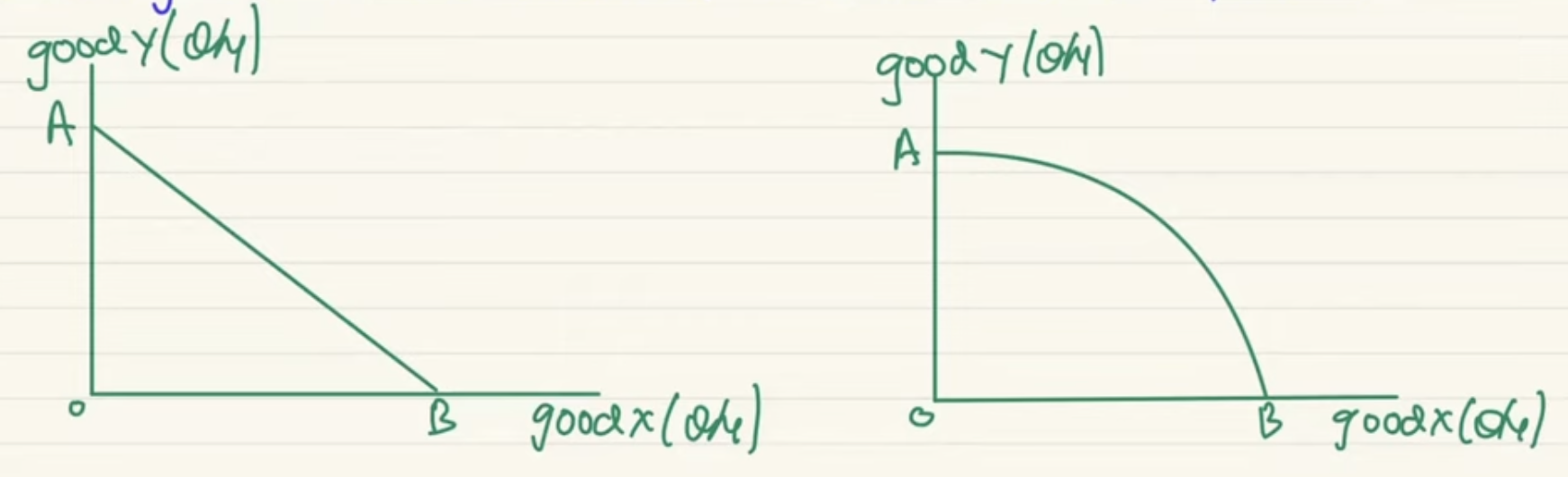
With the help of a production possibility curve (PPC) diagram(s), explain the difference between constant and increasing opportunity costs and consider how choices in deciding which type of goods to produce in the short run may influence future economic growth. AO1-
define ppc (not counted)
Accurately drawn and labelled production possibility diagram
curved- increasing opportunity cost
straight- constant opportunity cost
Explanation for the difference between constant and increasing opportunity cost. For example, constant opportunity cost demonstrates no change in the rate of trade off whereas increasing opportunity costs demonstrate an increase rate in the trade off between the two products
With the help of a production possibility curve (PPC) diagram(s), explain the difference between constant and increasing opportunity costs and consider how choices in deciding which type of goods to produce in the short run may influence future economic growth. AO2-
future economic growth will be influenced by the choices an economy makes about the split between consumer spending and capital spending
if a country decides to focus its spending and output on consumer goods, then this may create growth in the short run but may not be sustainable
for a decision to focus on spending and output on capital goods, this may have a short run negative impact on economic growth but should create more long term sustainable growth as output may expand
With the help of a production possibility curve (PPC) diagram(s), explain the difference between constant and increasing opportunity costs and consider how choices in deciding which type of goods to produce in the short run may influence future economic growth. AO3-
choices will depend on achivement of which types of growth the government is looking for, actual or potential growth
It actual growth then consumer goods and if potential growth then capital goods.
Assess whether a market economy is always the best economic system to effectively answer the three basic questions of resource allocation. AO1&AO2 (only market)
define market economy (price mechanism)
three basic question-
what to produce?
how to produce it?
for whom to produce?
advantages of market economy-
consumers are sovereign (they have the power) d increases qs increases (answers- what to produce? for whom to produce?
competition increases, prices decrease, affordability increase and SOL increases
innovation increases, quality increases consumer choices increase, profit max ( motivate incentive) (answers how to produce- cost effective method)
disadv of market economy- Market failure
non provision of public goods by the private sector
merit goods, underallocated
demerit goods, overallocated
merge, monopoly, output restrict, price increases, abnormal profits, abuse of monopoly power
Assess whether a market economy is always the best economic system to effectively answer the three basic questions of resource allocation. AO1&AO2 (only planned)-
define planned economy
adv-
social welfare, resource allocation (need), provision of merit goods and public goods, inequality of income decreases
disadv-
lack of competition, no incentive to work hard, to improve, quality decreases, efficiancy decreases, cost increases losses
bureacratic, decision making delay
what to produce- needs
how to produce- government
for whom to produce- overal people
Assess whether a market economy is always the best economic system to effectively answer the three basic questions of resource allocation. AO3-
Whether a market economy is the best economic system depends on the situation. In rich developed countries, where most people can afford basic goods and services, the market system can work quite well. But in poorer countries, where many people have low incomes and access to healthcare and education is limited, relying only on market forces can cause problems
The market economy is usually good at deciding what and how to produce, but not always fair for whom to produce.
so a market economy is not always the best one. it works best when it is supported by some kind of government help to make sure everyone’s needs are met.
Assess whether supply-side policy is likely to be equally successful in reducing both structural and cyclical unemployment. AO1 &AO2 (supply-side)-
define supply side policy, cyclical unemployment (caused by lack of demand), structural unemployment ( elaborate on oppupational and geographical unemployment)
training and education and vocational training, increases occupational mobility
infrastructural spending and reallocation grants, increasing geographical mobility
supply side policy tends to be less effective in reducing cyclical unemployment, especially in the short run
for example, improving worker productivity or skills does not immediately generate demand for goods and services
howevere some supply side policies may have an indirect impact on AD
for example, if government increases spending on infrastructure or education this can raise AD in the short term. Yet it is usually smaller and slower than direct demand side policies
effectiveness- potential cost of the policy and the time taken for the policy to be effective
no garentee that the skill gained is required in the future. If skills does not increase, increased AD may cause demand pull inflation
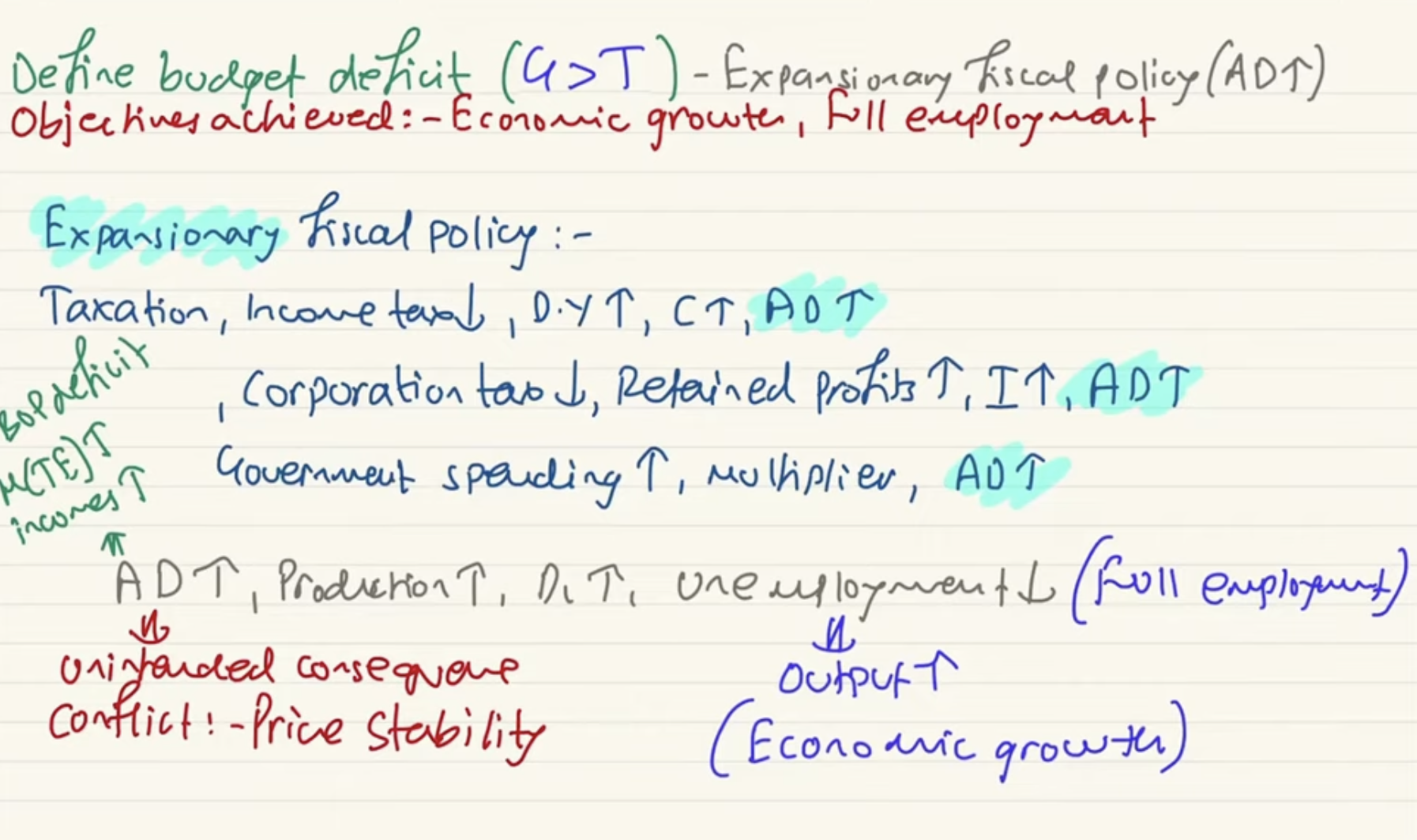
Assess whether supply-side policy is likely to be equally successful in reducing both structural and cyclical unemployment. AO1 &AO2 (expansionary fiscal policy)-
define expansionary fiscal policy
taxation decreases
indirect taxation decreases, C ^, AD^
corporation tax decreases, retained profits increases, investment increases, AD increases
government spending increases, multiplier effect, AD increases
AD ^, production ^, demand for labour^, unemployment decreases (cyclical)
AD>- multiplier effect-, incomes^, output^, employment^
cyclical UE>- demand deficit unemployment decreases
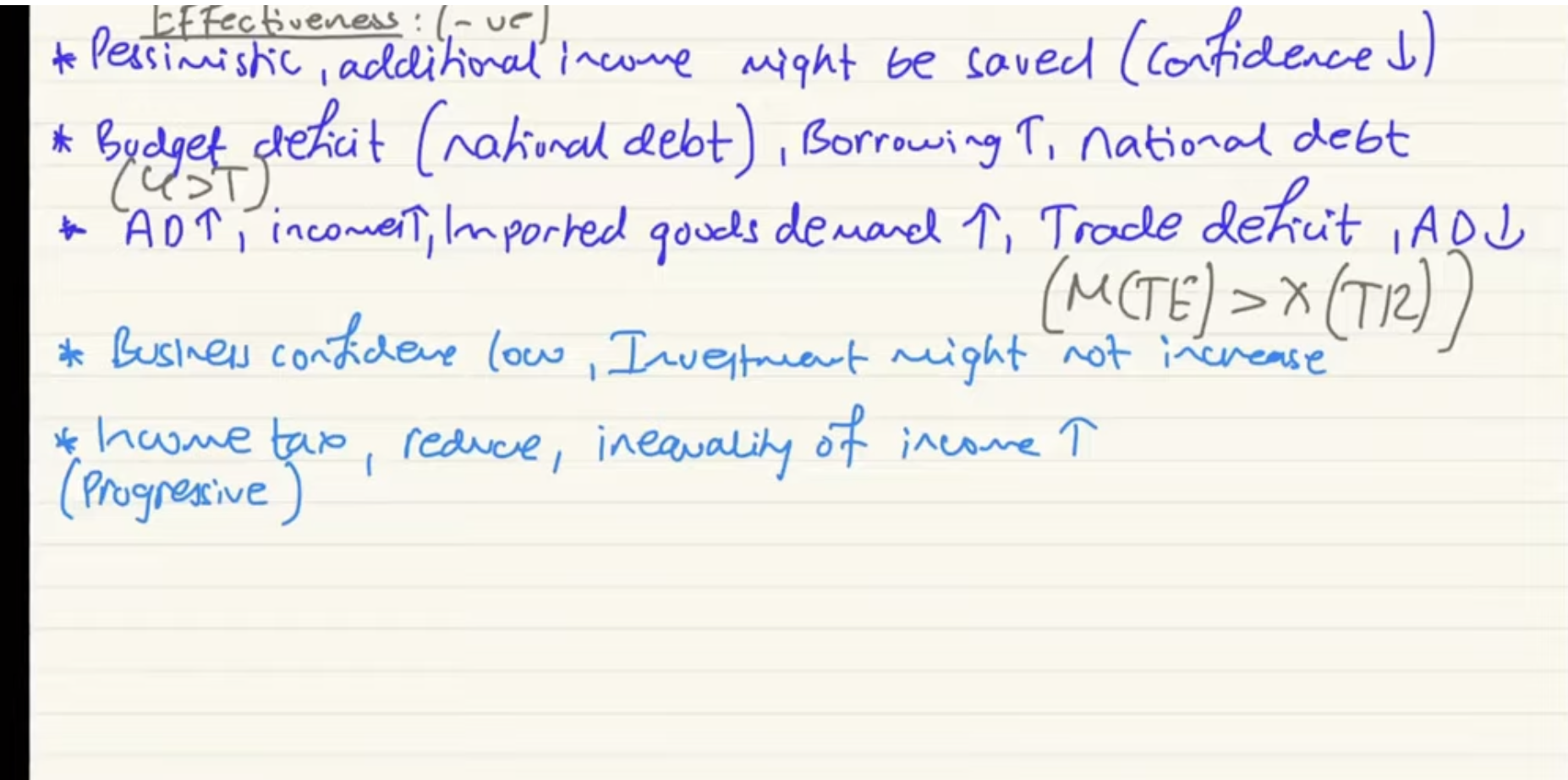
Effective (-ve)-
pessimistic, additional income might be saved (confidence decreases)
Budget deficit (g>t), borrowing^, national debt^
AD^, incomes^, imported goods demand^, trade deficit, ad decreases
business confidence low, investment might not increase
progressive income tax reduces, inequality of income ^
Assess whether supply-side policy is likely to be equally successful in reducing both structural and cyclical unemployment. AO3-
In order to conclude, supply-side policies are more successful in tackling structural unemployment because they address fundamental inefficiencies in the labour market. Their ability to reduce cyclical unemployment is limited, especially in the short run, due to the week impact on aggregate demand. Therefore, while supply-side policies measures are crucial for long-term improvements, they are not all equally effective for all types of unemployment and should ideally be combined with with demand side policies, like fiscal policies when addressing cyclical unemployment.
With the help of examples, explain the difference between the marginal rate of taxation and the average rate of taxation and consider whether a government should decide to increase the rate of indirect tax to raise additional revenue. AO1-

With the help of examples, explain the difference between the marginal rate of taxation and the average rate of taxation and consider whether a government should decide to increase the rate of indirect tax to raise additional revenue.AO2-
easier and quicker to put in place than direct tax
they may be less easy to avoid than direct tax
however, they are often seen as regressive and can lead to a higher MRT for poorer households
their effectiveness in raising revenue depends on PED
they may also lead to cost push inflation
With the help of examples, explain the difference between the marginal rate of taxation and the average rate of taxation and consider whether a government should decide to increase the rate of indirect tax to raise additional revenue.AO3-
In order to conclude, while indirect taxes are a convinient tool for raising government revenue, their regressive nature and inflationary risks mean that they need to be used carefully. If the government’s goal is to raise revenue without harming the poorest households, a more balanced approach that includes progressive direct taxes may be more appropriate
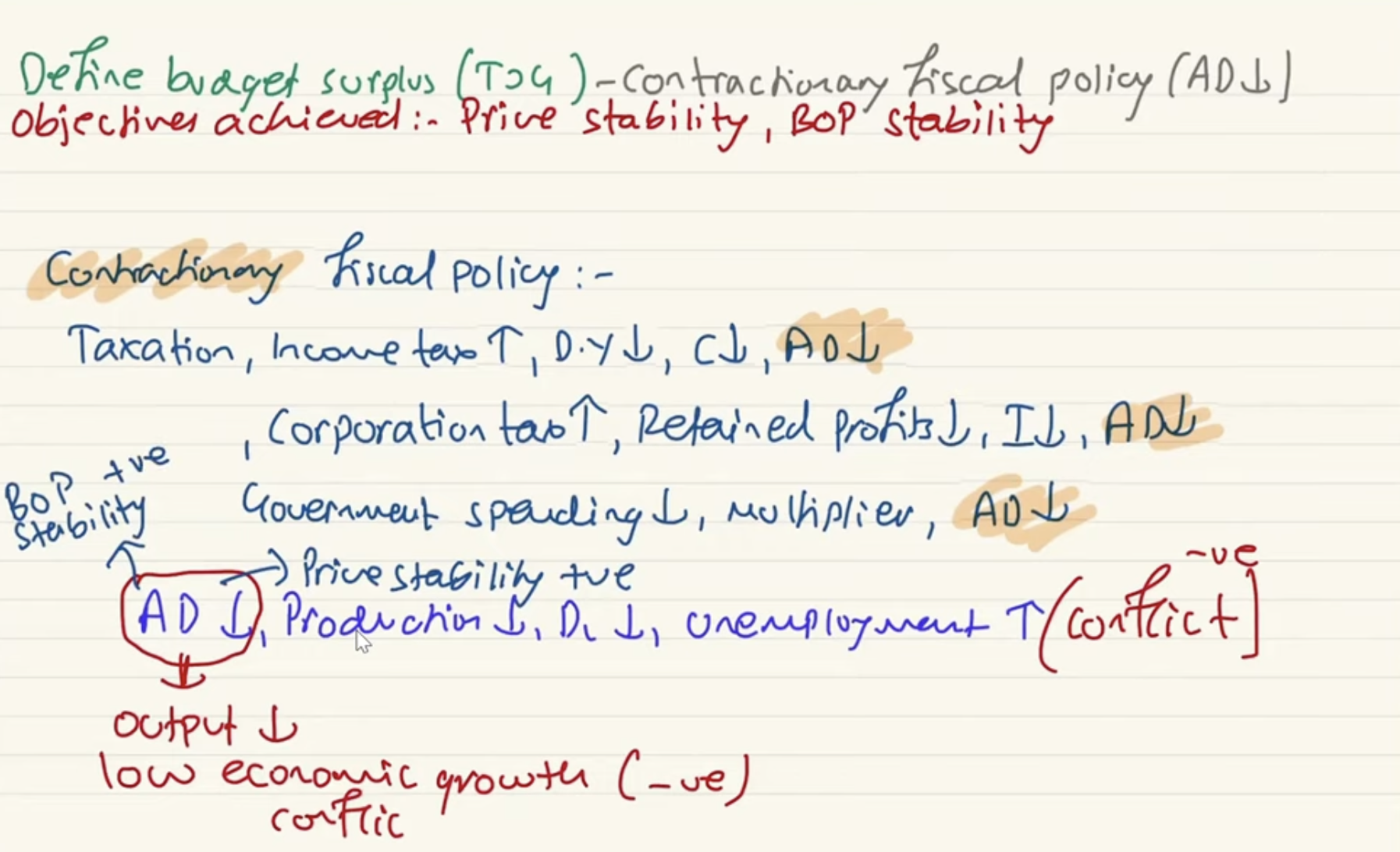
Assess whether the achievement of a balanced budget should always be a main government macroeconomic objective. -1

not necessary if u give the disadvantages mentioned on previous page
not necessary if u give the disadv mentioned on previous page

eval-
