Interactive with Patients
 Call Kai
 Learn
Learn Practice Test
 Spaced Repetition
 Match
Match Flashcards
 Knowt Play
1/32

There's no tags or description
Looks like no tags are added yet.
Name | Mastery | Learn | Test | Matching | Spaced | Call with Kai | Chat |
|---|
No analytics yet
Send a link to your students to track their progress
33 Terms
Therapeutic Relationship
Central aspect of the OT process.
Catalyst for change in mental health recovery.
Interactive process between tx and cx (two-way things).
Requires interpersonal & communicative skills developed through reflective practice.
Knowing how to talk, to listen, read the room, and adjust to what the client needs.
Degree of intimacy varies along a continuum based on:
Nature of the condition
Disruption to life and identity
Extent of recovery expected
Length and complexity of therapy
Emphatic Competence
Emotional ability to accurately perceive and respond to cxs.
Understanding the client’s lived experience.
Accurately perceiving their emotions
Picking with their verbal and non-verbal cues
Fine-tuning the therapy process based on client responses.
Essential for building trust and rapport
Foundational skill for therapeutic use of self
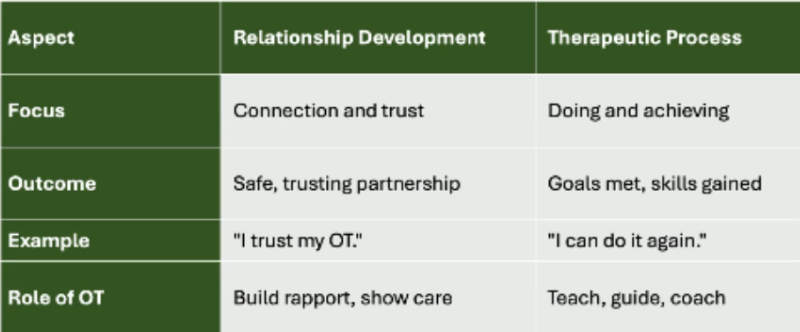
Components of the Therapeutic Relationship
Phases of Developing Therapeutic Relationship
Stages of Therapeutic Process
Phases of Developing Therapeutic Relationship
Phase 1: Developing Rapport
Phase 2: Establish Trust
Phase 3: Collaborative Partnership
Phase 4: Sustain the Partnership
Phase 5: Relationship Ensured
Phase 1: Developing Rapport
Show respect and care.
Listen and understand their story.
Meet them at their comfort level.
Show genuine interest.
Initial connection that you build with the client
Not limited to clinical details because we have to meet them where they are
Adjust to their comfort level
Quiet → speak softly
Anxious → slow down
Phase 2: Establish Trust
Spend time and listen.
Give clear information.
Show you understand their fears.
Something to earn through consistency
Explain OT in layman term (interpersonal skill)
Unsure patient → give choices (sense of control)
Worried/anxious patient → make them feel validate
Phase 3: Working Together
Equal partnership.
Therapist brings expertise; client brings life knowledge.
Set goals together.
Try tasks to explore strengths and limits.
Phase 4: Enabling Occupational Performance
Teach problem-solving.
Encourage trying new things.
Practice in realistic situations.
Shift roles: guide → supporter
Go at their pace.
Phase 5: Achieving Outcomes
Goals reached.
Sense of control and confidence.
Relationships and impact continue.
Components of Therapeutic Relationship
Therapeutic Communication
Not limited to talking but it’s about verbal & non-verbal skills.
Core Skill (improved through time through practice)
The work of OT hinges on effective communication or exchange of thoughts and feelings between client and therapists.
Verbal communication, nonverbal communication, therapeutic listening.
Verbal Communication
Not limited to words you say but on HOW you will say it because it can calm or trigger them.
Clear and audible in voice and mouth movements.
Clear, brief, and accurate in terms of the content being transmitted.
Emotionally modulated to match the situation, preference, and comfort level of the client.
Confident in tone of voice about the content of what is being communicated.
Communicate at the level of the patient.
Professional, respectful, and tactful in terms of word choice.
Learn to stop when needed
Do not force the client to open
Intentional about timing the relation between talking and doing.
Talking with purpose and awareness.
Non-Verbal Communication
S — sit across the client squarely
O — open posture
L — leans slightly towards the other person
E — eye contact of approximately 50% OTT
R — relax
Therapeutic Listening
Empathic Learning
Guided Listening
Verbal Prompts and Sounds
Enrichment Questions
Empathic Learning
Involves the process of recounting, accepting, and affirming any perception or experience a client offers (Gardner, 1991).
Receiving and accepting w/o shaping or directing the answer of the patient.
Guided Listening
An alternative approach that involves a therapist’s attempts to shape what the client is saying by making one or more summary-type statements.
Verbal Prompts and Sounds
Include expressions such as “Ah,” “Uh huh” or “Umm”. These utterances may be used to remind a client that you are listening, to highlight something.
A client has just said, or encouraged a client to say more.
Enrichment Questions
Gentle forms of inquiry designed to encourage a client to continue to communicate and/or to enrich what is being described.
Given topic or life event
Therapeutic Use of Self
Modes
Attitudes
Therapeutic Use of Self: Modes
Specific ways of relating to the client.
Different from listening and non-verbal cues
Warm, firm, or giving them space (depends on the client)
Equally valued and therapeutic.
Selection based on client’s needs and interpersonal characteristics.
Mode shifts may be needed in response to interpersonal events.
Components of Modes
Instructing
Collaborating
Empathizing
Problem-Solving
Encouraging
Modes: Instructing
Teaching and educating.
Structuring activities clearly.
Providing clear instructions and feedback.
Setting limits when needed.
Explain the plan, sequence, and events of therapy.
Why is it happening in that order
We can praise while instructing
Modes: Collaborating
Joint decision-making.
Active and equal participation.
Ensuring choice, freedom, and autonomy.
Client involved in reasoning about therapy.
Working as partners.
The client leads but the therapist should also guide.
Modes: Empathizing
Understanding client’s thoughts, feelings, and behaviors.
Suspending judgement.
Bearing witness to their experience.
Validating their feelings.
No need for advice or fixing.
Not just having the right answer
Modes: Problem Solving
acilitating pragmatic thinking.
Help the patient with what’s practical and doable
“Sir pano toh, pwede ba natin itong i-try?”
“Sir ano kaya mangyayari if mag-try ka ng journaling kesi sa mag-meditate tayo?”
Outlining choices and options.
Posing strategic questions.
Trial and error and experimenting.
Using reason and logic.
Answers & solutions must be from the client.
Modes: Encouraging
Instilling hope and courage.
Celebrating thinking and behavior.
Positive comments and praise.
Conveying joyfulness, playfulness, and confidence.
Inspiring willingness to explore and try.
Not limited to positive comments of the output or outcome
Summary of Modes

Therapeutic Use of Self: Attitudes
Active Friendliness
Passive Friendliness
Kind Firmness
Matter of Fact
No Demand
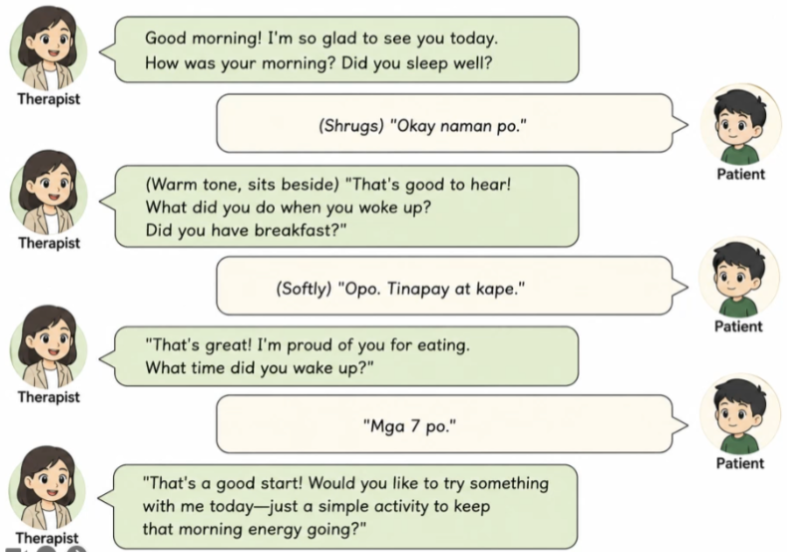
Attitudes: Active Friendliness
Mode: Collaborating (mostly)
Good for Initiating
Suitable For:
Depressed, withdrawn, apathetic, isolated from others, shy, aloof.
Stays in one state/room/setting all day, doesn’t talk, no internet
Manner of Delivery:
Warm, cheerful, initiative-taking.
The therapist assumes the initiative in making friendly overtures.
Strategies:
Approach first
Greet warmly
Invite to activities
Praise small efforts
Sit with them even if quiet
Use calm but cheerful tone
Smile (can be neutral)
Open posture
Attitudes: Passive Friendliness
You wait for them to take initiative
Suitable For:
Paranoid, suspicious, distrustful, manic
Thinks people are plotting again them, refuses food/interaction
Manner of Delivery:
Calm, patient, non-threatening
The therapist waits for the client to take initiative
Strategies:
Stay 4 feet away
Don’t touch
Don’t approach suddenly
Say “I’m here if you need me”
Wait for them to start; Move slowly
Don’t stare
Be consistent

Attitudes: Kind Firmness
Kind, present, and caring
Firmness comes in the structure & expectations
Validate their struggles
Compassion but with accountability
We OTs try to push the client to try even the client does not want to → set achievable expectations
Not as soft as active friendliness & not as hands-off as passive friendliness
Suitable For:
Depressed, suicidal, uncooperative, sad, hopeless
Patient says “I’m worthless,” refuses to get out of bed
Manner of Delivery:
Gentle but firm, reassuring
Strategies
Assign simple repetitive tasks
Say “Let’s try this together”
Don’t sympathize excessively

Attitudes: Matter of Fact
Neutral and unemotional
State the rule and stick to it (cx = manipulative)
Don’t validate feelings the way you do in kind firmness
Don’t get drawn into arguments or emotional reactions
Suitable For:
Manipulative, demanding, impatient, character disorders, substance abuse
Patient constantly asks for special favors, threatens to complain
Strategies:
Keep voice neutral
Say “The rule is..”
Don’t argue
Don’t show emotion
Stick to rules
Be consistent
Explain routines clearly
Follow through every time

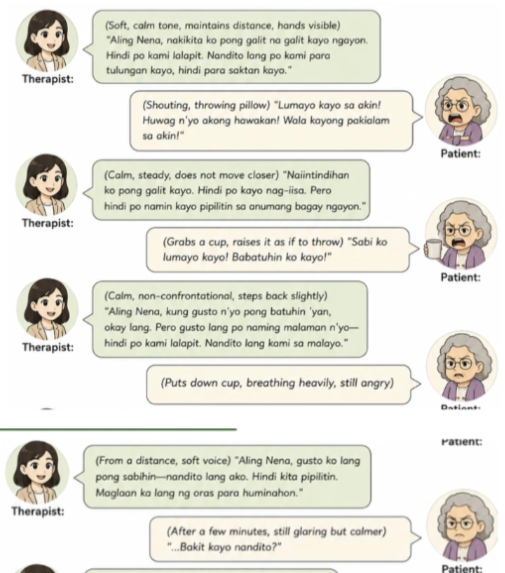
Attitudes: No Demand
Suitable For:
Assaultive, aggressive, furious, combative, violent
Patient shouting, throwing objects, pacing aggressively.
Manner of Delivery:
Calm, non-confrontational, team-based
Strategies:
Don’t confront; don’t demand
Remove others
Call team
Surround with group
Say “where here to help you”
Avoid direct eye contact
Give space
Return later when calm