Chapter 2: International Flow of Funds
 Call Kai
 Learn
Learn Practice Test
 Spaced Repetition
 Match
Match Flashcards
 Knowt Play
1/48

There's no tags or description
Looks like no tags are added yet.
Name | Mastery | Learn | Test | Matching | Spaced | Call with Kai | Chat |
|---|
No analytics yet
Send a link to your students to track their progress
49 Terms
Balance of Payments
They indicate the volume of transactions between specific countries & may even signal potential shifts in specific exchange rates
Summary of transactions between domestic & foreign residents for a specific country over a specific period of time
includes transactions by business, individuals, & government
What is Balance of Payments comprised of?
Current Account
Financial Account
Capital Account
What is Current Account? Ahat are its main components?
Summary of the flow of funds due to purchases of goods or services or the provision of income from financial assets
Merchandise, goods, & services
primary income
secondary income
Payments for Goods & services
Merchandise exports & imports represent tangible products that are transported between countries
service exports and imports represents tourism & other services
The Balance of Trade - is the difference between exports & imports
Primary Income Payments (Factory Income)
Represents income earned by MNC’s on their DFI as well as income earned by investors on their portfolio investments
Net primary in U.S. represents the difference between primary income recipts (inflows) & the primary income payments (outflows)
Secondary Income (transfer payments)
Represents aids, grants, and gifts from one country to another
Net secondary income — is the difference between secondary income receipts (inflows) & secondary income payments (outflows)
What is Financial Account? What are their measures of funds?
Refers to special types of investment, including DFI and portfolio investment
DFI — summarizes the new direct foreign investment over a given period (control over subsidiary acquisition)
Portfolio Investment — records new portfolio investment over a given period
Other Capital Investment — transactions involving short-term financial assets between countries
Measure the net flow due to financial asset transactions between individual or institutional investors
Capital Account
Summary of flow of funds resulting from the sale of assets between one specified country and all other countries over a specified period of time
Financial assets transferred across country borders by people who move to a different country, or due to sales of patents and trademarks
What is the difference between Capital & Financial Account?
Capital Account items are relative minor (in terms of money) when compared to financial account items
What are some events that increased Trade volume?
Removal of the Berlin Wall: Led to reductions in trade barriers in Eastern Europe
Single European Act of 19 87: Improved access to supplies from firms in other European countries
North American Free Trade Agreement (NAFTA): Allowed U S firms to penetrate product and labor markets that previously had not been accessible
General Agreement on Tariffs and Trade (GATT): Called for the reduction or elimination of trade restrictions on specified imported goods over 10 years across 117 countries
The European Union: Free movement of products, services, and capital among member countries
Inception of Euro: Avoid exposure to exchange rate risk
Other Trade Agreements: The United States has established trade agreements with many other countries
What is Outsourcing?
The process of subcontracting to a third party in another country to provide supplies or services that were previously produced internally
What is the impact of Outsourcing on Trade?
there is an increase in International Trade activity because MNC’s now purchase products or services from another country
it lowers cost of operation and job creation in countries with LOW wages
What are the criticisms of Outsourcing?
It may lead a a reduction in jobs within the United States or said country
What is the impact that Outsourcing has in Managerial decisons?
Managers of a U.S.-based MNC may argue that they create jobs for U.S. workers.
Shareholders may suggest that the managers are not maximizing the MNC’s value as a result of their commitment to creating U S jobs.
Managers should consider the potential savings that could occur as a result of outsourcing against the potential unforeseen costs of having a dispersed supply chain.
Managers must also consider the possible bad publicity or bad morale that could occur among the US workers.
What are the factors affecting International Trade Flows?
Cost of Labor
Inflation
National Income
Credir Conditions
Government Policies
Exchange Rates
How does Cost of Labor affect International Trade Flows?
The cost of Labor varies substantially among countries
all depends on countries rates compared to another
Firms in countries where labor costs are low commonly have an advantage when competing globally, especially in labor-intensive industries
How does Inflation affect International Trade Flows?
Current account decreases if inflation increases relative to trade partners
decreases if customers shift to cheaper alternatives in other countries
increases if local individuals & firms shift to cheaper alternatives
How does National Income affect International Trade Flows?
Current Account decreases if national income increases relative to other countries
How does Credit Conditions affect International Trade Flows?
When credit conditions become more restrictive, MNC’s may reduce their corporate spending and reduce their demand for imported supplies
What are the Government Policies that Impact Government Policies?
Restrictions on Imports
Subsidies for Exporters
Restrictions on Piracy
Environmental Restrictions
Labor Laws
Business Laws
Tax Breaks
Country Trade Requirements
Government Ownership or Subsidiaries
Country Security Laws
Policies to Punish Country Government
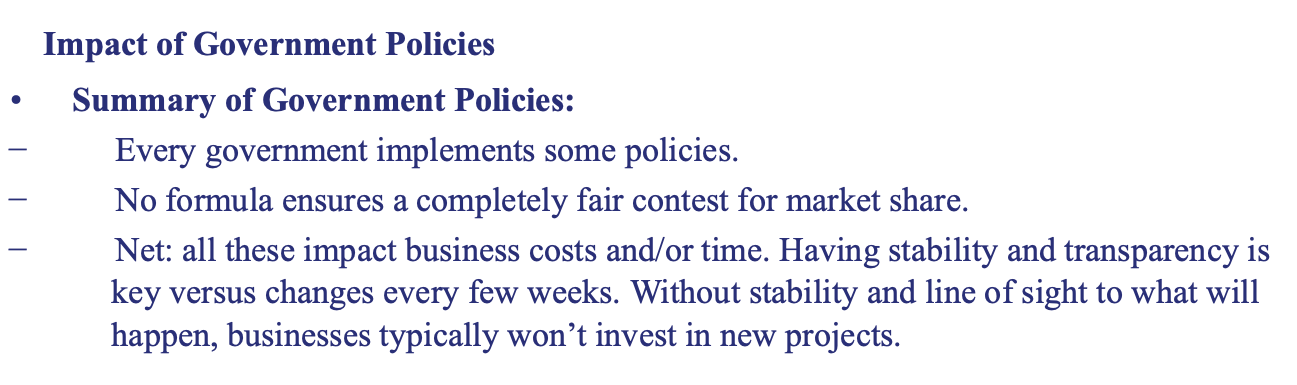
Restriction on Imports
Taxes (tariffs) on imported goods increase prices and limit consumption. Quotas limit the volume of imports.
Subsidies for Exporters
Government subsidies help firms produce at a lower cost than their global competitors.
dumping — exporting of products that were produced with the help of government subsidies
Restriction on Piracy
A government can affect international trade flows by its lack of restrictions on piracy.
Environmental Restrictions
Environmental restrictions impose higher costs on local firms, placing them at a global disadvantage compared to firms in other countries that are not subject to the same restrictions.
Labor Laws
Countries with more restrictive laws will incur higher labor costs, all else equal.
Due to this, some firms may be at a disadvantage when competing against firms based in other countries
Business Laws
Firms in countries with more restrictive bribery laws may not be able to compete globally in some situations.
Trade Breaks
Though not necessarily a subsidy, still a form of government financial support that might benefit many firms that export products
Country Trade Requirements
Requiring various forms or obtaining licenses before countries can export to the country (bureaucracy) is a strong trade barrier.
often result in delays simply because the government is inefficient in validating the forms or licenses
Government Ownership Ownership or Subsidaries
Some governments maintain ownership in firms that are major exporters
Country Security Laws
Government may impose certain restrictions when national security is a concern, which can affect trade
Policies to Punish Country Government
Many expect countries to restrict imports from countries that:
Fail to enforce environmental laws and child labor laws
Initiate war against another country
Are unwilling to participate in a war
How does Exchange Rate affect International Trade Flows?
Currency account decrease if currency appreciates relative to other currencies
How does exchanage rate correct a balance of trade deficit?
When a home currency is exchanged for a foreign currency to buy foreign goods, then the home currency faces downward pressure, leading to increased foreign demand for the country’s products.
Why does exchange rates not correct a balance of trade deficit?
Exchange rates will not automatically correct any international trade balances when other forces are at work
What are the limitations that Exchange Rates have on a weak home currency solution?
Competition: Foreign companies may lower their prices to remain competitive.
Impact of other currencies: A country that has a balance of trade deficit with many countries is not likely to solve all deficits simultaneously.
Prearranged international trade transactions: International transactions cannot be adjusted immediately. The lag is estimated to be 18 months or longer, leading to a J-curve effect. (Exhibit 2.5)
Intracompany trade: Many firms purchase products that their subsidiaries produce. These transactions are not necessarily affected by currency fluctuations, but are estimated to account for >50% of all international trade.
What is the J-curve effect?
The effect of a weaker dollar on the U.S Trade balance in which the trade balance initially deteriorates; it improves only when U.S. & Non-U.S. importers respond to the change in purchasing power that is caused by the weaker dollar
Exchange Rates and International Friction
All governments cannot weaken their home currencies simultaneously.
Actions by one government to weaken its currency cause another country’s currency to strengthen.
Government attempts to influence exchange rates can lead to international disputes.
What are the factors affecting DFI?
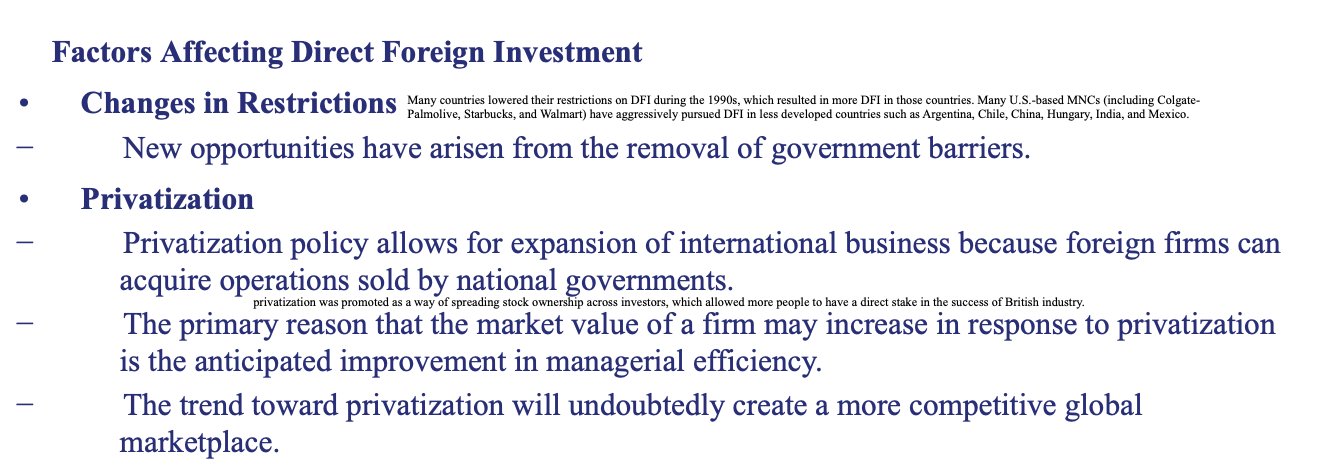
Changes in Restrictions — New opportunities have arisen from the removal of government barriers.
Privatization — LOOK AT IMAGE
Potential Economic Growth — Countries with greater potential for economic growth are more likely to attract DFI.
Tax Rates — Countries that impose relatively low tax rates on corporate earnings are more likely to attract DFI.
Exchange Rates — Firms typically prefer to pursue DFI in countries where the local currency is expected to strengthen against their own.
What are the factors affecting Portfolio Investment
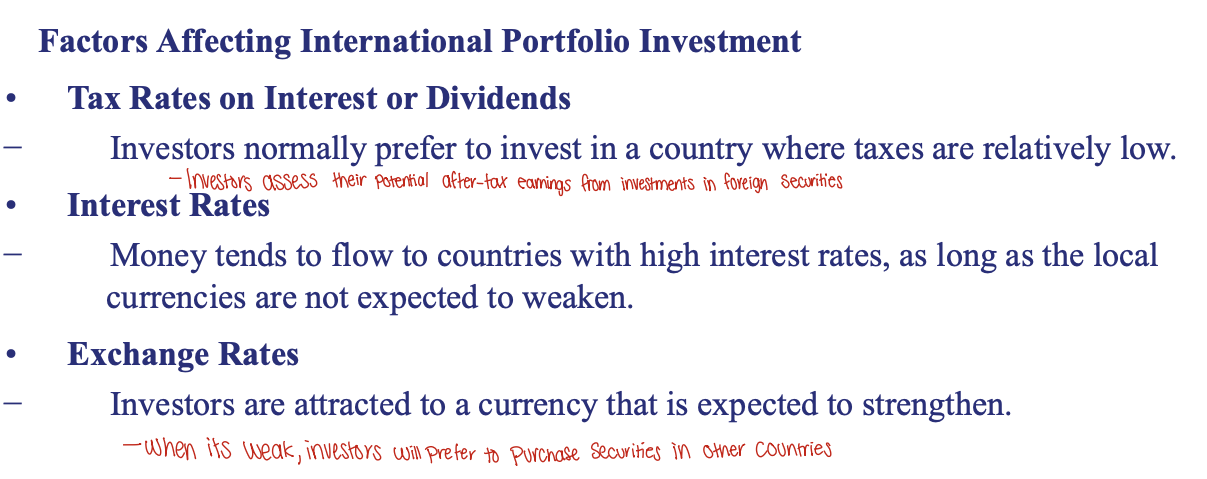
Tax Rates on Interest or Dividends — Investors normally prefer to invest in a country where taxes are relatively low.
Interest Rates — Money tends to flow to countries with high interest rates, as long as the local currencies are not expected to weaken.
Exchange Rates — Investors are attracted to a currency that is expected to strengthen.
What are the Agencies that Facilitate International Flows?
International Monetary Fund
World Bank
Structural Adjustment Loans
World Trade Organization
International Finance Corporation
International Development Association
Bank for International Settlements
Organization for Economic Cooperation and Development
Regional Development Agencies
International Monetary Fund (IMF)
The agency attempts to increase International Trade by promoting cooperation among countries on international monetary issues
Promote cooperation among countries on international monetary issues
Promote stability in exchange rates
Provide temporary funds to member countries attempting to correct imbalances of international payments
Promote free mobility of capital funds across countries
Promote free trade
It is clear from these objectives that the IMF’s goals encourage increased internationalization of business
Its compensatory financing facility (CFF) attempts to reduce the impact of export instability on countries. Financing is measured in special drawing rights (SDRs)
World Bank (International Bank for Reconstruction and Development)
Its major objective is to make loans to countries to enhance economic development
Structural Adjustment Loans (SAL’s)
are intended to enhance a country’s long-term economic growth.
World Trade Organization (WTO)
Its major objective is to provide a forum for multilateral trade negotiations and to settle trade disputes related to the GATT accord
Member countries are given voting rights that are used to make judgments about trade disputes and other issues.
They help promote international trade because the rules are communicated to exporters and importers alike
International Finance Corporation (IFC)
Its major objective is to promote private enterprise within countries
Provides loans to corporations and purchases stock
It traditionally has obtained financing from the World Bank but can borrow in the international financial markets.
International Development Association (IDA)
Its major objective is to extend loans at low interest rates to poor nations that cannot qualify for loans from the World Bank
Bank for International Settlements (BIS)
Its major objective is to facilitate cooperation among countries with regard to international transactions
Provides assistance to countries experiencing a financial crisis
Sometimes referred to as the “central banks’ central bank” or the “lender of last resort”
Organization for Economic Cooperation and Development (OECD)
Its Major objective is to facilitate governance in governments and corporations of countries with market economics
It has 30 member countries and has relationships with numerous countries.
Promotes international country relationships that lead to globalization
Regional Development Agencies
Inter-American Development Bank: focusing on the needs of Latin America
Asian Development Bank: established to enhance social and economic development in Asia
African Development Bank: focusing on development in African countries
European Bank for Reconstruction and Development: created in 1990 to help Eastern European countries adjust from communism to capitalism