Chemistry Instrumentation Solo 1 Lecture 2 Study Guide
 Call Kai
 Learn
Learn Practice Test
 Spaced Repetition
 Match
Match Flashcards
 Knowt Play
1/23

Earn XP
Description and Tags
Name | Mastery | Learn | Test | Matching | Spaced | Call with Kai | Chat |
|---|
No analytics yet
Send a link to your students to track their progress
24 Terms
What are the three basic components of an immunoassay
Analyte
Antibody
Detectable Label
What is the most commonly used antibody type in immunoassays
IgG
What types of analytes are typically measured using immunoassay
Proteins, hormones, metabolites, therapeutic drugs, and drugs of abuse
What types of labels are used in immunoassays
Horseradish peroxidase
Beta-galactosidase
Alkaline Phosphatase
Name four requirements for enxymes to be used as labels
High amount of stability
Extreme specificity
Absence from the antigen or antibody
No alteration by inhibitor with the system
2 examples of luminescent labels used in chemiluminescence
Luminol
Acridinium Ester
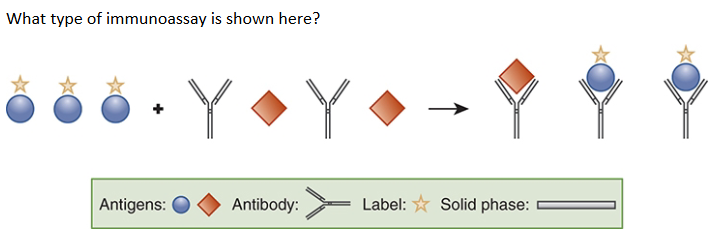
Competitive Immunoassay
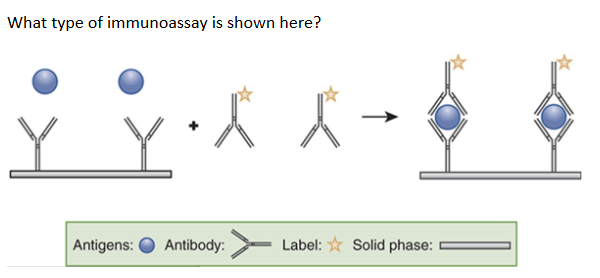
Noncompetitive Immunoassay
Which type of assay does not require a physical separation step such as washing?
Homogenous Assay
Which type of assay does require a physical separation step such as washing
Heterogenous Assay
Most common separation technique to distinguish free labeled reactant from bound labeled reactant
Solid Phase
Four formats available for an Enzyme-linked immunoabsorbent assay (ELISA)?
A competitive assay using labeled Ag
A competitive assay using labeled Ab
A noncompetitive assay to detect Ag
A noncompetitive assay to detect Ab
Describe EMIT
Used to test for a drug, hormone, or metabolite in a patient’s sample. An enzyme-labeled drug or molecule is added with patients sample that may or may not contain the same drug or molecule. Antibody specific to the drug, as well as an enzyme substrate, is added. The enzyme-labeled drug/molecule competes with the patient’s drug/molecule for antibody binding sites. The enzyme attached to the drug is affected by antibody binding. When the antibody binds to the enzyme labeled drug, it reduces the enzymes’ ability to catalyze a reaction. The change in enzyme activity can be measured through a change in absorbance detected by the instrument. This change is proportional to the amount of unbound enzyme-labeled drug, which in turn is proportional to the amount of the target substance in the sample.
What is the purpose of a calibration curve
To establish a relationship between the concentration of the analyte and the magnitude of the signal given by the measuring device
What should be done if the signal is below the analytic measurement range
The result is typically reported as less than the lower end of the AMR or less than the lowest calibrator used in the clinical laboratory
What should be done if a signal is reported above the analytical measurement range
The result may be reported as greater than the upper limit of the AMR or greater than the highest calibrator used in the lab. Alternatively, the sample may be diluted to bring the analyte concentration within the AMR and reanalyzed. The measured value on the diluted sample is then multiplied by the dilution factor to determine the concentration in the original sample
2 types of antibodies that may interfere with sanwich immunoassays
Human anti-mouse antibodies
Heterophile antibodies
Immunoassay
An assay based on the reaction of an antibody that is specific for an antigen
Label
A substance with a measurable property attached to an antigen, antibody, or binding substance that will better detect lower concentrations of immune complexes
Stokes Shift
The difference between the excitation wavelength and the emission wavelength
Solid Phase
Solid particles, beads, trays, or tubes onto which antibody or antigen is absorbed
Interpolation
Connecting the points on the calibration plot to form the best fit line or curve; establishes an expected signal for the range of concentrations of analyte that fall between the lowest and highest calibrator
Analytic Measurement Range (AMR)
Also known as the dynamic range, it defines the lowest to highest measurable quantities
Hook Effect
Excess antigen binds to free labeled antibody, prohibiting the labeled antibody to bind to the capture antibody