15 - Antineoplastic , Cell Cycle Specific & Non-specific Agents
 Call Kai
 Learn
Learn Practice Test
 Spaced Repetition
 Match
Match Flashcards
 Knowt Play
1/114

There's no tags or description
Looks like no tags are added yet.
Name | Mastery | Learn | Test | Matching | Spaced | Call with Kai | Chat |
|---|
No analytics yet
Send a link to your students to track their progress
115 Terms
b. Pulmonary fibrosis
Bleomycin causes ______
a. Cardiotoxicity
b. Pulmonary fibrosis
c. Nephrotoxicity
d. Peripheral neuropathy

b. Pulmonary fibrosis
Busulfan causes _____
a. Cardiotoxicity
b. Pulmonary fibrosis
c. Nephrotoxicity
d. Peripheral neuropathy

b. Nephrotoxicity and ototoxicity
Cisplatin causes ______
a. Cardiotoxicity and pulmonary fibrosis
b. Nephrotoxicity and ototoxicity
c. Peripheral neuropathy and hepatotoxicity
d. Myelosuppression and alopecia

b. Nephrotoxicity and ototoxicity
Carboplatin causes _____
a. Cardiotoxicity and pulmonary fibrosis
b. Nephrotoxicity and ototoxicity
c. Peripheral neuropathy and hepatotoxicity
d. Myelosuppression and alopecia

c. Cardiotoxicity
Doxorubicin causes _____
a. Nephrotoxicity
b. Ototoxicity
c. Cardiotoxicity
d. Pulmonary fibrosis

b. Myelosuppression
Methotrexate causes ______
a. Cardiotoxicity
b. Myelosuppression
c. Pulmonary fibrosis
d. Nephrotoxicity

b. Myelosuppression
5-Flurouracil causes ______
a. Cardiotoxicity
b. Myelosuppression
c. Pulmonary fibrosis
d. Nephrotoxicity

b. Neurotoxicity (crosses BBB)
Nitrosoureas (lomustine, carmustine) causes _____
a. Cardiotoxicity
b. Neurotoxicity (crosses BBB)
c. Pulmonary fibrosis
d. Nephrotoxicity

b. Neurotoxicity (crosses BBB)
Lomustine causes ____
a. Cardiotoxicity
b. Neurotoxicity (crosses BBB)
c. Pulmonary fibrosis
d. Nephrotoxicity

b. Neurotoxicity (crosses BBB)
Carmustin causes _____
a. Cardiotoxicity
b. Neurotoxicity (crosses BBB)
c. Pulmonary fibrosis
d. Nephrotoxicity

b. Hemorrhagic cystitis
Cyclophosphamide causes ______
a. Pulmonary fibrosis
b. Hemorrhagic cystitis
c. Cardiotoxicity
d. Ototoxicity

c. Peripheral neuropathy
Taxanes (paclitaxel, docetaxel) causes _____
a. Cardiotoxicity
b. Nephrotoxicity
c. Peripheral neuropathy
d. Pulmonary fibrosis

c. Peripheral neuropathy
Paclitaxel causes _____
a. Cardiotoxicity
b. Nephrotoxicity
c. Peripheral neuropathy
d. Pulmonary fibrosis

c. Peripheral neuropathy
Docetaxel causes _____
a. Cardiotoxicity
b. Nephrotoxicity
c. Peripheral neuropathy
d. Pulmonary fibrosis

b. Peripheral neuropathy
Vinca alkaloids (vincristine > vinblastine) causes _____
a. Cardiotoxicity
b. Peripheral neuropathy
c. Nephrotoxicity
d. Hemorrhagic cystitis

b. Peripheral neuropathy
Vincristine causes _____
a. Cardiotoxicity
b. Peripheral neuropathy
c. Nephrotoxicity
d. Hemorrhagic cystitis

b. Peripheral neuropathy
Vinblastine causes _____
a. Cardiotoxicity
b. Peripheral neuropathy
c. Nephrotoxicity
d. Hemorrhagic cystitis

b. Antineoplastic agents
Prevents, inhibits, or halts the development of a neoplasm or tumor.
a. Antibiotics
b. Antineoplastic agents
c. Antivirals
d. Antifungals
b. Benign tumor
Collection of abnormally proliferating cells that does not invade surrounding tissues.
a. Malignant tumor
b. Benign tumor
c. Carcinoma
d. Sarcoma
b. Malignant tumor
Collection of abnormally proliferating cells that invades and metastasizes to all parts of the body.
a. Benign tumor
b. Malignant tumor
c. Adenoma
d. Lipoma
b. Carcinoma
Solid tumor arising from epithelial cells.
a. Sarcoma
b. Carcinoma
c. Lymphoma
d. Leukemia
b. Sarcoma
Solid tumor arising from connective tissues.
a. Carcinoma
b. Sarcoma
c. Lymphoma
d. Leukemia
c. Osteosarcoma
Sarcoma of the bone.
a. Liposarcoma
b. Leiomyosarcoma
c. Osteosarcoma
d. Rhabdomyosarcoma
b. Leiomyosarcoma
Sarcoma of the muscles.
a. Osteosarcoma
b. Leiomyosarcoma
c. Liposarcoma
d. Chondrosarcoma
b. Lymphoma
Hematologic malignancy of the lymphatic system.
a. Leukemia
b. Lymphoma
c. Myeloma
d. Sarcoma
c. Leukemia
Hematologic malignancy of the blood-forming elements.
a. Lymphoma
b. Sarcoma
c. Leukemia
d. Carcinoma
f. All of the above
Viruses
Environmental and occupational exposure
Ionizing and UV rad
Vinyl chloride, asbestos, benzene
Lifestyle factors
Medications
Genetic factors
Etiology of Cancer include:
a. Viruses
b. Environmental and occupational exposure
c. Lifestyle factors
d. Medications
e. Genetic factors
f. All of the above
c. Both a and b Ionizing radiation
Ionizing radiation
UV radiation
Vinyl chloride
Asbestos
Benzene
Environmental and occupational exposure that causes cancer includes:
a. Ionizing and UV radiation
b. Vinyl chloride, asbestos, benzene
c. Both a and b
d. Neither a nor b
Smoking
Diet
Alcohol
Lifestyle factors that can cause cancer.
a. Smoking, diet, alcohol
b. Exercise, sleep, hydration
c. Vitamins, minerals, antioxidants
d. Fresh air, sunlight, rest
h. All of the above
Change in bowel or bladder habits
Non-healing sore
Unusual bleeding / discharge
Thickening or lump in breast or elsewhere
Indigestion or difficulty of swallowing
Obvious change in a wart or mole
Nagging cough or hoarseness
Warning Signs of Cancer include:
a. Change in bowel or bladder habits
b. Non-healing sore
c. Unusual bleeding / discharge
d. Thickening or lump in breast or elsewhere
e. Indigestion or difficulty of swallowing
f. Obvious change in a wart or mole
g. Nagging cough or hoarseness
h. All of the above
d. Mammography
Screening test for breast cancer.
a. Fecal-Occult Blood Test (FOBT)
b. Papanicolaou Test (Pap Smear)
c. Digital Rectal Exam (DRE)
d. Mammography
c. Fecal-Occult Blood Test (FOBT)
Screening test for colorectal cancer that detects hidden blood in stool.
a. Mammography
b. Papanicolaou Test (Pap Smear)
c. Fecal-Occult Blood Test (FOBT)
d. Digital Rectal Exam (DRE)
d. Papanicolaou Test (Pap Smear)
Screening test for cervical cancer.
a. Mammography
b. Fecal-Occult Blood Test (FOBT)
c. Digital Rectal Exam (DRE)
d. Papanicolaou Test (Pap Smear)
c. Digital Rectal Exam (DRE)
Screening test for prostate and rectal cancer.
a. Mammography
b. Fecal-Occult Blood Test (FOBT)
c. Digital Rectal Exam (DRE)
d. Papanicolaou Test (Pap Smear)
b. Carcinoembryonic antigen (CEA)
Tumor marker for colorectal cancer.
a. PSA
b. Carcinoembryonic antigen (CEA)
c. Alpha-fetoprotein (AFP)
d. CA15-3
c. PSA / High acid phosphatase
Tumor marker for prostate cancer.
a. CEA
b. Alpha-fetoprotein (AFP)
c. PSA / High acid phosphatase
d. CA15-3
ER
PR
CA15-3
HER-2
Tumor markers for breast cancer include:
a. ER, PR, CA15-3, and HER-2
b. PSA and high acid phosphatase
c. CEA and AFP
d. CA19-9 and CA-125
d. Alpha-fetoprotein (AFP)
Tumor marker for liver cancer.
a. CEA
b. PSA
c. CA15-3
d. Alpha-fetoprotein (AFP)
a. CA-125
Tumor marker for ovarian cancer.
a. CA-125
b. CEA
c. PSA
d. AFP
a. Cell Cycle Non-Specific Agents
________ are not dependent on the cell being in a particular phase of the cell cycle for them to work
a. Cell Cycle Non-Specific Agents
b. Cell Cycle Specific Agents
b. Cell Cycle Specific Agents
They affect cells in all phases of the cell cycle
a. Cell Cycle Non-Specific Agents
b. Cell Cycle Specific Agents
d. G0 / Resting Phase
Phase of the cell cycle where the cell is not committed to division.
a. G1 Phase
b. S Phase
c. G2 Phase
d. G0 / Resting Phase
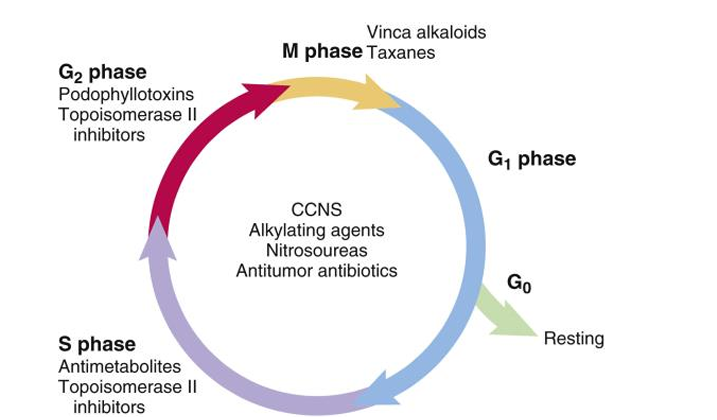
a. G0 Phase
Resting Phase
a. G0 Phase
b. G1 Phase
c. S Phase
d. G2 Phase
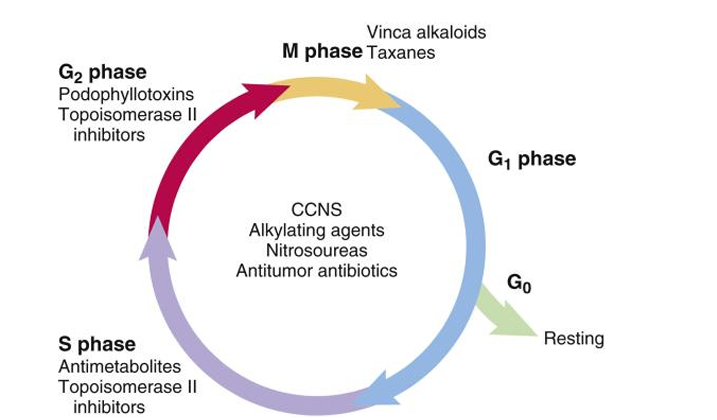
b. G1 Phase
Phase of the cell cycle where RNA and proteins are synthesized
a. G0 Phase
b. G1 Phase
c. S Phase
d. G2 Phase
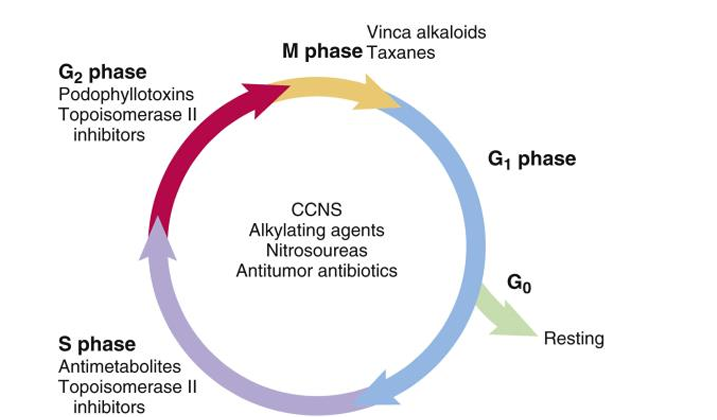
b. G1 Phase
Cells grow larger.
a. G0 Phase
b. G1 Phase
c. S Phase
d. G2 Phase
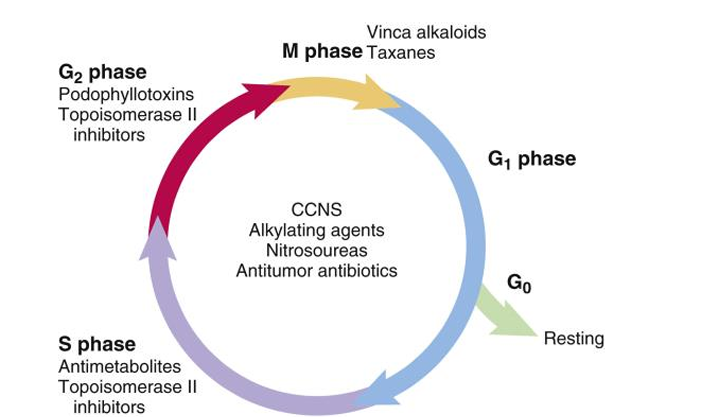
c. S Phase
Phase of the cell cycle where DNA synthesis and replication occur.
a. G1 Phase
b. G2 Phase
c. S Phase
d. M Phase
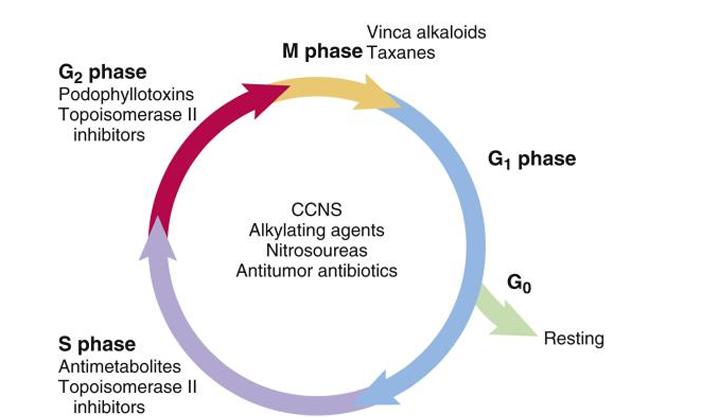
c. G2 Phase
Phase of the cell cycle where DNA synthesis ceases
a. G1 Phase
b. S Phase
c. G2 Phase
d. M Phase
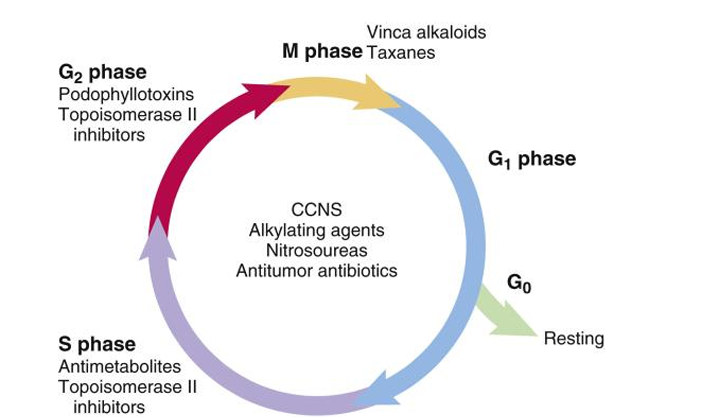
c. G2 Phase
Phase of the cell cycle where RNA and other enzymes (e.g., topoisomerase I and II) are produced to prepare for cell duplication.
a. G1 Phase
b. S Phase
c. G2 Phase
d. M Phase
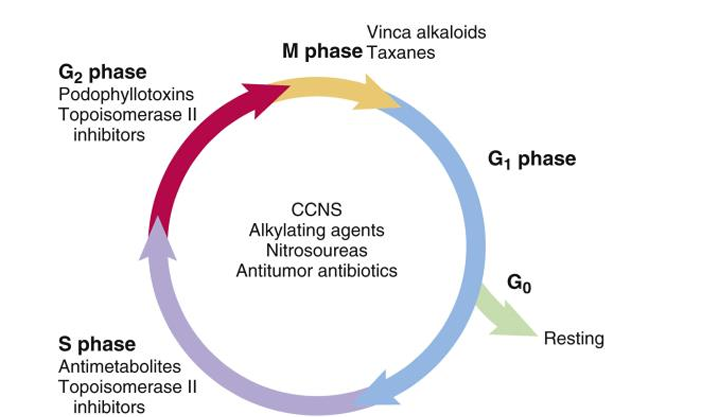
d. M Phase / Mitosis
Phase of the cell cycle where the cell divides into two daughter cells.
a. G1 Phase
b. S Phase
c. G2 Phase
d. M Phase / Mitosis
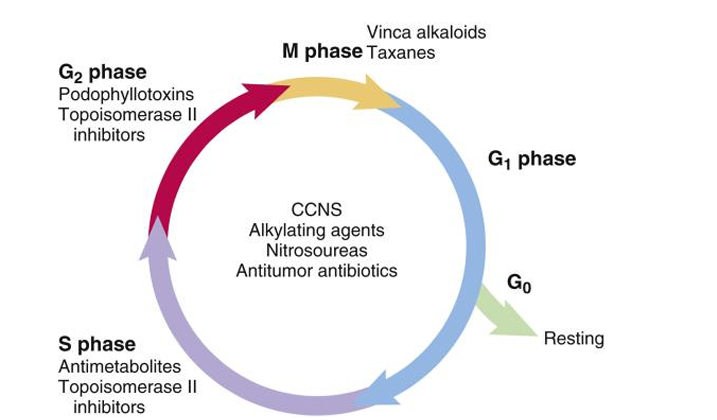
b. Alkylating agents
MOA: Alkylation of reactive species of DNA.
a. Antimetabolites
b. Alkylating agents
c. Vinca alkaloids
d. Taxanes
g. All of the above
Mechlorethamine
Melphalan
Chlorambucil
Bendamustine
Ifosfamide
Cyclophosphamide
Nitrogen mustards include
a. Mechlorethamine
c. Chlorambucil
d. Bendamustine
e. Ifosfamide
f. Cyclophosphamide
g. All of the above
Bone marrow depression
Hemorrhagic cystitis (fibrosis of bladder)
Side effect of nitrogen mustards includes ____
a. Cardiotoxicity
b. Bone marrow depression and Hemorrhagic cystitis (fibrosis of bladder)
c. Pulmonary fibrosis
d. Ototoxicity
d. Both b and c
Cyclophosphamide
Ifosfamide
______ [2] are alkylating agents that causes hemorrhagic cystitis (fibrosis of bladder)
a. Melphalan
b. Cyclophosphamide
c. Ifosfamide
d. Both b and c
b. Hemorrhagic cystitis
Fibrosis of the bladder.
a. Cardiotoxicity
b. Hemorrhagic cystitis
c. Pulmonary fibrosis
d. Peripheral neuropathy
b. MESNA
Antidote for Cyclophosphamide or Ifosfamide-induced hemorrhagic cystitis.
a. Leucovorin
b. MESNA
c. Dexrazoxane
d. Amifostine
a. Amenorrhea, testicular atrophy, sterility
Nitrogen mustards affect germ cells, causing:
a. Amenorrhea, testicular atrophy, sterility
b. Cardiotoxicity, pulmonary fibrosis
c. Nephrotoxicity, ototoxicity
d. Peripheral neuropathy, hepatotoxicity
c. Nitrogen mustards
________ affect germ cells, causing amenorrhea, testicular atrophy, and sterility.
a. Antimetabolites
b. Vinca alkaloids
c. Nitrogen mustards
d. Taxanes
c. Ifosfamide
Alkylating agent that causes neurotoxicity due to its metabolite chloroacetaldehyde.
a. Cyclophosphamide
b. Melphalan
c. Ifosfamide
d. Chlorambucil
b. Chloroacetaldehyde
Ifosfamide is an alkylating agent that causes neurotoxicity due to its metabolite ________
a. Acrolein
b. Chloroacetaldehyde
c. Phosphoramide mustard
d. Carboxyphosphamide
c. Secondary malignancies
Long-term side effect of nitrogen mustards includes:
a. Hypertension
b. Diabetes mellitus
c. Secondary malignancies
d. Hyperthyroidism
c. Both a and b
Thiotepa
Altretamine (Hexamethylmelamine)
Ethylenimine / Methylmelamine alkylating agents include:
a. Thiotepa
b. Altretamine (Hexamethylmelamine)
c. Both a and b
b. Methylmelamines
Ethylenimine is also known as _____
a. Alkyl sulfonates
b. Methylmelamines
c. Nitrogen mustards
d. Nitrosoureas
b. Hexamethylmelamine
Altretamine is also known as _____
a. Thiotepa
b. Hexamethylmelamine
c. Busulfan
d. Cyclophosphamide
c. Busulfan
Alkyl sulfonate alkylating agent that causes pulmonary toxicity.
a. Thiotepa
b. Altretamine
c. Busulfan
d. Ifosfamide
b. Pulmonary toxicity
Busulfan is an alkyl sulfonate alkylating agent that causes ______
a. Cardiotoxicity
b. Pulmonary toxicity
c. Nephrotoxicity
d. Hemorrhagic cystitis
d. All of the above
Carmustine
Lomustine
Stretozotocin
Nitrosoureas include:
a. Carmustine
b. Lomustine
c.Stretozotocin
d. All of the above
a. Nitrosoureas
Used in the treatment of brain tumors.
a. Nitrosoureas
b. Antimetabolites
c. Vinca alkaloids
d. Taxanes
c. Pulmonary toxicity
Side effect of Nitrosoureas includes:
a. Hemorrhagic cystitis
b. Cardiotoxicity
c. Pulmonary toxicity
d. Peripheral neuropathy
c. Streptozotocin
Nitrosourea used for insulinomas because it is toxic to beta cells of the islets of Langerhans.
a. Carmustine
b. Lomustine
c. Streptozotocin
d. Busulfan
b. Beta cells of islets of Langerhans
Streptozotocin is toxic to which cells of the pancreas?
a. Alpha cells of islets of Langerhans
b. Beta cells of islets of Langerhans
c. Delta cells of islets of Langerhans
d. Acinar cells
c. Both a and b
Dacarbazine
Temozolomide
Triazene alkylating agents include:
a. Dacarbazine
b. Temozolomide
c. Both a and b
c. Procarbazine
Methylhydrazine alkylating agent.
a. Dacarbazine
b. Temozolomide
c. Procarbazine
d. Streptozotocin
e. All of the above
Doxorubicin
Epirubicin
Daunorubicin
Idarubicin
Anthracyclines include:
a. Doxorubicin
b. Epirubicin
c. Daunorubicin
d. Idarubicin
e. All of the above
c. Mitoxantrone
Anthracenedione antibiotic.
a. Doxorubicin
b. Daunorubicin
c. Mitoxantrone
d. Idarubicin
c. Anthracyclines and Anthracenedione
MOA: Inhibits Topoisomerase II and intercalates DNA.
a. Vinca alkaloids
b. Taxanes
c. Anthracyclines and Anthracenedione
d. Antimetabolites
Side effect of Anthracyclines is _____
cardiotoxicity
c. Dexrazoxane
Antidote for side effect of anthracyclines such as “cardiotoxicity”
a. Leucovorin
b. MESNA
c. Dexrazoxane
d. Amifostine
a. Dactinomycin / Actinomycin D
MOA: Intercalates between GC base pairs of DNA.
a. Dactinomycin / Actinomycin D
b. Doxorubicin
c. Mitoxantrone
d. Plicamycin
b. GC base pairs
Dactinomycin / Actinomycin D intercalates between ______ pairs of DNA?
a. AT base pairs
b. GC base pairs
c. AG base pairs
d. CT base pairs
a. Streptomyces plicatus
Plicamycin is derived from which source?
a. Streptomyces plicatus
b. Streptomyces caespitosus
c. Streptomyces griseus
d. Streptomyces aureofaciens
b. Streptomyces caespitosus
Mitomycin is derived from which source?
a. Streptomyces plicatus
b. Streptomyces caespitosus
c. Streptomyces nodosus
d. Streptomyces venezuelae
b. L-Asparaginase
Cell cycle specific agent that acts on the G1 phase.
a. Vinca alkaloids
b. L-Asparaginase
c. Taxanes
d. Methotrexate
a. E. coli
L-Asparaginase is derived from which source?
a. E. coli
b. Streptomyces griseus
c. Penicillium notatum
d. Bacillus subtilis
b. L-Asparaginase
MOA: Hydrolyzes asparagine to aspartic acid and ammonia, thus depriving the
tumor cells of asparagine, which is needed for protein synthesis
a. Vinca alkaloids
b. L-Asparaginase
c. Taxanes
d. Methotrexate
Topotecan
Irinotecan
S phase specific agents that are camptothecin derivatives.
a. Topotecan and Irinotecan
b. Etoposide and Teniposide
c. Paclitaxel and Docetaxel
d. Vincristine and Vinblastine
a. Camptothecin derivatives (Topotecan, Irinotecan)
MOA: Inhibits Topoisomerase I.
a. Camptothecin derivatives (Topotecan, Irinotecan)
b. Podophyllotoxin derivatives (Etoposide, Teniposide)
c. Anthracyclines (Doxorubicin, Daunorubicin)
d. Vinca alkaloids (Vincristine, Vinblastine)
b. Cholinergic diarrhea
Irinotecan side effect is _______
a. Hemorrhagic cystitis
b. Cholinergic diarrhea
c. Pulmonary fibrosis
d. Cardiotoxicity
c. Atropine or Loperamide
Management for the side effect of Irinotecan such as “cholinergic diarrhea”
a. MESNA
b. Dexrazoxane
c. Atropine or Loperamide
d. Leucovorin
b. S phase specific agents
Topotecan and Irinotecan are classified as:
a. G1 phase specific agents
b. S phase specific agents
c. G2 phase specific agents
d. M phase specific agents
b. S phase specific agent
Hydroxyurea is classified as:
a. G1 phase specific agent
b. S phase specific agent
c. G2 phase specific agent
d. M phase specific agent
c. HydroxyureaMOA: Inhibit enzymes necessary for folic acid, DNA, or RNA synthesis.
a. Alkylating agents
b. Antimetabolites
c. Antibiotics
d. Plant alkaloids
MOA: Inhibits ribonucleotide reductase (RNR), preventing the conversion of ribo- to deoxyribonucleotides.
a. Methotrexate
b. 5-Fluorouracil
c. Hydroxyurea
d. Cytarabine
b. Antimetabolites
MOA: Inhibit enzymes necessary for folic acid, DNA, or RNA synthesis.
a. Alkylating agents
b. Antimetabolites
c. Antibiotics
d. Plant alkaloids
c. Both a and b
Methotrexate
Pemetrexed
Folic acid analogues include:
a. Methotrexate
b. Pemetrexed
c. Both a and b
b. Myelosuppression
Methotrexate toxicity is called _____
a. Cardiotoxicity
b. Myelosuppression
c. Pulmonary fibrosis
d. Hemorrhagic cystitis
c. Leucovorin / Folinic Acid
The antidote for methotrexate toxicity (myelosuppression) is:
a. MESNA
b. Dexrazoxane
c. Leucovorin / Folinic Acid
d. Amifostine
Cytarabine
5-FU
Capecitabine
Gemcitabine
5-Azacytidine
Pyrimidine Analogues
a. 6-mercaptopurine, Fludarabine, Cladribine, Pentostatin
b. Cytarabine, 5-FU, Capecitabine, Gemcitabine, 5-Azacytidine
6-mercaptopurine
Fludarabine
Cladribine
Pentostatin
Purine Analogues:
a. 6-mercaptopurine, Fludarabine, Cladribine, Pentostatin
b. Cytarabine, 5-FU, Capecitabine, Gemcitabine, 5-Azacytidine
c. Bleomycin
G2 phase specific agent derived from Streptomyces verticillus.
a. Etoposide
b. Teniposide
c. Bleomycin
d. Hydroxyurea
c. G2 phase specific agent
Bleomycin is classified as:
a. G1 phase specific agent
b. S phase specific agent
c. G2 phase specific agent
d. M phase specific agent
c. Bleomycin
MOA: Binds to DNA and generates free radicals.
a. Etoposide
b. Teniposide
c. Bleomycin
d. Hydroxyurea