Thẻ ghi nhớ: Comprehensive Cytology Techniques and Diagnostic Applications in Veterinary Medicine | Quizlet
 Call Kai
 Learn
Learn Practice Test
 Spaced Repetition
 Match
Match Flashcards
 Knowt Play
1/52

There's no tags or description
Looks like no tags are added yet.
Name | Mastery | Learn | Test | Matching | Spaced | Call with Kai | Chat |
|---|
No analytics yet
Send a link to your students to track their progress
53 Terms
What is cytology?
The study of cells, often used for diagnostic purposes.
What are the indications for performing a cytological exam?
Ear problems, nasal issues/discharge, timing for breeding, diagnosis of masses, aspiration of fluid in body cavities, and trans-tracheal wash.
What are the advantages of cytology?
Relatively non-invasive, works well with most tissues and fluids, inexpensive, provides rapid results, and has few complications.
How does cytology differ from histopathology?
Cytology examines individual cells, while histopathology examines tissue architecture.
What information should be included when submitting cytology specimens?
Identification name or number, species, age, sex, brief history, relevant physical examination findings, previous therapy, summary of results from previous tests, differential diagnoses, and sample site.
What stains are commonly used for cytology smears?
Wright Stain, Wright-Giemsa stain, or Diff-Quik.
What is the purpose of immunophenotyping in cytology?
It may be useful in diagnosing some neoplastic diseases.
What methods are used to collect cytology samples from solid masses?
Swab, scrape, imprinting, fine needle biopsy (FNB), tissue biopsy, wedge technique, and punch biopsy.
What is the technique for collecting samples using swabs?
Use sterile swabs moistened with 0.9% sterile saline, roll against the surface, and transfer to a slide.
Why is gentle heat applied to cytology slides?
To remove excess ear wax or for Gram staining without damaging cellular components.
What is the advantage of impression smears?
They collect many cells from the tissue and require minimal restraint.
What is the disadvantage of impression smears?
They collect fewer cells than skin scrapings and may contain more contamination.
What equipment is needed for Tzanck Preparation?
6 clean glass slides and a #10 scalpel blade.
What is the technique for making a Tzanck Preparation?
Touch the slide directly to the lesion, clean with saline, and touch again, then debride and touch the slide to the lesion.
What should be done before making smears from necropsy or surgical tissues?
Blot the surface to remove blood and tissue fluid to ensure cells adhere well.
What is the main disadvantage of scrapings in cytology?
Cells can be damaged during the collection process.
What is the technique for performing a Fine-Needle Aspiration (FNA)?
Useful for masses and lymph nodes, can be performed using aspiration or non-aspiration techniques.
What is the purpose of cytology in veterinary medicine?
To evaluate superficial masses, abnormal tissues, and fluid accumulation.
What types of samples can be collected for cytology?
Samples from external lesions, biopsies, excised masses, and fluids.
What is the role of Wright Stain in cytology?
It is used to stain samples for better visualization of cells.
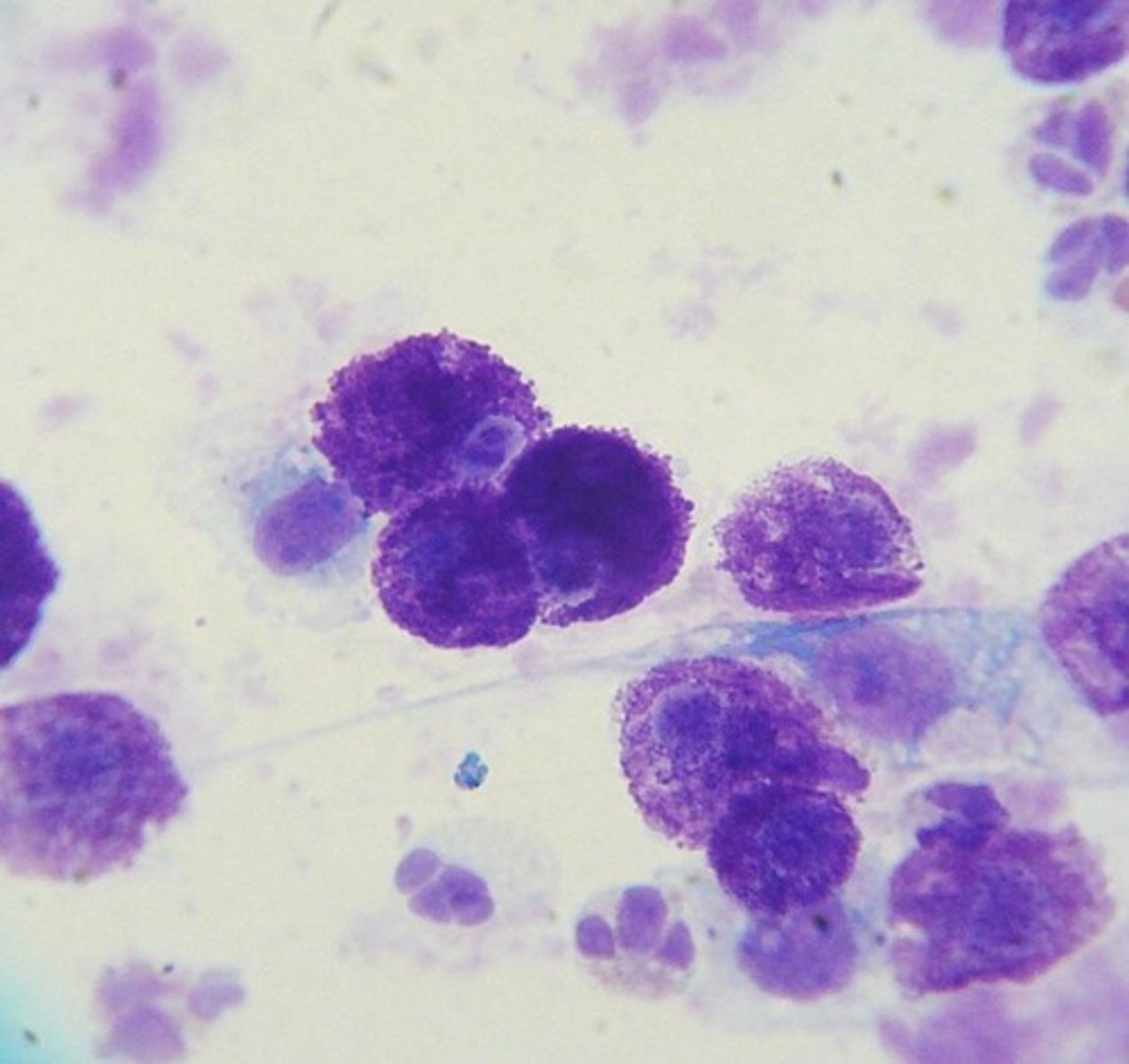
What is the importance of labeling cytology specimens?
To ensure accurate identification and tracking of samples during analysis.
What types of cells can be observed in ear canal cytology?
Keratinized anucleate squamous epithelial cells, cocci, yeast, and mites.
What is Otodectes cynotis?
The most common parasitic infestation of the external ear canal, especially in cats.
What is the significance of using sterile techniques in cytology?
To minimize contamination and ensure accurate results.
What is the purpose of using a dull scalpel blade in scrapings?
To avoid excessive pressure that can damage cells.
What should be avoided when heating cytology slides?
Excess heat, which can destroy cellular components and alter morphology.
What is the main advantage of using fine needle aspiration (FNA)?
It allows for the collection of cells from deep lesions with minimal invasiveness.
What is the advantage of Fine-Needle Aspiration (FNA) for cutaneous lesions?
It helps avoid superficial contamination from bacteria and cells.
What is a disadvantage of Fine-Needle Aspiration (FNA)?
Fewer cells are collected compared to other methods like scraping.
What materials are needed for preparing a collection site for FNA?
A 21 to 25 gauge needle and a 3 to 20 ml syringe.
What is the general rule for selecting needle and syringe size for tissue collection?
The softer the tissue, the smaller the needle and syringe required.
What technique is used during Fine-Needle Aspiration?
Stabilize the mass, insert the needle, apply negative pressure, and redirect the needle while maintaining pressure.
What should be done before removing the needle from the mass during FNA?
Release the negative pressure.
What is the purpose of ultrasound-guided FNB/FNA?
To ensure correct needle placement and prevent laceration of surrounding tissues.
What are the smear techniques used after FNA?
Compression/Modified compression, Combination, Starfish prep, Line prep.
What should not be done to the lesion before performing a biopsy?
The lesion should not be cleaned, as scales and crusts may provide diagnostic clues.
What are the two types of tissue biopsies mentioned?
Wedge biopsy and Punch biopsy.
What is a key advantage of a wedge biopsy?
It provides a large specimen that can be easily oriented by the pathologist.
What is a punch biopsy used for?
It is used for skin biopsies.
What is the technique for performing a punch biopsy?
Rotate the tool in one direction only to avoid shearing damage.
What is the purpose of centesis?
To insert a sterile needle into a body cavity or organ and withdraw fluid.
What are the types of centesis procedures mentioned?
Cystocentesis, Abdominocentesis, Thoracocentesis, Arthrocentesis.
What should be done with fluid collected during abdominocentesis?
Place a portion in EDTA tubes to prevent clotting.
What is synovial fluid evaluated for?
Swollen joints, joint pain, and fever of undetermined origin.
What test is used to evaluate the viscosity of synovial fluid?
Mucin Clot Test.
What is the difference between a bone biopsy and a bone marrow biopsy?
A bone biopsy involves the outer layers of bone, while a bone marrow biopsy involves the innermost part.
What is the first step in performing a bone biopsy?
Administer a local anesthetic before making an incision.
What should be done with the sample after a punch biopsy?
Remove it with fine tissue forceps, blot it dry, and place it on a splint.
How long should a sample remain in fixative before evaluation?
24 hours.
What is the significance of the clarity and color of fluid collected during centesis?
They may indicate underlying disease processes.
What is the recommended needle insertion site for thoracocentesis?
Along the cranial aspect of the rib in the 7th or 8th intercostal space.
What is the recommended needle insertion site for abdominocentesis?
1 to 2 cm caudal to the umbilicus, to the right of ventral midline.
Đang học (3)
Bạn đã bắt đầu học những thuật ngữ này. Tiếp tục phát huy nhé!