MEDICINAL EMULSIONS
 Call Kai
 Learn
Learn Practice Test
 Spaced Repetition
 Match
Match Flashcards
 Knowt Play
1/29

There's no tags or description
Looks like no tags are added yet.
Name | Mastery | Learn | Test | Matching | Spaced | Call with Kai | Chat |
|---|
No analytics yet
Send a link to your students to track their progress
30 Terms
Define a pharmaceutical emulsion.
A system of two immiscible liquids where one phase (disperse phase) is present as fine droplets (0.1–100 µm) within the other (continuous phase).
What are the disperse and continuous phases in emulsions?
Disperse phase: droplets (oil or water)
Continuous phase: surrounding liquid medium
What type of emulsion is predominantly used for oral formulations?
Oil-in-water (O/W) emulsions.
Differentiate between O/W and W/O emulsions.
O/W: oil droplets in water (internal use)
W/O: water droplets in oil (mainly topical, greasy)
What are multiple emulsions? (O/W/O or W/O/W)
Oil droplet enclosing a water droplet suspended in water!
Water droplet enclosing an oil droplet suspended in oil!
* Have uses as delayed action delivery systems.
What is a microemulsion?
A homogeneous, transparent, thermodynamically stable system with the dispersed droplets being 1 nm – 1 (micro)m in size,
the formulation is referred to as a ‘microemulsion’.
How do microemulsions differ from conventional emulsions?
They are thermodynamically stable, transparent, and much smaller in droplet size.
How can dye solubility help identify emulsion type?
Hydrophilic dye → dissolves in O/W
Hydrophobic dye → dissolves in W/O
How does conductivity distinguish emulsion type?
O/W emulsions conduct electricity better than W/O.
What is interfacial tension?
The energy at the boundary between two immiscible phases that keeps them separate.
Why are emulsions inherently unstable?
High interfacial tension leads to droplet coalescence and eventual phase separation to lower the tension.
What happens when oil and water are mixed without stabilisers?
Droplets form temporarily but rapidly coalesce, leading to phase separation.
Why are O/W emulsions preferred for oral use?
(3)
• Fats or oils as medicaments or vehicles for oil-soluble drugs are generally pleasant to take as O/W emulsions.
Can mask taste with water-soluble flavourings
Fine emulsification can enhance absorption of lipid-soluble drugs if an absorbable oil is used
What are emulsions used for in intravenous administration, and what does it administer?
Total Parenteral Nutrition (TPN) to deliver calories, lipids, and fat-soluble vitamins.
How does IV administration work when O/W emulsions used and what emulsifiers are used commonly and why?
• The disperse phase (oil phase) will solubilise many lipophilic
vitamins and proteins, which are present naturally in the oils.
• Cottonseed, olive, soybean, and safflower are natural oils
with high calorific values used in TPN.
Common emulsifier used:
Lecithin, due to low toxicity
Compare topical O/W and W/O emulsions.
O/W: washable, spread easily
W/O: greasy, occlusive barrier - blocking barrier
What does the HLB value represent?
The balance between hydrophilic and lipophilic properties of a surfactant.
An HLB number is assigned to the emulsifying agent.
The higher the HLB value, the more hydrophilic
the emulsifying agent.
How does HLB relate to surfactant properties?
High HLB of agent → more hydrophilic
Low HLB of agent→ more lipophilic
What is the Required HLB (RHLB)?
The specific HLB value required to stabilise a given oil phase.
How is the overall RHLB of an emulsion calculated?
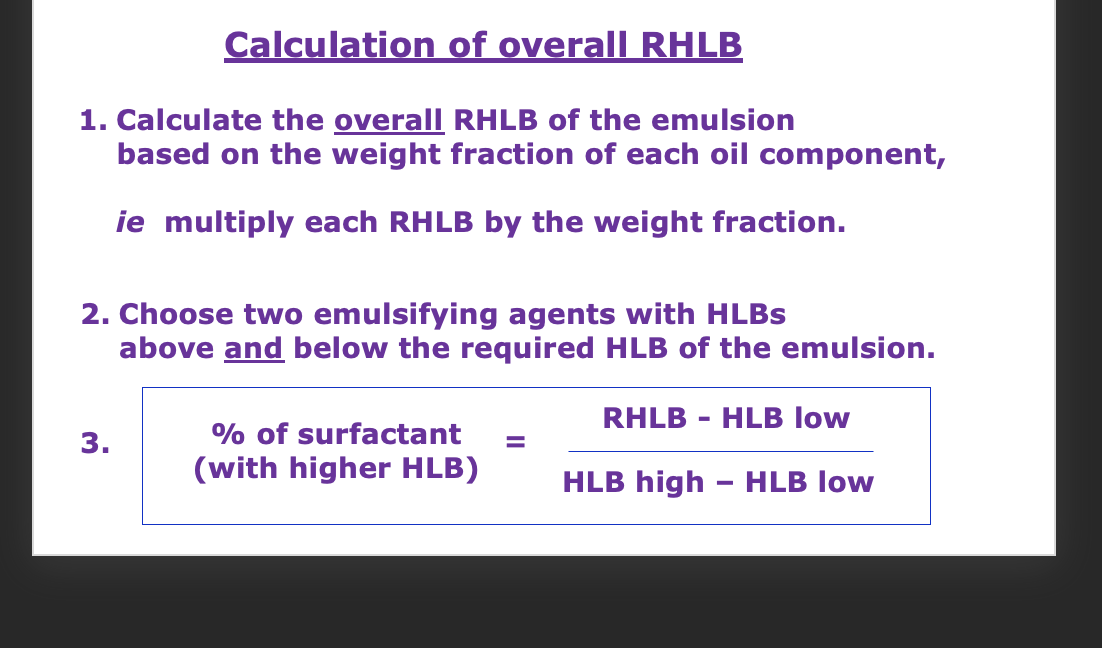
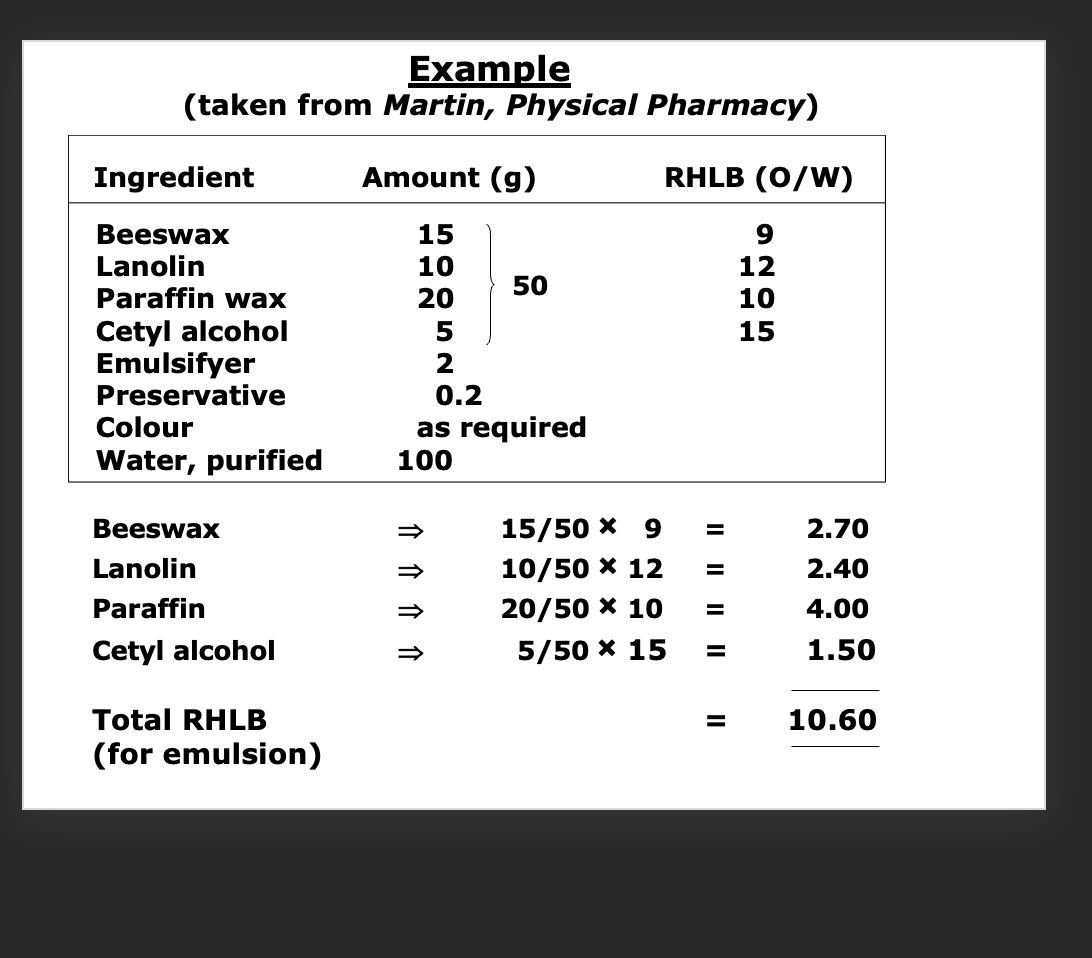
How is the overall RHLB of an emulsion calculated? Example
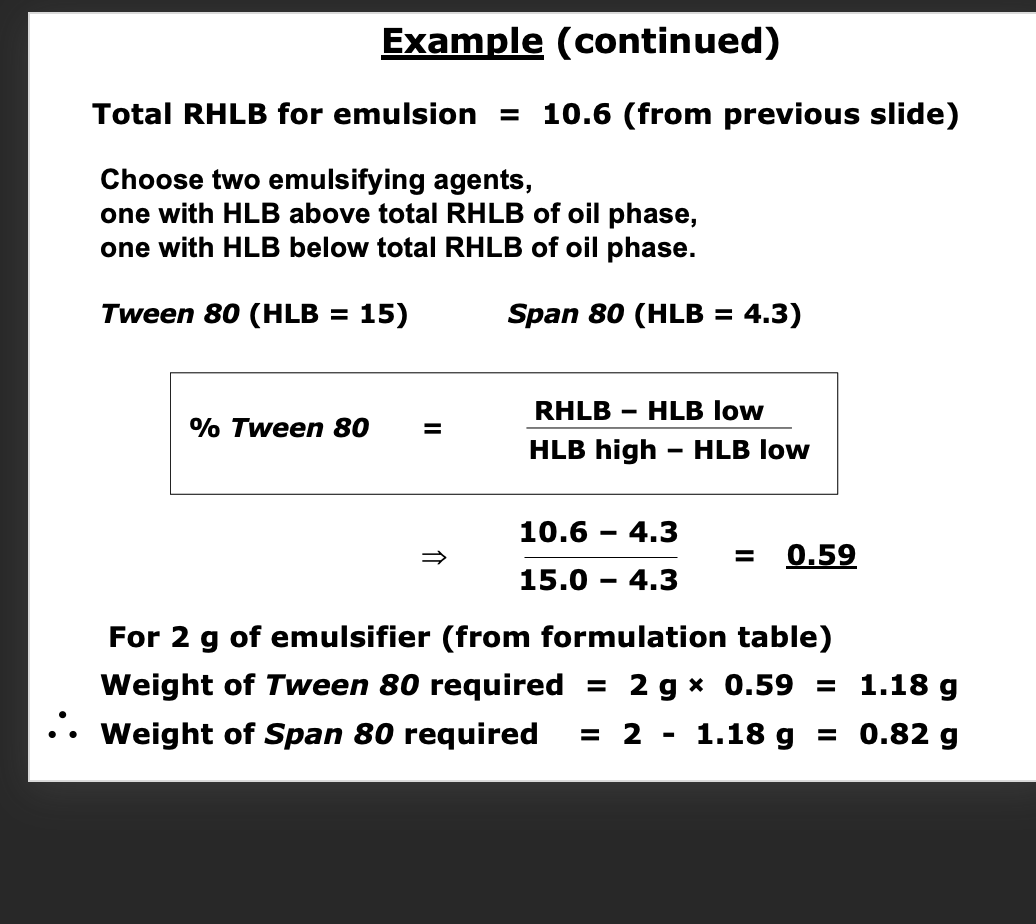
How are emulsifying agents selected using RHLB?
Choose two surfactants with HLB values above and below the required HLB and blend them.
What are the characteristics of an ideal emulsion? (3)
• Globules of disperse phase retain their initial character.
i.e., size and shape
• Globules remain evenly distributed.
i.e., do not coalesce
• Emulsions do not support bacterial growth.
List key properties of an ideal emulsifying agent. (4)
Non-toxic, non-irritant
Colourless, odourless, tasteless
Produces stable emulsions:
- no creaming,
- no cracking,
- no flocculation,
- no deflocculation,
- no phase inversion.
Effective at low concentration
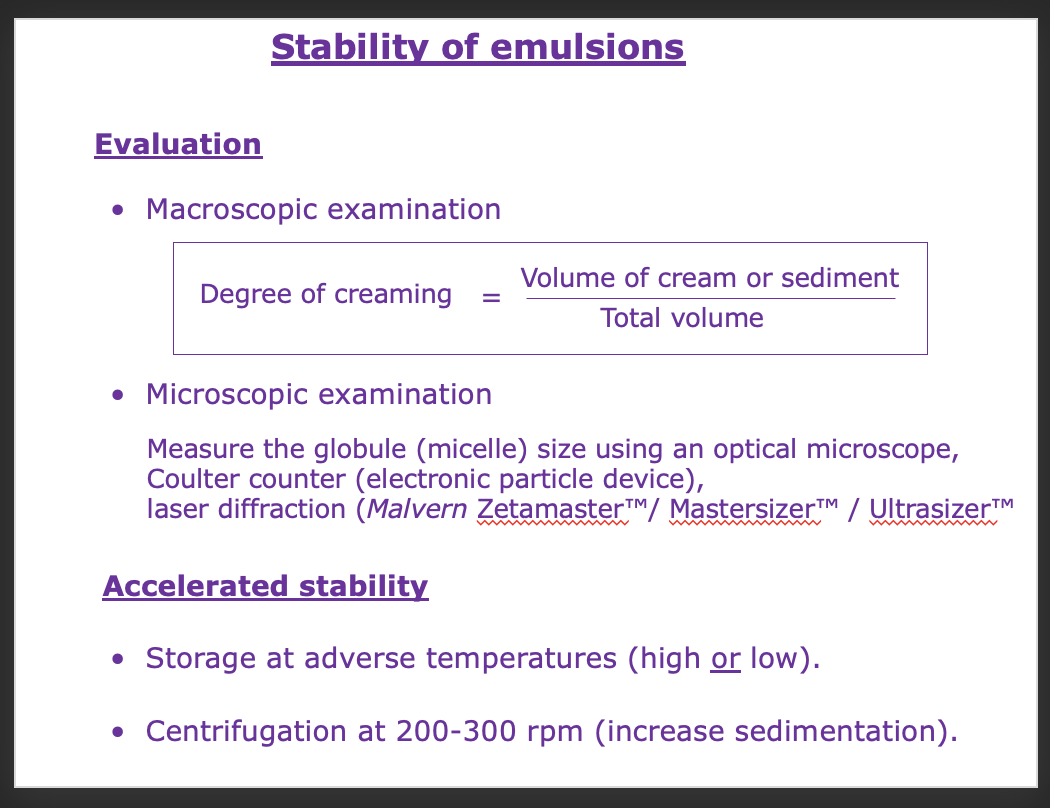
How is emulsion stability evaluated? (3)
Macroscopic and microscopic examination
Droplet size measurement
Accelerated stability testing (temperature, centrifugation)
What type of flow behaviour do most emulsions exhibit?
A: Non-Newtonian (often pseudoplastic) flow.
What factors influence emulsion viscosity?(4)
Phase volume ratio
Particle size distribution
Viscosity of phases
Concentration and properties of emulsifying agent
Why must emulsions be preserved?
The aqueous phase supports microbial growth, which can degrade the formulation.
Where do microorganisms primarily grow in emulsions?
In the aqueous phase.
What properties are required for an effective preservative in emulsions?(4)
Low toxicity
Broad antimicrobial activity
Remains un-ionised
Does not bind to formulation components