LSU ECON 2030 Final Study Guide 2026
 Call Kai
 Learn
Learn Practice Test
 Spaced Repetition
 Match
Match Flashcards
 Knowt Play
1/148

There's no tags or description
Looks like no tags are added yet.
Name | Mastery | Learn | Test | Matching | Spaced | Call with Kai | Chat |
|---|
No analytics yet
Send a link to your students to track their progress
149 Terms
Economics
the study of how human beings coordinate their wants and desires, given the decision-making mechanisms, social customs, and political realities of the societyand the scarcity of resources. It examines the production, distribution, and consumption of goods and services.
what to produce, how to produce it, for whom to produce it
the three central coordination problems any economy must solve
microeconomics
the branch of economics that studies individual agents and choices such as the pricing of firms, decisions on what to buy, and how to allocate market resources among alternative ends
macroeconomics
branch of economics that studies things such as inflation, unemployment, and economic growth
marginal cost
the additional cost over and above costs already incurred
marginal benefit
the additional benefit above what has already been derived
economic reasoning
reasoning based on the premise that everything has a cost
opportunity cost
the benefit one might have gained from choosing the next-best alternative
implicit costs
costs associated with a decision that often are not included in normal accounting costs and ARE included in opportunity costs
sunk costs
costs that show up in financial accounts that are already spent and ARE NOT included in opportunity costs
economic forces
the necessary reactions to scarcity
market force
an economic force that is given relatively free rein by society to work through the market
the invisible hand
the price mechanism that guides our actions in a market and an example of a market force
economic, social, and political forces
what happens in society is a reaction to, and interaction of these
positive economics
the study of what is and how the economy works
normative economics
the study of what the goals of the economy should be
the art of economics
using the knowledge of positive economics to achieve the goals determined in normative economics
economic institutions
laws, common practices, and organizations in a society that affect the economy
economic theories
these tie together economists’ terminology and knowledge about economic institutions
economic model
a framework that places the generalized insights of a theory in a more specific contextual setting
economic principle
a commonly held insight stated as a law or general assumption
Production possibility curve
a curve measuring the maximum combination of outputs that can be obtained from a given number of inputs
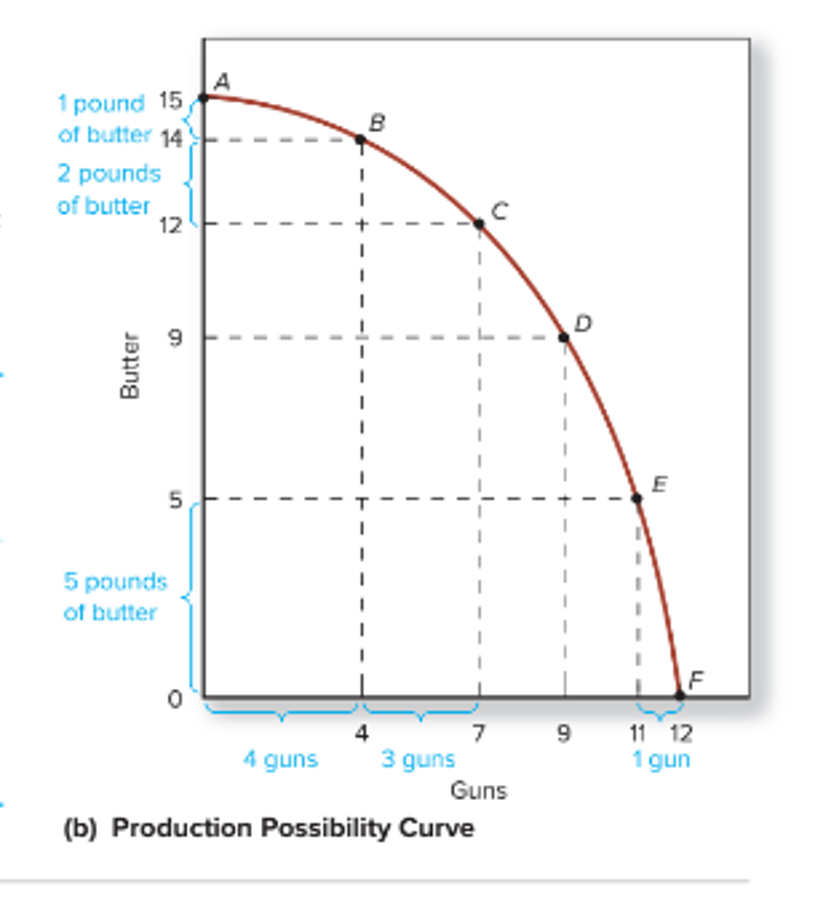
productive efficiency
achieving as much output as possible from a given amount of inputs or resources
productive inefficiency
getting less output from inputs that, if devoted to some other activity, would produce more output
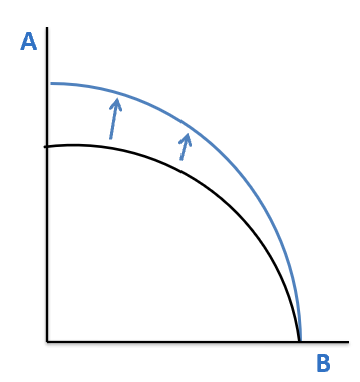
technological or resource increase
what can move a PPC outwards
biased
what kind of technological increase is this
comparative advantage
something a resource has if it is better suited to the production of one good than to the production of another good
specializattion and trade
how countries can increase consumption
the law of one price
a law that states wages of workers in one country will not differ significantly from the wages of equal workers in another instituionally similar country
the law of demand
a law that states that the quantity of a good demanded is inversely related to the goods price
inversely
quantity demanded and price are ______ related
demand
income, prices of other goods, tastes, expectations, and taxes and subsidies all are shift factors of ______
quantity demanded
a specific amount that will be demanded per unit of time at a specific price, other things constant. It refers to a specific point on the demand curve
demand
a schedule of quantities of a good that will be bought per unit of time at various prices, other things constant. it refers to the entire demand curve
the law of supply
law that states the quantity of a good supplied is directly related to the good’s price
directly
quantity supplied and price are _____ related
quantity supplied
a specific amount that will be supplied per unit of time at a specific price, other things constant. It refers to a specific point on the supply curve
supply
a schedule of quantities of a good a seller is willing to sell per unit of time at various prices, other things constant. It refers to the entire supply curve.
equilibrium quantity
the amount bought and sold at quilibrium price
equilibrium price
the price towards which the invisible hand drives the market
excess supply or surplus
if this exists, quantity supplied is greater than the quantity demanded
excess demand or shortage
if this exists quantity demanded is greater than quantity supplied
rise
prices adjust and tend to ____ when there is a shortage or excess demand
fall
prices adjust and tend to ____ when there is a surplus or excess supply
Price elasticity of demand
the percentage change in quantity demanded divided by the percentage change in price
positive
price elasticity of demand is always a _____ number
perfectly elastic
if ED = infinity, demand is ________ because quantity changes infinitely in repsonse to a change in price
elastic
if ED > 1, demand is _____ because the % change in quantity is greater than the change in price
unit elastic
if ED = 1, demand is _____ because the % change in quantity and price are the same
inelastic
if ED < 1, demand is _____ because the % change in quantity is less than the percentage change in price
perfectly inelastic
if ED = 0, demand is ______ because the quantity does not change in response to changes in price
decrease
if ED > 1, increasing price will _____ total revenue
increase
if ED < 1, an increase in price will ______ total revenue
not change
if ED = 1, an increase in price will ______ total revenue
income elasticity of demand
the responsiveness of demand to changes in income
normal good
a good whose consumption increases with an increase in income
necessity
a good whose E_income is between 0 and 1l
luxury
a good whose E_income > 1
inferior
a good whose consumption decreases with an increase in income
cross-price elasticity of demand
a measure of the responsiveness of demand to changes in prices of other related goods
substitutes
goods that can be used in place of others, and whose E_cross-price > 0
complements
goods that are used in conjunction with others, and whose E_cross-price < 0
Price elasticity of supply
the percentage change in quantity supplied divided by the percentage change in price
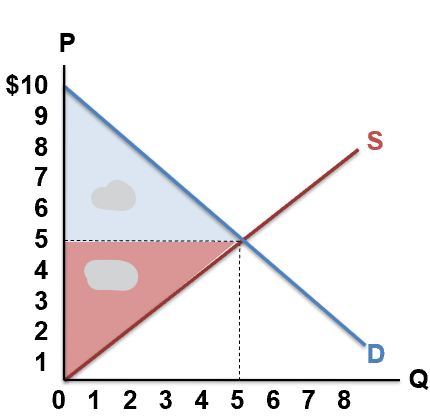
consumer surplus
what does the blue shaded region represent
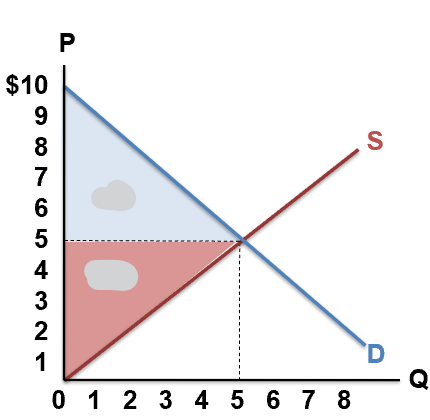
producer surplus
what does the red shaded region represent
market equilibrium
at what price is the combination of consumer and producer surplus maximized
elastic
producers bear the burden of taxation more when demand is
inelastic
consumers bear the burden of taxation more when demand is
to maximize profits
the goal of a firm
total cost
the explicit payments to the factors of production plus the opportunity cost of the factors provided by the owners of the firm
total revenue
the amount a firm receives for selling its product or service plus any increase in the value of the assets owned by the firm
false
economists and accountents measure profit the same way
total costs
fixed costs plus variable costs equals
economic profit
total revenue - total costs =
marginal cost
change in total cost divided by the change in quantity
average fixed cost
fixed cost divided by quantity
average variable cost
variable cost divided by quantity
average total cost
average fixed cost + average variable cost
perfectly competitive
a market in which economic forces operate unimpeded is considered to be
buyers and sellers are price takers, no barriers to entry, firms’ products are identical
3 conditions for perfect competition
marginal revenue
the change in total revenue associated with a change in quantity
marginal cost
the change in total cost associated with a change in quantity
decreasing
if marginal revenue is less than marginal cost, a firm can increase profit by _____ output
increasing
if marginal revenue is less than marginal cost, a firm can increase profit by _____ output
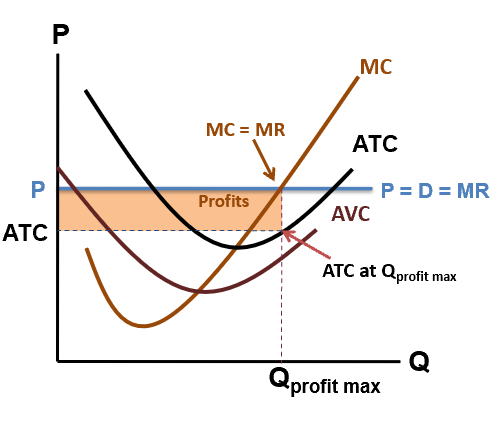
Yes
is this firm making profit
No
is this firm making profit
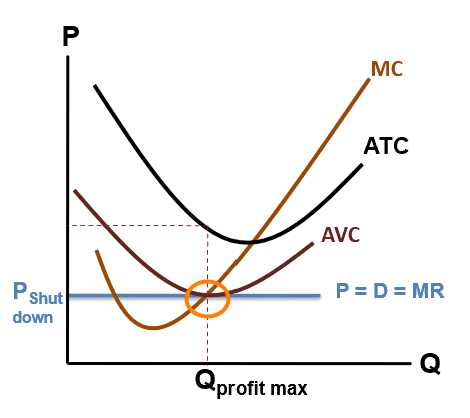
the shutdown point
the point at which below it the firm would be better off to temporarily shut down than stay in business
the profit maximizing level of output
the point at which marginal cost equals price
MC = MR = P
the profit maximizing condition for perfectly competitive firms
average variable costs
firms shut down production if price falls below the minimum of their
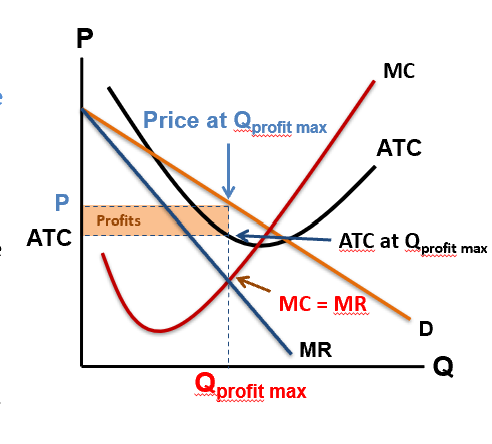
monopoly
a market structure in which one firm makes up the entire market
below
marginal revenue is always ____ its price for a monopolistic firm
just look
price discrimination
charging different prices to different individuals based on their elasticity of demand
classical economists
economists who believe that business cycles are temporary glitches, and generally favor laissez-faire, or non-activist policies
kenyesian economists
economists who believe that business cycles reflect underlying problems that can be addressed with activist government policies
business cycle
an upward or downward movement of economic activity that occurs around the growth trend
potential output
the highest amount of output an economy can sustainably produce and sell using existing production processes and resources
the unemployment rate
the percentage of people in the economy who are willing and able to work but cannot find jobs
frictional unemployment
unemployment caused by people entering the job market and people quitting a job juts long enough to look for and find another job