SEM Cross Cutting Theme 1 - The Life Course Approach
 Note
Note Call Kai
 Learn
Learn Practice Test
 Spaced Repetition
 Match
Match Flashcards
 Knowt Play
1/25

There's no tags or description
Looks like no tags are added yet.
Name | Mastery | Learn | Test | Matching | Spaced | Call with Kai | Chat |
|---|
No analytics yet
Send a link to your students to track their progress
26 Terms
Equality
Equality is about giving everyone the same resources.
Equity
Equity is about recognizing different needs and starting points, ensuring each person gets what they need to thrive. Advancing equity involves addressing social justice, human rights, equitable access, and the determinants of health. It requires a political process and an intersectoral approach, bringing together various sectors to create comprehensive solutions.
Inequality
The uneven distribution of health and/or health resources due to biological factors or lack of access to healthcare.
Inequity
Unfair, avoidable differences due to social exclusion, racial discrimination and gorvement corruction.
To Advance Equity

“At risk”
“At risk” refers to groups with higher exposure to specific hazards. For instance, people living in flood-prone areas are at higher risk of flooding than people living in non-flood-prone areas.
“Vulnerability”
Vulnerability, however, goes deeper. Vulnerable populations are those who, due to social or physical characteristics, face greater danger from these risks. For example, elderly residents or those with disabilities in a flood-prone area are more vulnerable because they may lack the resources or mobility to respond effectively.
“Personal preferences”
Inequity in health can result from not providing access that meets individual needs. People experience inequity when, because they are part of a specific group, they are treated unfairly. All of the following are sources of inequity except:
The life course approach is based on the understanding that there is a complex interplay of multiple factors. All of the following factors are considered in the life course approach except:
Unknown
The life Course Approach

The Barker Hypothesis: Fetal Origins of Adult Disease
Barker’s hypothesis was that intrauterine growth restriction, low birth weight, and premature birth have a causal relationship with adult chronic diseases like heart disease and type II diabetes. The work of Barker and others set the stage for researchers and practitioners to focus their attention on the life course: the ways in which prior conditions and experiences affect later health.
Life Course Stages
Pregnancy: The development of a zygote into an embryo and then into a fetus in preparation for childbirth.
Infancy: The earliest part of childhood. It is the period from birth through age 1.
Toddler years: Occur during ages 2 and 3 and are the end of early childhood.
Childhood: Takes place from ages 4 to 8.
Puberty: The period from ages 9 to 13, which is the beginning of adolescence.
Older adolescence: The stage that takes place between ages 14 and 18.
Adulthood: The period from adolescence that begins at age 19 to the end of life.
Middle age: The period of adulthood that stretches from age 31 to 50.
Senior years, or old age: Extend from age 51 until the end of life.
Life Course Functional Phases
Health development through the life course can also be viewed through four distinct functional phases:
Phase 1 - Generativity
The preconception and prenatal period is dedicated to the formation of the organism and includes the context in which the developing fetus grows. This phase can include the nutritional inputs and neural-hormonal contexts that influence a person’s reproductive health trajectory, including those early influences on the eggs that are developing in the ovaries years before a person is reproductively able (Halfon et al., 2014).
Phase 2 - Acquisition of capacity
The early years of childhood and adolescence through early adulthood are dedicated to the development, acquisition, and optimization of specific capacities, including, under optimal conditions, investing in future health potential and anticipated developmental reserves.
Phase 3 - Maintenance of function
The middle years of life, comprising adulthood and early middle age, are dedicated to maintaining function of these capacities in the face of accumulating risks and ongoing weathering.
Phase 4 - Managing decline
The later years of old age are dedicated to managing, adjusting, and adapting to functional decline of various body and regulatory systems.
Five Major Constructs of the Life Course Approach
1. Early Programming
Programming is the process whereby a stimulus or insult, at a sensitive or "‘critical period", has a lasting or lifelong impact on health or function.
Early programming posits that early-life experiences, including prenatal, can influence health and function for life.
2. Critical and Sensitive Periods
The Life Course Approach recognizes that timing of an exposure during specific time periods of unalterable biological development, called “critical periods,” can affect that development. Sensitive periods are periods where an exposure can have a greater impact than at another time. Critical periods are a specific type of sensitive period, defined by a specific time window.
3. Cumulative Impact and Allostasis
The cumulative impact of exposure to both beneficial and adverse circumstances over the life course will vary for each individual and will constitute a unique “life exposure trajectory” that will manifest itself in different expressions of health and well-being. Allostasis is the process by which the body maintains stability through change.
4. Risk and Protective Factors
When examining the role of exposure on health, we take into account both risk and protective factors. By addressing cumulative impact and timing of both types of factors, it is possible to improve the strategies we use to reduce inequity and improve health outcomes.
5. Trajectories
A trajectory is defined as an individual’s long-term pattern of stability and change. Changes include major life events, life transitions, and turning points that produce lasting shifts in a person’s life trajectory.
Sensitive Period Example: Fetal Development
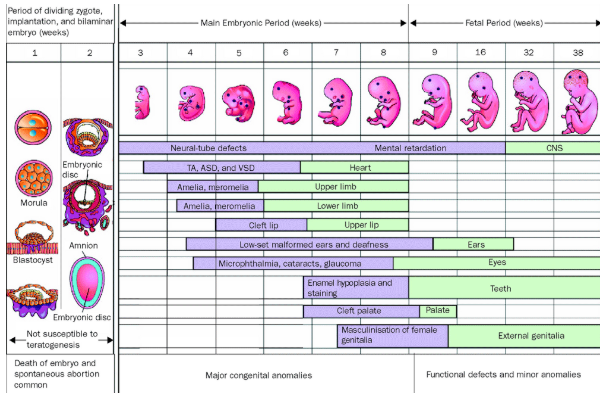
When cancer is diagnosed in a pregnant person, life-saving chemotherapy for the pregnant person poses life-threatening concerns for the developing fetus. Depending on the type of cancer and the stage at diagnosis, chemotherapy cannot necessarily be delayed until after delivery. Figure 11 illustrates sensitive periods in fetal development, showing how the impact of the pregnant person’s chemotherapy on development differs during different phases of pregnancy. Safe use of chemotherapy, especially during the second and third trimester, has been reported, and pregnant people with cancer can accept therapy without definite neonatal harm (Cardonick, E. et al., 2004).
Important note about Figure 11: This figure contains terms that are outdated and may be considered offensive, such as “mental retardation.” These terms reflect historical usage and are included here for historical context and completeness. In contemporary practice, we use more respectful and accurate language, such as “intellectual disability.” Please understand that the inclusion of these terms does not reflect current terminology standards or our commitment to respectful and inclusive language.
Critical and Sensitive Period Example: Famine
We know from terrible “natural experiments” such as exposure to famine during World War II that the earlier in gestation that the exposure to malnutrition occurs, the greater the extent of effects on metabolic homeostasis. The Hunger Winter (aka Dutch Famine) was caused by the German blockade of food and fuel from farm towns to the densely populated regions of western Netherlands. When examined decades later, people who were exposed to famine during different trimesters of their fetal development showed various health impacts.
The Dutch famine cohort illustrates the critical effect of timing of exposures in humans. Individuals who were in utero early in gestation during the famine suffer from an increased incidence of coronary heart disease, hypertension, dyslipidemia, and obesity.
Those who were in utero midgestation suffer from an increased incidence of obstructive airway disease and impaired glucose tolerance (Boekelheide, et al. 2012).
The next generation born to this utero–deprived cohort were also impacted, indicating a multiple generation exposure (Painter et al., 2008).
Figure 12 highlights the timing of in utero nutritional deprivation, which is associated with different later-life disease outcomes.

The Weathering Hypothesis
The weathering hypothesis was motivated by observations of earlier onset of chronic diseases such as hypertension impacting birth outcomes in Black people relative to white people and originated from Geronimus' empirical studies on racial disparities in birth outcomes. Geronimus found that white teenage mothers had a higher risk for infant mortality and low birth weight babies than white mothers in their mid-to-late 20s. In addition, Black teenage mothers had a lower risk for infant mortality and low birth weight babies than older Black mothers.
Allostasis and Allostatic Load
The study of allostasis and allostatic load is a model that can help us understand the ways in which stress affects the body through cumulative impact. “The brain and the body are in two-way communication via the autonomic nervous system and the endocrine and immune systems. It is these systems that provide protection and allow adaptation in the face of acute stress, yet they also contribute to the negative impact of chronic stress and an unhealthy lifestyle” (McEwen, 1998).
Allostasis
Allostasis works through a negative feedback mechanism, which is common to many biological systems. It works very much like a thermostat. When the temperature of a room falls below a preset point, it triggers the heat to turn on. Once the temperature reaches that preset point, the heat automatically turns off. Acting similarly in the human body, the hypothalamic-pituitary-adrenal (HPA) axis involves the central nervous system and the endocrine system adjusting the balance of hormones in response to stress. In the stress response, the HPA axis produces cortisol. Cortisol, in turn, feeds back to the brain to shut off the HPA axis.
Allostatic Load
Chronic exposures to stressful events and circumstances, in which there is insufficient or no opportunity to recover, accumulate over time, leaving lasting impacts on health. In the face of repeated or chronic stress, the body loses the ability for self-regulation: You can turn it on, but you can’t shut it off. Biologically speaking, chronically elevated levels of cortisol start to down-regulate the glucocorticoid receptors in the brain, leading to the loss of negative feedback.
Risk and Protective Factors
Risk factors include food insecurity, lack of access to quality health services, environmental pollution, racial discrimination, and living in poverty. Protective factors include economic security, safe neighborhoods, strong and positive relationships, a nurturing family, and access to quality primary care and other health services.
Risk Reduction Strategies
Understanding the number and timing of risk and protective factors can make it possible to improve the types of strategies we use in order to reduce disparities and improve health outcomes, particularly if timed during sensitive periods of development. In Figure 17, risk reduction strategies are represented with dashed lines and health promotion strategies with solid lines. These interventions, when implemented throughout the life course, might change developmental trajectories and close the Black-white gap in reproductive potentials (Lu & Halfon, 2003).

Trajectories vs transition
A trajectory is defined as an individual’s long-term pattern of stability and change involving multiple transitions. A transition is a distinct change in roles and status, for example, getting married or being diagnosed with a chronic health condition. A transition leads to a longer pathway that will have some stability and is likely to involve additional transitions along the way.
Major life events: Significant occurrence of abrupt change with long-lasting effects
Transition: Distinct change in roles and statuses
Turning point: Life events or transitions producing lasting shift in trajectory
Adverse Childhood Experiences (ACEs)
The Original ACE Study
The original Adverse Childhood Experiences (ACEs) study was conducted in the 1990s by Robert F. Anda, MD, at the CDC and Vincent J. Felitti, MD, with Kaiser Permanente. The original sample of 17,337 adult subscribers underwent routine comprehensive physical examinations and chose to provide detailed information about their childhood experiences of abuse, neglect, and family dysfunction.
The ACE Study used a pyramid diagram, as shown in Figure 21, to depict ACEs and their impact as spanning from conception at the base of the pyramid up through life stages, with death at the peak of the pyramid. By working within this framework, the ACE Study began to progressively uncover how ACEs are strongly related to the development and prevalence of risk factors for disease and health and social well-being throughout the lifespan.
ACE Categories
Adverse childhood experiences (ACEs) were categorized into three groups: abuse, neglect, and household challenges. Participants were asked to respond either Yes or No on ten items about their experiences as children:
Family Dysfunction
1. Mentally ill, depressed, or suicidal person in the home
2. Drug-addicted or alcoholic family member
3. Parental discord (divorce, separation, abandonment)
4. Witnessing domestic violence against the mother
5. Incarceration of any family member
Abuse as a Child
6. Physical
7. Sexual
8. Emotional
Neglect as a Child
9. Physical
10. Emotional
Results Summary
ACEs are common:
64% of adults have one or more
32% have three or more
12.5% have four or more
ACE categories are interrelated, with 87% of people having more than one. Study results show a graded dose-response relationship between ACEs and negative health and well-being outcomes. In other words, as the number of ACEs increases, so does the risk for negative outcomes. Higher ACE scores were linked to higher-risk populations. Table 11 provides demographic information for the ACE study.
Preventing ACEs
