Unit B - Energy Transformation
 Call Kai
 Learn
Learn Practice Test
 Spaced Repetition
 Match
Match Flashcards
 Knowt Play
1/109

Earn XP
Description and Tags
Biochemistry
Name | Mastery | Learn | Test | Matching | Spaced | Call with Kai | Chat |
|---|
No analytics yet
Send a link to your students to track their progress
110 Terms
A1:
Given a molecular structure, classify it as an aldose, ketose or non-carbohydrate.
Given a carbohydrate structure, identify the anomeric carbon(s).
Given a disaccharide, oligosaccharide or polysaccharide structure, identify glycosidic linkages.
Given a monosaccharide, disaccharide, oligosaccharide, or polysaccharide structure, identify the reactive (reducing) end(s) of the molecule and location(s) of glycosidic linkage(s).
Given a carbohydrate covalently bonded to another biomolecule (e.g., phosphoryl group, protein, lipid) discriminate between glycosidic and non-glycosidic linkages.
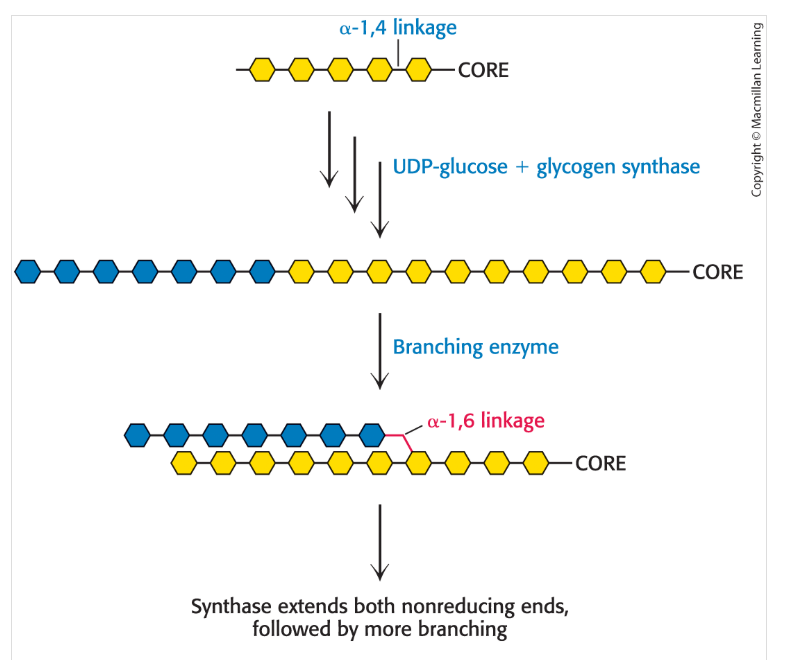
Given the structure of glycogen, discriminate between components synthesized by glycogenin, glycogen synthase and branching enzyme.
Given the structure of glycogen, summarize its chemical and physical properties that make it a safe and efficient way of storing energy in cells.
Carbohydrates
Carbon-based molecules that are rich in hydroxyl groups (CH2O)n
“Polyhydroxy aldehydes and ketones and their derivatives”
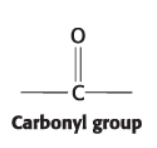
Carbonyl Group
A functional group with a carbon atom double-bonded to an oxygen atom, found in aldehydes and ketones.
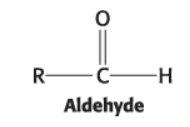
Aldehyde
A type of organic compound containing a carbonyl group located at the end of the carbon chain, characterized by the formula RCHO.
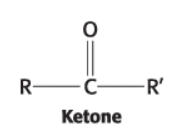
Ketone
An organic compound containing a carbonyl group located within the carbon chain, characterized by the formula RC(=O)R'.
Monosaccharides
Commonly Known as Sugars used for DNA and fuel molecules
3 to 7 carbons in length
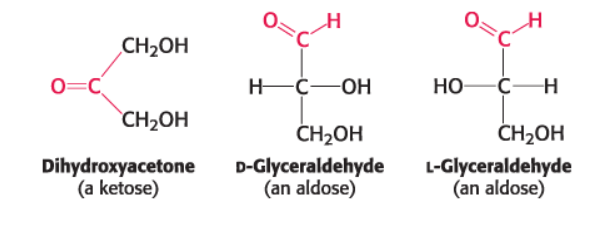
Monosaccharides are Classified by :
by carbon-chain length and identity of most oxidized group
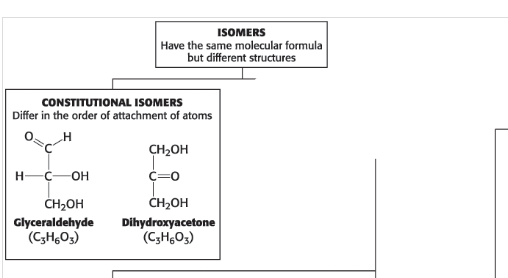
Constitutional Isomers
identical molecular formulas but differ in how the atoms are ordered
Stereoisomers
Atoms are connected in the same order but differ in spatial arrangement
compounds with the same formula and connectivity but different 3D spatial arrangements.
2n - where n is the number of chiral centers
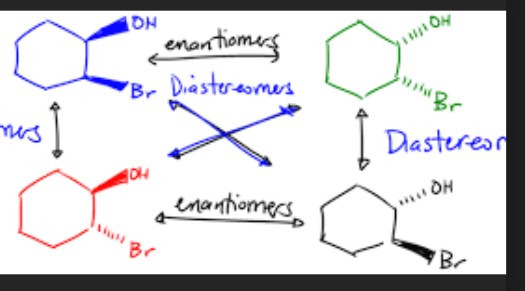
Diastereomers
A specific type of stereoisomer that are not mirror images of each other and are not superimposable
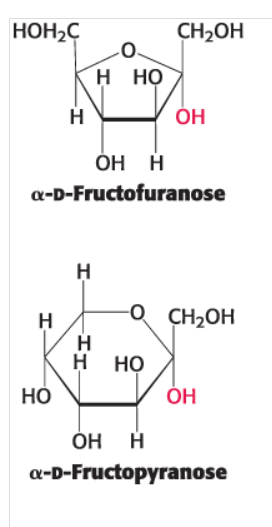
Anomers
A type of cyclic sugar isomer that differs from another isomer at the anomeric carbon, resulting in different configurations.
alpha Haworth projections
hydroxyl groups attached to C-1 below the plane of the ring
beta Haworth projections
hydroxyl groups attached to C-1 above the plane of the ring
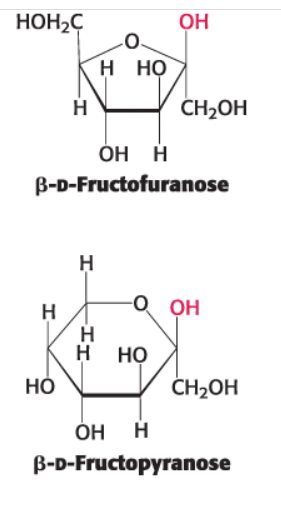
Anomeric Carbon
It is a chiral carbon atom in a cyclical sugar characterized by being bonded to two oxygen atoms—the ring oxygen and a hydroxyl group—allowing for two configurations: (trans) and (cis).
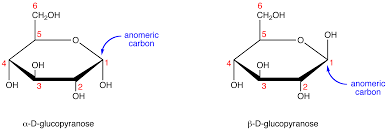
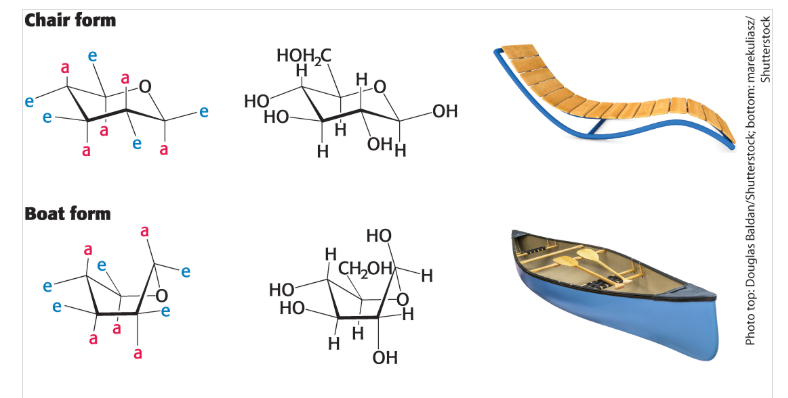
Axial bonds
perpendicular to the plane of the ring can cause steric hindrance if on the same side of the ring
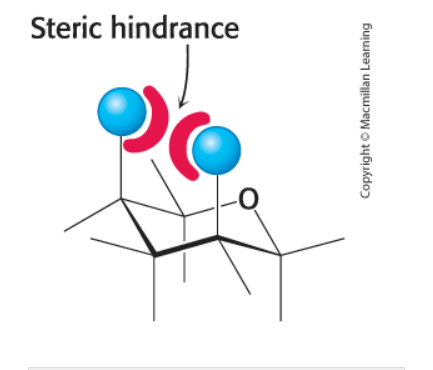
Equatorial Bonds
parallel to the plane of the ring and generally less sterically hindered compared to axial bonds, this causes more stable conformations in cyclic structures.
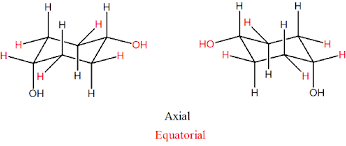
What conformation is the most stable
Chair conformation with (-OH and CH2OH) in the equatorial positions to minimize steric strain
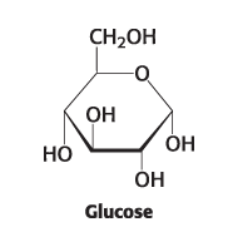
Glucose is a Reducing Sugar
because it has a free aldehyde or ketone group that can donate electrons, enabling it to reduce other compounds
in its open-chain form) or a free hemiacetal group (in its cyclic form), allowing it to reduce oxidizing agents like Cu+
Glycation
Reducing sugars can often nonspecifically react with a free amino group, usually at alysine or arginine residue, to form a stable covalent bond.
This process can lead to the formation of advanced glycation end products (AGEs), which are implicated in various diseases.
Glycosidic linkage
is a type of covalent bond that joins a carbohydrate (sugar) molecule to another group, which can be another sugar or a different molecule. These linkages are formed through a dehydration reaction, involving the removal of a water molecule.
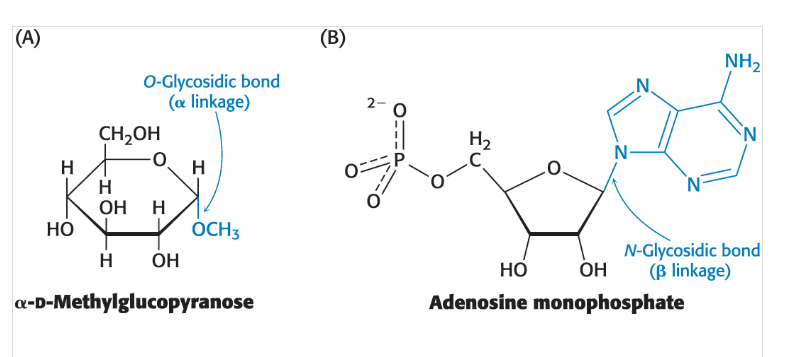
O-Glycosidic linkage
are prominent when carbohydrates are joined together to form long polymers
Oligosaccharides
two or more monosaccharides by O-glycosidic linkages
Directionality defined by their reducing and nonreducing end
Glycosidic Linkage
between the a-anomeric form of C-1 on one sugar and the hydroxyl oxygen atom on C-4 of the adjacent sugar.
This type of linkage can be classified as alpha or beta based on the orientation of the anomeric carbon.
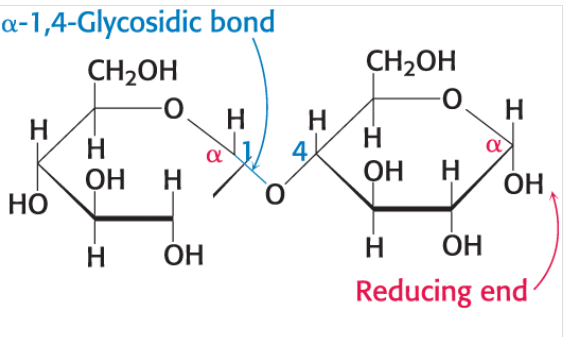
Reducing End for Oligosaccharide
refers to the end of an oligosaccharide that has a free anomeric carbon capable of acting as a reducing agent in chemical reactions.
By convention, this end of the oligosaccharide is still called the reducing end even when it is bound to another molecule such as a protein and thus no longer has reducing properties.
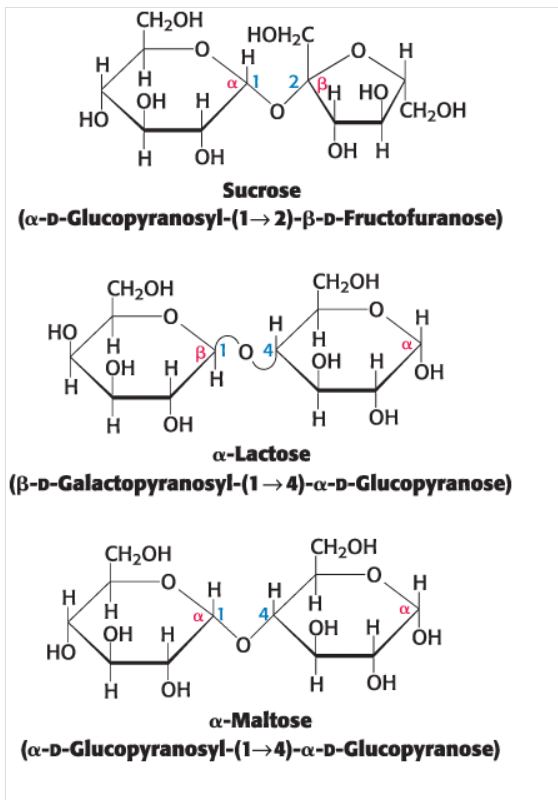
Disaccharides
are carbohydrates formed from two monosaccharides linked by a O-glycosidic bond.
Polysaccharides
are carbohydrates composed of long chains of monosaccharide units connected by glycosidic bonds, serving various functions such as energy storage and structural support.
Such as Glycogen and Starch
Glycogen
is a polysaccharide that serves as a form of energy storage in animals, composed of glucose units bonded together.
Most Abundant in skeletal muscle and liver but most tissues have glycogen
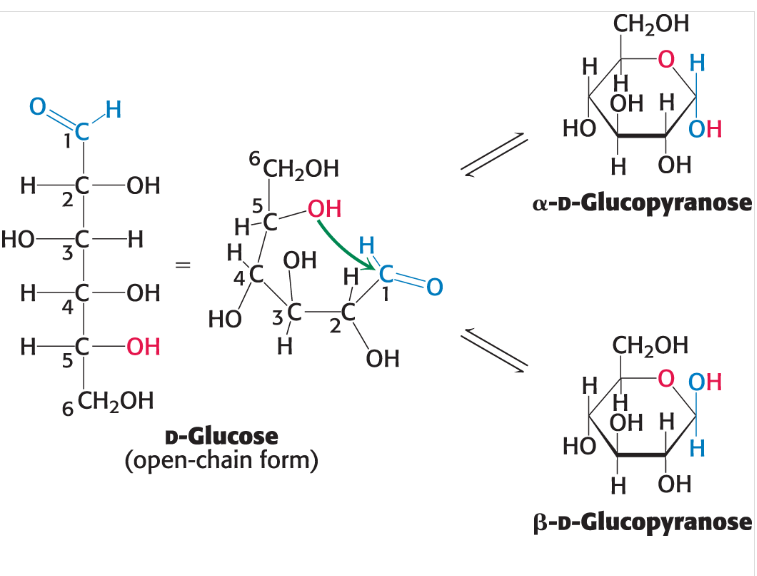
Intramolecular Hemiacetal
C-1 aldehyde in the open-chain form of glucose reacts with the C-5 hydroxyl group to form a cyclic structure.
The open-chain form of glucose cyclizes when the C-5 hydroxyl group attacks the C-1 carbon of the aldehyde group to form an intramolecular hemiacetal. Two interchanging anomeric forms of the pyranose ring, designated α and β can result, both in rapid equilibrium with the open-chain (linear) form.
Glycosyltransferases
catalyze the formation of glycosidic linkages between monosaccharides in carbohydrate synthesis.
Glycogen
A polysaccharide used for energy storage in animals, primarily found in muscles and liver.
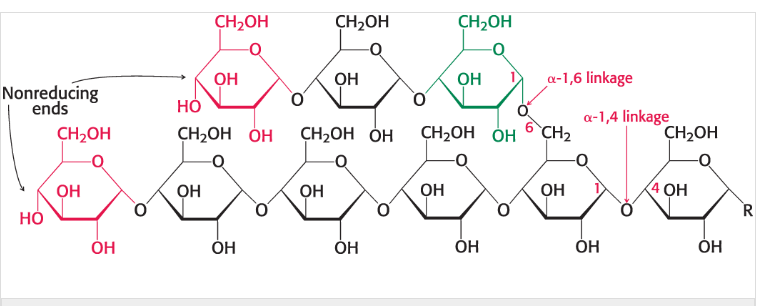
alpha Glycosidic linkages
form open helical polymers
commonly form open, flexible helical, coiled structures. These linkages are characterized by the oxygen atom at the anomeric carbon (C1) pointing downward (below the ring plane) in the
-D-glucose monomers
beta Glycosidic linkages
produce nearly straight strands that can form rigid structures
. These linkages are characterized by the oxygen atom at the anomeric carbon (C1) pointing upward (above the ring plane) in the -D-glucose monomers.
Glycogen Degradation:
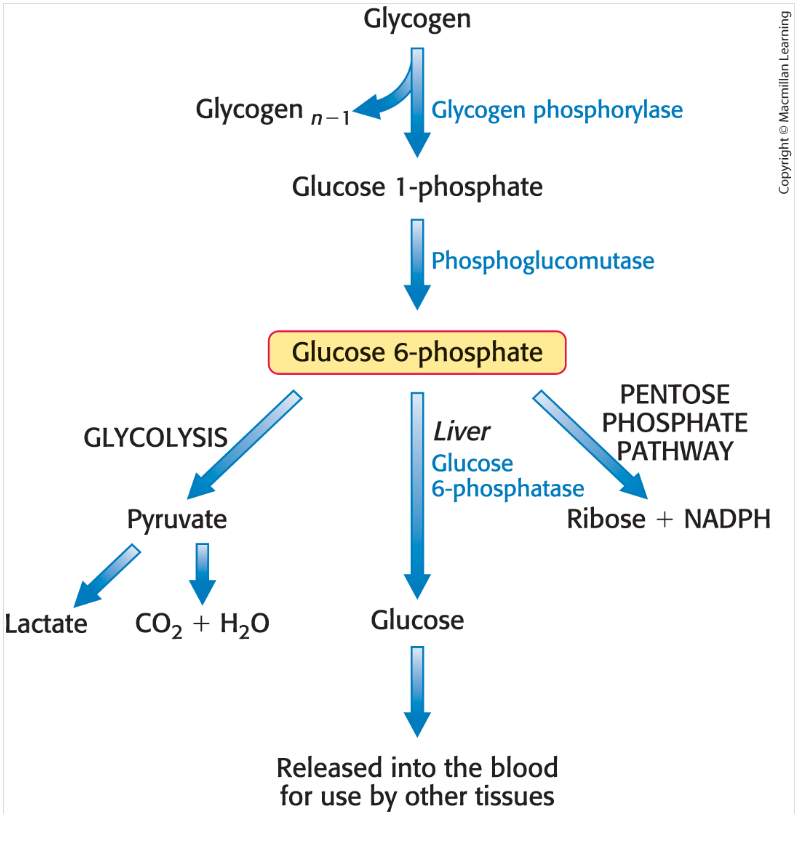
Glucose 6-phosphate has three possible fates
(1) it can be metabolized by glycolysis;
(2) in the liver it can be converted into free glucose for release into the bloodstream;
(3) it can be processed by the pentose phosphate pathway
Glycogen Phosphorylase
cleaves its substrate by the addition of orthophosphate (Pi) to yield glucose 1-phosphate. The cleavage of a covalent bond by the addition of orthophosphate is referred to as phosphorolysis:

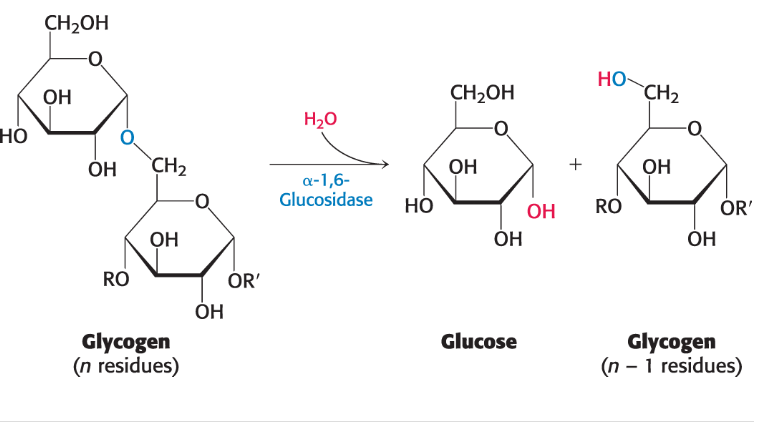
Debranching enzyme
is responsible for removing a glucose unit from the branching points of glycogen. It acts on both alpha-1,6-glucosidic bonds, which allows for the complete mobilization of glucose units during glycogen degradation.
Glycogen synthase
is the key regulatory enzyme responsible for synthesizing glycogen from glucose, joining glucose molecules through alpha-1,4-glycosidic bonds, and plays a crucial role in glycogen storage.
Steps of Glycogen Synthesis Occurs?
Glycogen synthesis requires a primer such as Glycogenin
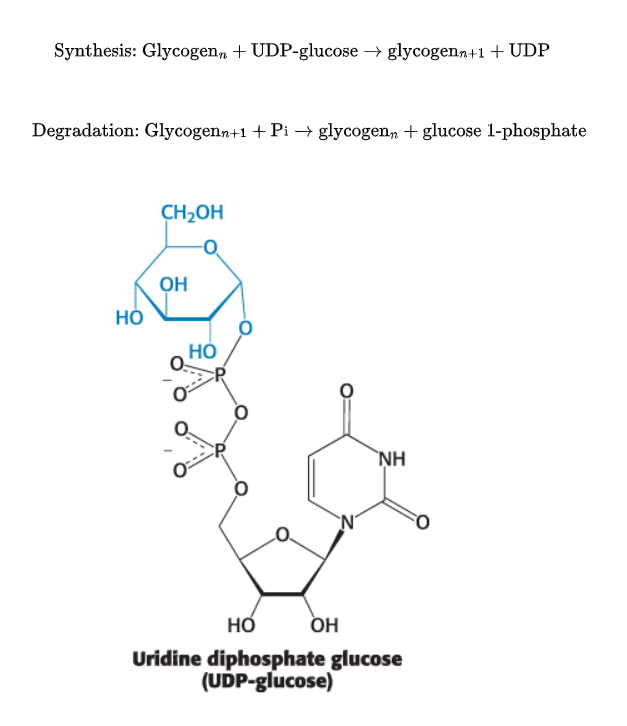
Glucose Units are added stepwise using UDP-glucose as the donor
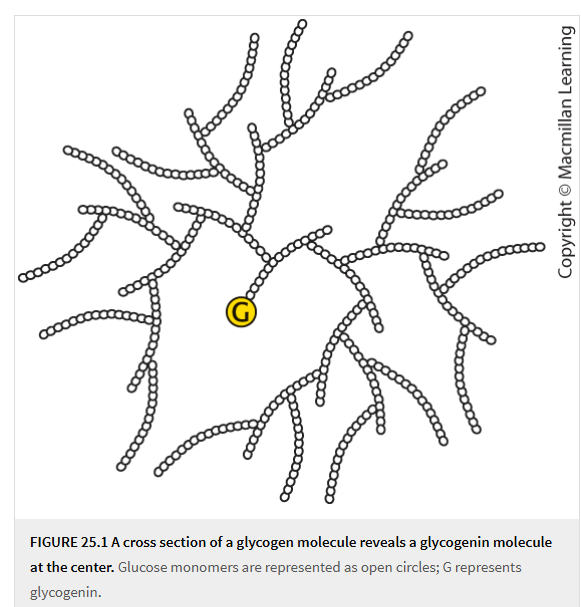
Glucosyl residues are joined in alpha-1,4-linkages to extend the glycogen chain, while branch points are formed by alpha-1,6-linkages.
Branching enzymes introduce alpha-1,6-linkages to create branches, enhancing the solubility and accessibility of the glycogen molecule.
Branching Increases the rate of glycogen synthesis and degradation
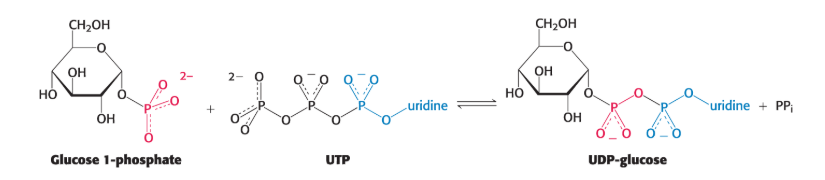
Uridine diphosphate glucose
is a vital activated nucleotide sugar () that serves as a key glycosyl donor in metabolism. It is a precursor for glycogen, glycolipids, and glycoprotein synthesis. It is synthesized from glucose-1-phosphate and uridine triphosphate (UTP)
Glycogen Synthase exist in two forms :
nonphosphorylated alpha form
usually inactive phosphorylated beta form - when glycogen synthesis is not needed, though it can be partially activated by high concentrations of glucose-6-phosphate.
B2:
Given the structure of ATP, summarize the thermodynamic and chemical basis for its suitability as the energy currency of the cell.
Given an enzyme-coupled reaction involving the utilization of ATP, summarize the principles that promote catalysis of an otherwise thermodynamically unfavorable reaction.
Given an enzyme-coupled reaction other than those involving ATP, identify the activated carrier and its high energy transfer potential group that operates under similar kinetic and thermodynamic principles as ATP.
Given information about the physiological status of a cell or tissue, demonstrate the concept of energy charge to predict changes in the adenine nucleotide pool and resultant anabolic or catabolic state of that cell or tissue.
Three reasons for continual input of free energy:
(1) mechanical work in muscle contraction and cellular movements,
(2) the active transport of molecules and ions
(3) the synthesis of macromolecules and other biomolecules from simple precursors.
Phototrophs
organisms that obtain energy from light.
Chemotrophs
organisms that obtain energy from chemical compounds.
Unifying themes to all metabolic reactions :
Metabolism is a coherent network containing many common motifs. - ATP is the primary energy currency, driving biochemical processes.
While metabolism involves many different reactions, it uses only a few kinds of mechanisms
Metabolic reactions are highly regulated.and are interconnected through various pathways.
Metabolic Pathways into broad classes :
Those that convert energy form fuels into biologically useful forms
Those who require inputs of energy to proceed
Catabolic reactions
processes that break down molecules to release energy
Example oxidation of carbs and fat in human to make ATP and waste products CO2 and H2O

Anabolic Reactions
processes that build up molecules, requiring energy input.
Examples include DNA, protein synthesis and glucose formation.

Amphibolic Pathways
pathways that can function in both anabolic and catabolic processes, depending on the energy conditions in the cell
Pathways Must Have Two Criteria :
Individual reactions must be specific
Each of the reactions that constitutes the pathway must be thermodynamically favored under real, rather than standard, conditions. A reaction that is specific yields only one particular product or set of products from its reactants
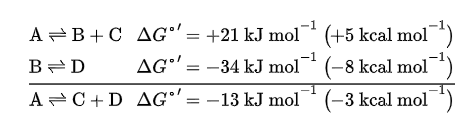
In a metabolic pathway, reactions with a positive ΔG°′ :
Can Proceed under physiological conditions because the concentrations of reactants and products are far from standard conditions, such that the ΔG of the reaction is negative
Adding other reaction that have - ΔG can help drive the overall pathway forward, allowing cellular processes to occur.
Thermodynamically unfavorable reactions can be driven by a thermodynamically favorable reaction to which it is coupled
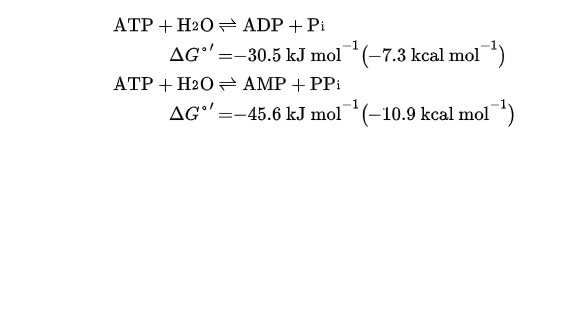
ATP
Energy-rich molecule because its triphosphate unit contains two phosphoanhydride linkage
Adenine, Ribose, Triphosphate Unit
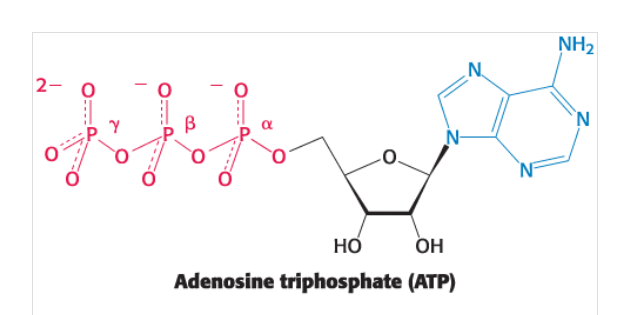
ATP releases energy when converting to ADP
Because it breaks a high-energy phosphate bond, relieving electrostatic repulsion between negatively charged phosphate groups
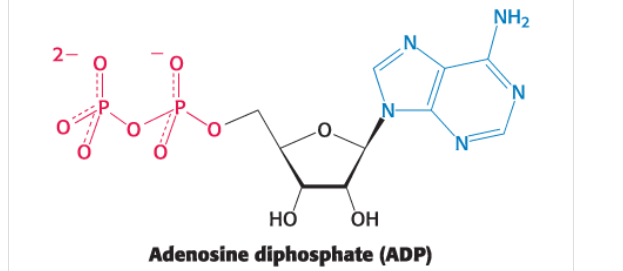
ADP
B3:
Given the and the values of the reactions of glycolysis, determine if they are metabolically reversible or irreversible.
Given metabolites of glycolysis or the products of pyruvate catabolism, define their oxidation states.
Given the ATP-synthesizing steps of glycolysis, summarize the thermodynamic rationale for ATP production from glycolytic intermediates with high phosphoryl-transfer potential.
Given defined biochemical or physiological conditions, discriminate between the aerobic or anaerobic fate of pyruvate.
Ch 16.1: Glycolysis is an energy-conversion pathway in most organisms
Ch 16.2: NAD+ is generated from the metabolism of pyruvate
Ch 18.1: Pyruvate dehydrogenase forms acetyl coenzyme A from pyruvate
Glycolysis
a sequence of reactions that break down (metabolize) one molecule of glucose → two molecules of pyruvate, producing a net production of ATP
Does not require oxygen (anaerobic)
Occurs in Prokaryotic and Eukaryotic
In aerobic conditions pyruvate can
can by completely oxidized to CO2, generating much more ATP
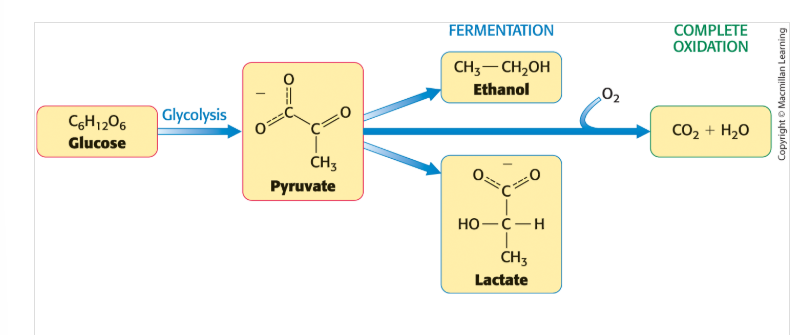
Glucose is the most common fuel for almost all organisms:
It could have been available for prehistoric conditions
Most stable hexose because of the hydroxyl groups and hydroxymethyl group in equatorial position and minimizing steric clashes
Stability allows for efficient energy extraction during glycolysis and cellular respiration, making it the primary energy source for cellular functions.