BIO EXAM 1
 Call Kai
 Learn
Learn Practice Test
 Spaced Repetition
 Match
Match Flashcards
 Knowt Play
1/75

There's no tags or description
Looks like no tags are added yet.
Name | Mastery | Learn | Test | Matching | Spaced | Call with Kai | Chat |
|---|
No analytics yet
Send a link to your students to track their progress
76 Terms
Who wrote the origin of species and what is the significance of the book?
Charles Darwin. launched the era of evolution theory
Plato
All species have a perfect form, species variation is an imperfection of that form
Aristotle
Saw that organisms vary in complexity and can be arranged based on their order of increasing complexity
Count Buffon
Wrote plants and animals. Suggested Environmental influences the struggle for existence
Carolus Linnaeus
Believed each species had an ideal structure, and a place in the scala naturae (sequential ladder of life)
Erasmus Darwin
Proposed that species change overtime
Georges Cuvier
proposed a new assembly of species moves into an area after mastic extinction events (catastrophism)
Jean-Baptiste Lamark
Proposed that physical changes that are aquired by an organism during its lifetime are passed onto its offspring (The inheritance of acquired characteristics)
Charles Lyell
Propose that the Earth today is shaped by the same slow natural process that shaped it in the past (uniformitarianism)
Thomas Malthus
proposed the human population is growing at an exponential rate, but Limited food, water and shelter keep this growth in check.
Charles darwin observations
Observations led him to conclude EARTH IS OLD, LIVING FORMS COULD BE FROM EXTINCT FORMs…SPECIES ARE NOT FIXED INSTEAD THEY CHANGE OVER TIME
How did the process of artificial selection influence Darwin’s development of the idea of natural selection
If artificial selection can bring lots of changes within a short period of time, then natural selection could modify species over hundreds of years
Evidence that darwin gathered from fossils and biogeography tht supported the idea of shared ancestry
Fossils:
Marine shells high in cliffs —> earth is very old and living could have decent from extinct forms
Biogeography:
Similar environments, similar looking animals..(south america —> patagonian cavy, europe —> european rabbit)
Summarize the process of evolution by natural selection
Organisms has heritable variation
Organisms competes for recources
Organisms differ in reproduction success (Fitness)
Organisms becomes adapt
What observations provide the basis for natural selection
Heritable variation (possess different traits that can be passed down)
Competition (food, shelter, water)
Reproductive success (better traits = better survival and reproduction
What is the significance of transitional fossils
Transitional fossils are a common ancestor for two difference groups of organisms..Allows us to trace the descent of organisms
Describe the fossil record
Evolution over millions of years engraved in the order of fossils that appear in rocks.
Examples of transitional fossils (3)
Archaeopteryx:
In between birds and reptiles
Tiktaalik:
“Fishapod
Ambulocetus:
Whale with legs
interpret one example from each of the four areas of study - fossil, anatomical, biographical, and biochemical - as evidence supporting the descent of all life from a common ancestor.
Fossil:
Transitional fossils (tiktaalik)
Anatomical:
Pentadactyl limbs (share same basic bone structure)
Biogeographical:
Marsupials in south america, and Australia
Biochemical:
All living organisms use same DNA triplet code
What are some of the misconceptions of evolution proposed by critics of evolution?
“ Evolution Is not observable or testable; thus is not science”
“ there are no transitional fossils”
What is a gene pool
Total alleles of all the individuals in a population
What is a population
Group of organisms of a single species living in the same area
Genetic variation
Difference in DNA and phenotypic expression
Microevolution
Change in gene frequency between a population of species overtime
5 conditions required for a population to be in Hardy Weinberg equilibrium
No mutations = no allelic changes
No migraines = no gene flow
A large gene pool = no genetic drift
Random mating
No selection
What is the Hardy weinburg equation?
p² + 2pq + q²
What does each Variable stand for in the hardy Weinberg equation
p = homozygous dominant
pq = Heterozygous
q = homozygous recessive
What is the significance of the hardy Weinberg equilibrium to natural populations?
It is like a speedometer for evolution. If a population does not match the equilibrium Evolution is actively happening.
Five main causes of evolutionary change
Natural selection
Mutations
Gene flow
No Random mating
Genetic drift
What is genetic drift?
Changes in alle frequencies of a population due to change rather than selection by the environment
Two types of genetic drift
Bottleneck effect:
severe reduction in population due to natural disasters, predation , or habitat reduction
Founder effect:
Few individuals break away from large population to found a new population (Higher chances of inbreeding)
How does natural selection consistently lead to adaptive evolution?
Favors the variant that is most adapted to the present environmental conditions
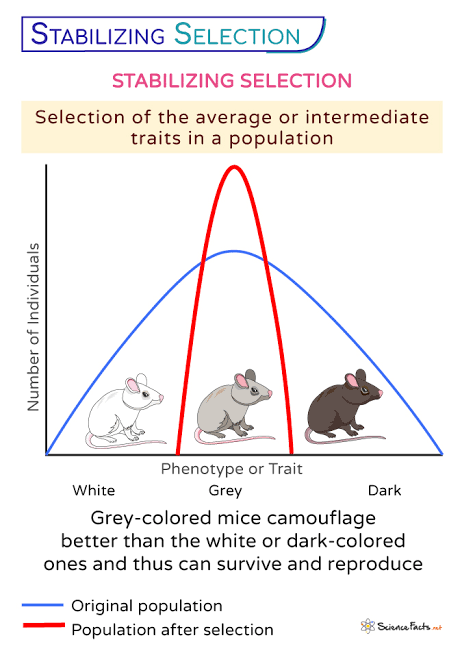
Stabilizing selection
Favors intermediate phenotypes(grey mouse over white or black)…The peak of the curve increases and tail decrease
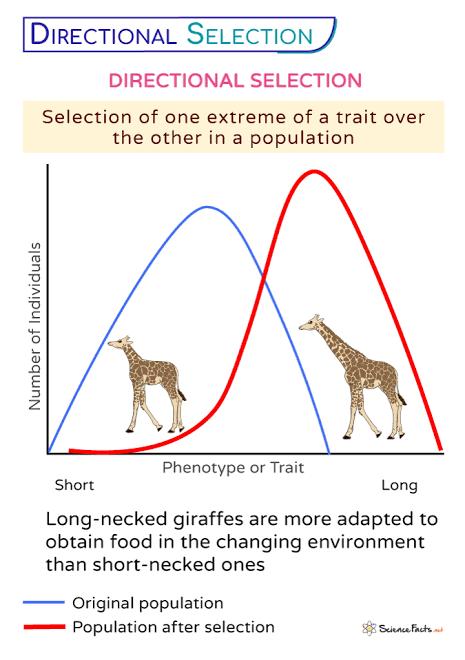
Directional selection
Favors one extreme phenotype(Long neck, giraffe)… Curve shifts in One Direction
Disruptive selection
Favorites two or more extreme phenotypes over the intermediate phenotype(Black and white moths over grey)… The curve has two peaks

What is sexual selection?
Adaptive changes in males and females that increase the ability to secure a mate
How does sexual selection drive adaptation for increased fitness?
Males:
Increased ability to compete with other males to mate
Females:
Select a male with best fitness
Why is heterozygote advantage a form of stabilizing selection?
Shelters recessive alleles from selection..
What are two examples of heterozygote advantage?
Sickle cell disease
Cystic fibrosis
Macroevolution
Evolution on a large scale
Involves origin of species
Microevolution
Small shift in allele frequency in a single population over a short time
What is taxonomy
The process of Identifying, naming, and classifying species
Who is the founder of taxonomy?
Carolus Linnaeus
The four species concepts
Morphological
Evolutionary
Phylogenetic
Biological
Morphological species concept
Identify species based on diagnostic traits
Advantage: Can be used on asexual organisms and fossils
Disadvantage: relies on subjective criteria, Researchers may disagree on what features distinguish a species
Evolutionary species concept
Identify species based on structural traits
Advantage: Explains specialization in the fossil record
Disadvantage: requires members in a species that share a special evolutionary pathway
Phylogenetic species concept
Identify species based on common ancestor
Biological species concept
Identify species based on reproductive isolation (behavioral)
Advantage: For similar looking species that reproduce with one another
Disadvantage: Asexual and hybrids (mule)
What is a zygote?
Cell formed when sperm and egg meet
Five types of prezygotic barriers
Habitat isolation
Temporal isolation
Behavioral isolation
Mechanical isolation
Gametic isolation
Habitat isolation
Certain place
Temporal isolation
Different Times a day/season
Behavioral isolation
Mating dances
Mechanical isolation
Physically incompatible
Gametic Isolation
Molecular and compatibility Of eggs and speem
Two types of postzygotic isolation
Hybrid inability
Hybrid sterility
Hybrid inability
Impaired hybrid development or survival
Hybrid sterility
Cannot produce offspring
What is speciation?
Splitting of one species into two
Two modes of speciation
Allopatric speciation
Sympatric species
Allopatric speciation
New species from populations that are geographically separated
Sympatric speciation
New species from reproductively isolated groups that are not geographically isolated
What is adaptive radiation?
Rapid evolution of several species from a common ancestor
Example of adaptive radiation
Darwin’s finches
Big beak → seeds
Small beak → insects
Homologous structures
Similar structure from common ancestor
Example:
Butterfly and moth
Analogous structure
Similar function Different origin
Example:
Bird wing and bat wing
What is the process of convergent evolution?
Unrelated species develop similar traits bc they live in similar environments or face the same challenges
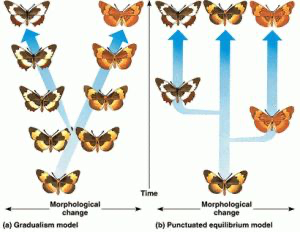
Distinguish between the gradualistic and the punctuated equilibrium models of evolution
gradualistic equilibrium is a gradual change that results in two separate species, punctual equilibrium is not gradual change, species appear suddenly
how does gene expression influence the process of speciation
drives phenotypic divergence and reproduction barriers or influences development?
examples of developmental genes
Pax6 (eye formation)
Tbx5 (limb buds)
Hox (number and appearance of repeating structures)
PitX1 (hind limbs)
how is macroevolution or natural selection is not goal-oriented?
it is opportunistic, enables a population with an advantage to have more offspring
What is LUCA
last universal common ancestor
what were the early earth conditions?
little oxygen, volcanic activity, lightning
what is the Oparin-Haldane hypothesis?
Conditions on early earth could have generated organic molecules
Who tested the Oparin-Haldane hypothesis and how?
stanley miller, built and apparatus mimicking the conditions of early earth