Biochemistry Exam #1 Chapter 4
 Call Kai
 Learn
Learn Practice Test
 Spaced Repetition
 Match
Match Flashcards
 Knowt Play
1/84

There's no tags or description
Looks like no tags are added yet.
Name | Mastery | Learn | Test | Matching | Spaced | Call with Kai |
|---|
No analytics yet
Send a link to your students to track their progress
85 Terms
Amino acid
Monomer (building block) of proteins
Oligopeptide
Short chain of amino acids (typically 2-20 residues
Polypeptide
Long chain of amino acids linked by peptide bonds
Protein
One or more folded polypeptides that perform a biological function
What must be memorized for the 20 standard amino acids?
Structure
3-letter code
1-letter code
Side-chain properties
what are the properties of amino acids?
Nonpolar (hydrophobic) → Avoids water
Polar uncharged → Hydrogen bond, no charge
Acidic → Negatively charged at physiological pH
Basic → Positively charged at physiological pH
Aromatic → Contains aromatic rings, absorbs UV light
What happens during amino acid ionization?
Amino acids gain or lose H+ depending on pH, changing their charge
Draw the structure of glycine at pH 7
(zwitterion form)
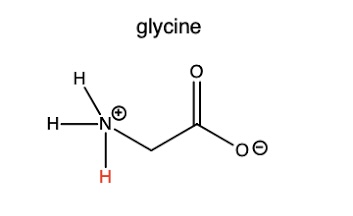
What is the isoelectric point (pI) ?
The pH at which an amino acid has a net charge of 0
How do you calculate pI for an amino acid with no ionizable side chain (ex. glycine)?
Average the two pKa values surrounding the zwitterion
pI = ½ (pKj + pKj)

Practice: Ionization and pI calculation for glutamate (slide 53)
Answer on module 2 handout
What is a zwitterion?
A molecule with both a positive and negative charge but an overall net charge of 0
What is the overall charge when pH> pI for amino acids/ peptide/ protein?
pH < pI → +
pH = pI → Neutral (0)
pH > pI → -
What is cystine?
Two cysteine amino acids join by a disulfide bond
What type of reaction forms cystine?
Oxidation reaction
Cystine is the oxidized form where a disulfide bridge connects the two residues
Cysteine is the only amino acid that can be oxidized and reduced. True or false
True
What reaction converts cystine back into two cysteines?
Reduction reaction
What happens during oxidation vs reduction of cysteine?
Oxidation → Forms disulfide bond (S-S)
Reduction → Breaks disulfide bond into two SH groups
What is a disulfide bond?
A covalent bond formed between two sulfur atoms of cysteine residues
How is a peptide bond formed?
By a condensation (dehydration) reaction between two amino acids
What molecule is released during the peptide bond formation?
Water (H2O)
What is a peptide bond?
A covalent bond between the carboxyl group of one amino acid and the amino group of another amino acid
What are the properties of peptide bonds?
Planar
Partial double-bond character
Rigid
Usually trans
What is Ψ (psi) bond rotation?
Rotation around the N-Cα bond
What is Φ ( phi) Bond Rotation?
Rotation around the Cα-C bond
Why can Ψ and Φ rotate?
They are single bonds
Can the peptide bond rotate?
No. The peptide bond has partial double-bond character and is rigid
What is another name for peptide bond?
An amide bond
What are amino acids called once they are incorporated into a peptide?
Residues
What enzyme catalyzes peptide hydrolysis?
Proteases
What are the two unique ends of every peptide?
N-terminus (amino terminus) ad C-terminus (carboxyl terminus)
How are peptide residues numbered?
Start at the N-terminal residue (1) and count toward the C-terminus
What is the difference between a peptide backbone and side chains?
A backbone (main chain) = all atoms not in R groups
Side chains = R groups
How do you determine the structure (draw) of a peptide at a given pH?
Identify ionizable groups
Compare pH to Pka
Assign charges
How do you determine the overall charge of a peptide at a given pH?
Identify all ionizable groups (N-terminus, C-terminus, and ionizable side chains).
Compare the pH to each group's pKa:
pH < pKa → protonated
pH > pKa → deprotonated
Assign charges to each group.
Add all charges together to get the net charge.
What is the overall charge of a peptide relative to its pI?
pH < pI → net positive (+)
pH = pI → net zero (0)
pH > pI → net negative (−)
What are the types of proteins?
Globular
Fibrbous
Membrane
Motor
What are globular proteins?
Compact, roughly spherical proteins that are usually water-soluble and perform functions such as catalysis, transport, and regulation
What are fibrous proteins?
Long, extended proteins that provide structural support and strength.
Examples: Collagen, keratin
What are membrane proteins?
Proteins associated with cell membranes that function in transport, signaling, and cell recognition
What are motor proteins?
Proteins that convert chemical energy (ATP) into mechanical movement
Examples: Myosin, kinesin, dynein
Compare the four major types of proteins
Globular: Compact, soluble, functional
Fibrous: Structural support
Membrane: Embedded in membranes; transport/signaling
Motor: Movement using ATP
What is a conjugated protein?
A protein that contains a non-protein component required for its function
What is a prosthetic group?
A non-protein component that is tightly bound to a protein and is necessary for its function
What prosthetic group does a glycoprotein contain?
A carbohydrate prosthetic group
What is the difference between a protein and a conjugated protein?
A conjugated protein contains a prosthetic group (non-protein component) in addition to amino acids
Conjugated protein vs prosthetic group?
Conjugated protein = protein + non-protein component
Prosthetic group = the non-protein component itself
What is the primary (1°) structure of a protein?
The linear amino acid sequence of a polypeptide.
What is the secondary (2°) structure of a protein?
Local folding patterns stabilized by hydrogen bonds.
Examples:
α-helix
β-sheet
β-turn
What is an α-helix?
A right-handed coiled secondary structure stabilized by hydrogen bonds.
What interactions stabilize protein tertiary structure?
Hydrogen bonds
Salt bridges (ionic interactions)
Van der Waals interactions
Hydrophobic interactions
Disulfide bonds
What stabilizes an α-helix?
Hydrogen bonds between backbone C=O and N-H groups.
Which amino acids tend to disrupt α-helices?
Proline and glycine.
What is a β-sheet?
A secondary structure made of extended strands connected by hydrogen bonds.
What are the two types of β-sheets?
Parallel and antiparallel.
What stabilizes β-sheets?
Hydrogen bonds between adjacent strands.
What is a β-turn?
A short turn that reverses the direction of a polypeptide chain.
What stabilizes β-turns?
Hydrogen bonds.
What are super secondary structures (motifs)?
Combinations of α-helices and β-sheets that form recurring patterns.
What is the purpose of motifs?
Bury hydrophobic amino acids
Increase protein stability
Create common folding patterns
What are examples of structures that can form motifs?
α-helices
β-sheets
β-turns
Tertiary (3°) Structure
Overall 3D shape of a single polypeptide
Stabilized by:
Hydrogen bonds
Salt bridges
Van der Waals interactions
Hydrophobic effect
Disulfide bonds
Contains domains
Hydrophobic effect is the major driving force for folding
Fibrous vs. Globular Proteins
Fibrous
Long and rope-like
Structural support
Usually insoluble
Examples: collagen, keratin
Globular
Compact and spherical
Functional proteins
Usually soluble
Examples: enzymes, hemoglobin
What contributes to protein folding?
ΔH (Bond Energy)
ΔS (Entropy)
What interactions contribute to ΔH (bond energy) during protein folding?
Covalent interactions
Non-covalent interactions
What is a covalent interaction involved in protein folding?
Disulfide bonds between cysteines.
What non-covalent interactions stabilize proteins?
Electrostatic interactions (salt bridges)
Hydrogen bonds
Van der Waals interactions
What are electrostatic interactions?
Attractions between opposite charges (salt bridges/ion pairs).
What are hydrogen bonds?
Attractions between H attached to an electronegative atom and another electronegative atom.
What are van der Waals (London dispersion) forces?
Weak attractions between nearby atoms.
What contributes to ΔS (entropy) during protein folding?
The hydrophobic effect.
What is the hydrophobic effect?
Nonpolar amino acids move to the protein interior away from water, helping drive folding.
What is quaternary (4°) structure?
The arrangement of 2 or more polypeptide subunits into one functional protein.
What is a subunit?
An individual polypeptide chain within a multi-subunit protein.
What is a domain?
An independently folding and functional region within a protein.
Subunit vs Domain
Subunit
Entire polypeptide chain
Found in quaternary structure
Domain
Part of a polypeptide chain
Independently folds and functions
What is protein denaturation?
Unfolding of a protein that disrupts its native structure and function.
What reagents promote protein denaturation (unfolding)?
Heat
Extreme pH
Detergents (SDS)
Organic solvents (alcohols)
Reducing agents (β-mercaptoethanol, DTT)
What are the effects of denaturing reagents?
They disrupt the interactions that stabilize protein structure:
Hydrogen bonds
Salt bridges
Hydrophobic interactions
Disulfide bonds (reducing agents)
Result: protein unfolds and loses function.
What does each denaturing reagent disrupt?
Heat: hydrogen bonds & hydrophobic interactions
Extreme pH: ionic interactions (salt bridges)
Detergents: hydrophobic interactions
Reducing agents: disulfide bonds
Chromatography separates proteins based on what 3 properties?
Size
Charge
Binding affinity
How does Size Exclusion Chromatography work?
Separates proteins based on size.
Large proteins elute first
Small proteins elute last
Memory Trick: Big = Bypass pores = First out
How does Ion Exchange Chromatography work?
Separates proteins based on charge.
Opposite charges attract
Proteins bind to a charged column and are eluted later
How does Affinity Chromatography work?
Separates proteins based on specific binding interactions.
Protein binds a ligand on the column
Other proteins wash away
Desired protein is eluted
Compare the three types of chromatography.
Type | Separates By |
|---|---|
Size Exclusion | Size |
Ion Exchange | Charge |
Affinity | Specific binding |