PSYCH MCAT
 Call Kai
 Learn
Learn Practice Test
 Spaced Repetition
 Match
Match Flashcards
 Knowt Play
1/38

There's no tags or description
Looks like no tags are added yet.
Name | Mastery | Learn | Test | Matching | Spaced | Call with Kai | Chat |
|---|
No analytics yet
Send a link to your students to track their progress
39 Terms
What is split-brain syndrome?
severed corpus callosum
prevents communication btwn hemispheres
individuals experience a disconnect btwn info processed on right and left sides of brain
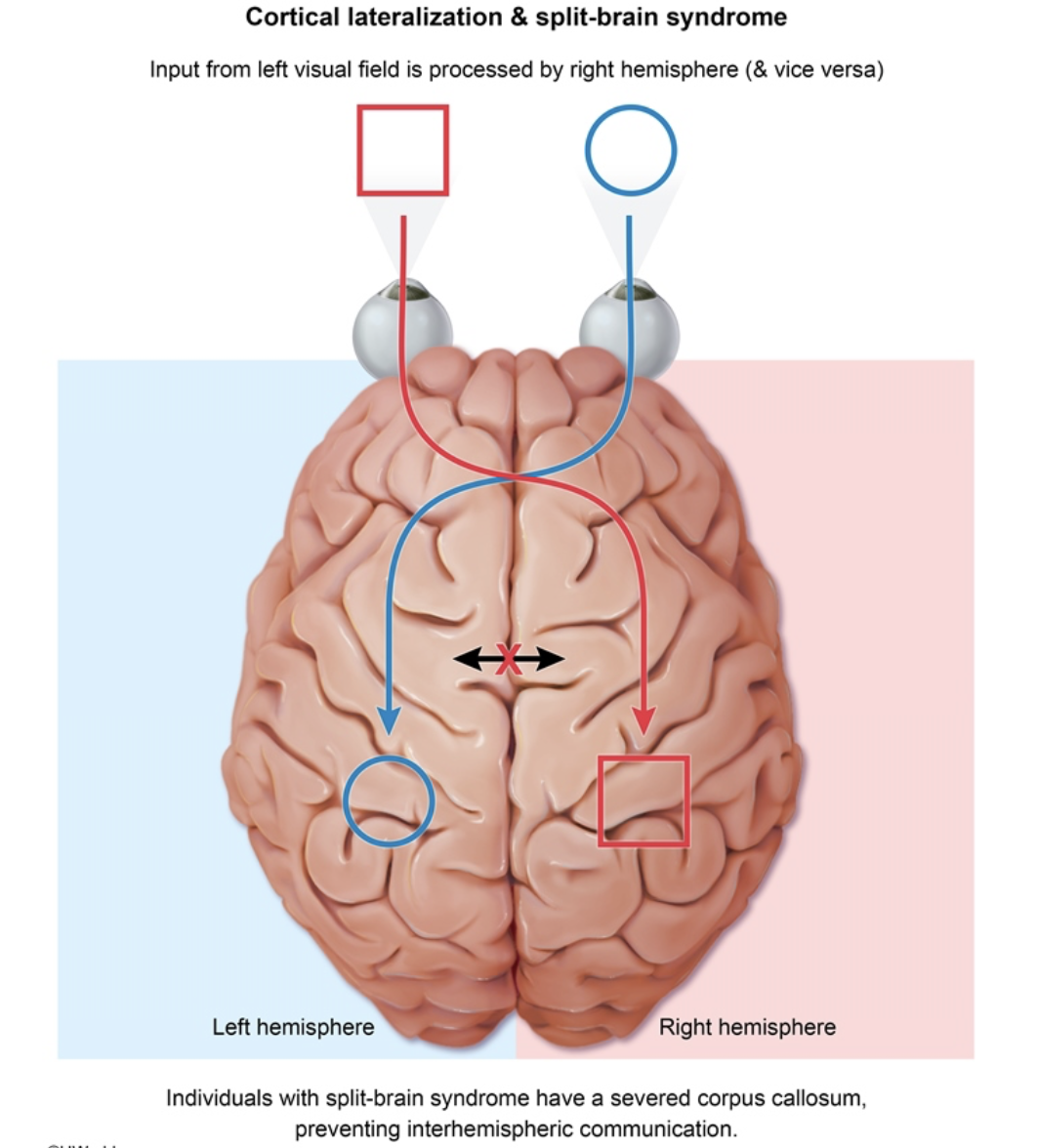
If a patient has split-brain syndrome, and information presented in the patient’s left visual field, what can or can’t happen?
visual info processed in right hemisphere
but without interhemispheric communication → patient can’t express what is being seen using language, but CAN draw it
What is the corpus callous?
bundle of axonal projections connecting right and left hemisphere → allowing the 2 hemispheres to communicate
What allows communication btwn right and left hemispheres of brain?
corpus callous
What is the left hemisphere specialized for?
language function
speech production (Broca area)
language comprehension (Wernicke area)
What is Broca’s area?
speech production
What is Wernicke’s area?
language comprehension
What is top-down processing?
beliefs, ideas, expectations guide perception
What is bottom-up processing?
sensory input guides perception
What is parallel processing?
processing multiple sources of info that occur simultaneously
ie. perceiving auditory & visual events tgthr when watching someone talk
Which psychophysiology concept determines how high the volume of the tone must be for the participants to detect it roughly half the time?
absolute threshold
Which psychophysiology concept refers to the strength of a stimulus at which one can detect its presence or change in intensity?
perceptual threshold
Which psychophysiology concept determines the smallest difference btwn 2 stimuli that a person can detect 50% of the time?
difference threshold / just noticeable difference
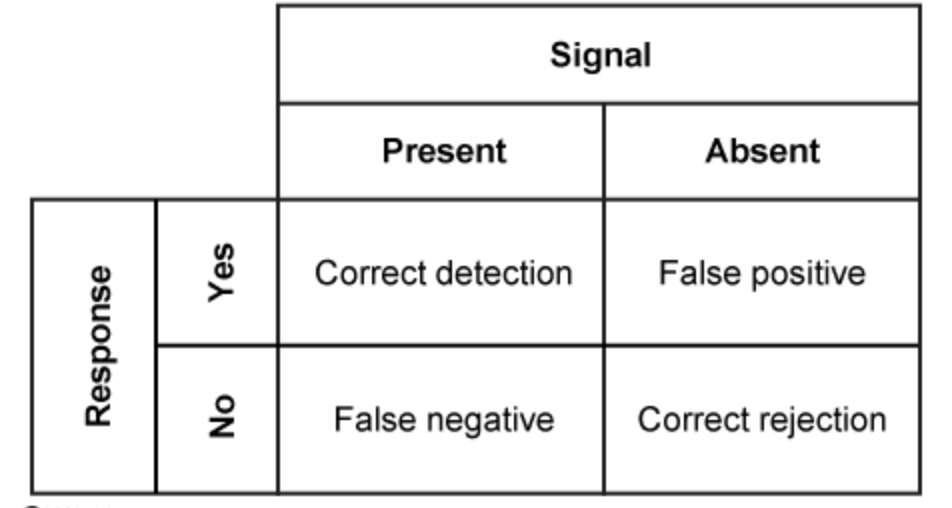
What are the principles of signal detection theory?
how judgements or decisions are made under uncertain conditions amid “noise” (external/internal distractions)
correct detection: signal correctly perceived
false negative: signal not detected even tho it was present
false positive: signal is absent but perception erroneously reported'
correct rejection: signal accurately judged absent
What is the primary neurotransmitter for depressants?
GABA, inhibitory NT
What is the idea of Gestalt principles?
how humans holistically perceive sensory stimuli
What are the Gestalt principles?
emergence
multistability
subjective contours
invariance
closure
similarity - group objects tgthr that share similar features (ie. shape, color)
proximity - physically closer things are a group (ie. letters closer tgthr are a word)
continuity - elements continue on a smooth path (ie. X is 2 lines crossing, not 2 Vs)
common fate - things moving tgthr are grouped tgthr (flock of birds in V formation perceived as unit)
What is the cerebellum for?
motor coordination + motor learning
What is the prefrontal cortex for?
executive functions
critical thinking
executive decision making
problem solving
planning
impulse control
What is the amygdala for?
emotion processing (esp fear + anger)
What is the primary visual cortex for?
processing visual input from retinas
What is the primary motor cortex for?
initiation of voluntary movement + Broca area (speed production)
What brain region is activated with lucid dreaming?
prefrontal cortex
involves critical analysis and executive decision making
When do dreams most commonly occur?
REM, particular REM cycles closer to waking
What are characteristics of REM sleep?
rapid closed eye movements
visually intense dreams
brain activity that resembles beta waves seen in awake, alert state
muscle paralysis
irregular and increased cardiovascular and respiratory activities
lowest body temp
What stage are K-complexes present?
stage 2
What stages are spikes in the release of growth hormone (GH) present in?
stages 3 + 4
What stage are sudden, jerking body movements present in?
entering stage 1 as the person is falling sleep
What is Parkinson's disease?
loss of dopaminergic neurons in substantial nigra
→ causes resting tremors, muscle rigidity, shuffling
What kind of medications are used to treat Parkinson’s disease?
dopamine agonists (mimic effects of dopamine, but too much can induce psychotic symptoms)
What is the monoamine hypothesis?
biomedical model of depression
depletion of monoamine NT in CNS directly causes depression symptoms
monoamines: serotonin, norepinephrine, dopamine
What is serotonin for?
positive mood, satisfaction, social dominance
What is norepinephrine for?
alertness, attention, memory formation
What is dopamine for?
pleasure, reward
What would support the monoamine hypothesis?
taking antidepressant meds that increase levels for all or some of the monoamine NT alleviates depression symptoms
Where is the substantial nigra?
basal ganglia
What is the basal ganglia for?
selection and execution of voluntary motor programs
What is the nucleus accumbens for?
part of reward pathway in brain
includes ventral tegmental area (produces dopamine)
DBS in here would activate reward pathway, would alleviate anhedonia
What are monoamine oxidase MAOI