Ch. 4 DNA Packaging in Eukaryotes
 Call Kai
 Learn
Learn Practice Test
 Spaced Repetition
 Match
Match Flashcards
 Knowt Play
1/52

There's no tags or description
Looks like no tags are added yet.
Name | Mastery | Learn | Test | Matching | Spaced | Call with Kai | Chat |
|---|
No analytics yet
Send a link to your students to track their progress
53 Terms

Human genome is about 3 giga-bp (approx. 2 meters). A typical human cell is ~20 micrometers and a nucleus is ~5-10 micrometers. How does our genomic DNA fit into such a tiny nucleus?
DNA interacts with specific proteins to form a nucleoprotein complex called chromatin
Can cells develop into something else?
Despite having the same genome, cells not only develop into distinct types but also maintain their identity across cell divisions. For example, blood cells stay blood cells, they can’t turn into a neuron.

True or False: DNA exists only transiently for a brief phase in mitosis, when chromosomes must be accurately separated into daughter cells, in the highly condensed structures (X shaped).
True
Cells spend most of their time in what phase?
interphase (G1, S, and G2), when DNA, RNA, and proteins are actively synthesized on demand and depending on the needs of the cell
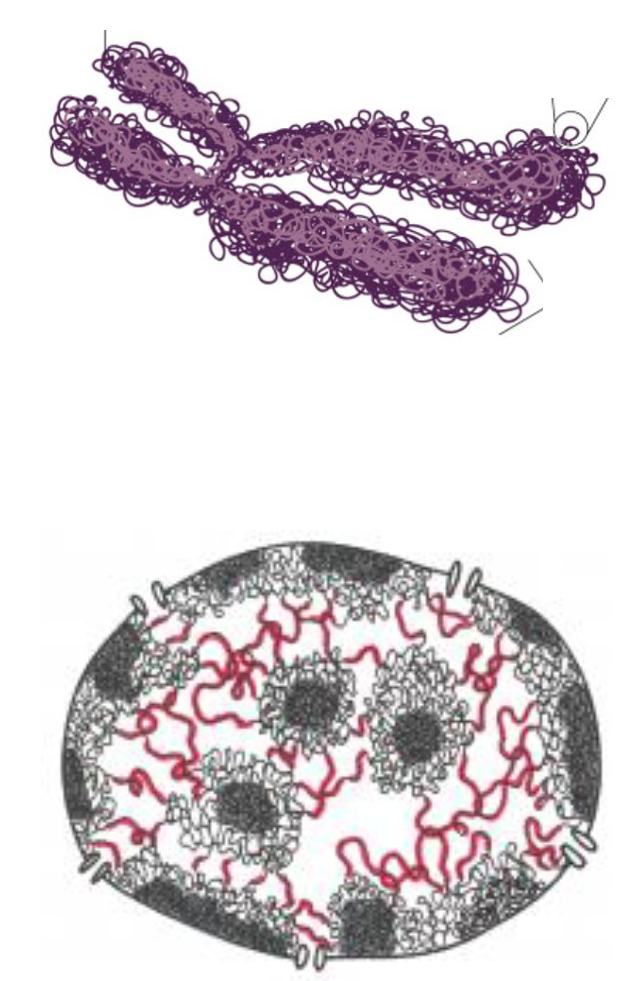
During interphase, chromatin exists in 2 different states of condensation. What are they?
Euchromatin
Heterochromatin
Euchromatin
Less condensed and more accessible to transcription factor
Generally associated with active gene transcription
It is more open and spread. It is more accessible.

Heterochromatin
More condensed and less accessible
Generally associated with transcriptionally inactive genes
More closely packed

Can chromatin transition between euchromatin and heterochromatin by changing the proteins associated with DNA?
yes, these changes help regulate whether genes are turned on or off
What are the 3 levels of chromatin organization?
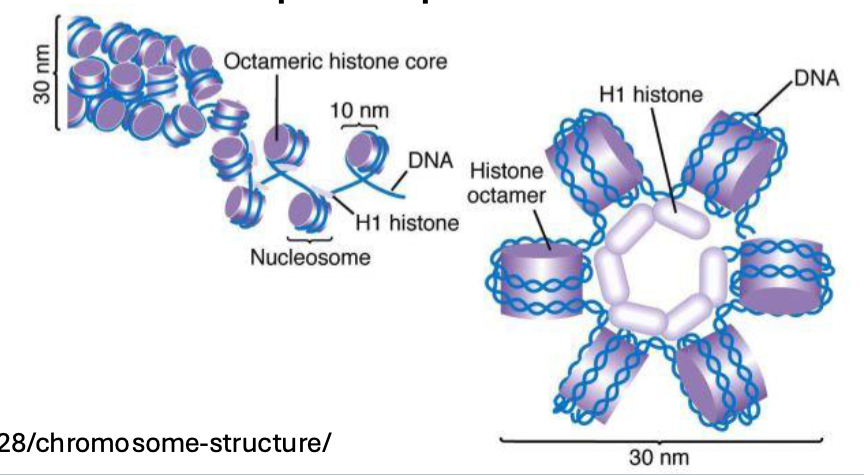
DNA wrapped around histone proteins (nucleosomes) like “beads on a string”
Multiple nucleosomes coiled (condensed) into 30 nm fiber (solenoids) structures
Higher-order packing of the 30 nm fiber into the eventual familiar metaphase chromosome

Histones
a type of protein that plays a central role in DNA packaging
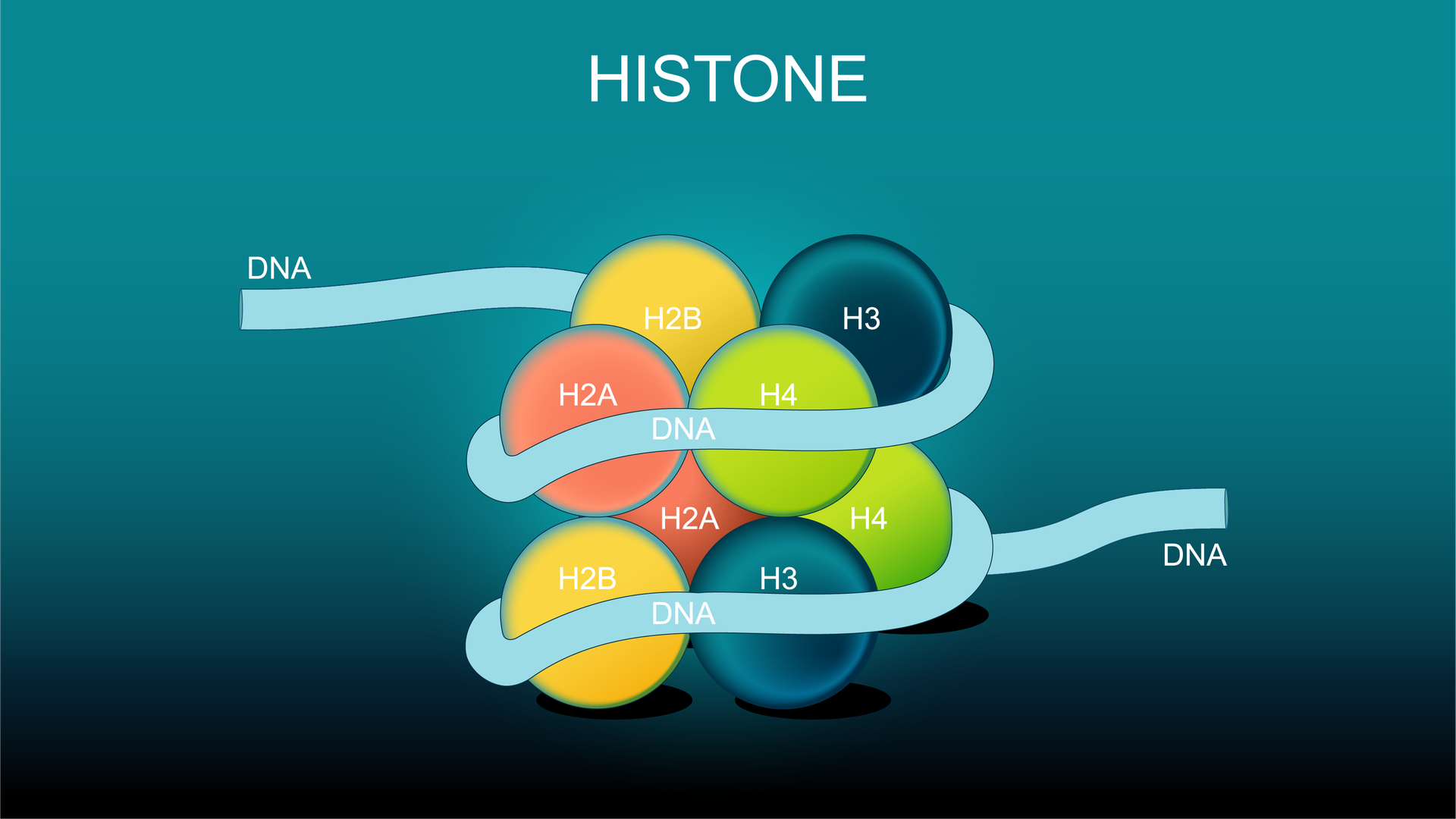
What are the 5 major classes of histones?
H1, H2A, H2B, H3, and H4
Are histones basic or acidic? Positively or negatively charged?
basic, positively charged proteins, rich in lysine and arginine
What enables the amino acids in histone to bind to the acidic, negatively charged phosphodiester backbone of double-helical DNA
their positively charged side chains
True or False: BOTH eukaryotes and prokaryotes have histones.
False, only eukaryotes do.
What do the “beads on a string” mean?
Beads: DNA-wrapped nucleosomes
String: linker DNA of uniform length connecting adjacent nucleosomes

What is the basic unit of chromatin?
nucleosome

What does the nucleosome core particle contain?
~1.47 bp of DNA wrapped around a histone core ~1.7 turns
a histone octamer containing 2 copies each of H2A, H2B, H3, and H4 histones
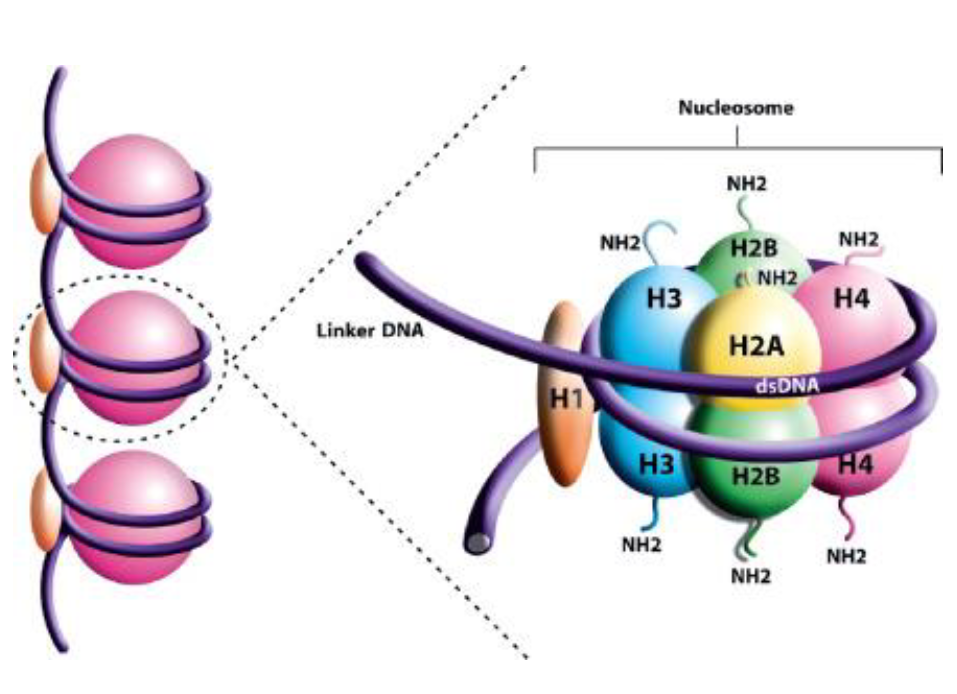
linker histone
Histone H1. H1 binds near the sites where DNA enters and exits the nucleosome, stabilizing DNA around the nucleosome and promoting higher-order chromatin compaction.

histone fold
consists of 3 alpha-helices connected by 2 short loops


What terminus of the protein does not participate in the fold and plays a crucial role in the regulation of chromatin structure?
The N-terminus
What 2 sub complexes are first formed in the assembly of the nucleosome core?
H3 interacting with H4 to form a H3.H4 heterodimer
H2A interacting with the H2B to form H2A.H2B heterodimer
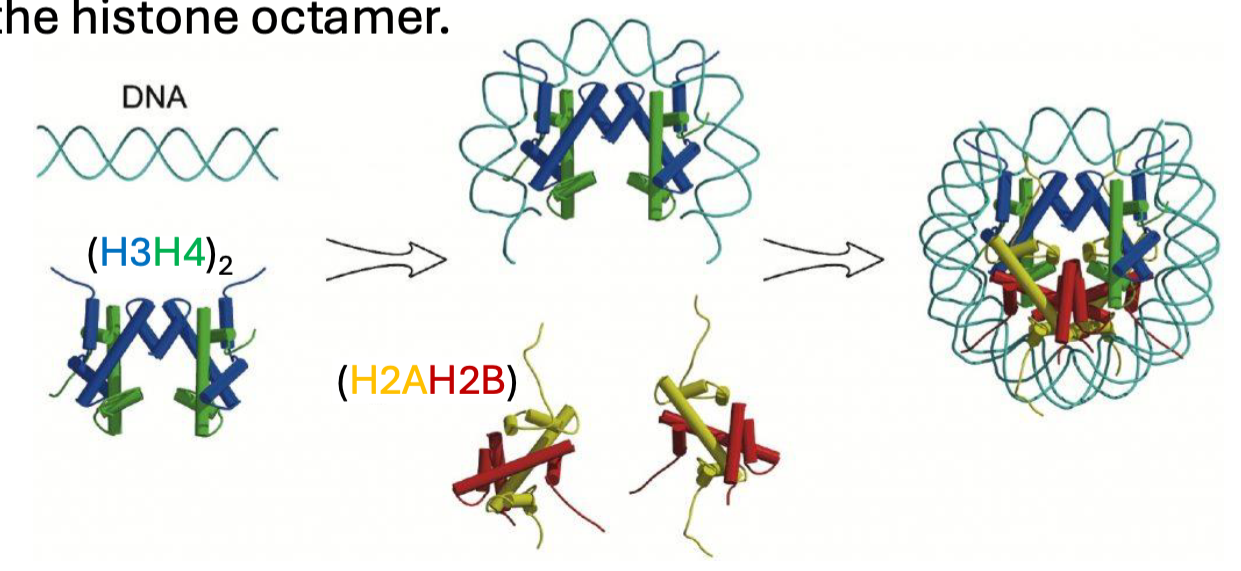
Histones use their histone folds to fit together in what kind of interaction?
a “handshake” interaction


2 H3.H4 heterodimers interact to form a tetramer, and DNA begins to wrap around it. 2 H2A.H2B heterodimers then do what?
caps the complex at the top and bottom to complete the histone octamer
Electrostatic interactions
negatively charged DNA phosphate backbone interacts with positively charged amino acids in histones
Hydrogen bonds form where in histone-DNA interactions?
between histones and DNA bases
True or False: Most histone-DNA interactions are not sequence-specific, allowing nucleosome to package almost any DNA sequence.
True
What areas of the genome are where nucleosomes position themselves preferentially?
Regions with A-T rich sequences which can bend more easily as DNA wraps around the histone octamer
H1 binds DNA where…
Where the DNA joins and leaves the histone octamer and helps lock the DNA into place, acting as a clamp around the nucleosome
H1 changes the path of the linker DNA, which helps what?
orient neighboring nucleosomes so they can interact and pack more closely together
Non-histone proteins are used for?
higher order structures that help organize and compact chromatin to form the highly condensed metaphase chromosome

What are some non-histone proteins?
condensins, cohesions, and scaffold proteins

Can a highly condensed chromatin metaphase chromosome be transcribed into any RNA or protein?
No
DNA compaction allows the genome to fit inside the nucleus, but it also limits DNA accessibility to the proteins required for gene expression. What must occur for gene expression to occur?
chromatin must be able to switch between condensed and decondensed states
Changes to chromatin structure can be brought about in what 2 ways that are not mutually exclusive adding layers of complexity to regulation?
via histone modifications
via chromatin remodeling complexes
histone tails are rich in what?
amino acids that can be chemically modified (lysine, arginine, serine, and threonine) and can undergo various post transitions modifications (PTMs)
epigenome
the set of chemical modifications or marks that influence gene expression and are transferred across cell divisions and, in some limited cases, across generations of organisms
epigenetic marks
histone modifications that help regulate chromatin structure and gene expression without changing the DNA sequence
What are the 3 common histone modifications?
methylation
acetylation
phosphorylation
Methylation of lysine and arginine
adding methyl groups by methyltransferase
can activate or repress gene expression, depending on which amino acid residue is modified and the degree of methylation
often creates binding sites for reader proteins

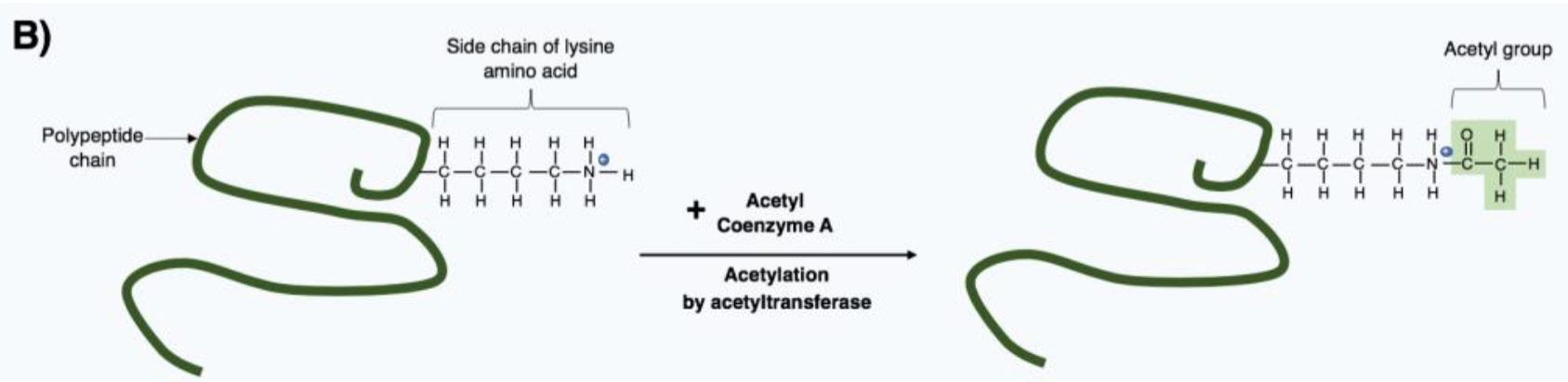
Acetylation of lysine
adding acetyl groups by acetyltransferase
neutralizes the positive charge of lysine, weakening histone-DNA interactions
Generally promotes more open chromatin and active gene expression
Phosphorylation of serine and threonine
adding negatively charged phosphate groups by protein kinases
Phosphorylation changes the electrical charge of the histone and can alter histone-DNA or protein-protein interactions
Acts as regulatory signals involved in several processes, including chromosome condensation, DNA damage responses, and gene expression

Writers
enzymes that add chemical modifications to histones
Erasers
enzymes that remove histone modifications

What enables dynamic regulation of gene expression?
the opposing activities of writers and erases allow histone modifications to be dynamically added or removed at specific genomic regions
Modifications not only regulate chromatin structure by merely being there, but they also…
recruit proteins that recognize particular modified amino acids residues
Proteins with bromodomains recognize…
acetylated lysine residues
Proteins with chromodomains recognize…
methylated residues
Protein and histone-modifying enzymes often function within a larger multi protein complex and can recruit what?
chromatin-remodeling complexes that can further alter nucleosome positioning
Chromatin remodeling complexes
multiprotein complexes that alter chromatin structure by repositioning nucleosomes
Chromatin remodeling complexes uses what mechanisms?
sliding nucleosomes along DNA
evicting nucleosome components (such as H2A-H2B dimers)
ejecting full nucleosomes (creating nucleosome-free regions)
replacing with variant histone subunits
Different chromatin remodeling complexes all have at least one enzymatic ATPase subunit. What is the function of ATPase subunit?
It allows them to utilize the energy released from ATP hydrolysis to reposition nucleosomes
Chromatin-remodeling complexes are often recruited to chromatin how?
by recognizing histone modifications or by interacting with proteins that modify or recognize histones
Because chromatin structure plays a key role in gene expression regulation, changes in acetylation signaling resulting from dysregulated histone acetyl transferases (HATs) or histone deacetylases (HDACs) can cause…
abnormal gene expression patterns and have been identified in numerous cancers
**There are a wide variety of small-molecule inhibitors targeting acetylation signaling pathways in development for use as anti-cancer drugs.