Nervous System Anatomy Physiology Objective 1
 Call Kai
 Learn
Learn Practice Test
 Spaced Repetition
 Match
Match Flashcards
 Knowt Play
1/64

There's no tags or description
Looks like no tags are added yet.
Name | Mastery | Learn | Test | Matching | Spaced | Call with Kai | Chat |
|---|
No analytics yet
Send a link to your students to track their progress
65 Terms
What are the two main structural divisions of the nervous system?
The central nervous system (CNS) and peripheral nervous system (PNS)
What structures make up the central nervous system (CNS)?
The brain and spinal cord
What makes up the peripheral nervous system (PNS)?
All the nerves that connect the rest of the body to the brain and spinal cord.
What is the basic difference between the CNS and PNS?
The CNS contains the brain and spinal cord, while the PNS contains the nerves connecting the rest of the body to the CNS.
What is the cerebrum?
The part of the brain that includes the cerebral cortex and the subcortical structures below it.
What is the cerebral cortex?
The outer layer of tissue of the cerebrum, about 2–4 mm thick.
How many lobes is the cerebrum divided into?
Four lobes
What are the four lobes of the cerebrum?
Frontal, parietal, temporal, and occipital lobes
What major functions are associated with the cerebrum?
Higher-level functions such as thought, memory, and complex processing of sensory and motor information.
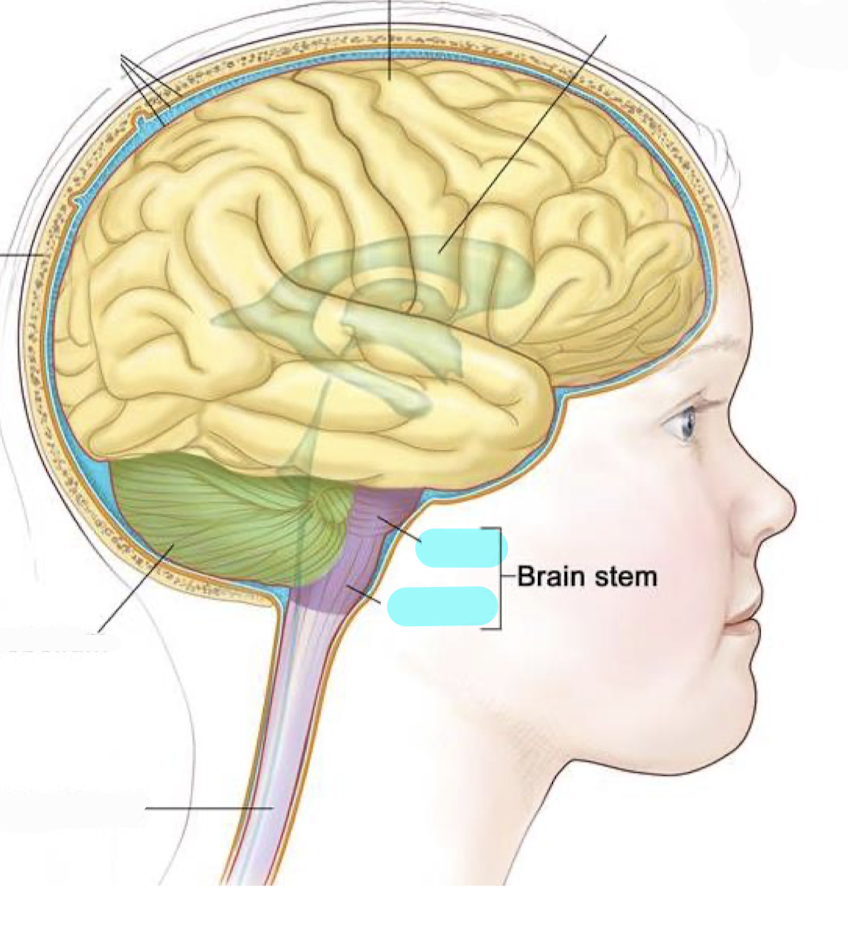
What is the cerebellum?
A cortex-covered brain structure that mainly regulates motor control.
What is the main function of the cerebellum?
Regulation of motor control.
What is the brainstem?
Deep brain structures that include the pons and medulla.
What does the brainstem control?
Many vital functions, including cardiac and respiratory functions.
What two structures highlighted in the slides are part of the brainstem?
The pons and medulla
What is the main function of the spinal cord?
It connects the brain to the rest of the body.
What makes up gray matter in the spinal cord?
Neuron cell bodies.
Where is gray matter located in the spinal cord according to the slide?
In the dorsal and ventral horns
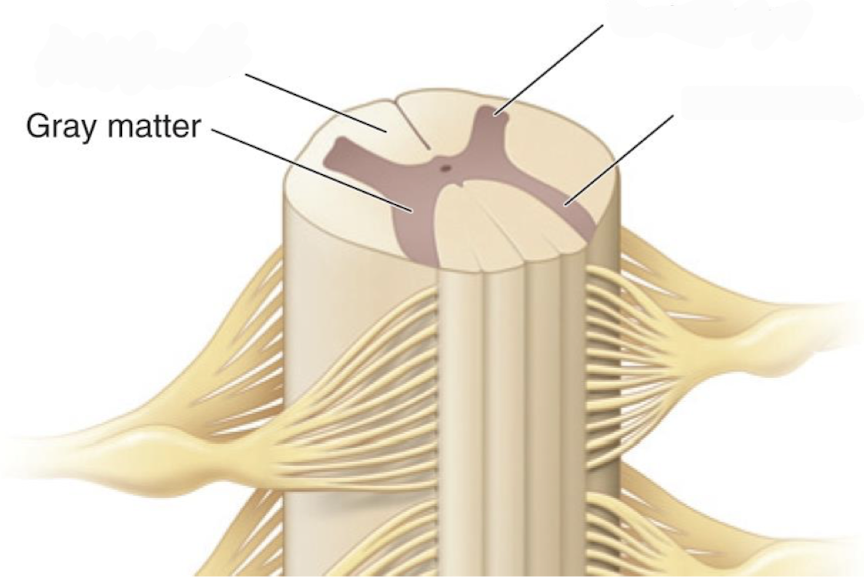
What makes up white matter in the spinal cord?
Myelinated axons.
What are tracts in the spinal cord?
Groups of axons that run up and down the spinal cord.
What do ascending tracts carry?
Sensory information from the body to the brain.
What is another name for an ascending sensory pathway?
An afferent pathway.
What does afferent mean?
A sensory pathway carrying information from the body toward the CNS.
What do descending tracts carry?
Motor signals from the brain to the body.
What is another name for a descending motor pathway?
An efferent pathway.
What does efferent mean?
A motor pathway carrying signals from the CNS toward the body.
What is an easy way to remember afferent vs. efferent?
Afferent = sensory information toward the CNS; efferent = motor information away from the CNS
What is a nerve?
A bundle of neurons plus blood supply and protective coverings.
How many pairs of spinal nerves are there?
31 pairs.
Where do spinal nerves emerge from?
The spinal cord.
What types of signals do spinal nerves carry?
Sensory, motor, and autonomic signals.
How many cranial nerves are there?
12 cranial nerves
Where do cranial nerves emerge from?
The brain.
How are PNS nerve fibers classified?
As A, B, and C fibers.
What characteristics differ among A, B, and C nerve fibers?
Myelination, diameter, and conduction speed.
What bone encloses and protects the brain?
The skull.
What bone structures enclose and protect the spinal cord?
The vertebrae.
What are the meninges?
Tough membranes that cover the brain and spinal cord.
What are the three layers of the meninges?
Dura mater, arachnoid mater, and pia mater.
What protective coverings surround nerves?
Epineurium, perineurium, and endoneurium.
What is CSF?
Cerebrospinal fluid.
How many ventricles are in the brain?
Four ventricles.
What fills the four ventricles of the brain?
Cerebrospinal fluid (CSF).
What fluid fills the central canal of the spinal cord?
Cerebrospinal fluid (CSF)
Where does CSF flow?
Around the outside of the brain and spinal cord
What are the major functions of CSF?
It provides cushioning and support and helps clear waste out of the CNS.
What is the Circle of Willis?
A circle formed by the brain's four major arteries.
Approximately what percentage of body weight does the brain make up?
2%.
Approximately what percentage of cardiac output does the brain receive?
18%.
Approximately what percentage of the body's oxygen supply does the brain use?
20%.
Why is the CNS especially susceptible to loss of blood supply?
Because it has a high metabolic demand and lacks energy reserves.
What is considered the command center of the nervous system?
The brain
What does the PNS do functionally?
It carries messages to and from the CNS.
What are the two major functional divisions of the PNS shown in the slides?
The somatic nervous system and autonomic nervous system.
What does the somatic nervous system control?
Voluntary muscles and transmission of sensory information to the CNS.
What does the autonomic nervous system control?
Involuntary body functions.
What are the two divisions of the autonomic nervous system shown in the slides?
The sympathetic and parasympathetic nervous systems.
What is the general role of the sympathetic nervous system?
It arouses the body to expend energy.
What is the general role of the parasympathetic nervous system?
It calms the body to conserve and maintain energy
What is the somatic nervous system?
Nerves that innervate the skin, joints, and voluntary muscles
What does the somatic sensory system do?
It uses receptors throughout the body to collect sensory information
What types of information does the somatic sensory system collect?
Pressure, temperature, proprioception, and pain
What does the somatic motor system control?
All voluntary muscle movements in the body
What is the autonomic nervous system (ANS)?
The nerves that control involuntary functions
What are examples of functions controlled by the ANS?
Blood pressure, intestinal function, and gland secretions.
What types of elements make up the ANS?
Sensory and motor elements.