Microeconomics Ch 10
0.0(0)
Studied by 1 person Call Kai
 Learn
Learn Practice Test
 Spaced Repetition
 Match
Match Flashcards
 Knowt Play
Card Sorting
1/29

Earn XP
Description and Tags
Last updated 4:09 AM on 4/19/23
Name | Mastery | Learn | Test | Matching | Spaced | Call with Kai | Chat |
|---|
No analytics yet
Send a link to your students to track their progress
30 Terms
1
New cards
Imperfectly competitive
Firms and organizations that fall between the extremes of monopoly and perfect competition
2
New cards
Monopolistic competition
Many firms competing to sell similar but differentiated products
3
New cards
Oligopoly
When a few large firms have all or most of the sales in an industry
4
New cards
Differentiated product
A product that consumers perceive as distinctive in some way
5
New cards
What are some ways that a product can be diffrentiated?
* Physical aspects
* Location from which it sells
* Intangible aspects
* Perceptions
* Location from which it sells
* Intangible aspects
* Perceptions
6
New cards
What does a perfectly competitive demand curve look like?
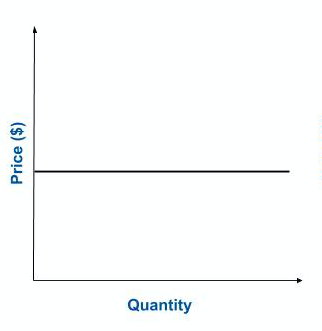
7
New cards
A perfectly competitive firm can sell what at the prevailing market price?
All the output it wishes
8
New cards
What does a monopolistic demand curve look like?
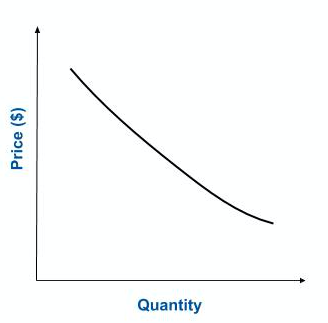
9
New cards
What does a monopoly have to do to sell more output?
Decrease the price it charges
10
New cards
What does a monopolistic competitor demand curve look like?
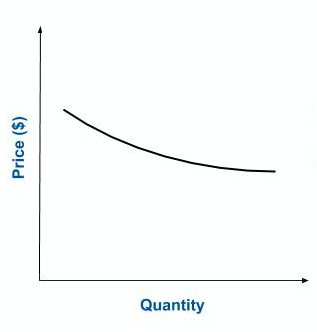
11
New cards
To maximize profits, a firm will choose a quantity where what equals what?
Marginal revenue = marginal cost
12
New cards
The monopolists demand curve is the ______ demand curve?
Market
13
New cards
T/F - the monopolistic competitors demand curve is not the market demand curve.
True
14
New cards
T/F - Monopolists have to fear competitors due to lack of barriers to entry
False, they don’t have to fear because of the many barriers to entry
15
New cards
If a monopolistic competitor makes economic profit, what can they expect?
For more firms to enter their market
16
New cards
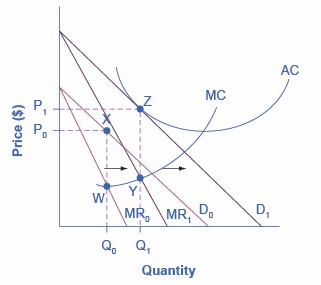
What does a monopolistic demand curve look like when profit induces entry?
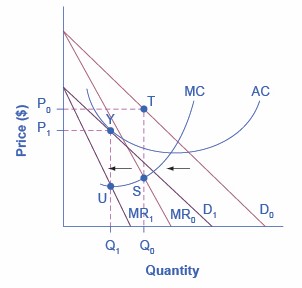
17
New cards
What does a monopolistic demand curve look like when loss induces exit?
18
New cards
T/F - in the short run economic profit or loss are both possible.
True
19
New cards
T/F - in the long run economic profit is possible.
False, economic profit is not possible
20
New cards
T/F - perfectly competitive markets are allocatively efficient.
True
21
New cards
T/F - monopolistic competition is not allocatively efficient.
True
22
New cards
T/F - if oligopolists work hard, they act similarly to perfect competitors.
True
23
New cards
T/F - oligopolists face barriers to entry similar to perfect competitors.
False, monopolies
24
New cards
What can oligopolists act like when they collude with each other?
Monopolies
25
New cards
Collusion
When firms act together to reduce output and keep prices high
26
New cards
How to firms collude with each other?
* Hold down industry output
* Charge a higher price
* Divide the profit among themselves
* Charge a higher price
* Divide the profit among themselves
27
New cards
Game theory
A branch of mathematics that analyzes situations in which players must make decisions and then receive payoffs based on what other players decide to do
28
New cards
Prisoner’s dilemma
A scenario in which the gains from cooperation are less than the rewards from pursing self-interest
29
New cards
Duopoly
An oligopoly with only two firms
30
New cards
What is a way to enforce cooperation within oligopolies and the prisoner’s dilemma?
Penalize those who don’t cooperate