6.3 Art Heads Back Outside: Sculpture at St. Pierre
 Call Kai
 Learn
Learn Practice Test
 Spaced Repetition
 Match
Match Flashcards
 Knowt Play
1/9

There's no tags or description
Looks like no tags are added yet.
Name | Mastery | Learn | Test | Matching | Spaced | Call with Kai | Chat |
|---|
No analytics yet
Send a link to your students to track their progress
10 Terms
A cloister is a secluded space used by monks and nuns on the grounds of an abbey to remove themselves to pray and meditate. It's often a peristyle-type walkway surrounding a garden
(Tu viện là một không gian biệt lập được các nhà sư và nữ tu sử dụng trong khuôn viên tu viện để cầu nguyện và thiền định. Nó thường là một lối đi có hàng cột bao quanh một khu vườn)
.
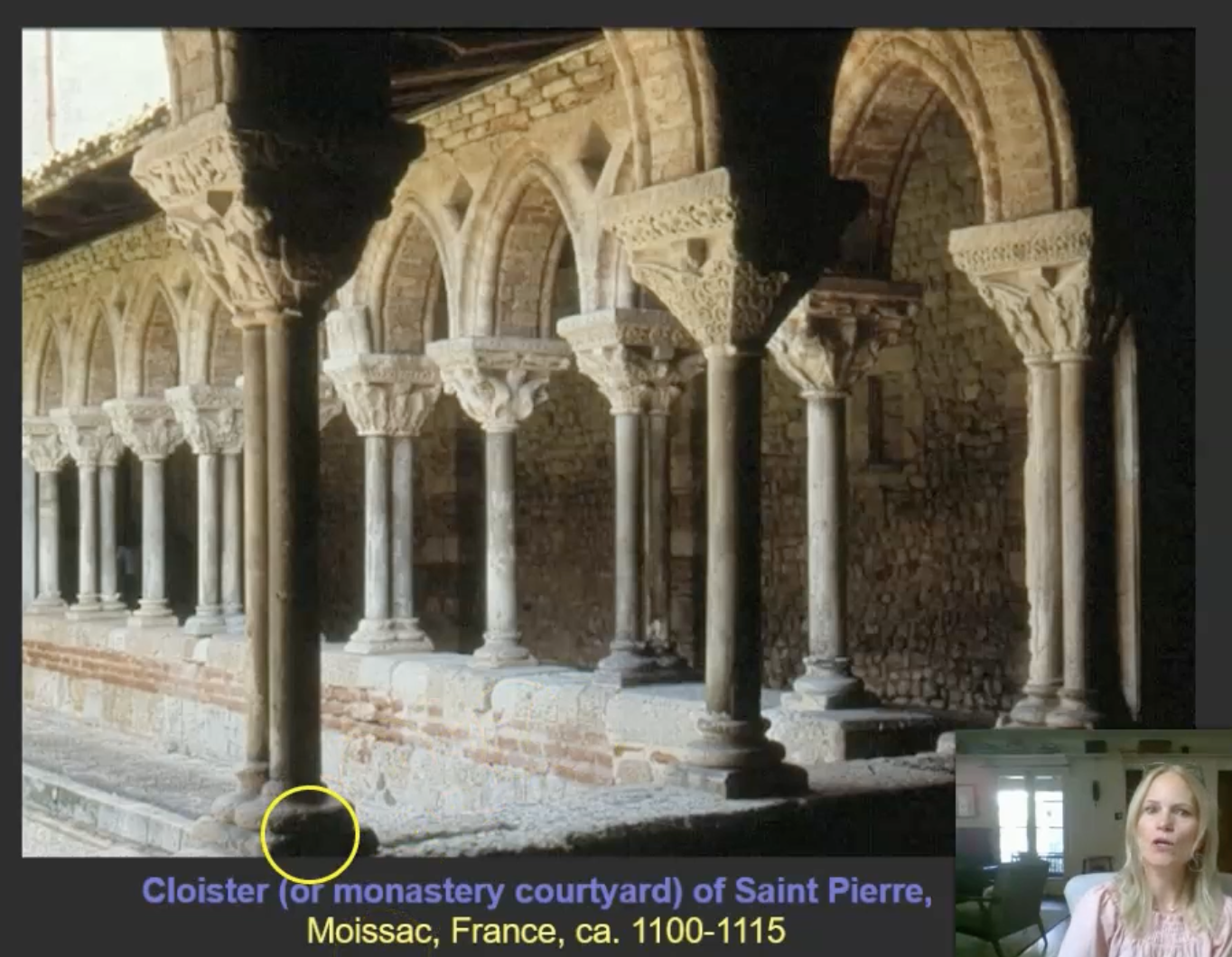
Cloister (Monastery Courtyard), read the pic
Cloister = monastery courtyard. (Tu viện)
Very religious time.
Monks and nuns gave up all worldly possessions.
Restrictive, disciplined devotion to God.
Filled with daily prayer.
Cloister = quiet retreat.
Garden-like courtyard, Walk the corridors, pray, contemplate, meditate.
Often surrounds a fountain or garden.
Column Capitals
Typical Romanesque example of art.
Column capitals are the remarkable feature.
Some single columns, some pairs (colonnettes).
All share similar-sized capitals.
Not Greco-Roman capitals.
More individualized and unique limestone reliefs of things top of mind in the Romanesque world.
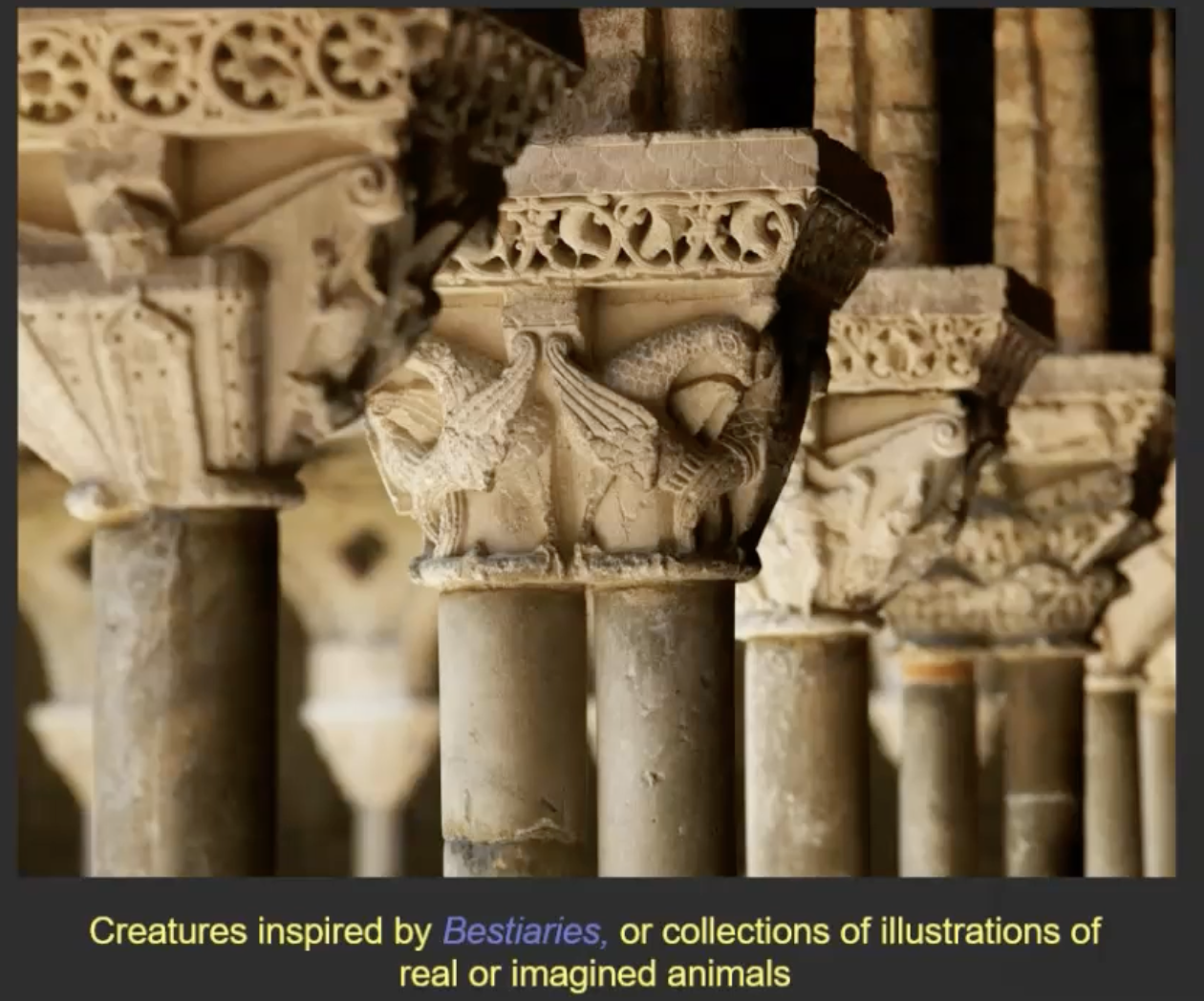
Creatures inspired by Bestiaries, or collections of illustrations of real or imagined animals
Images on the capitals:
Biblical scenes.
Lives of saints.
Abstract patterns.
Modern interest Subjects from book “Bestiaries”
Bestiaries = books of real or imagined animals and monsters.
Collections of illustrations.
Very popular during this period.
Not meant to entertain.
Meant to horrify people.
If people didn't please God, live a sinless life, and be not a good Christians...
The devil, monsters, and demons would take over the world.
Cloister illustrates this apocalyptic takeover of monsters.
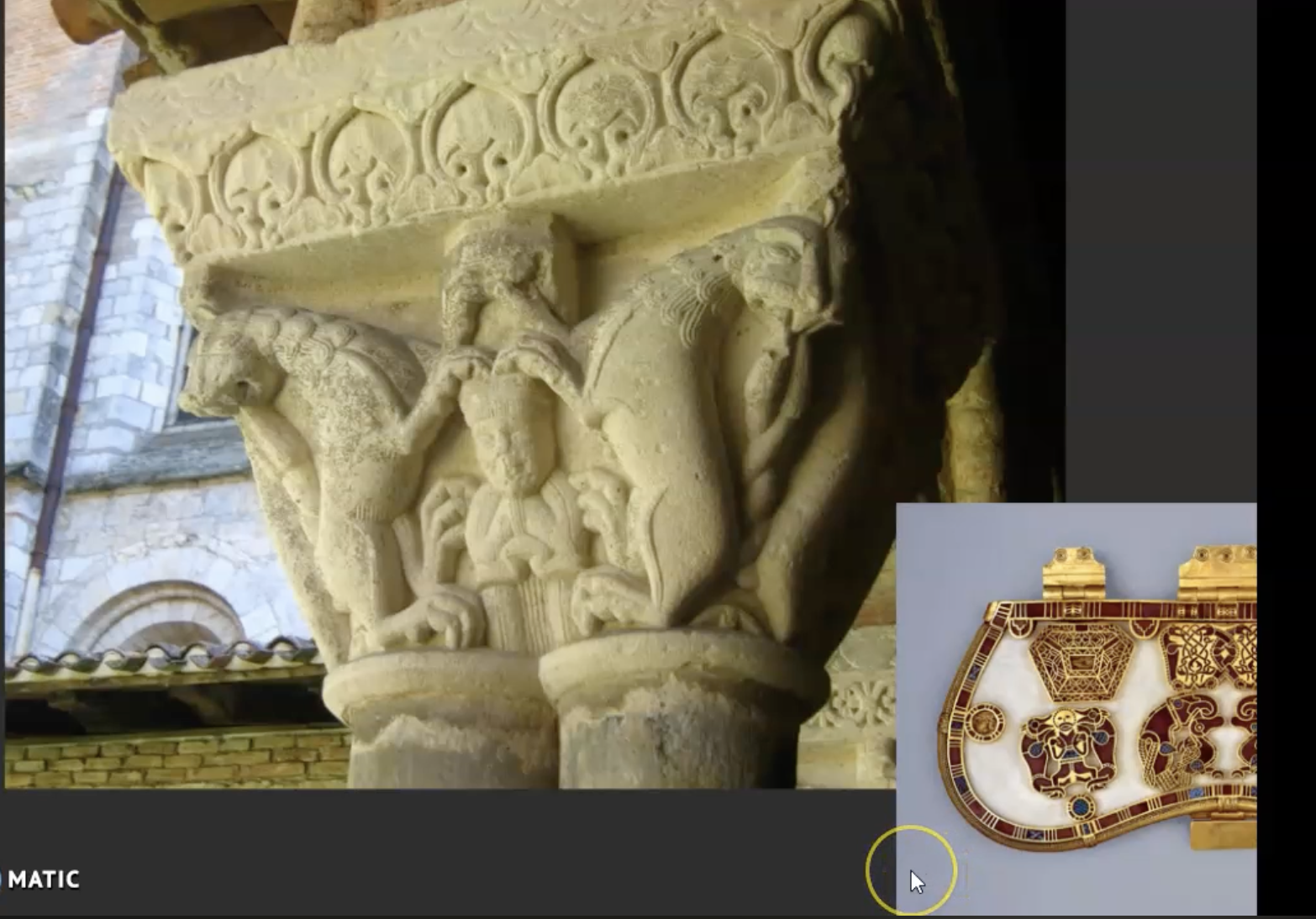
Hiberno-Saxon / Anglo-Saxon Influence
Hiberno-Saxon / Anglo-Saxon Influence
Winged griffin-like bird in mirror image.
Aesthetic lifted from Hiberno-Saxon and Anglo-Saxon art.
Warrior lords, Saxons, Vikings.
Brought a more abstract aesthetic.
Dominance of pattern.
Similar to the Anglo-Saxon purse cover.
Animal interlace style.
Vine-like tendrils. (Những tua cuốn giống như dây leo.)
Animals woven into the design.
Mirror image and symmetrical pairings.
Legacy of these warrior groups married with Christian art.
Seen in illuminated manuscripts.
Now translated into the Romanesque revival of stone sculpture.
Griffin-like beasts tearing into a human.
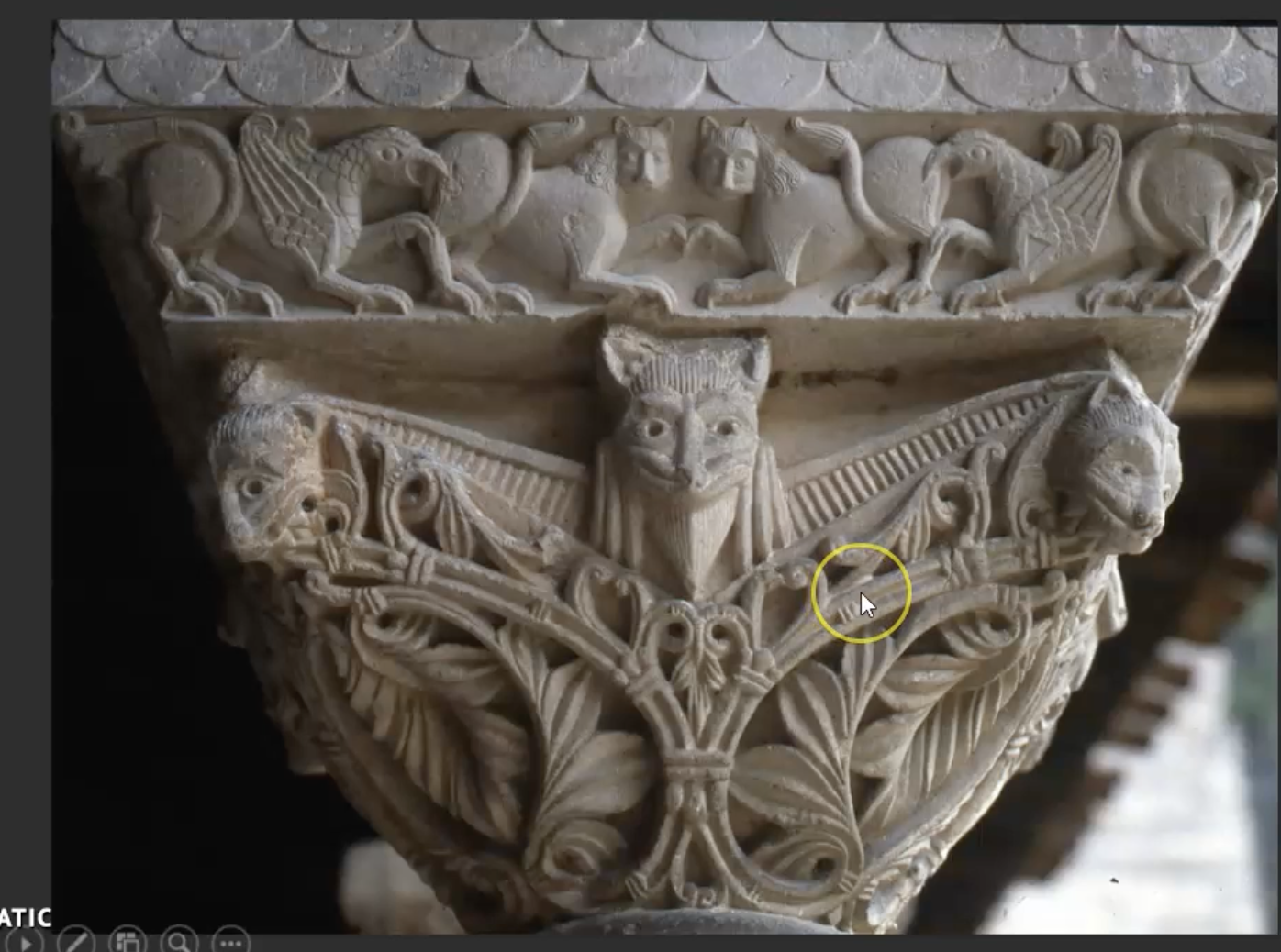
Strong symmetry, mirror image, and pattern.
Botanical tendrils reminiscent of illuminated manuscripts.
Three bat heads.
Griffins biting lions.
What you see on the left, you see on the right.
Balance and symmetry become part of the Romanesque aesthetic.
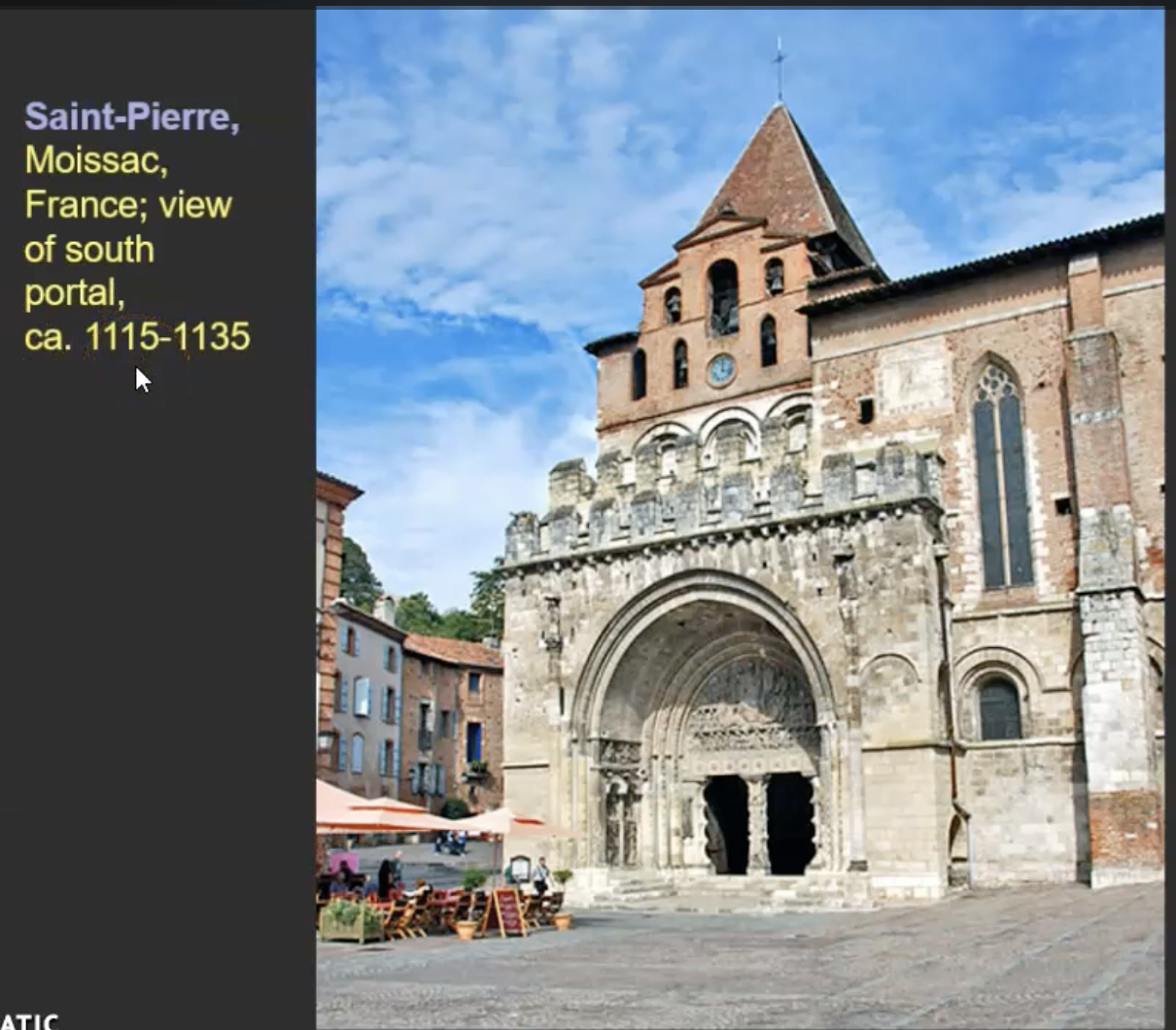
Saint-Pierre, Moissac, France; view of south portal, ca. 1115-1135
South portal (doorway) of Saint-Pierre.
Many people were illiterate.
Art was a way to visually connect with people.
Romanesque period = pilgrimages.
Traveling from one pilgrimage church to another.
Arduous journeys. (Những chuyến đi đầy gian nan, vất vả)
Visiting important relics.
Kind of a way to earn points to get into heaven.
Shift from decorating only the inside of churches.
Now decorating the outside as well.
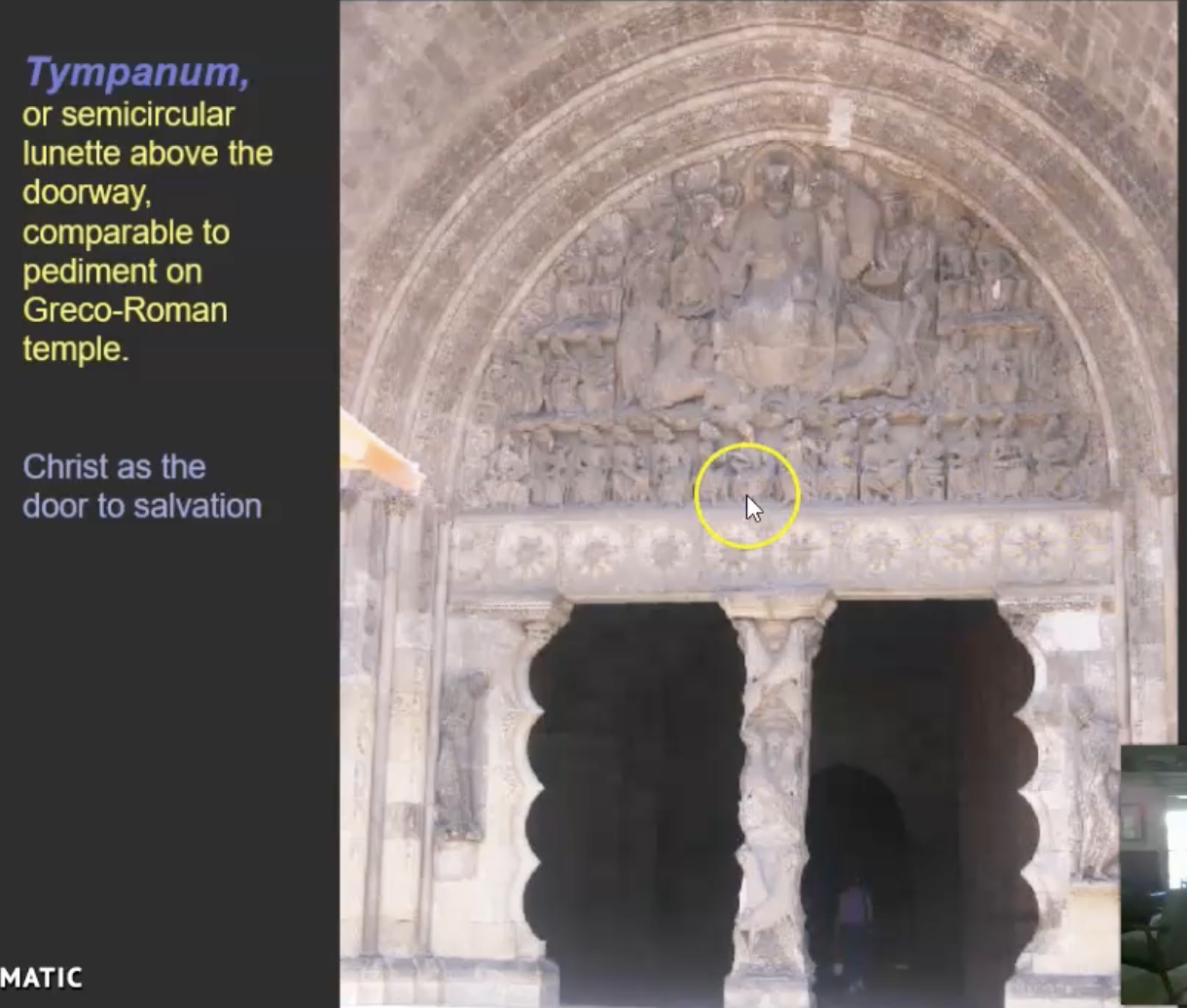
Tympanum,or semicircular lunette above the doorway, comparable to pediment on Greco-Roman temple.
Christ as the door to salvation
Above the doorway.
Like a billboard.
Catch the eye.
Send a message.
Motivate a certain set of actions.
Christ is the door to your salvation.
Tympanum = semicircular (lunette) sculptural relief above the doorway.
First appears in the Romanesque period.
Common in the Gothic period.
Comparable to the Greco-Roman pediment.
Connects to the religion practiced inside.
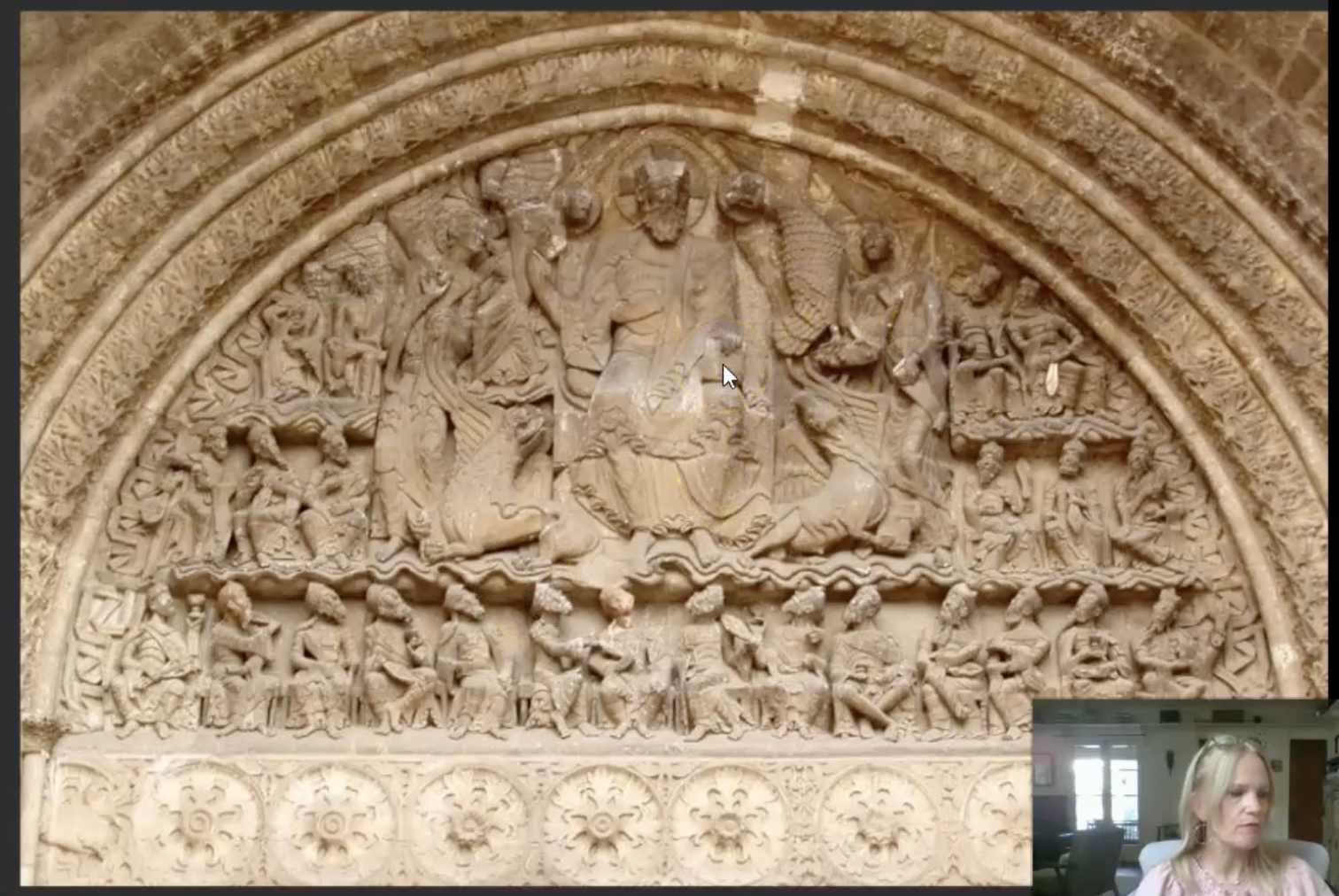
Second Coming of Christ
Main Message
Judgment Day.
Heavy message for the Romanesque viewer.
Reminder that you can still be saved, even if you're a sinner.
Go through those doors.
Christ and Christianity = salvation for your immortal soul.
Theme = Second Coming of Christ.
Christ returns on Judgment Day.
Judges who is worthy of heaven and who is condemned to hell.
Return to hierarchy of scale./ disproportionality
→Christ larger and in the center of the composition.
Surrounded by the four symbols of the evangelists.
Rows of biblical kings (the 24 elders) supporting Christ.
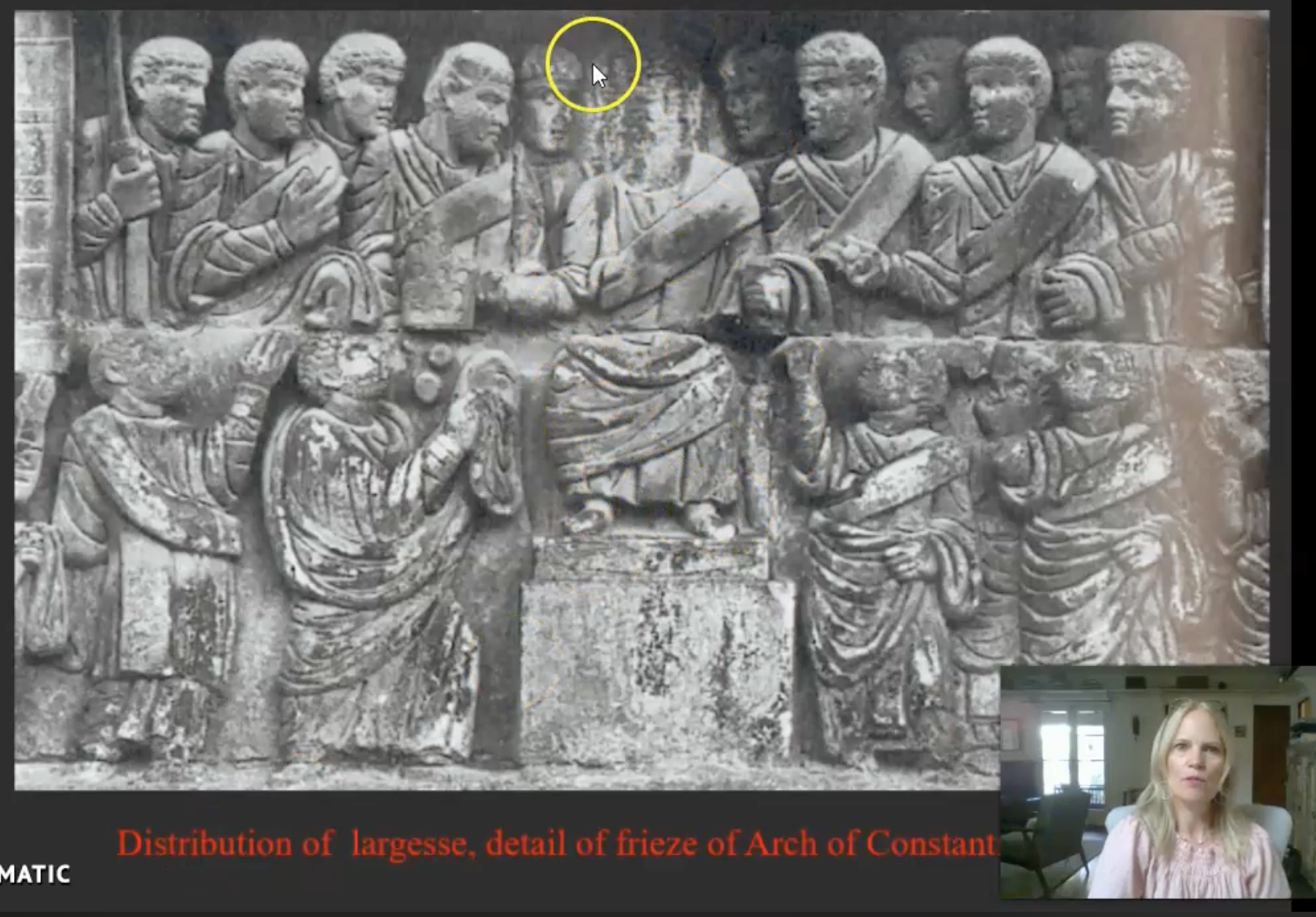
Reminiscent of Constantine surrounded by followers on the Arch of Constantine.
Christ surrounded by the four evangelists.
Authors of the New Testament.
-COmpare to the "Distribution of the Largesse."
very reminiscent in many ways to what we saw in the Late Antiquity/Late Empire of the Roman era with Constantine (the famous first Christian Roman emperor) surrounded by his followers flanking him in this scene from the Arch of Constantine the "Distribution of the Largesse."
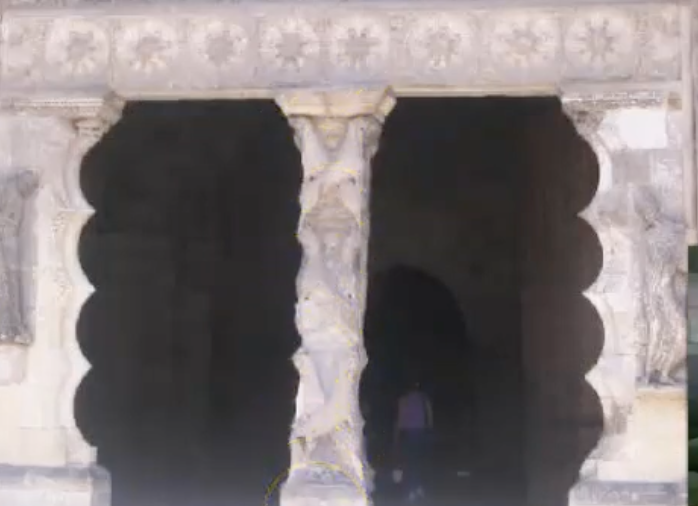
Below the tympanum of the saint pier
Front of the Pier
Pier below the tympanum.
Sculptural reliefs carved on the front and side.
X-shaped lions carved along the face of the column.
12th-century interpretation of lions.
Lions = gatekeepers.
Guard fortresses, palaces, and citadels.
Powerful creatures—"king of the jungle."
Highly stylized.
Not concerned with naturalism.
Design rules over naturalism.
Common throughout the medieval world.
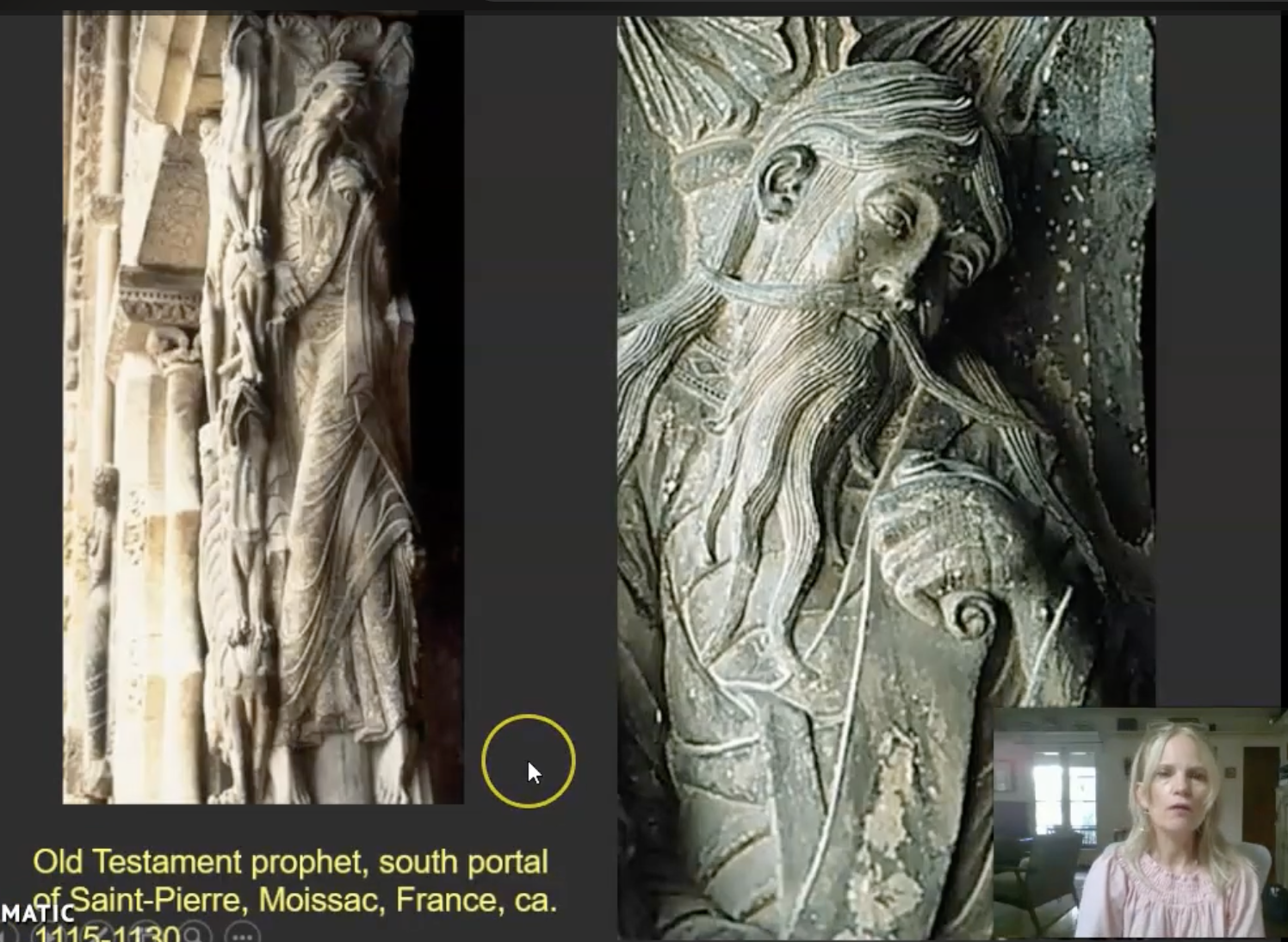
Old Testament prophet, south portal of Saint-Pierre, Moissac, France, ca 1115-1130
Side of the pier also carved in limestone.
Depicts an Old Testament prophet (possibly Jeremiah or Isaiah).
Old Testament figures connect the past to the New Testament.
Christ appears in the tympanum above, linking prophecy to its fulfillment. (tiên tri)
Prophet holds an unfurled scroll.
Scroll represents his prophecy.
Prophecy points to the coming Savior, Jesus.
Dazed, trance-like expression.
As if receiving or delivering the prophecy.
Style of the Prophet
Hyper-elongated legs stretched to fit the portal post.
Another X-shaped pattern in the figure.
Not meant to have accurate, naturalistic proportions.
Holy figures meant to look otherworldly and supernatural.
Distortion accepted and revered in the medieval world.
Fabric clings to the body.
Opportunity for design, pattern, and linear detail.
Beard and mustache made of repeating wavy lines.
Strong use of pattern play and line.
Reminiscent of illuminated manuscripts and earlier medieval abstract design.
Abstract pattern + figurative art + Christian message.
Example of raised sculptural relief.
Flattened feet help prevent chipping.
Recognizable holy figure, but intentionally stylized and distorted.