Bootcamp.com - Excretory System
 Call Kai
 Learn
Learn Practice Test
 Spaced Repetition
 Match
Match Flashcards
 Knowt Play
1/137

There's no tags or description
Looks like no tags are added yet.
Name | Mastery | Learn | Test | Matching | Spaced | Call with Kai | Chat |
|---|
No analytics yet
Send a link to your students to track their progress
138 Terms
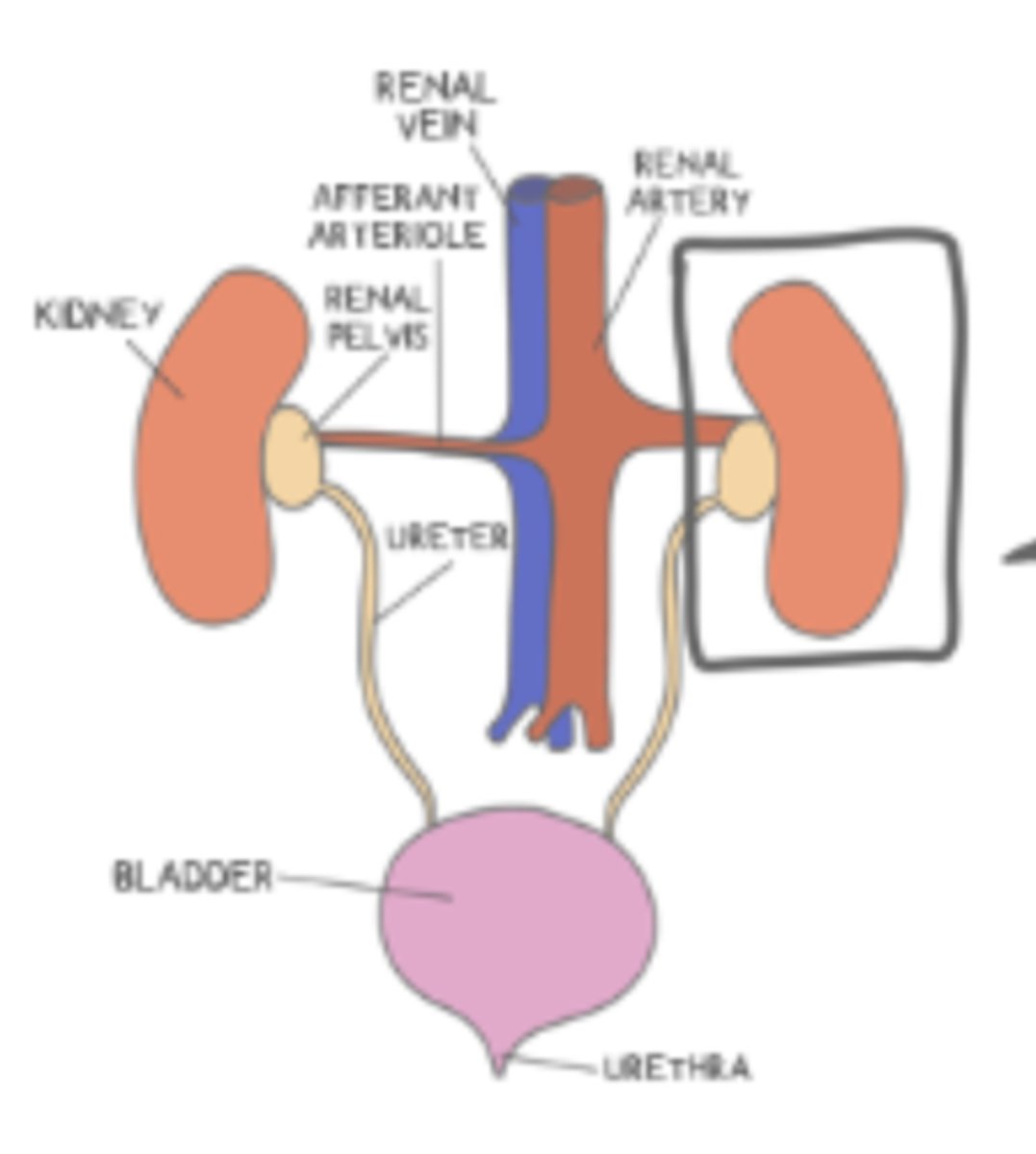
what is the primary role of the excretory system?
to filter out metabolic wastes from the body and eliminate them as urine
the excretory system also aids the body in retaining water and solutes
how many kidneys do humans have?
2
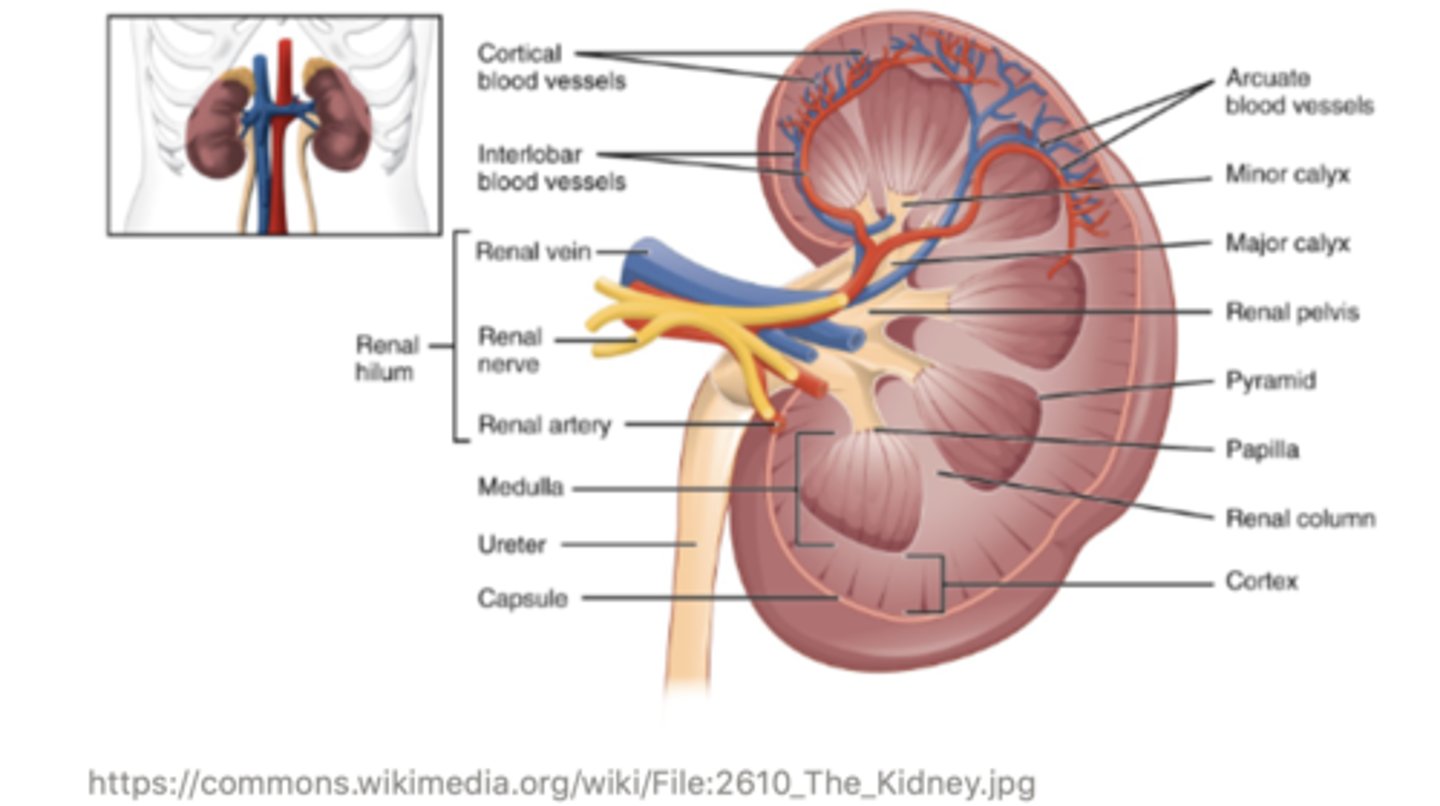
the outer portion portion of the kidney is called the ______ , and this is where blood enters
cortex
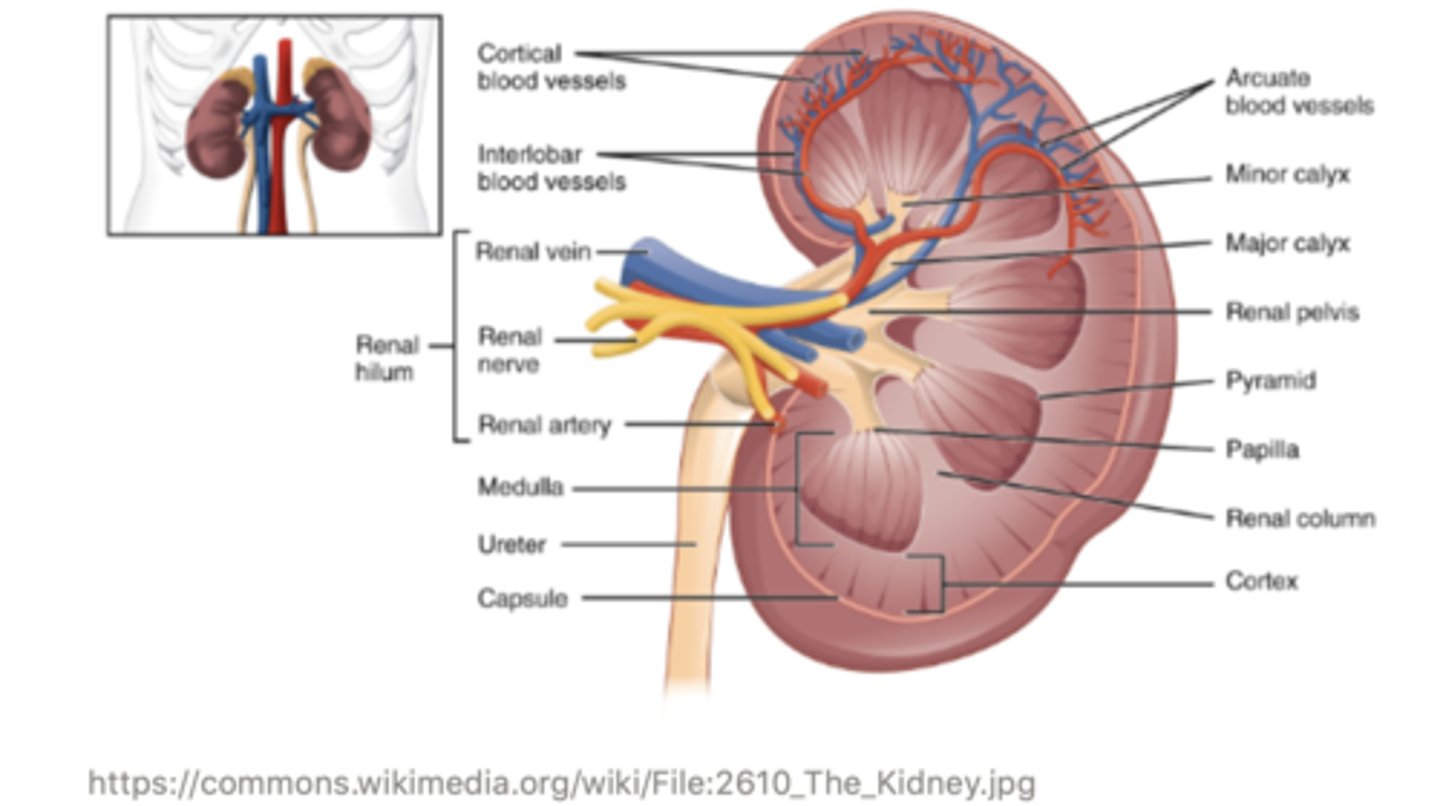
the middle portion of the kidney is called the ______
medulla
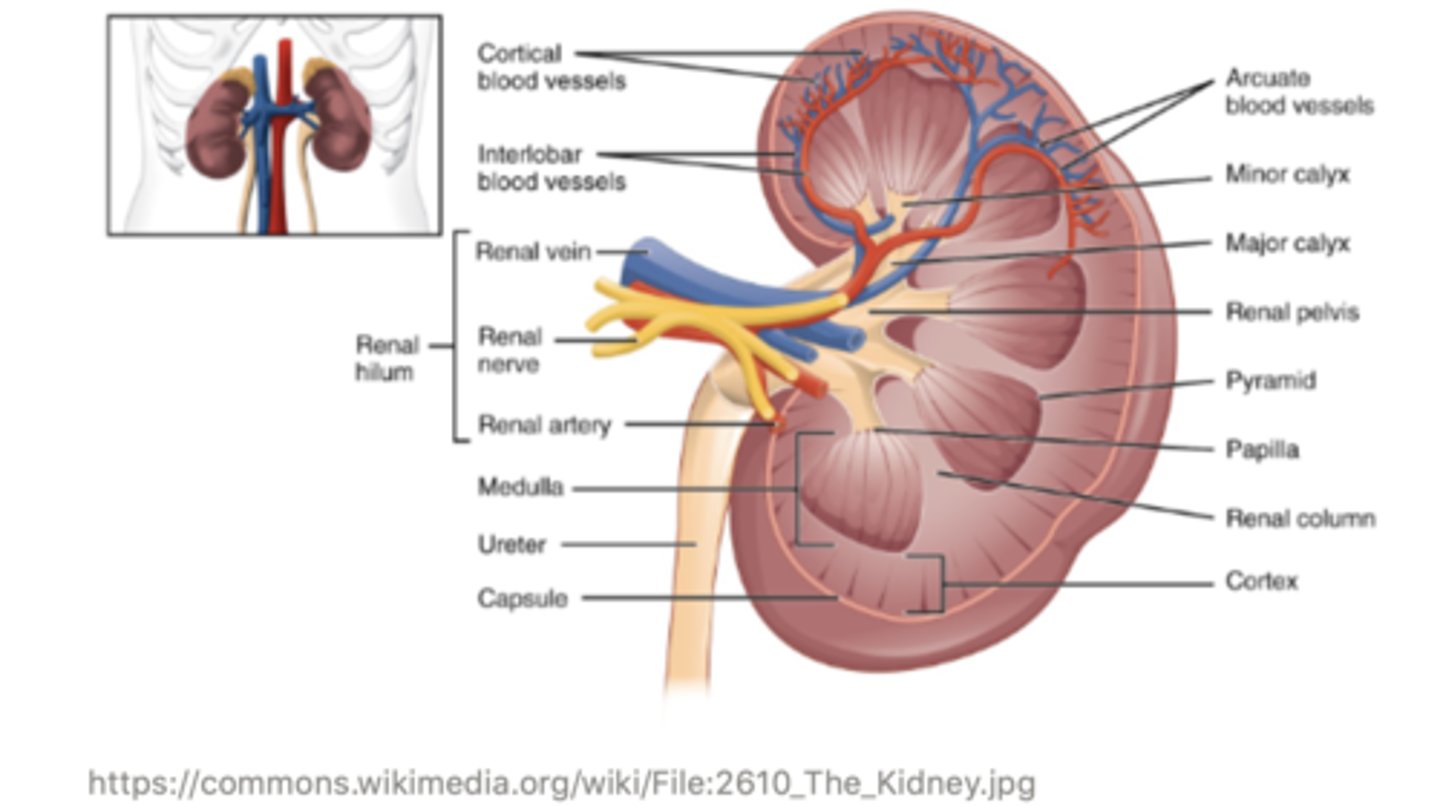
the very inner portion of the kidney is called the ______, and this is where filtrate exits the kidney
pelvis
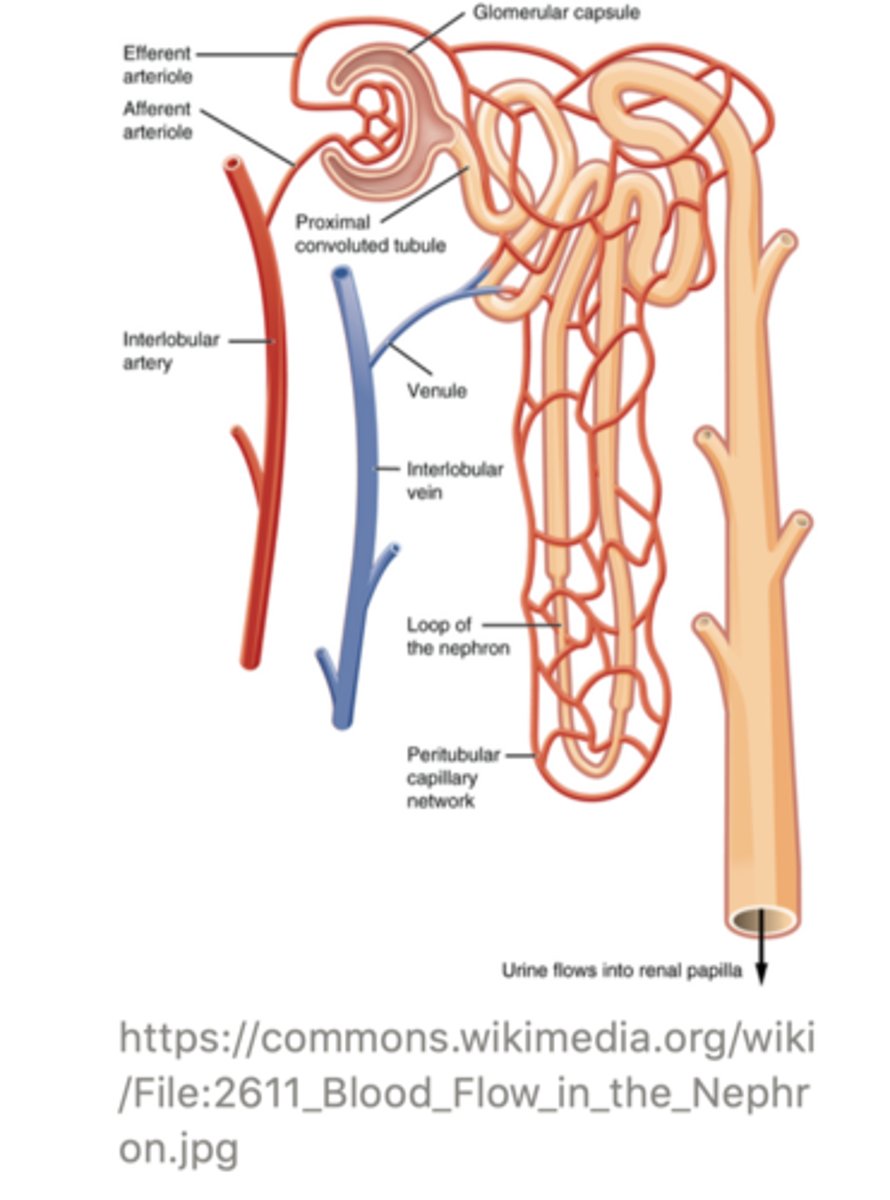
a ______ is the single, functional unit of the kidney
nephron
kidneys are made of thousands of individual nephrons!
what are the 4 main processes that occur in the kidneys?
filtration; reabsorption; secretion; excretion
the excretory process begins when blood flows from the body and into the ______ artery, which branches off into the ______. From there it is led into the ______
renal artery (interlobular artery is an accepted answer too) --> afferent arteriole --> glomerulus
the ______ is a ball/collection of blood vessels located in the renal cortex of the kidney
glomerulus
the glomerulus is strategically located adjacent to the ______
Bowman's capsule
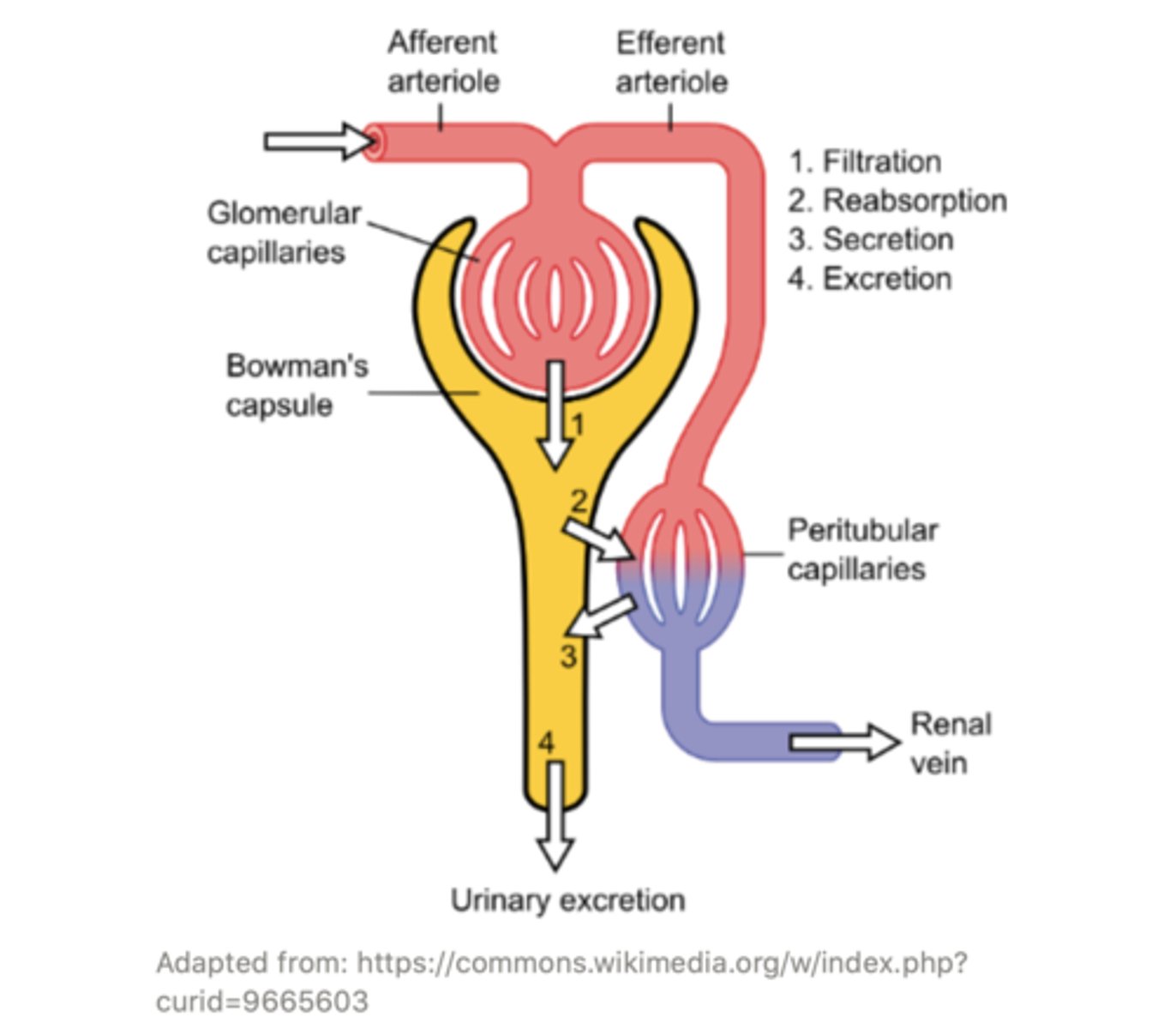
together, the glomerulus and Bowman's capsule are known as the ______
renal corpuscle
the substances that filter from the blood and into the Bowman's capsule are known as ______
filtrate
smaller substances can pass into the Bowman's capsule while the larger substances that cannot pass into the Bowman's capsule remain in the glomerulus. This process is called ______
filtration
the glomerulus acts like a sieve - it allows small substances (like _______ and ______) to pass into the Bowman's capsule while it keeps larger substances (like ______ and ______) in the blood
water; solutes; proteins; blood cells
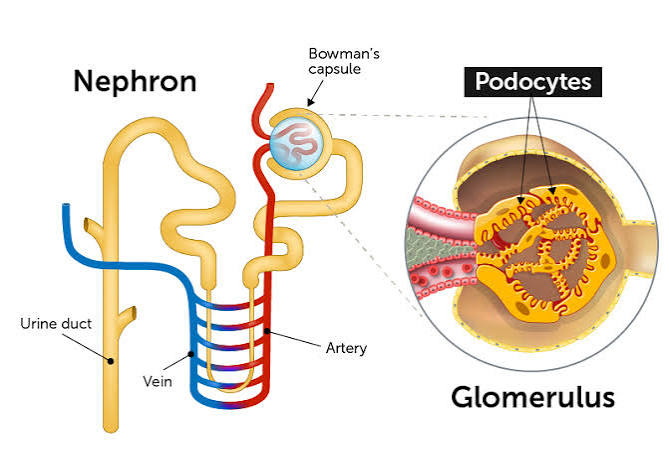
the Bowman's capsule has ______ (hint: long, foot-like processes) that wrap around the glomerulus
podocytes (podo = foot or foot-like part)
the podocytes form ______ (hint: 'window' or 'opening'). Some of these slits are large enough for certain small substances to pass through but small enough to prevent other large ones from passing through the Bowman's capsule
fenestrations (fenestra = window; opening)
blood within the glomerulus leaves the renal corpuscle via the ______ _______
efferent arteriole
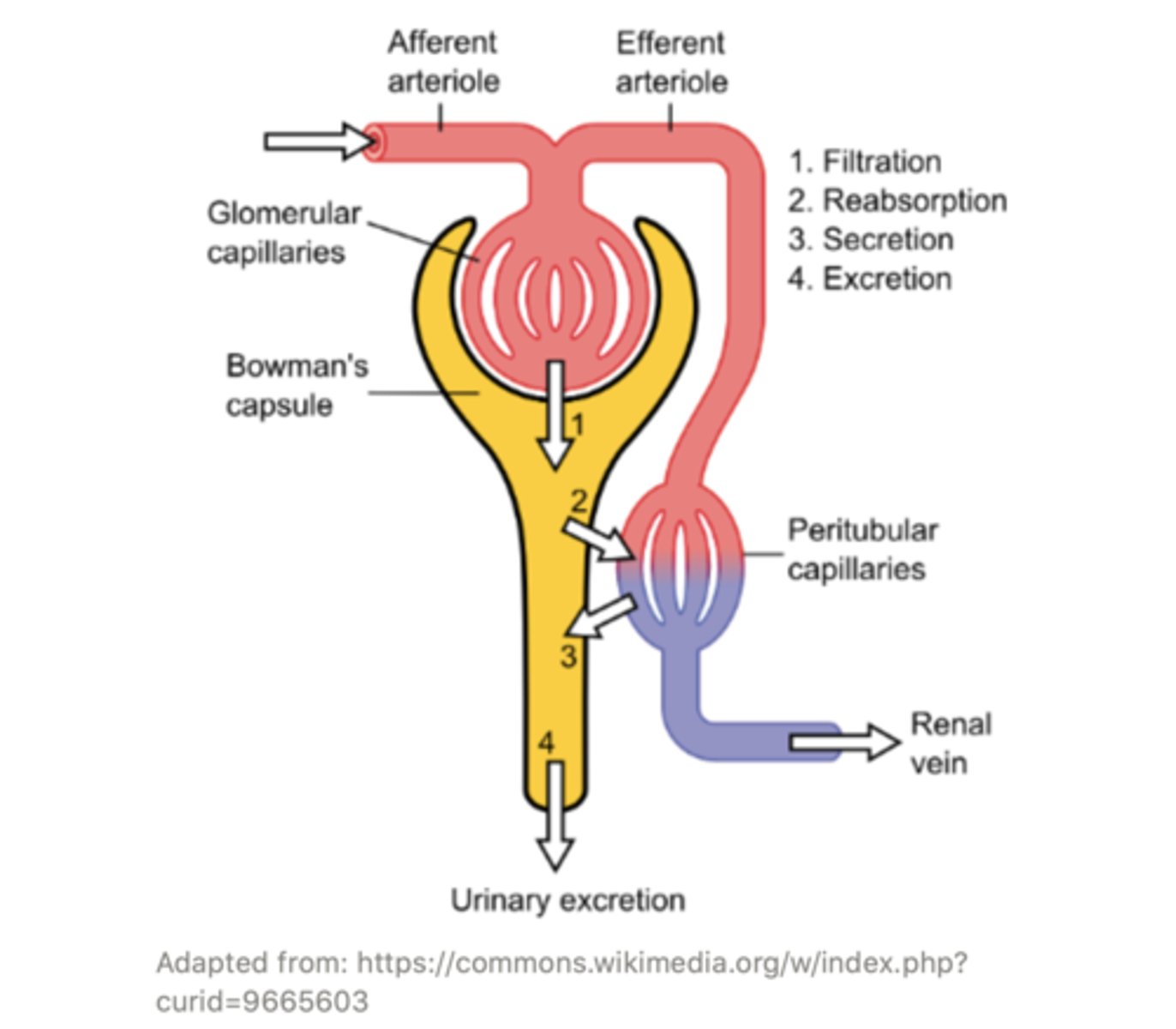
the efferent arteriole goes on to form a set of capillaries called the ______ capillaries
peritubular
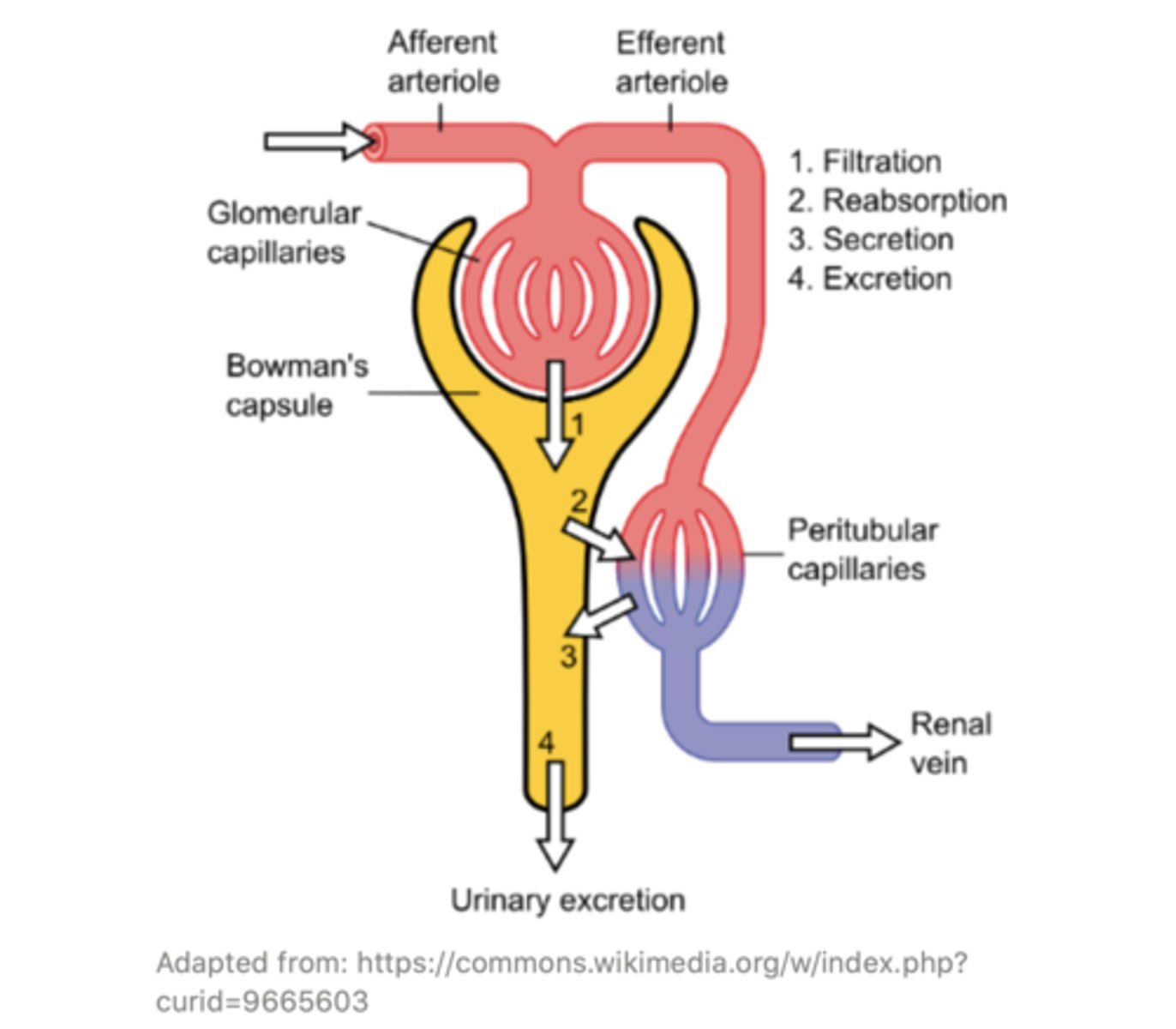
the ______ capillaries surround the different tubules of the nephron and exchange water, salts, and other important molecules with them. This modifies the content of the filtrate through processes of ______ and ______
peritubular;
reabsorption; secretion
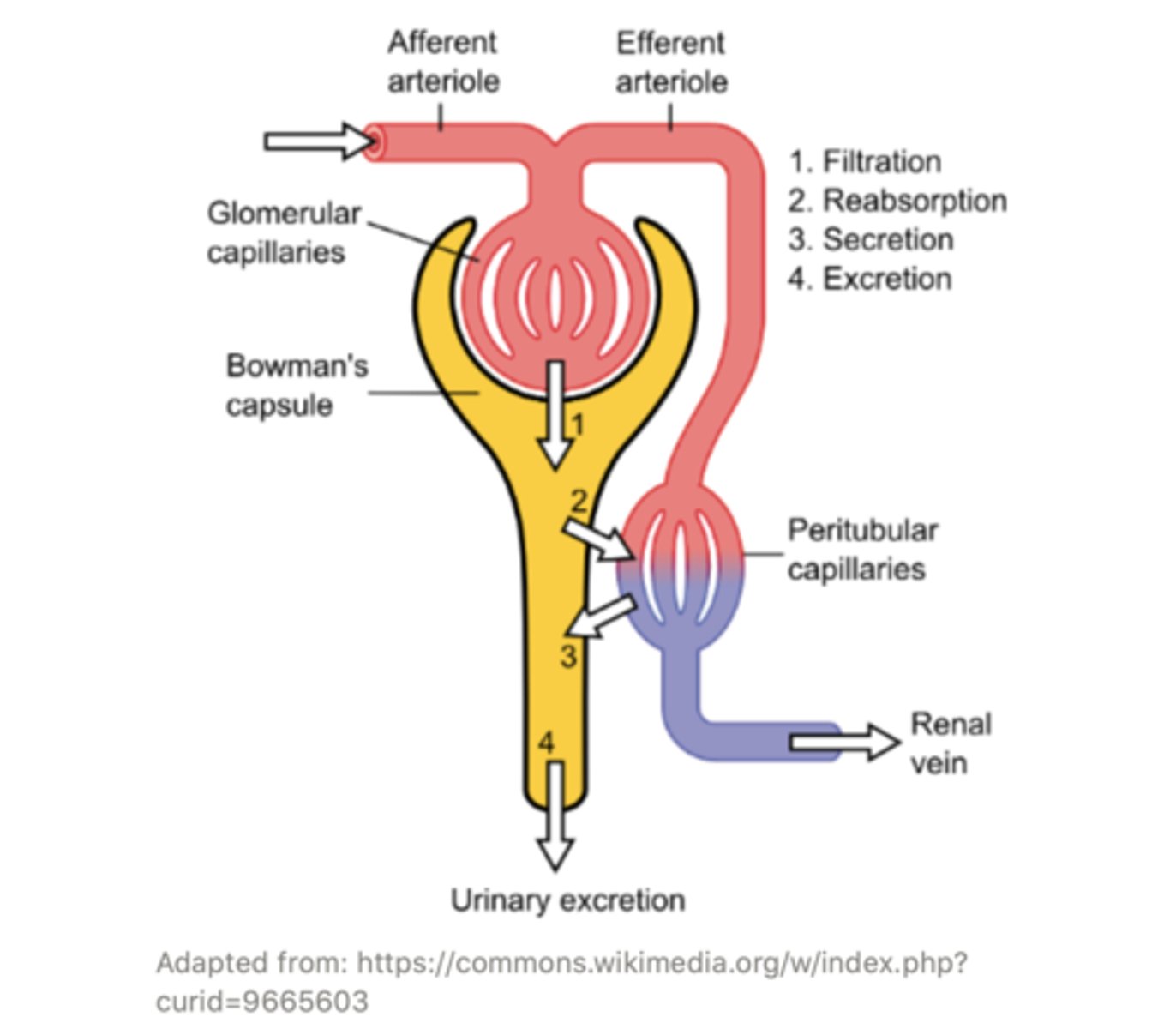
what is the mnemonic to remember the order of the afferent arteriole vs. the efferent arteriole in the kidney?
A comes before E in the alphabet, so the Afferent arteriole comes before the Efferent arteriole in the kidney (afferent enters and efferent leaves)
the process of the removal of water and solutes from filtrate back into the blood vasculature is called ______
reabsorption
reabsorption occurs from the ______ up to and including the ______
proximal convoluted tubule (predominantly); collecting duct
filtrate flows from the Bowman's capsule to the ______, then into the ______
proximal convoluted tubule; loop of Henle (descending limb is also an acceptable answer)
the _____ is the part of the nephron that descends from the cortex of the kidney to the medulla
loop of Henle
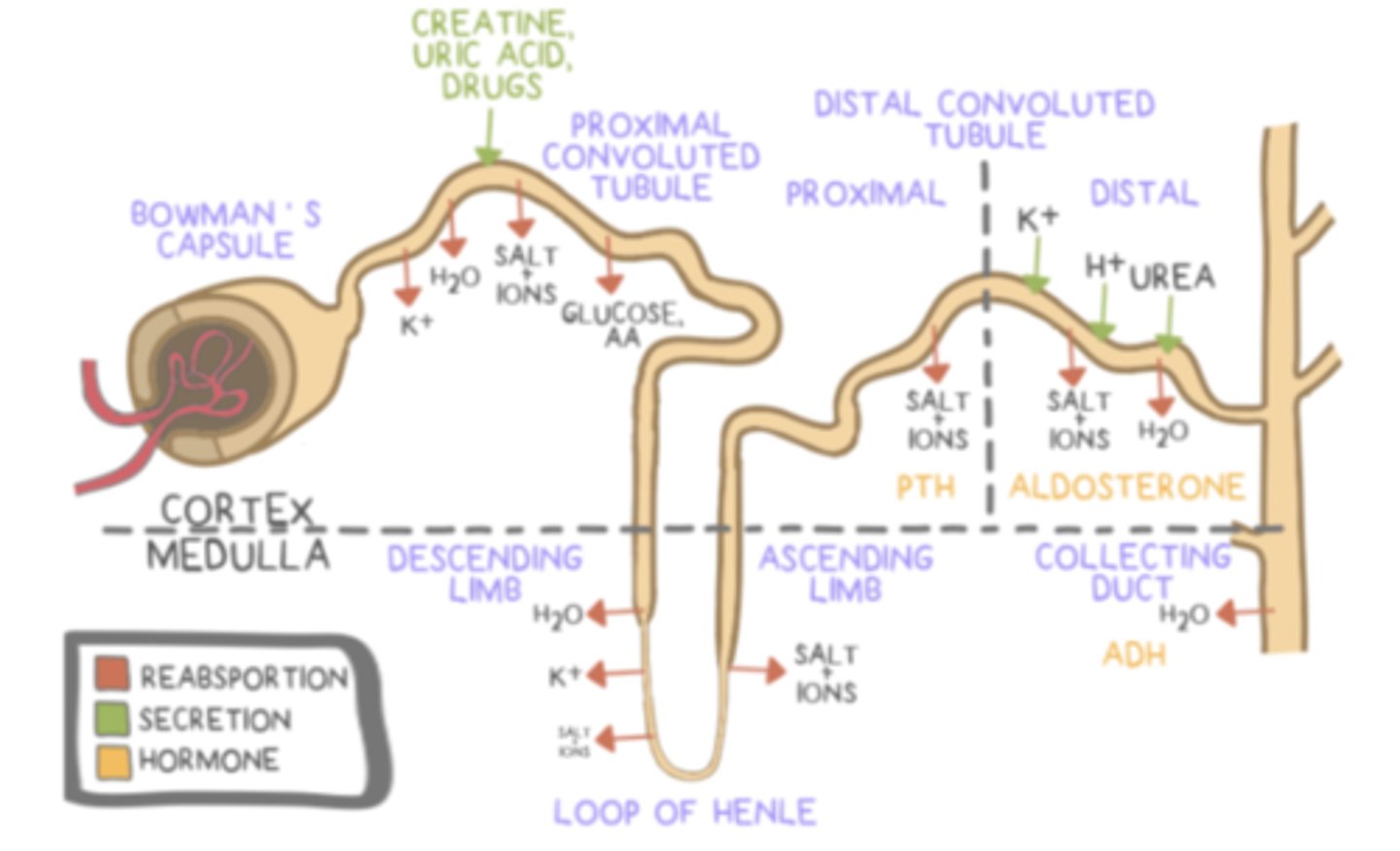
the descending limb of the loop of Henle has a _____ permeability to water and _____ permeability to solutes
high; low
the ______ limb of the loop of Henle has a high permeability to water and low permeability to solutes
descending
as filtrate travels down the descending limb it becomes ______ concentrated
more
(because water leaves the filtrate)
the water that leaves the descending limb is absorbed back into the blood supply by the ______, which are blood capillaries that run adjacent and parallel to the loop of Henle
vasa recta
this is our body's way of reabsorbing and retaining water!
the ascending limb of the loop of Henle has a very ______ permeability to water and ______ permeability to solutes
low; high
the ______ limb of the loop of Henle has a very low permeability to water and high permeability to solutes
ascending
as filtrate travels up the ascending limb it becomes ______ concentrated
less (because solutes leave the filtrate)
the solutes that leave the ascending limb are absorbed back into the blood supply by the ______, which are blood capillaries that run adjacent and parallel to the loop of Henle
vasa recta
this is our body's way of reabsorbing and retaining important salts
the process of the transfer of solutions from the blood vasculature directly into the nephron tubule filtrate secretion is called ______
secretion
via the process of ______ certain (usually harmful) substances are extracted from the blood, specially from the ______ capillaries, and taken up by the nephrons directly
secretion; peritubular
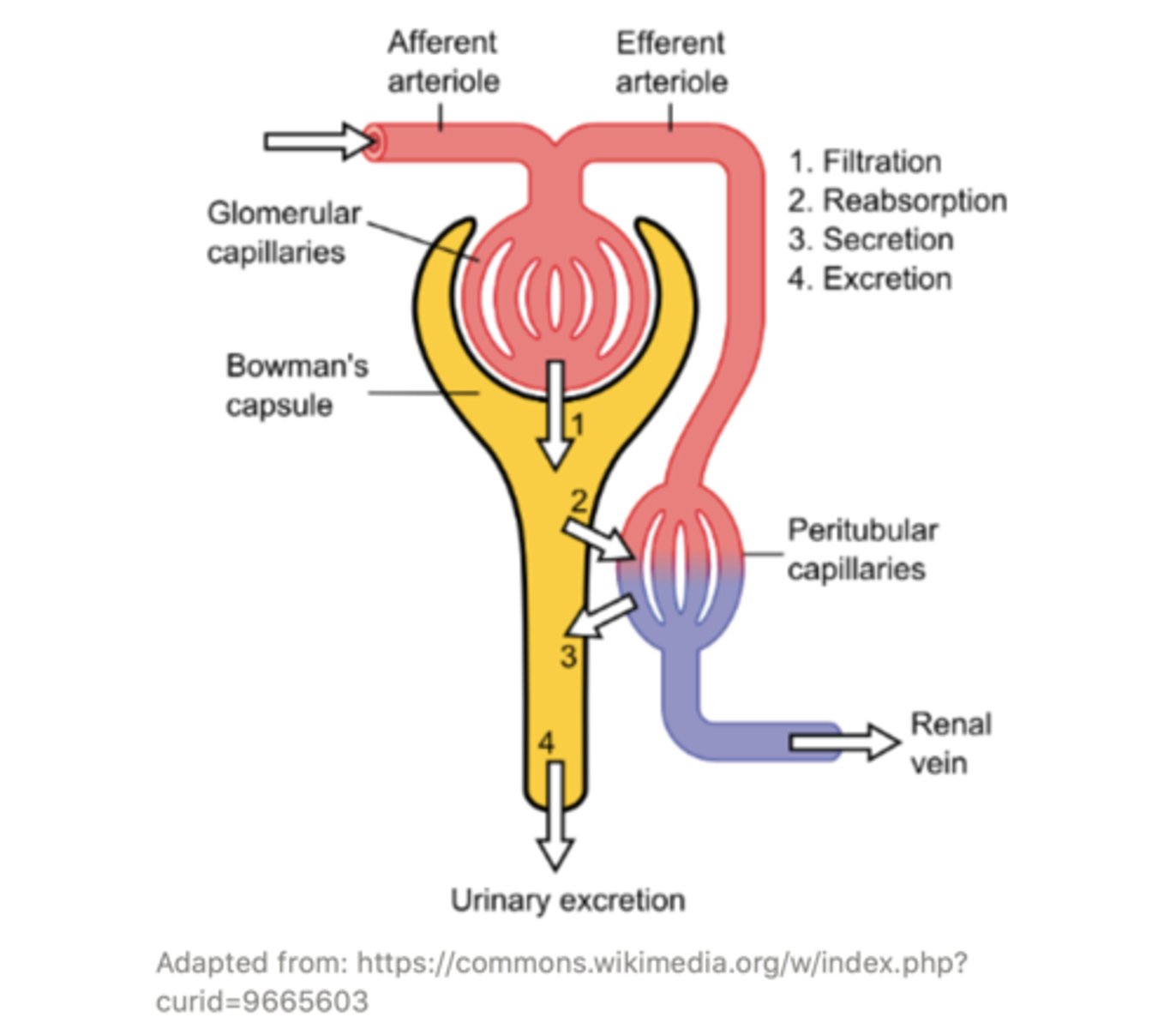
the proximal convoluted tubule is located between the ______ and the _____ of the loop of Henle
renal corpuscle (Bowman's capsule is an acceptable answer too); descending limb
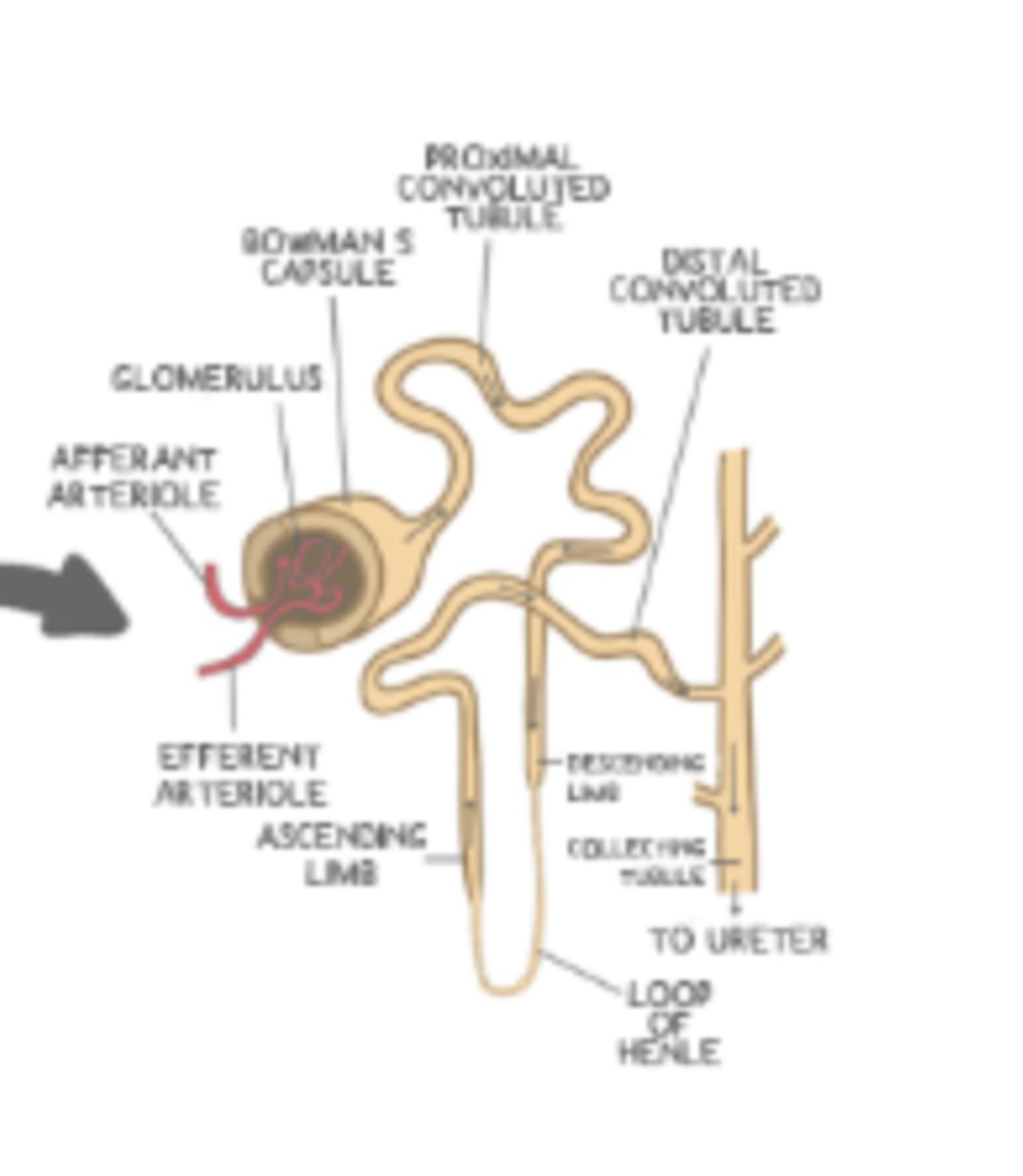
the distal convoluted tubule is located between the ______ of the loop of Henle and the ______
ascending limb; collecting duct
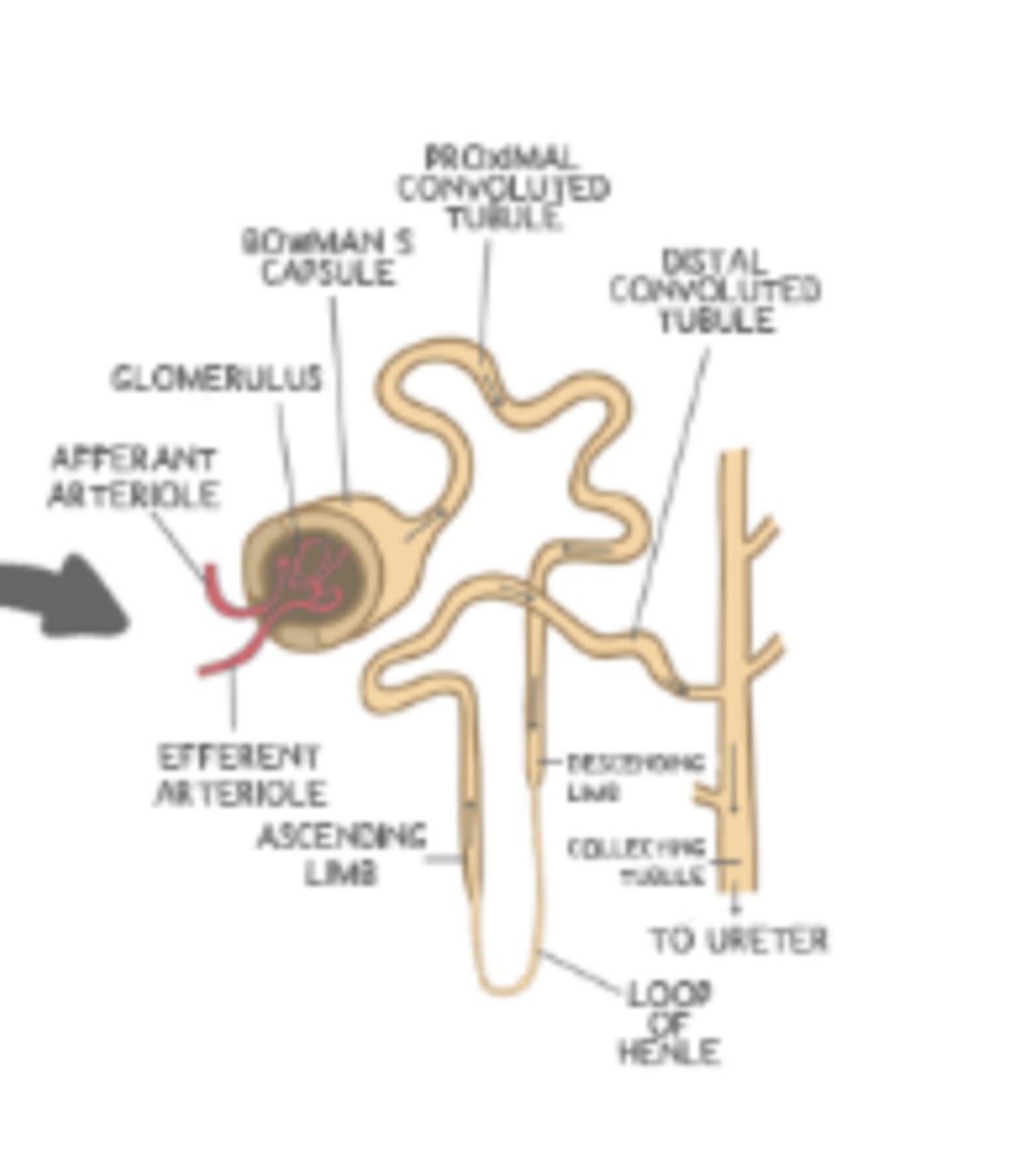
the process by which the filtrate (after filtration, reabsorption and secretion have occurred) is removed from the body as urine is called ______
excretion
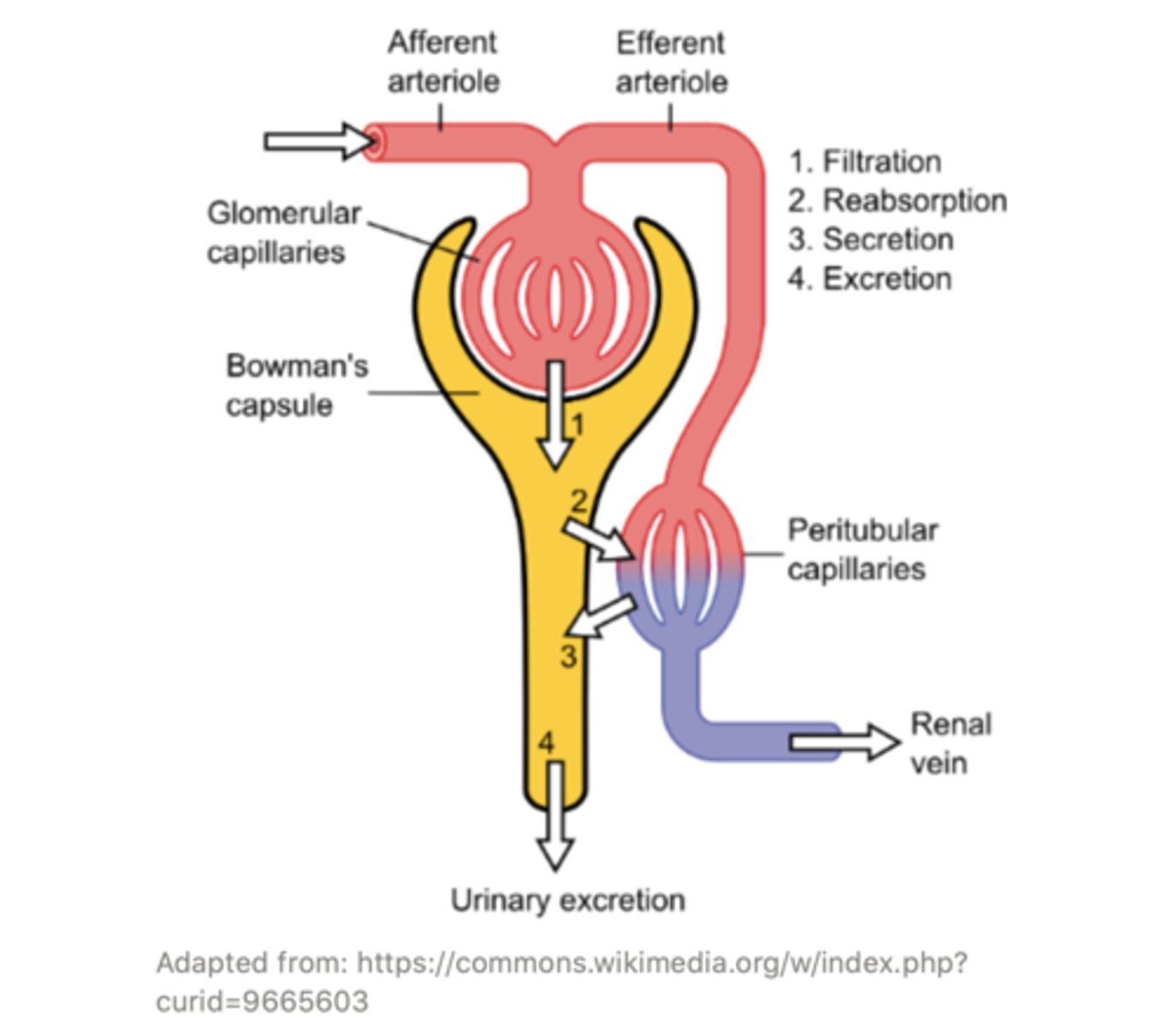
After filtration, reabsorption, and secretion, the filtrate is called ______ and is excreted
urine
the ______ collects filtrate from several different nephrons. The ______ leads to the renal pelvis, and from there goes to the ______
collecting duct; collecting duct; ureter
the ______ is the connecting passageway between the kidneys and the urinary bladder
ureter
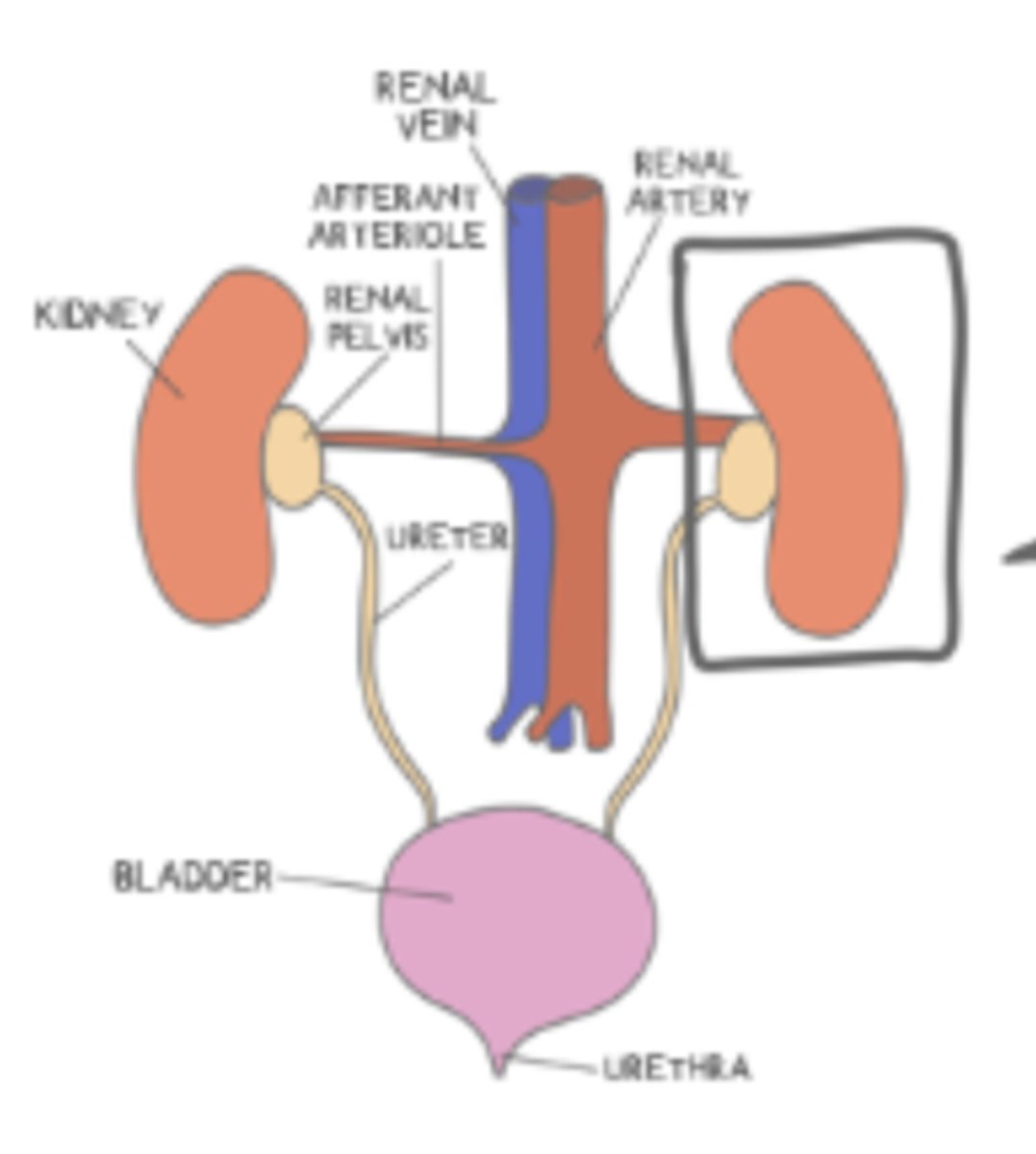
the _____ is where the urine is temporarily stored until the body signals for it to be excreted, and when this signal comes, the fluid flows to the ______
urinary bladder; urethra
the _____ is where the urine is excreted and exits the body
urethra
parathyroid hormone (PTH) ______ calcium levels in the blood
increases
parathyroid hormone (PTH) increases calcium levels in the blood by stimulating reabsorption of calcium in the ______ (hint: part of the kidney), and causing the ______ to release calcium
nephron tubules; bones
calcitonin _____ calcium levels in the blood
decreases
calcitonin lowers calcium levels in the blood by ______ reabsorption of calcium in the nephron tubules, and causing the ______ to retain calcium
inhibiting; bones
(calcitonin is released by the thyroid gland)
parathyroid hormone and calcitonin have the ______ effects on calcium levels in the blood
opposite
aldosterone is considered a _____ hormone, and is produced by the adrenal _____
mineralocorticoid; cortex
aldosterone functions to increase ______ and ______ reabsorption and to increase ______ secretion
increase sodium (Na+) and water (H2O) reabsorption; increase potassium (K+) secretion
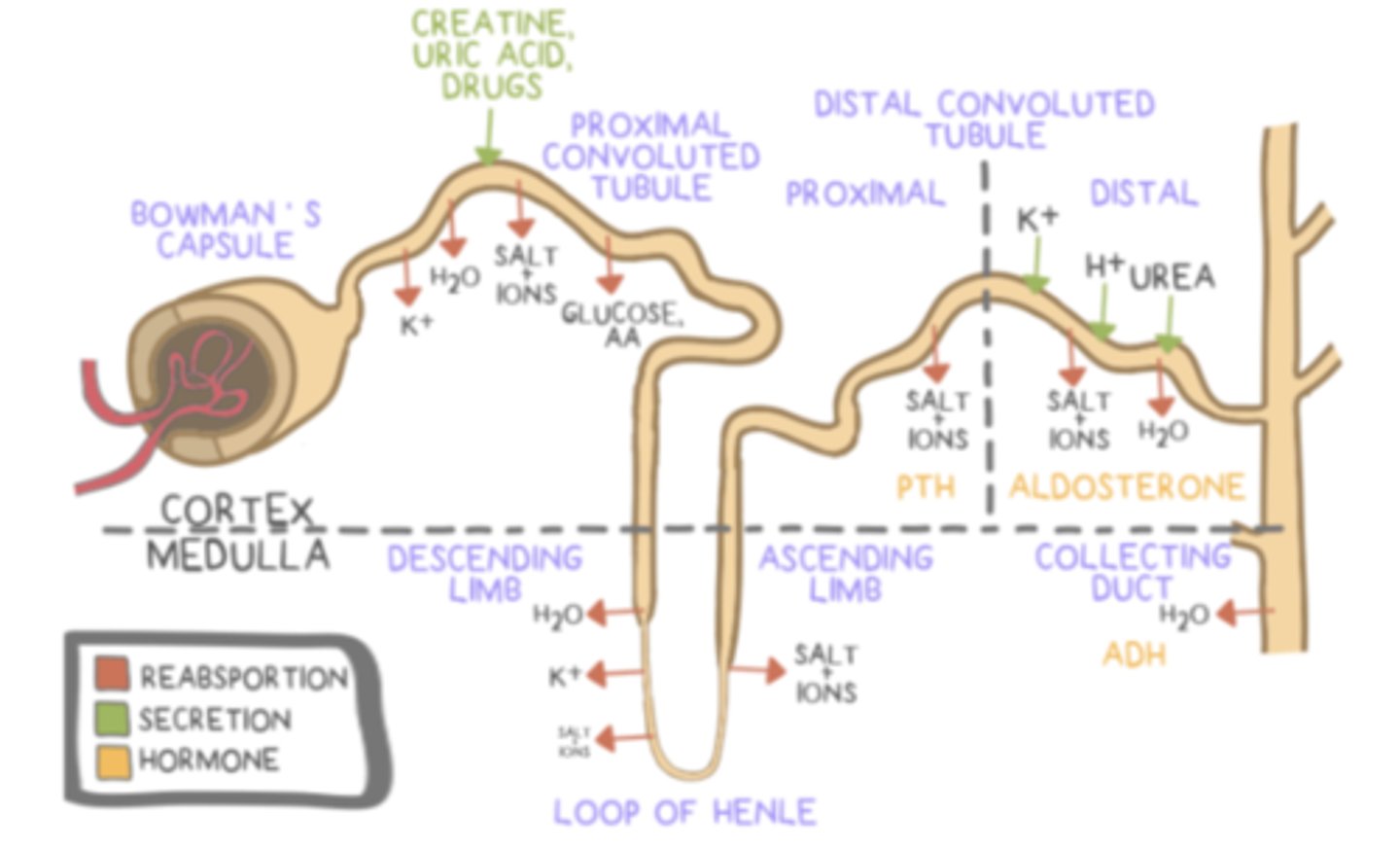
aldosterone functions in the ______ of the nephron and in the ______
distal convoluted tubule; collecting duct
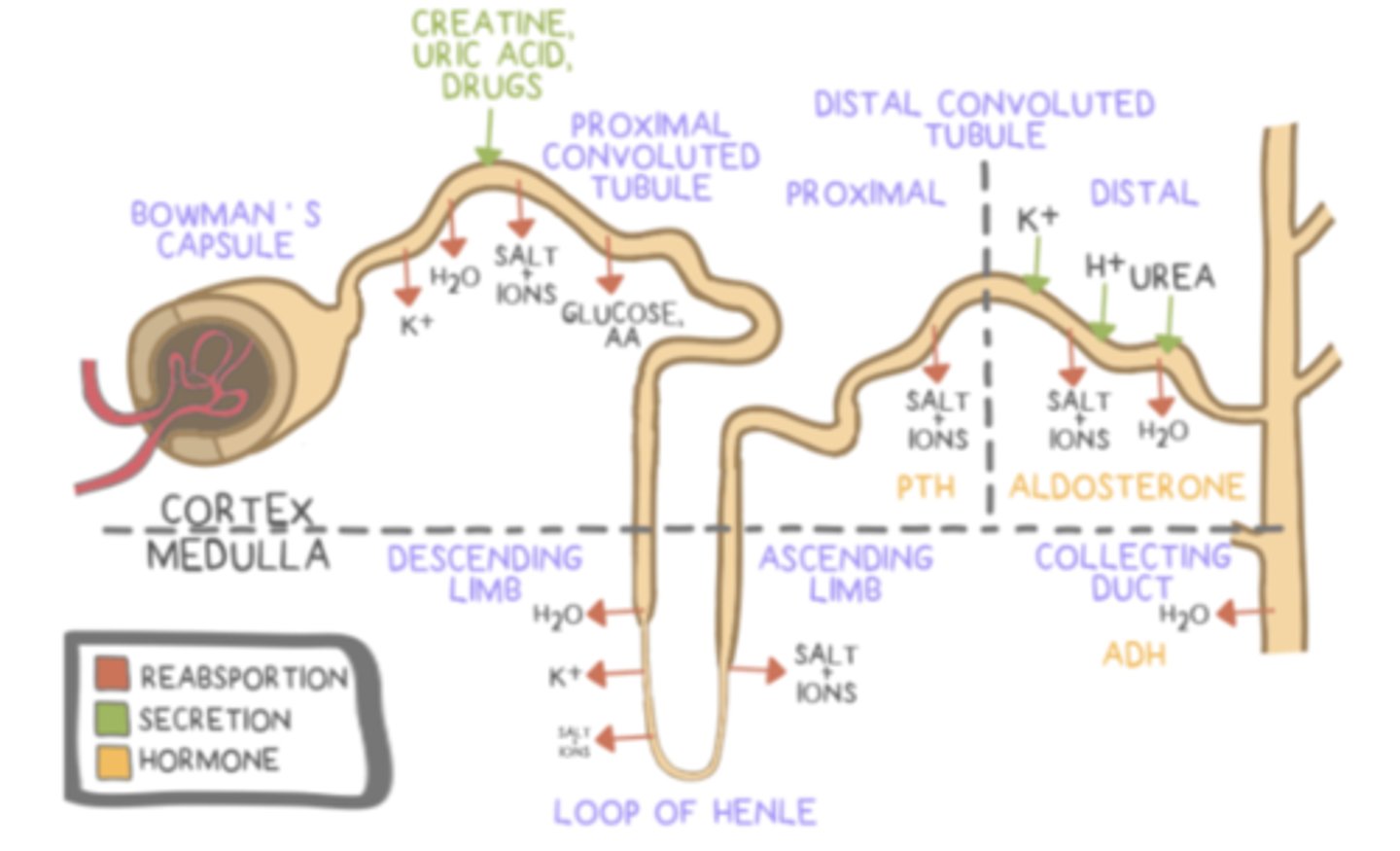
antidiuretic hormone (ADH/vasopressin) prevents ______ (production of urine)
diuresis = production of urine
antidiuretic hormone (ADH/vasopressin) is produced by the ______; however, it is stored in the ______
hypothalamus; posterior pituitary
the hypothalamus stimulates the ______ to release antidiuretic hormone (ADH/vasopressin) when the extracellular fluid volume is _____
posterior pituitary; low
antidiuretic hormone (ADH/vasopressin) causes ______to insert into the ______, which allows more water reabsorption
aquaporins; collecting duct
(less water goes into the urine, leading to very concentrated urine)
the special cells in the afferent arteriole near the glomerulus are called ______, and they can detect changes in blood pressure and sodium levels
juxtaglomerular cells (juxta = nearby)
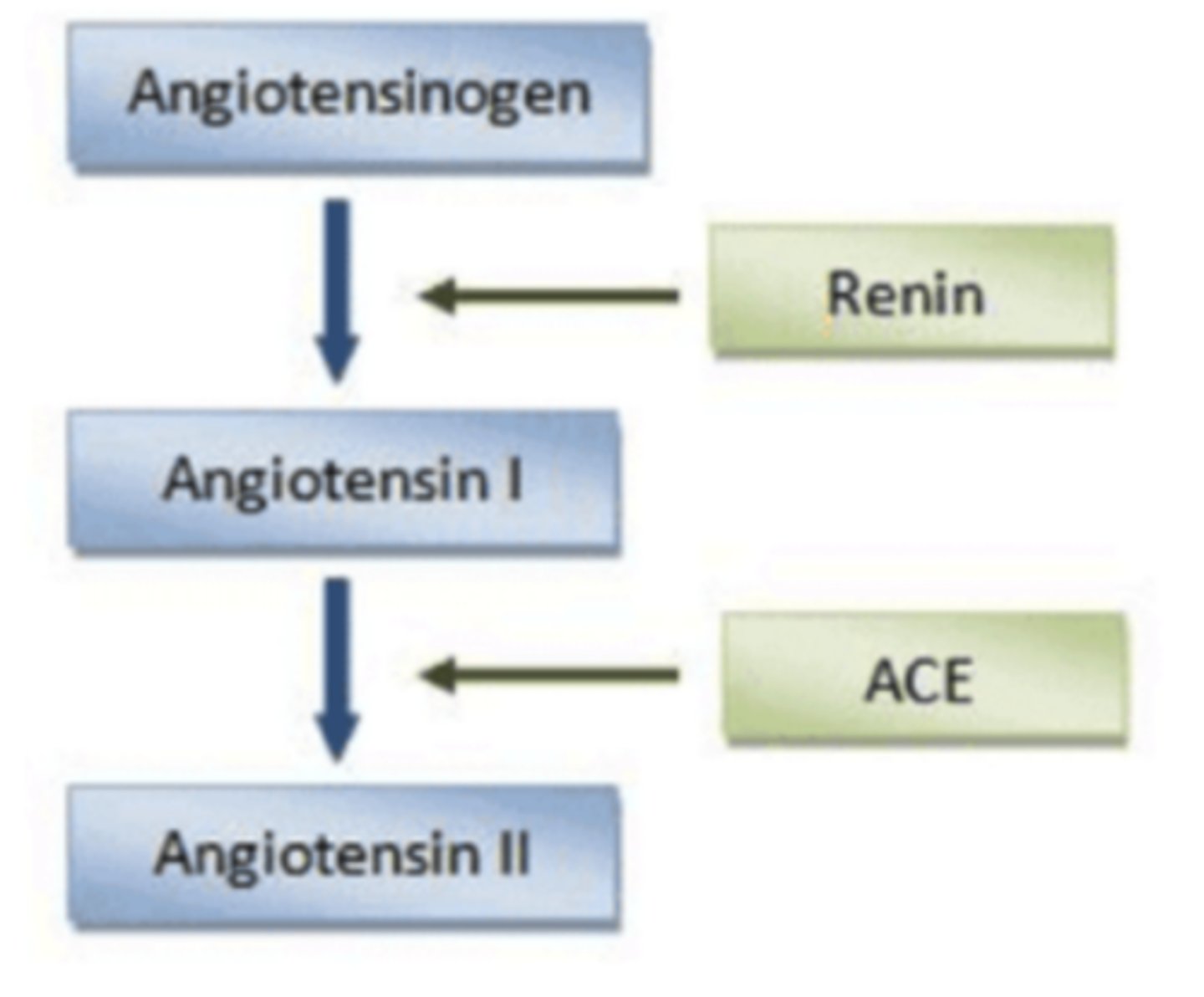
when blood pressure or blood sodium is low, these cells release ______
renin
renin is an ______ which acts on ______ to activate it to the form angiotensin I
enzyme; angiotensinogen
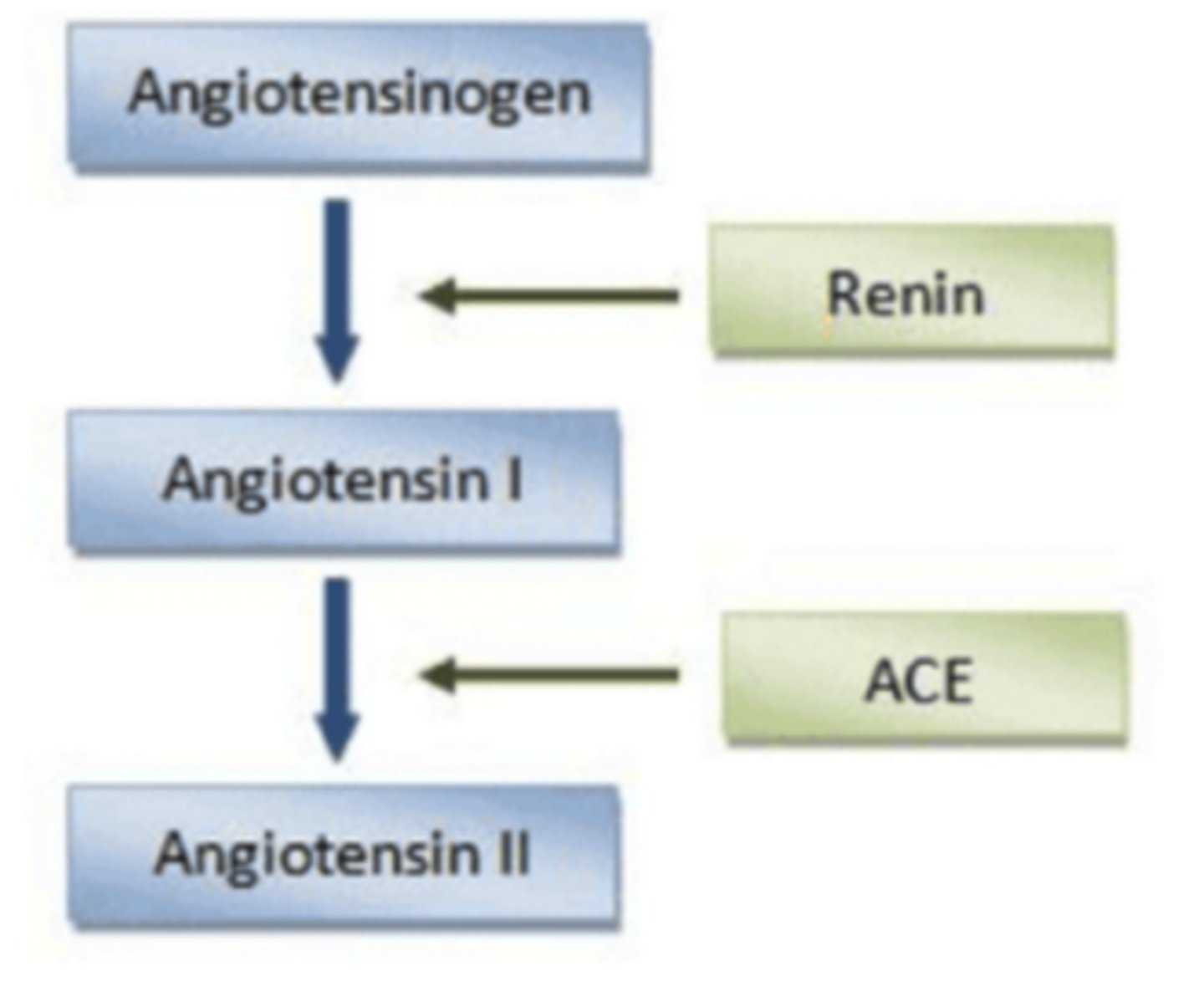
a different enzyme called ______ acts on angiotensin I to convert it to ______, which is the active form of the hormone
angiotensin converting enzyme (ACE); angiotensin II
atrial natriuretic peptide (ANP), which is made by atrial cells in the heart, has what three main effects in order to reduce blood volume and pressure?
1. Increases the glomerular filtration rate (GFR)
2. Decreases sodium reabsorption and increase sodium excretion
3. Inhibits renin and the renin-angiotensin-aldosterone system (RAAS)
What is the excretion pathway?
body
renal artery
afferent arteriole
glomerulus
bowlman’s capsule
proximal convulted tube
descending limb (absorb water)
ascending limb (absorb solutes)
distal convoluted dtube
collecting duct
renal pelvis
ureter
bladder
urethra
What filter the blood and prepares urine for excretion?
kidney
What are the key kidney functions?
regulates blood pressure
regulates pH
stimulates generation of RBC
What is the functional unit of the kidney?
nephorn
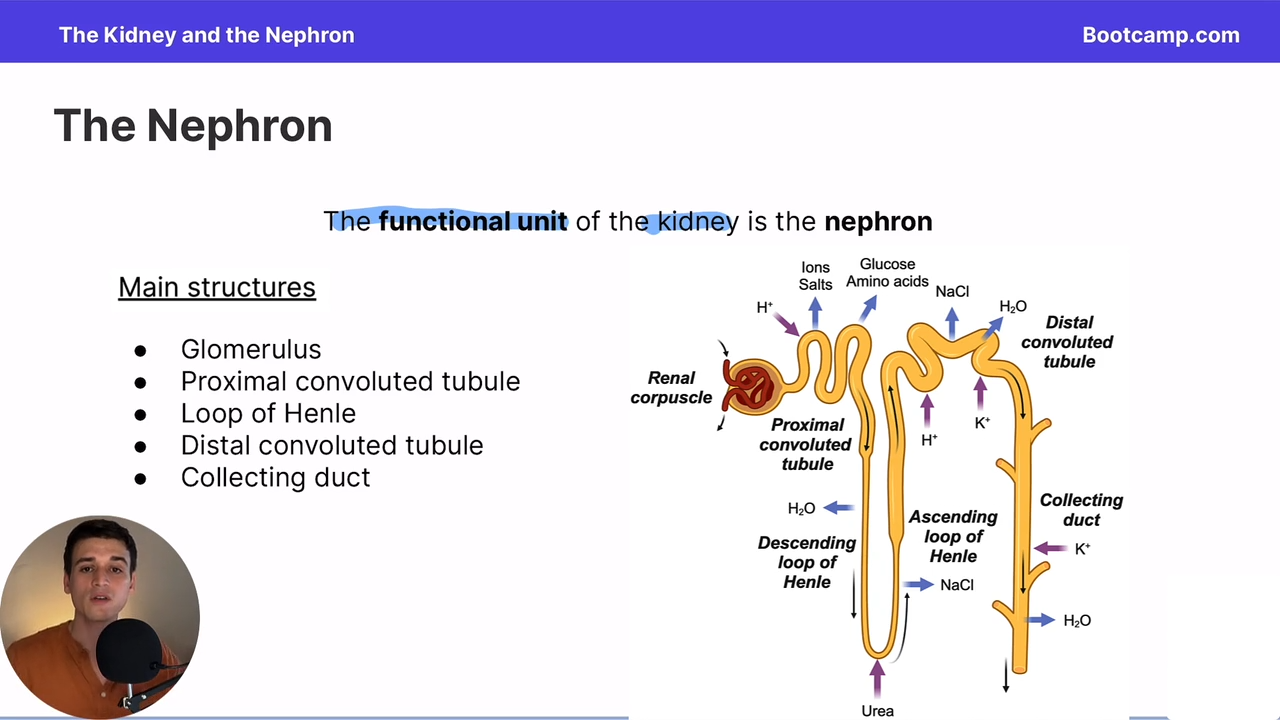
What are the main structures of the nephron?
glomerulus
proximal convoluted tubule
loop of henle
distal convoluted tubule
collecting duct
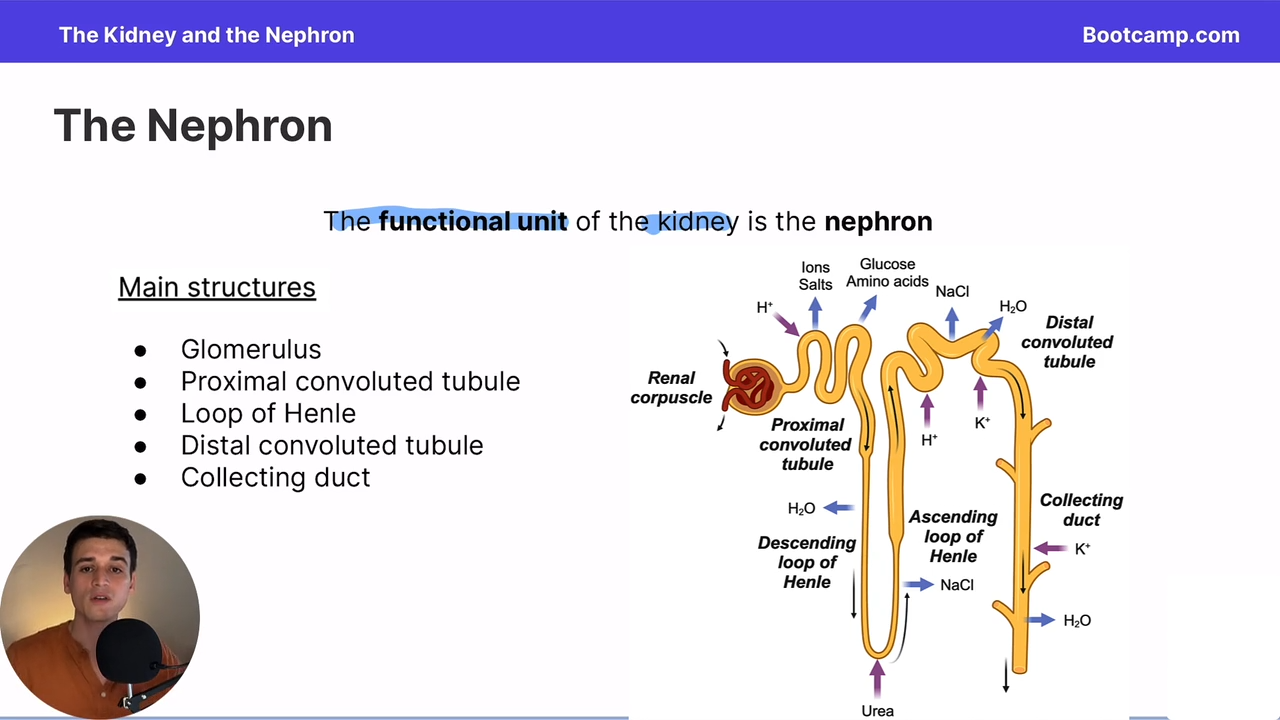
What is the renal corpsucle?
first structure of nephron and first site of blood entry
contains glomerulus and bowman’s capsule
site of filtration within renal cortex
blood brought there by afferent arteriole
Where are the glomerulus and bowman’s capsule?
Renal corpuscle
what is the glomerulus?
network of capillaries inside the nephron where blood filtration begins
surronded by Bowma'n’s capsule
inside renal corpuscle
What is Bowman’s capsule?
encapsulates renal corpuscle of nephron
surrounds glomerulus and collects filtrate produced when blood is filtered
What brings blood to the renal corpuscle?
afferent arteriole
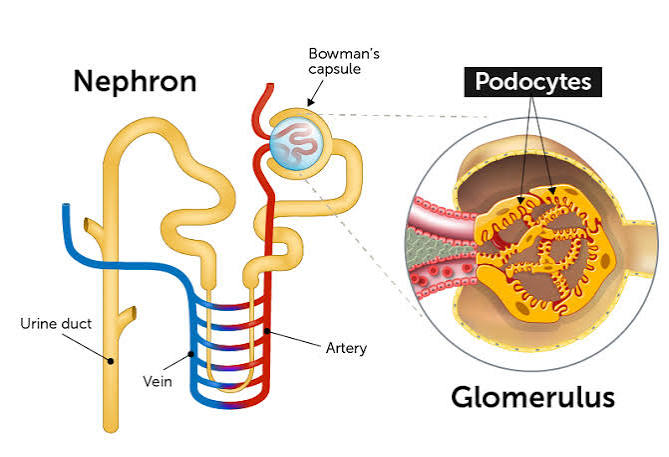
What are podocytes?
Cells in glomerulus that help form kidney’s filtration barrier
foot-like
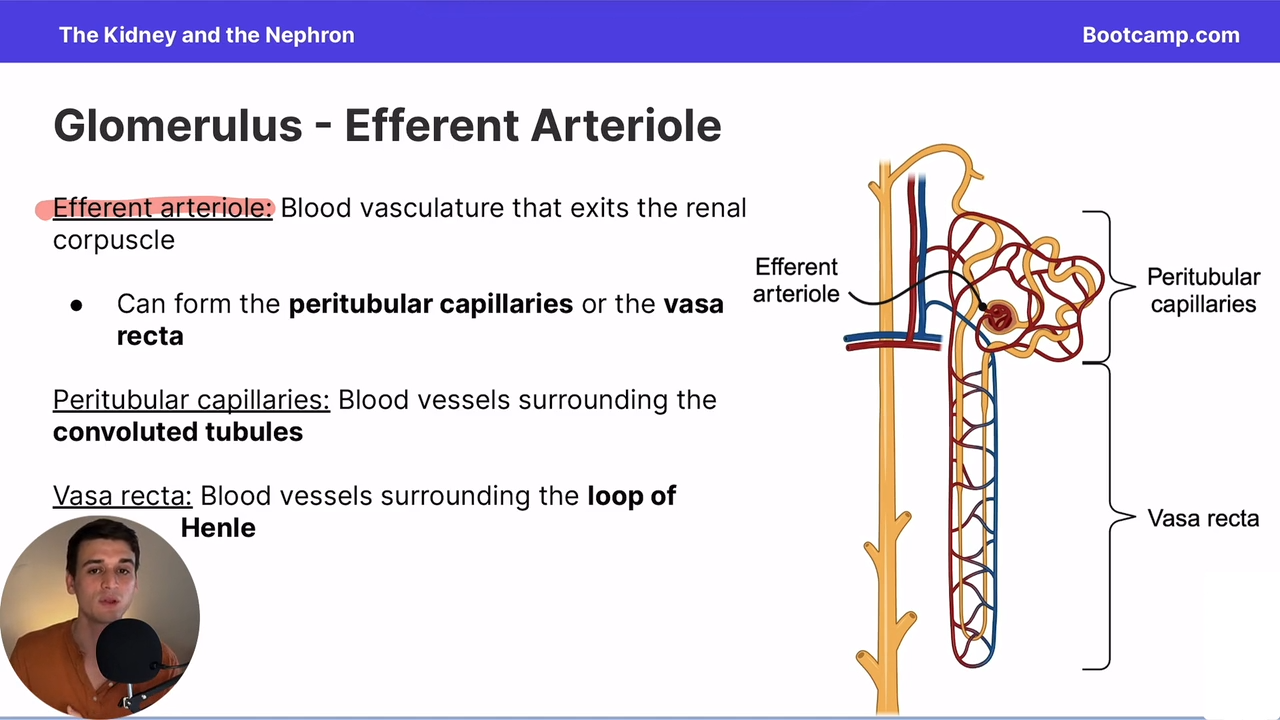
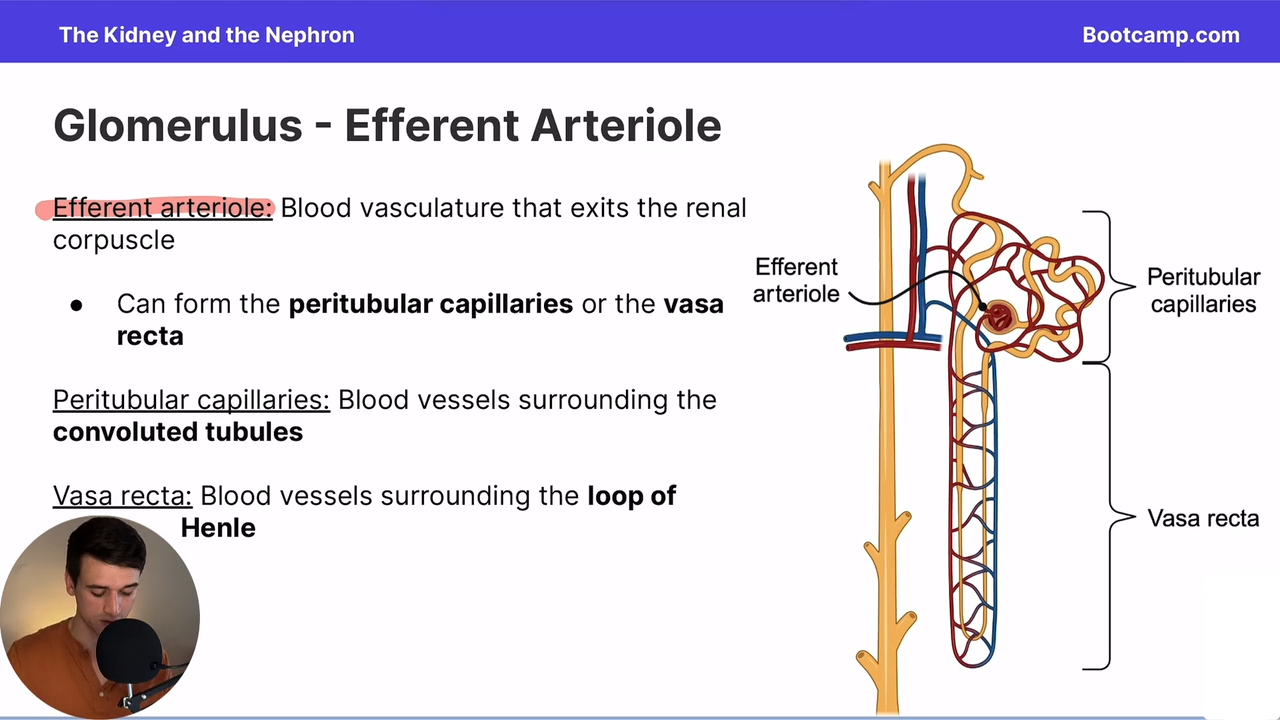
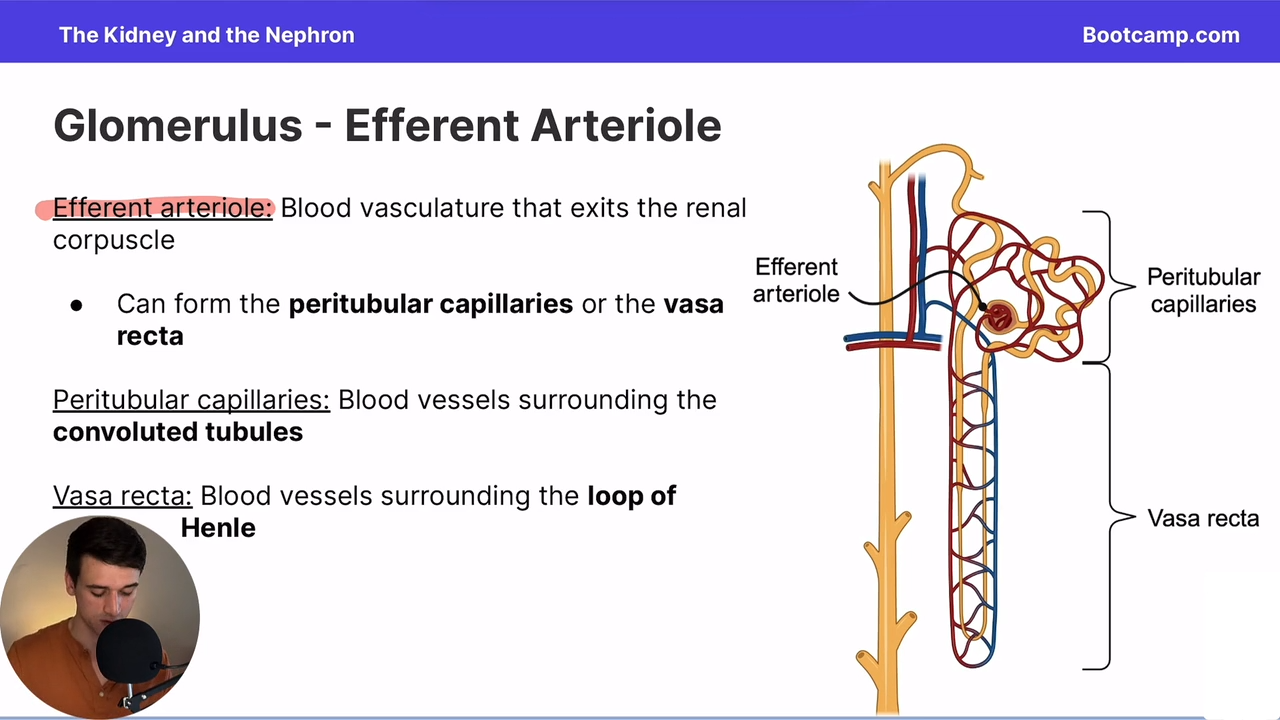
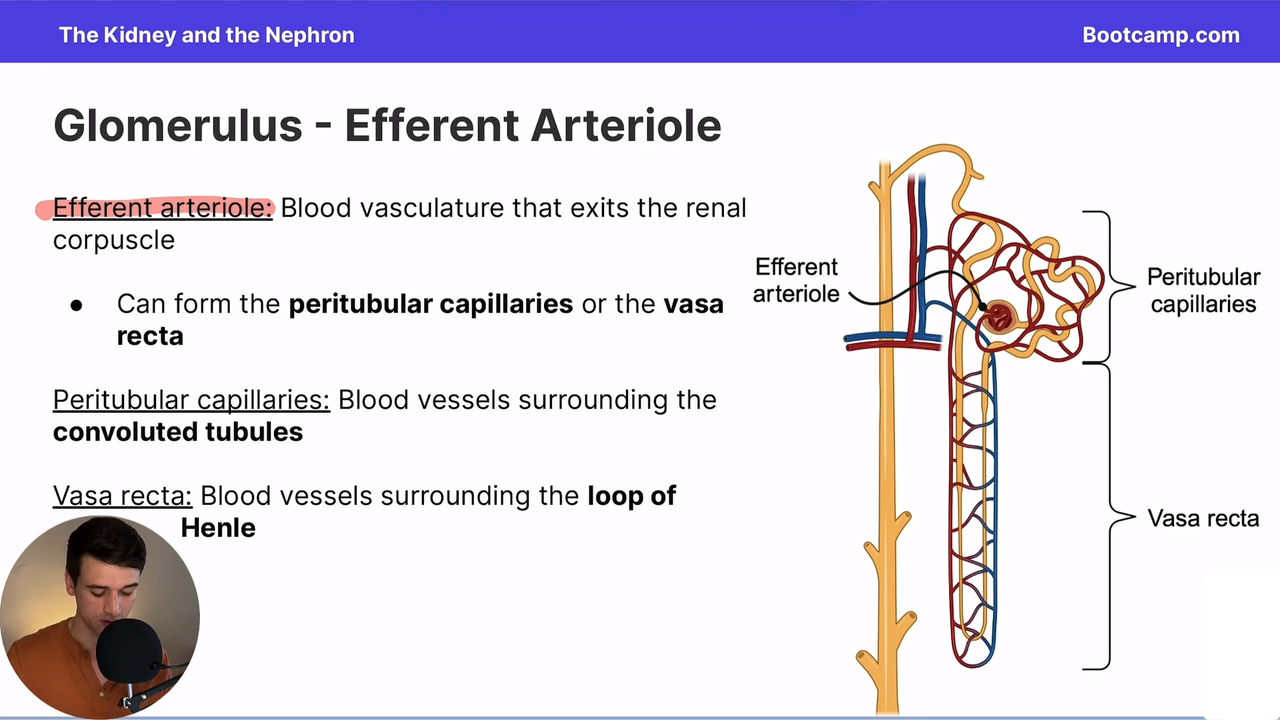
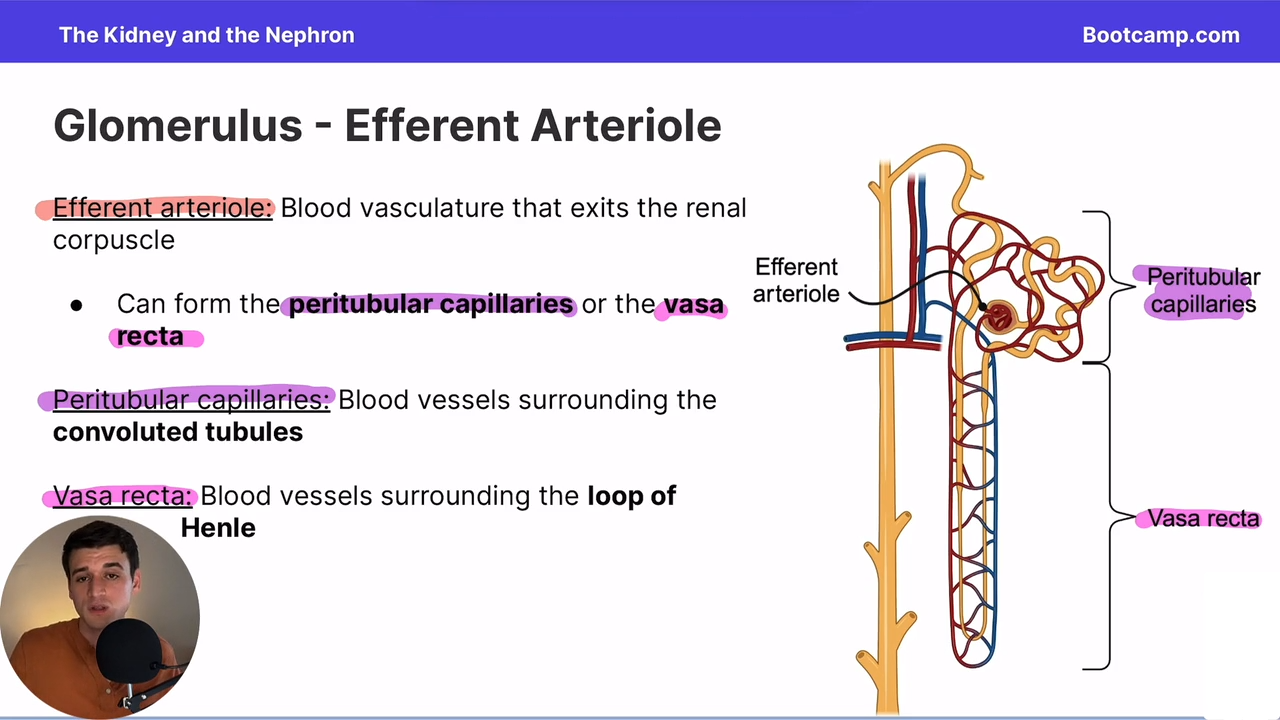
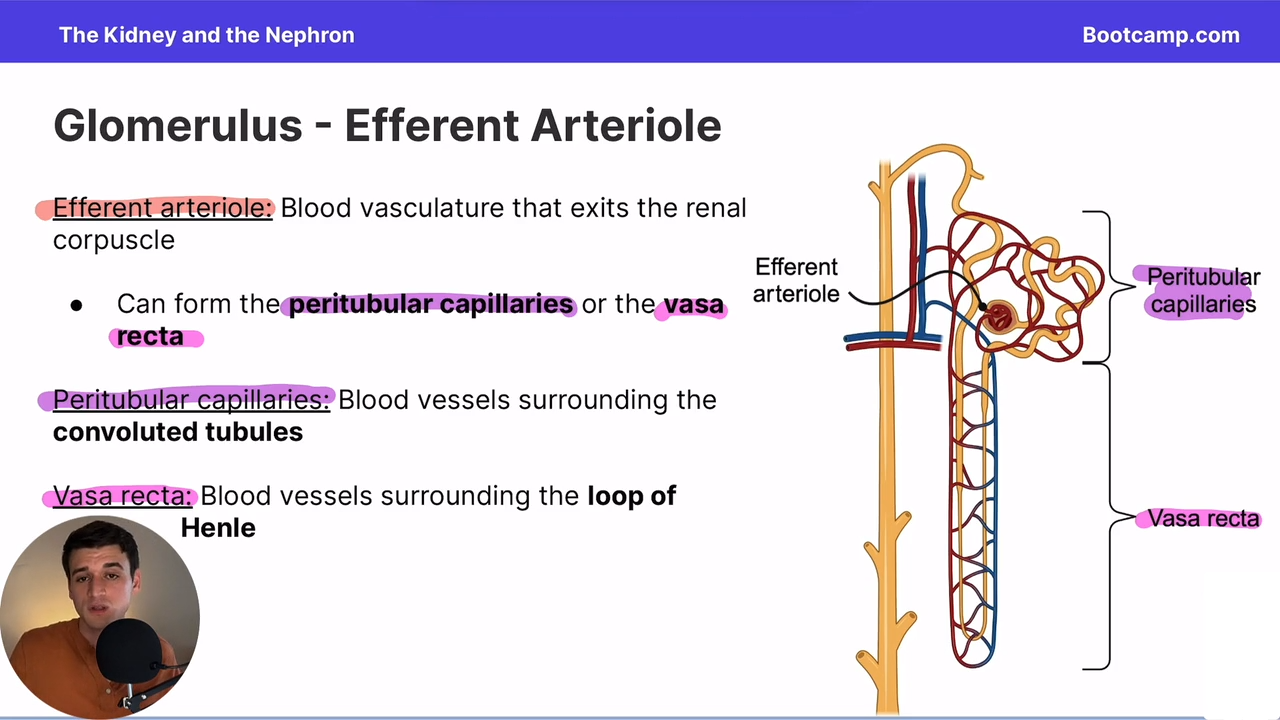
What is the efferent arteriole?
blood vessel that exits renal corpuscle and forms capilarry networks
can form peritubular capillaries or the vasa recta
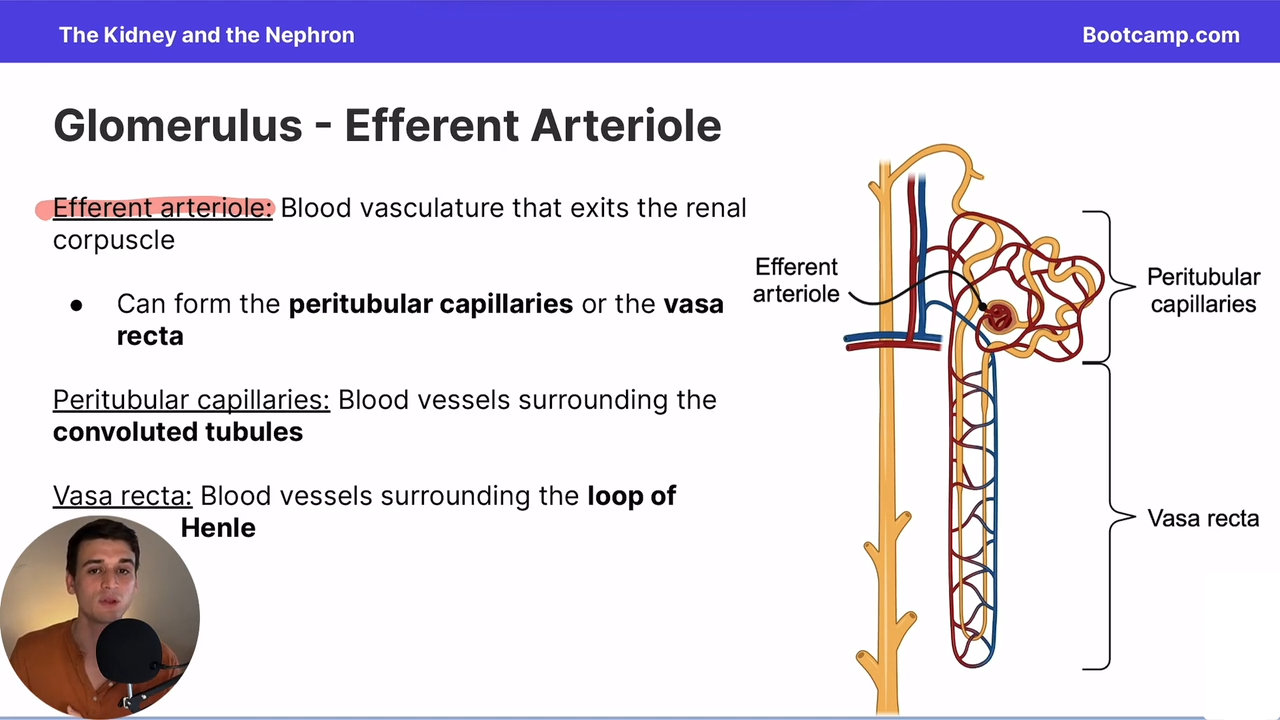
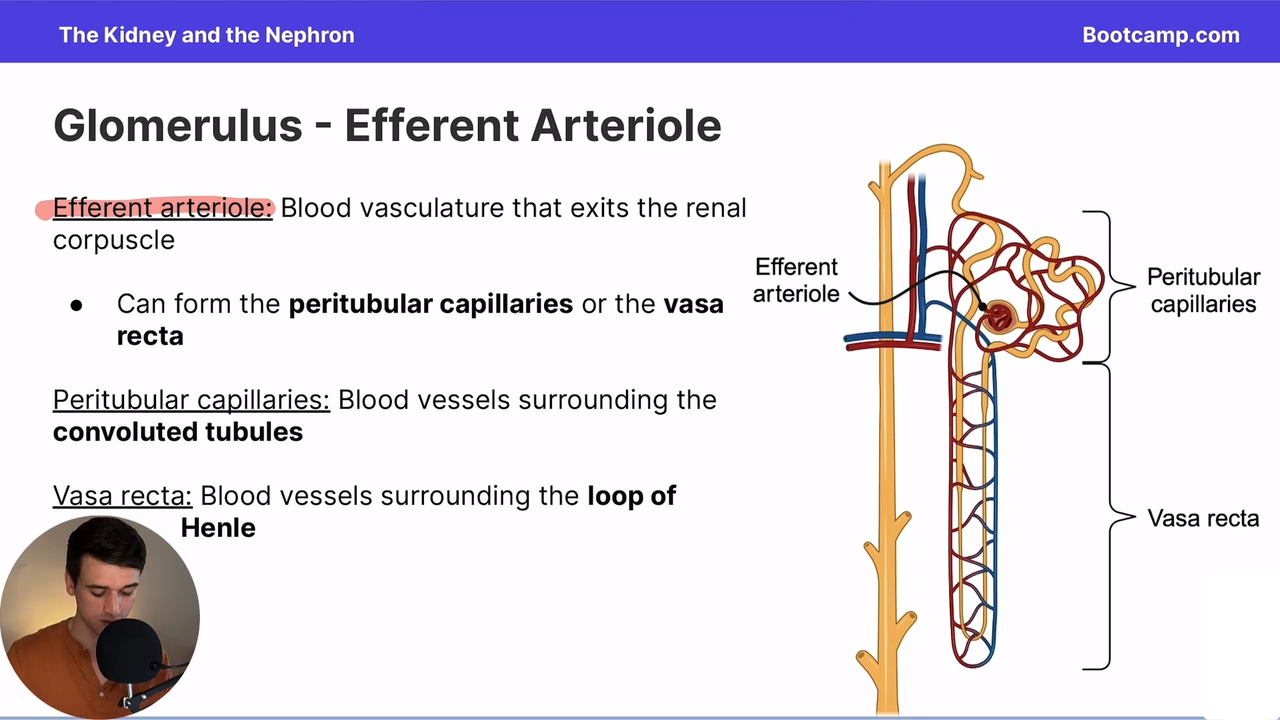
What are peritubular tubes?
blood vessels surronding convoluted tubes; stem from efferent arteriole
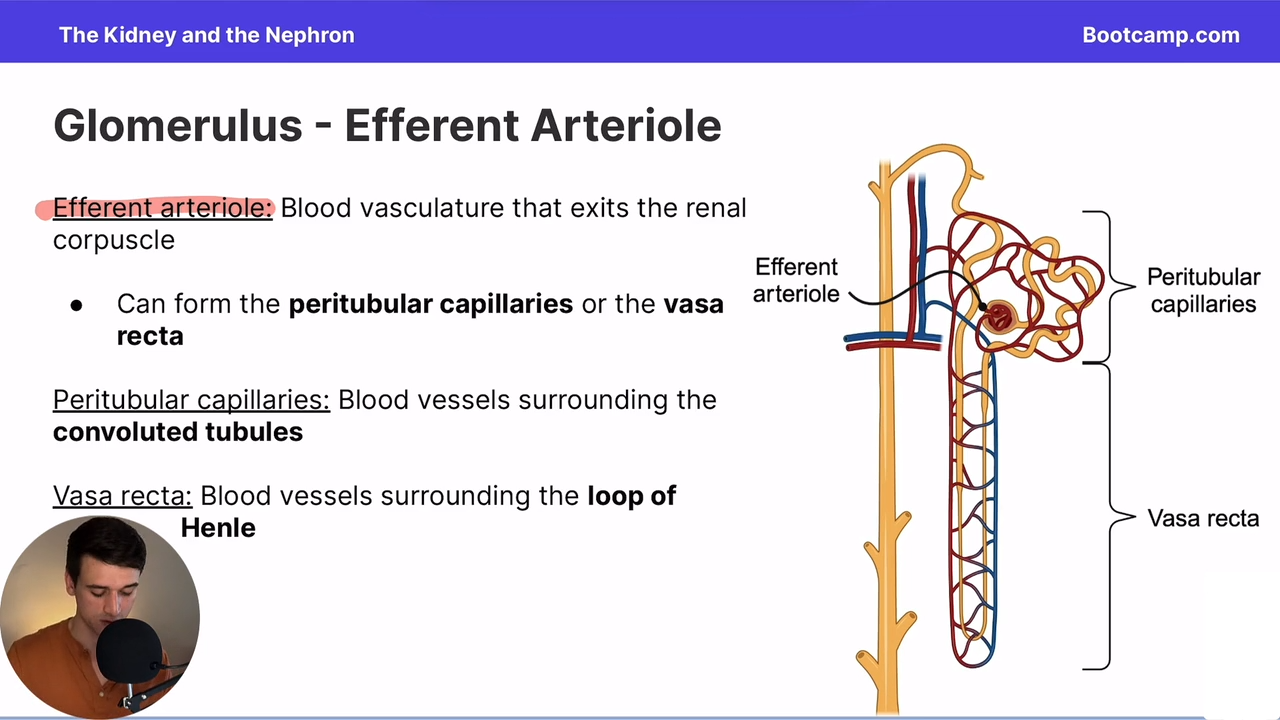
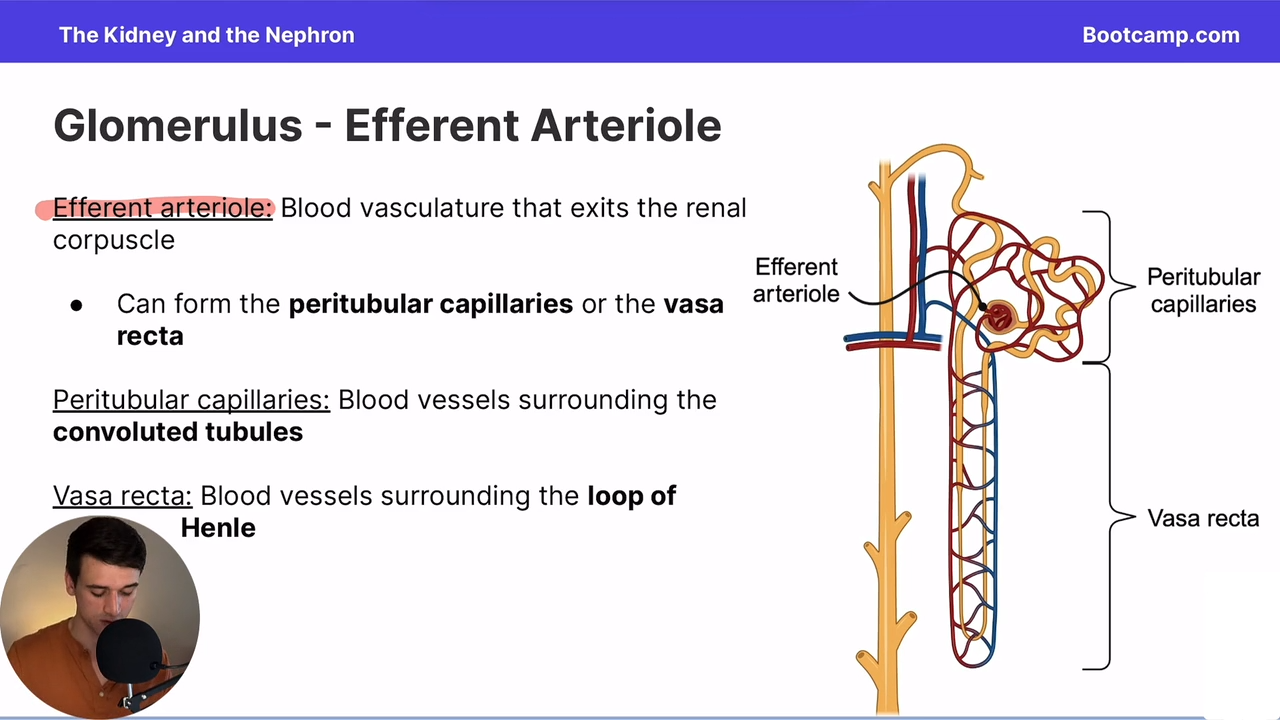
What is the vasa recta?
blood vessels surronding the loop of henle; stem from efferent arteriole
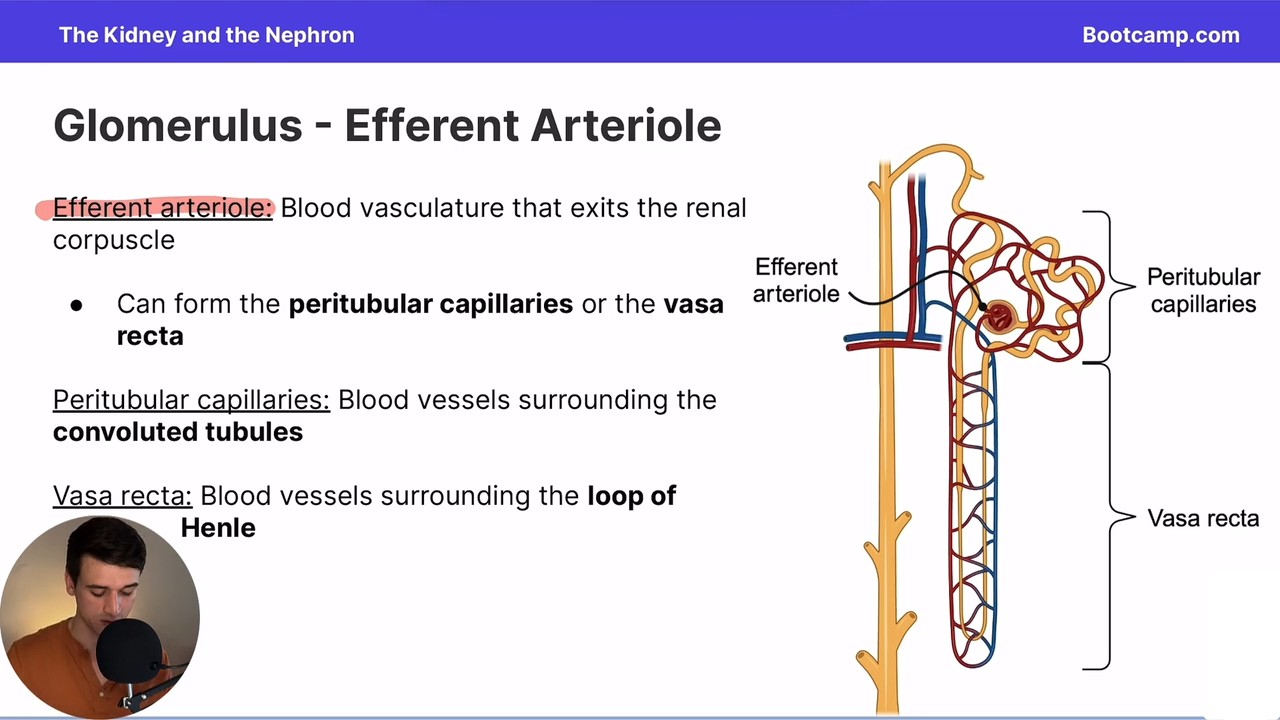
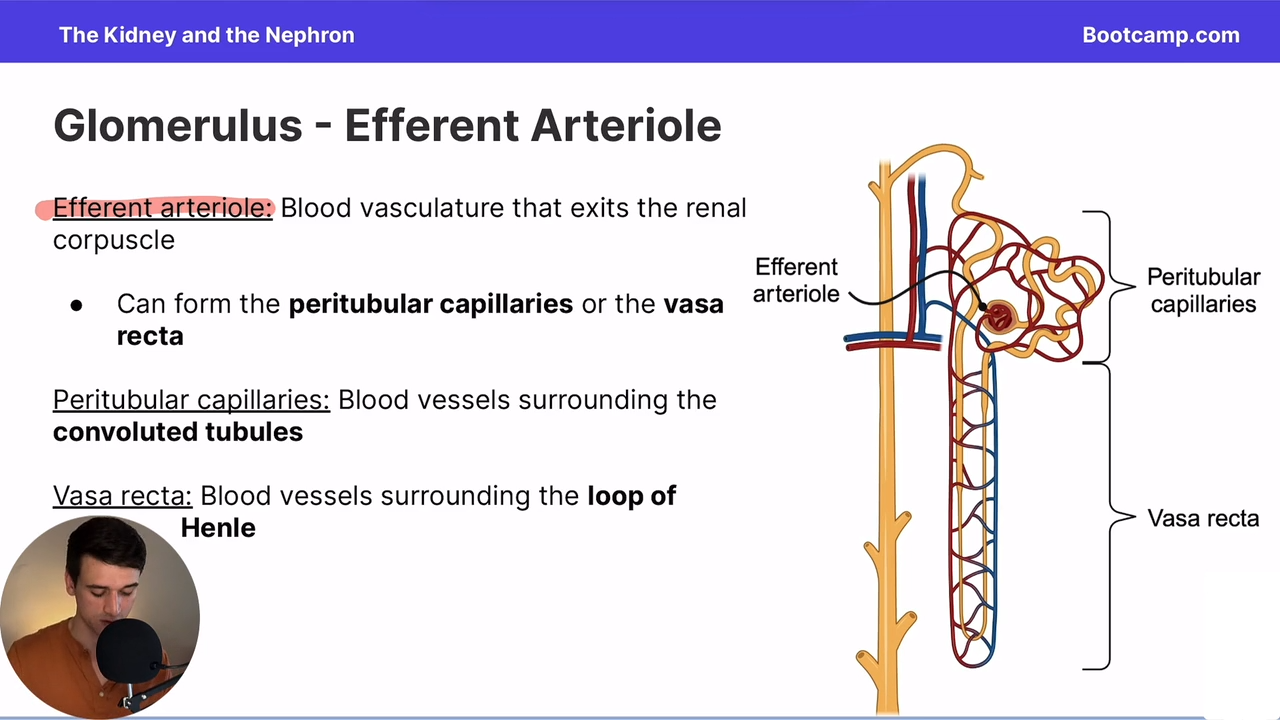
What blood vessels surround the loop of henle?
vasa recta
What blood vessels surround the convoluted tubes?
peritubular capillaries
What makes the efferent arteriole more likely to form the peritubular capillaries around the convoluted tube?
deeper within cortex, away from medulla
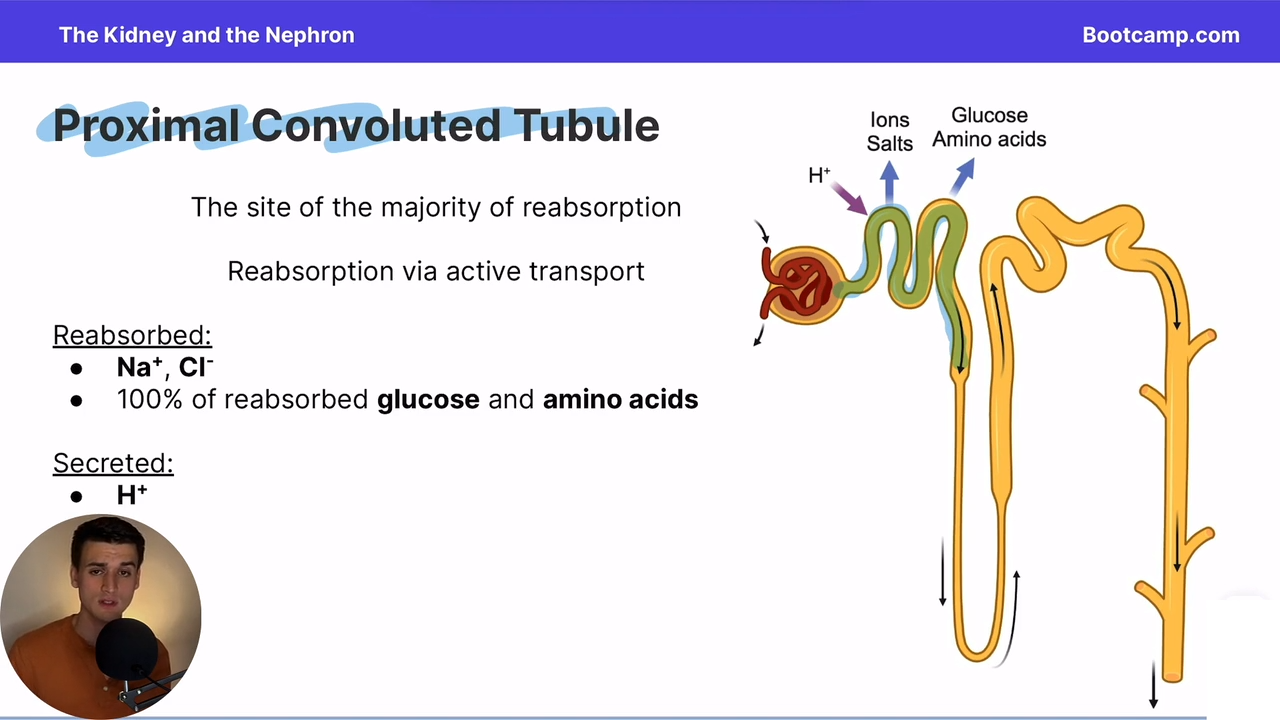
What is the proximal convoluted tubule?
site of majority of reabsorption into the blood in nephron
reabsorption occurs via active transport
reabsorbs sodium, chloride, 100% of glucose and amino acids
Secretes H+
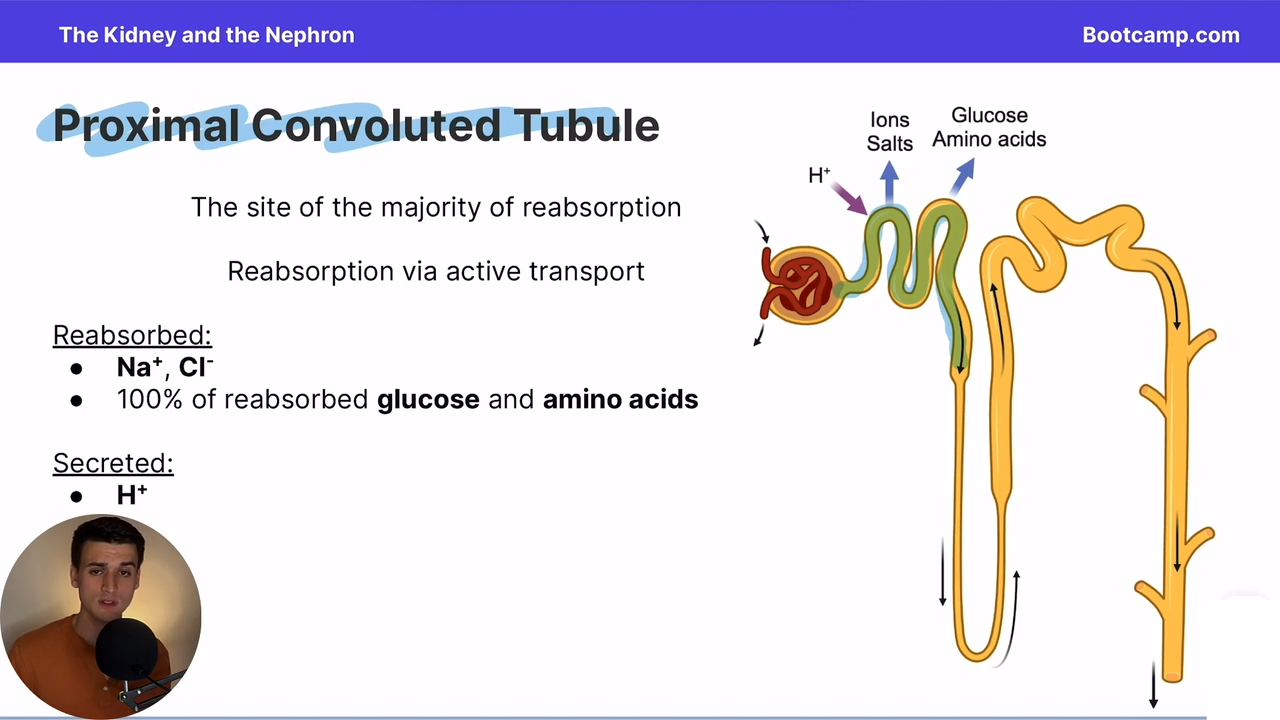
What does the proximal convoluted tube absorb?
sodium, choloride, glucose, amino acids
How is glucose reabsorbed in the proximal convoluted tube?
cotransport with Na
Na/K ATPase creates low Na+ in nephron, so Na+ wants to leave
Na+ moves back into blood down its gradient, and glucose moves with it
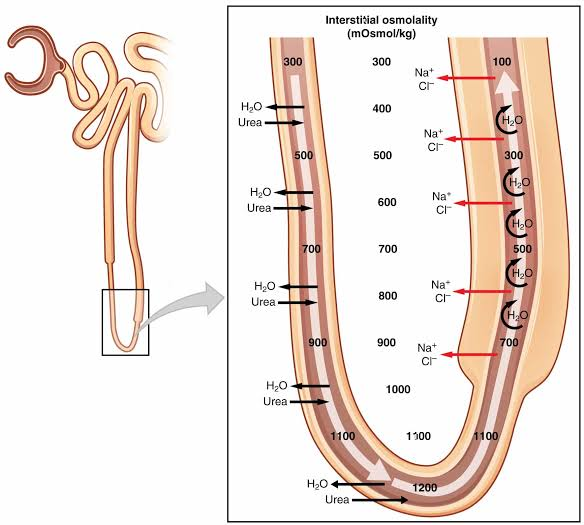
what is the loop of henle?
nephron tube that descends into the kidney medulla
has two limbs, descending and ascending
urea enters the filtrate
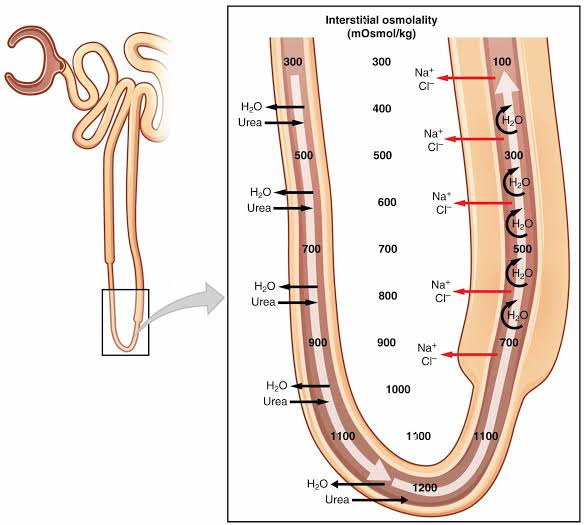
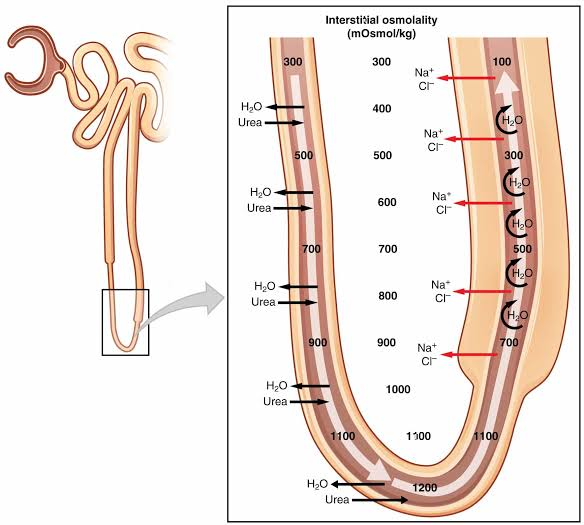
Describe the descending limb of the loop of henle
descends into the medulla from the proximal convoluted tube
permeable to water, so water flows out of the urine into the blood
increases urine conc, decreasing vollume
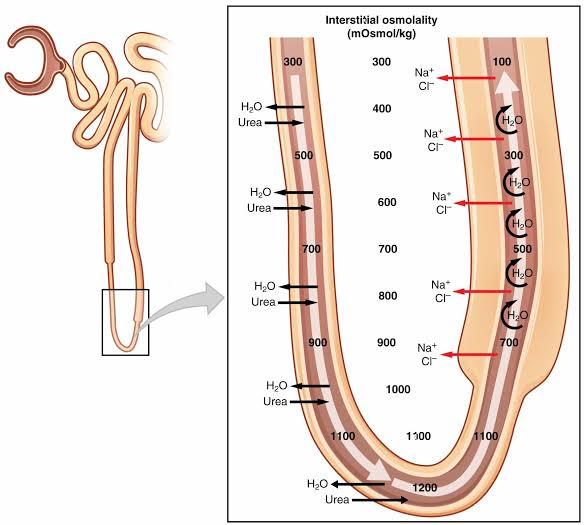
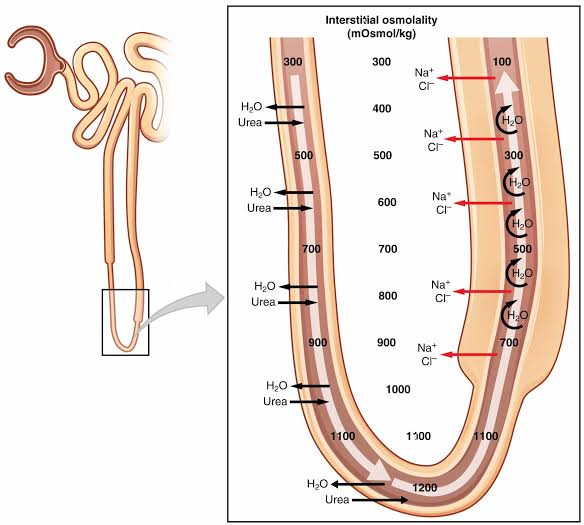
Describe the ascending limb of the loop of henle
ascending out of the medulla, connecting to the distal convoluted tube
imperable to water, so ions and salts flow out of the urine into the blood
decrease urine concentration
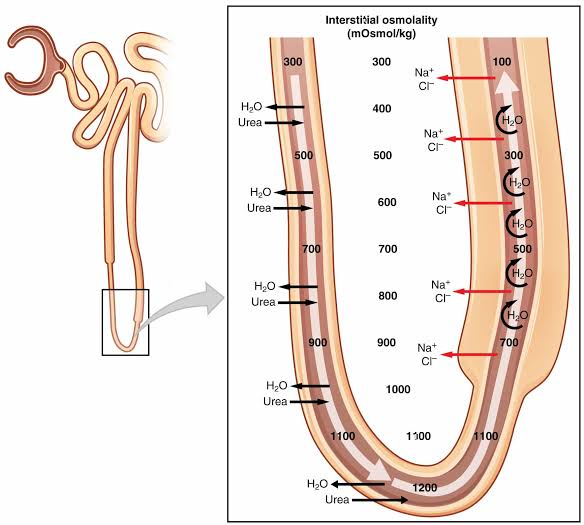
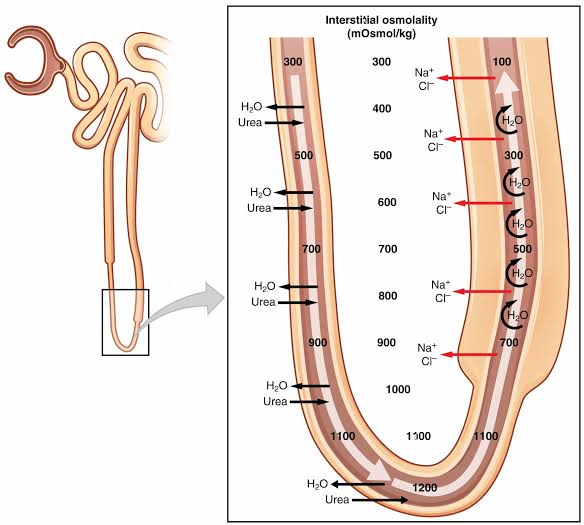
What limb of the loop of henle is permeable to water?
descending limb
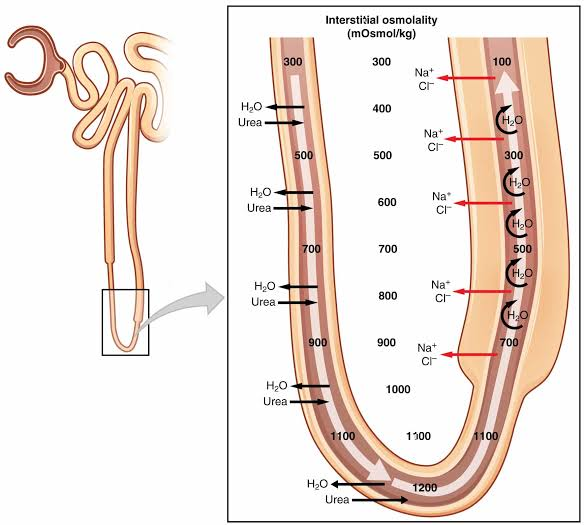
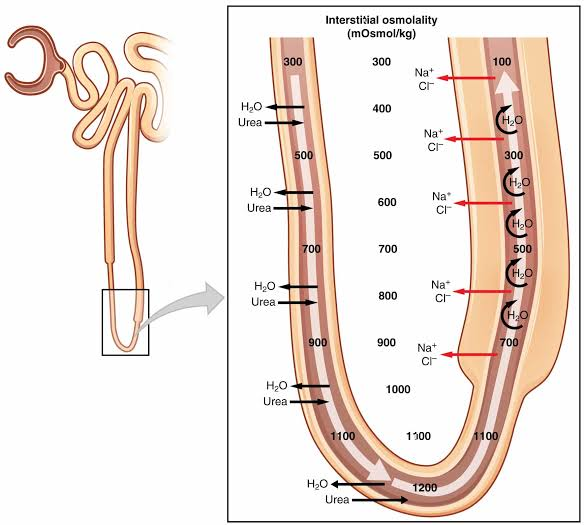
What limb of the loop of henle bumps out sodium, potassium, and chloride?
ascending limb
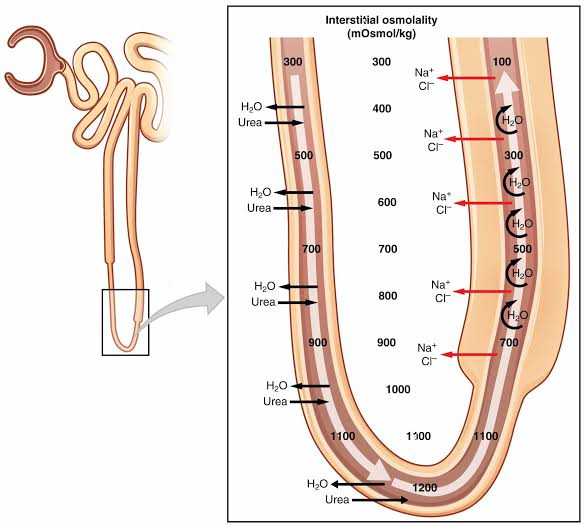
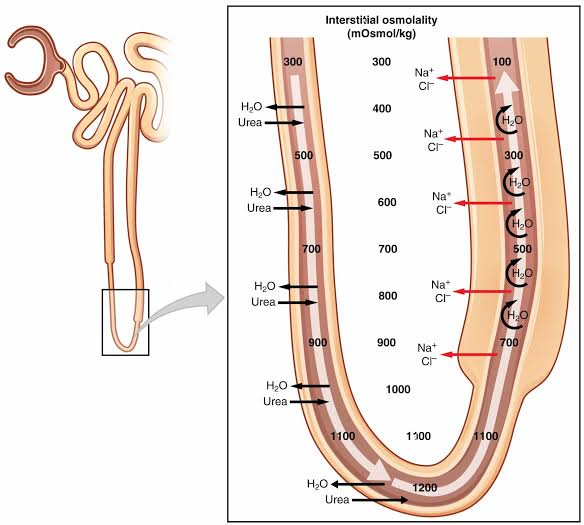
What limb of the loop of henle dilutes the filtrate?
ascending
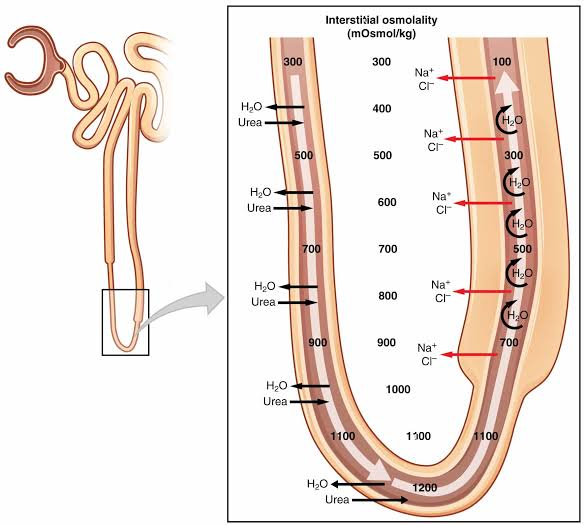
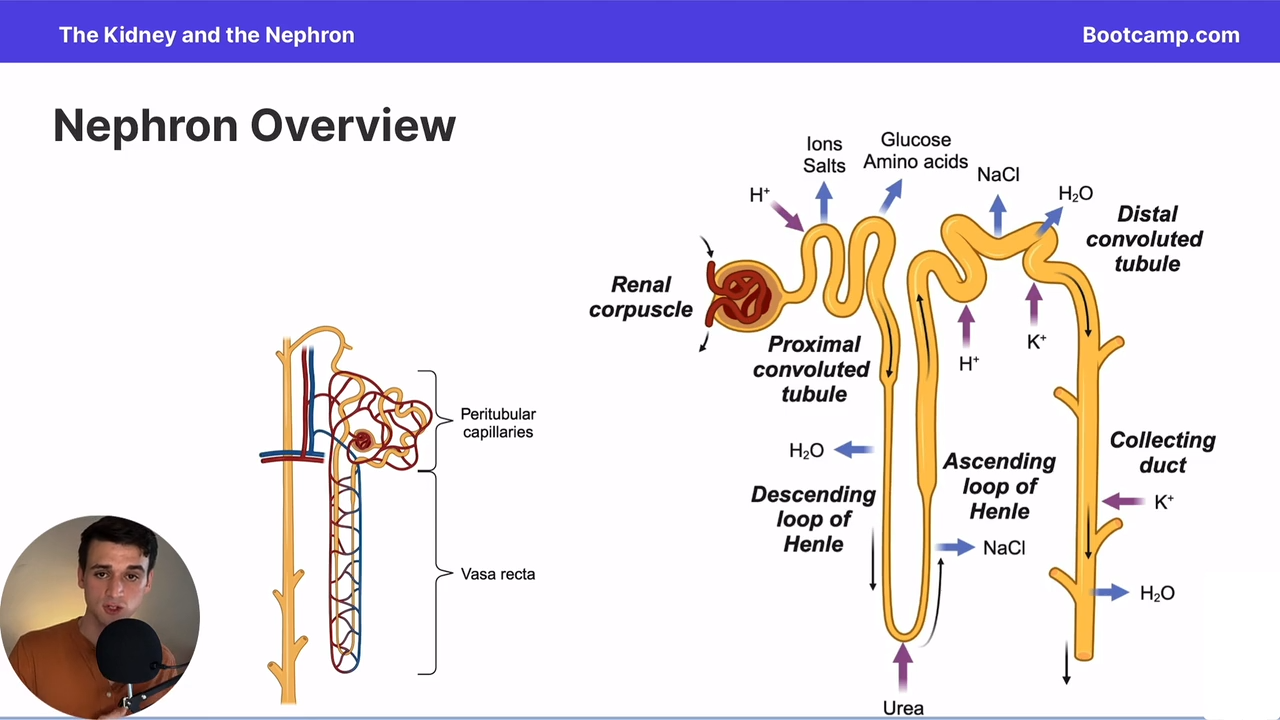
What is the distal convoluted tubule?
reabsorbs Na and Cl-, secretes K+ and H+
water follows reabsorb salts back into bloo
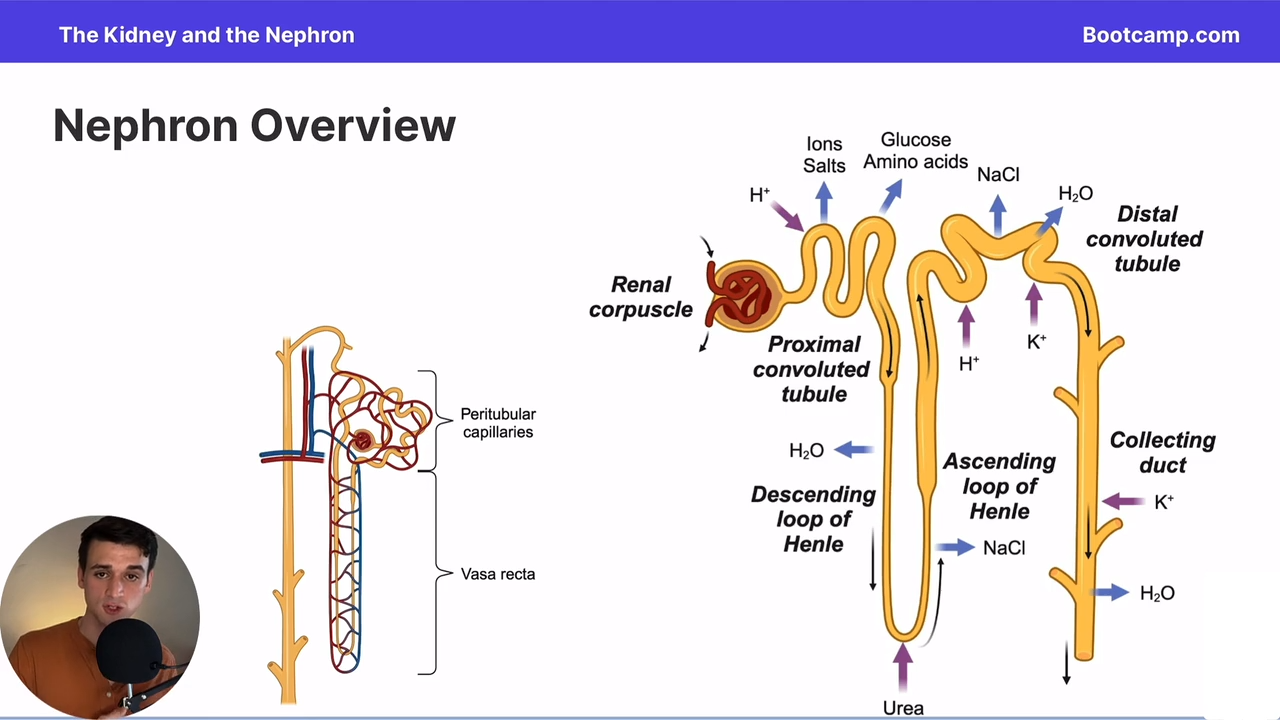
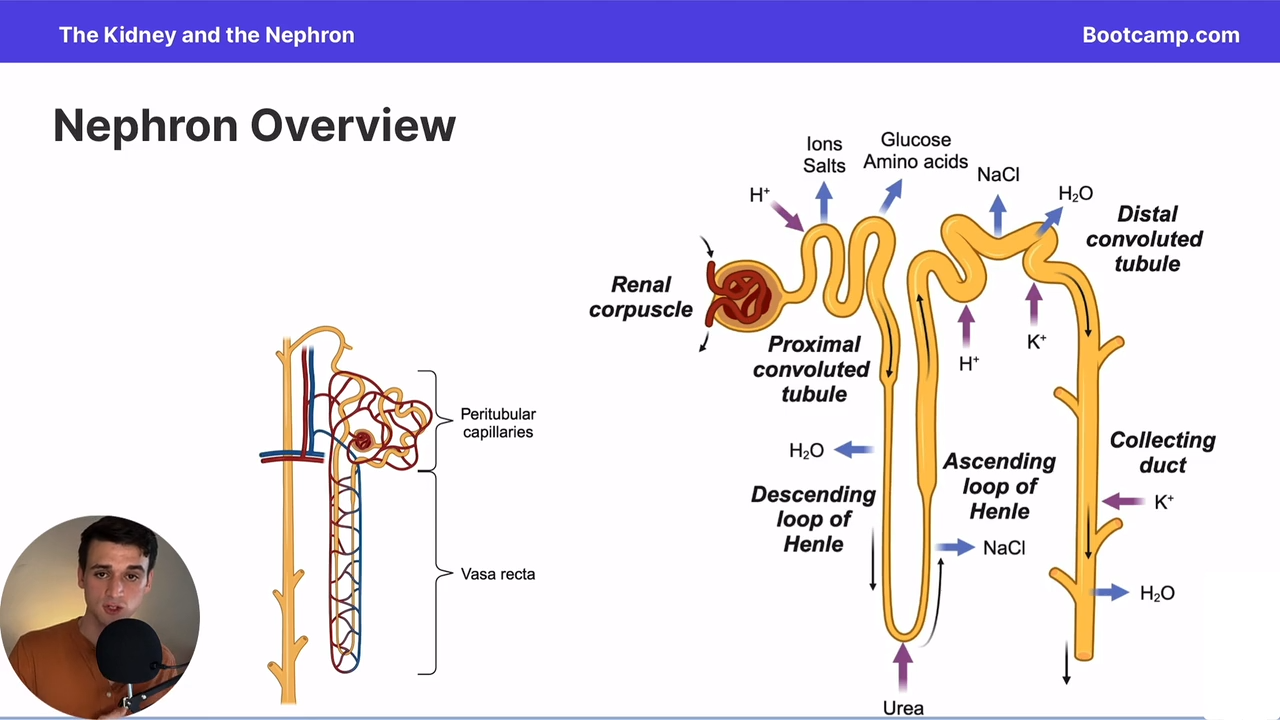
What is the collecting duct?
long tube at end of nephron
passively reaborbs water through aquaporins and secretes K+
increases conc of urine
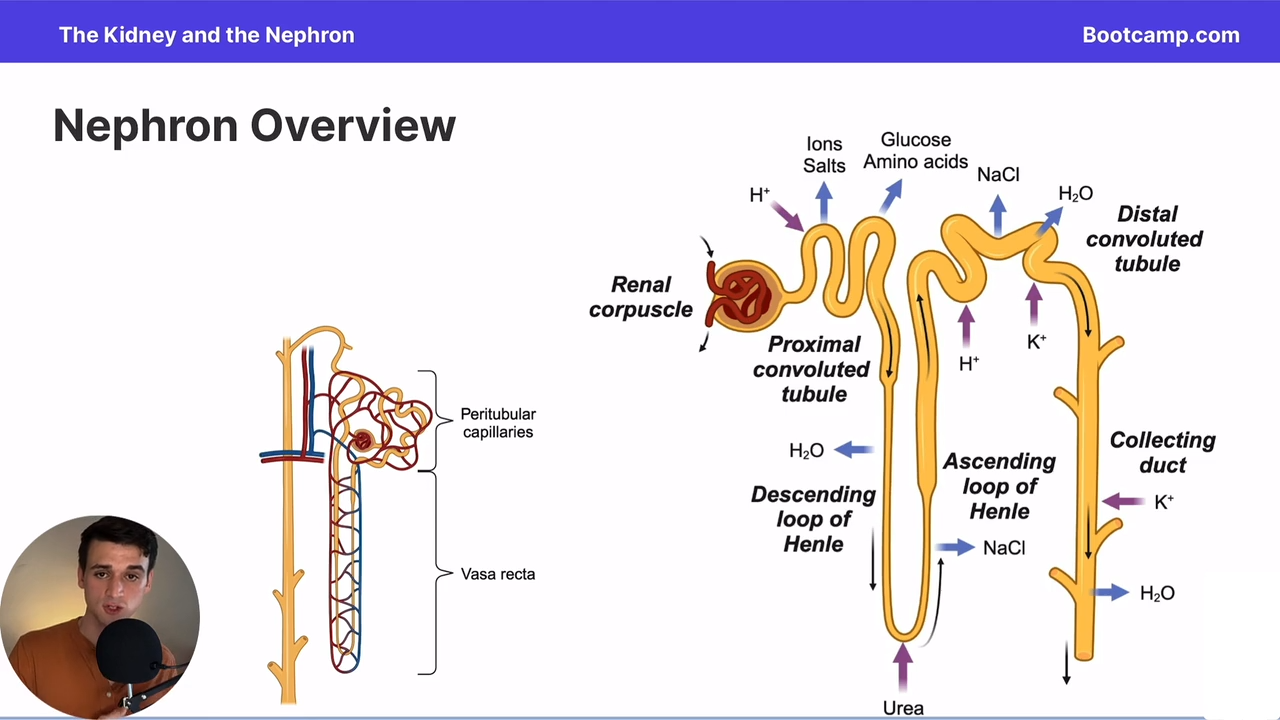
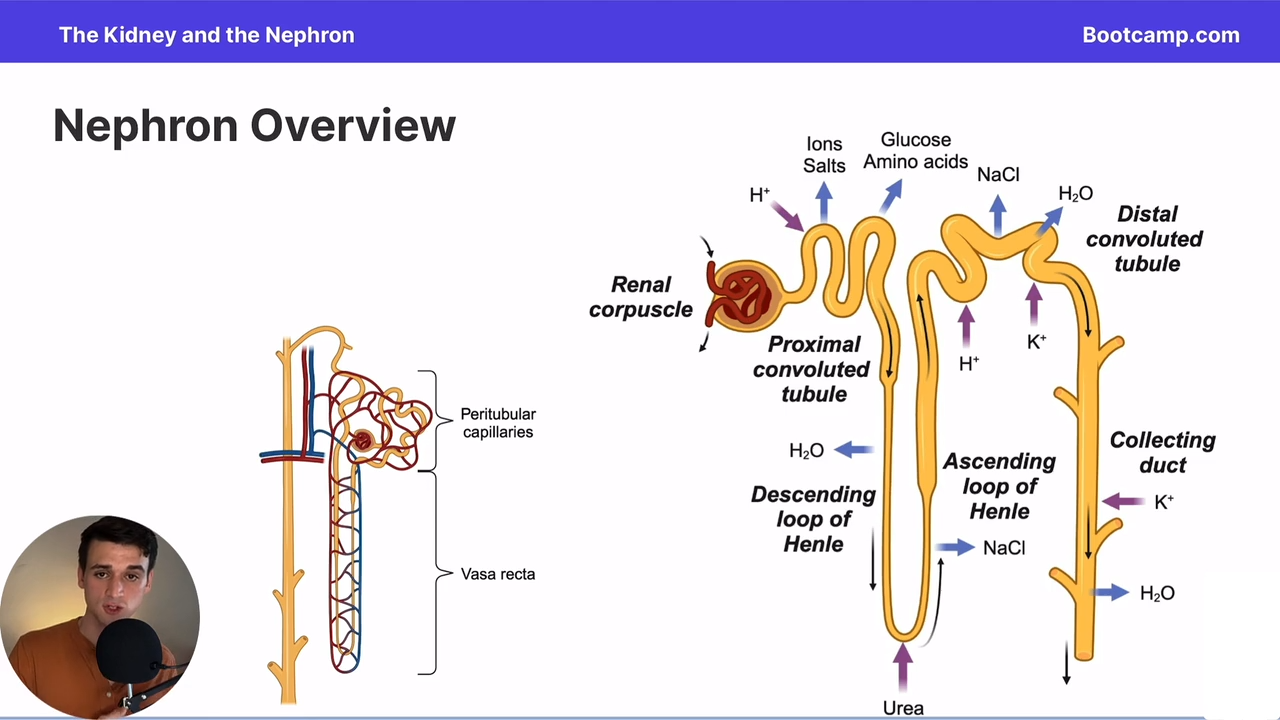
What is the pathway of urine post nephron?
collecting duct
renal pelvis
ureter
bladder
urethra
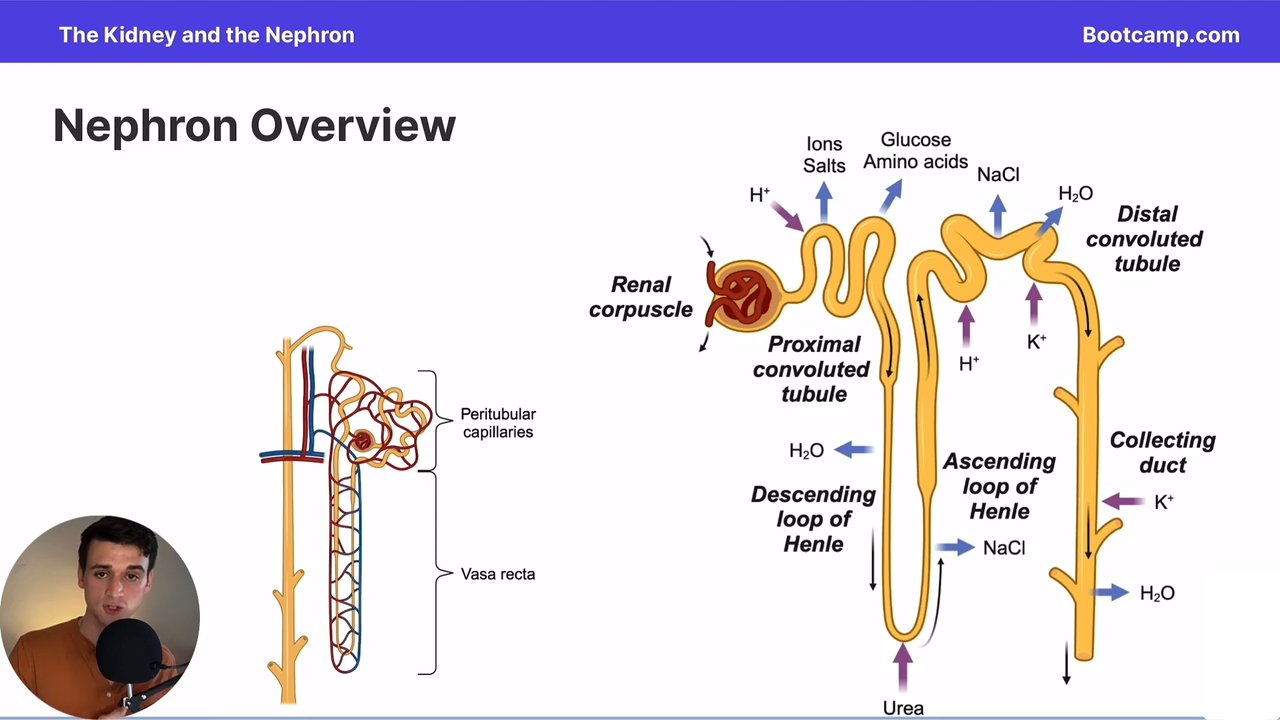
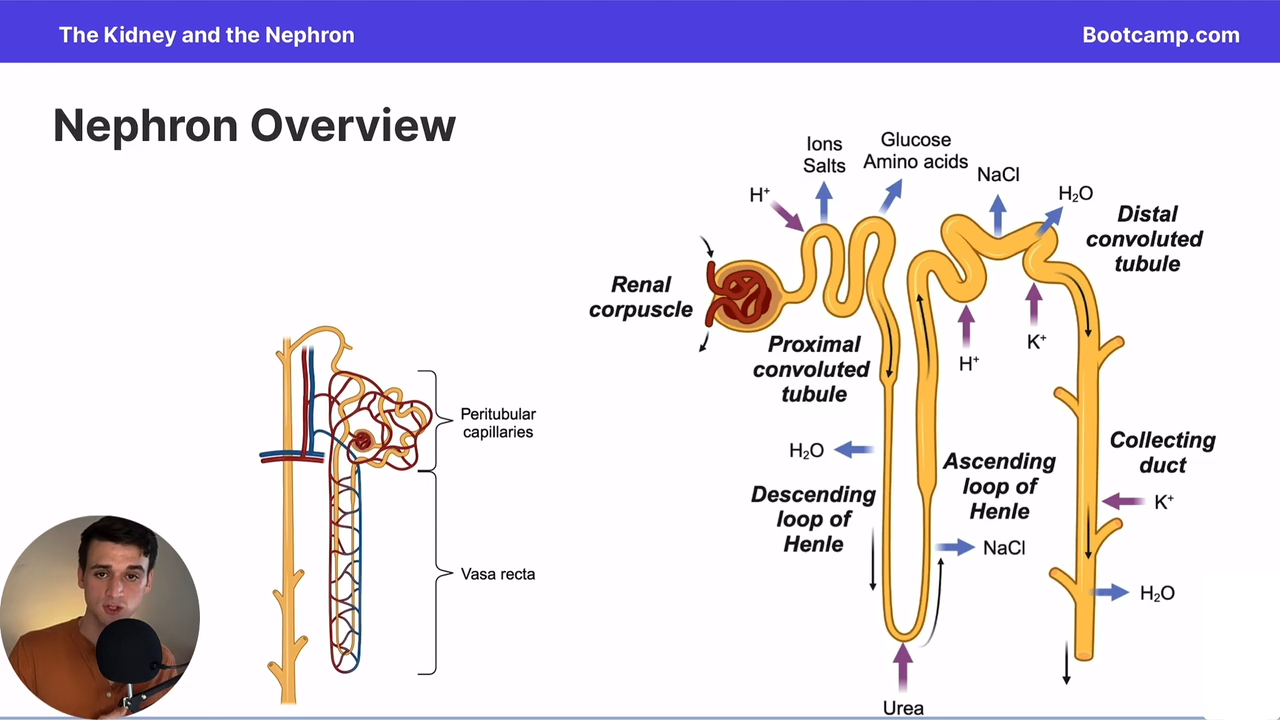
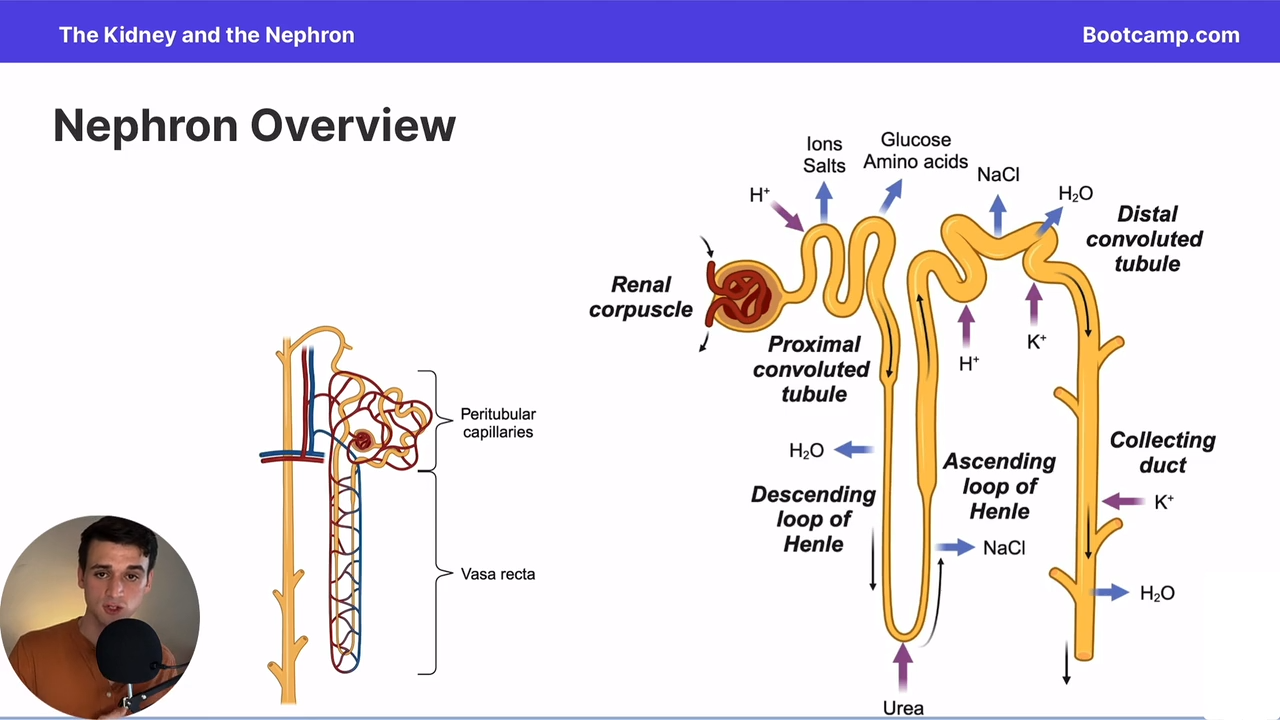
Where in the nephron does the bulk passive reabsorption of water occur?
collecting duct
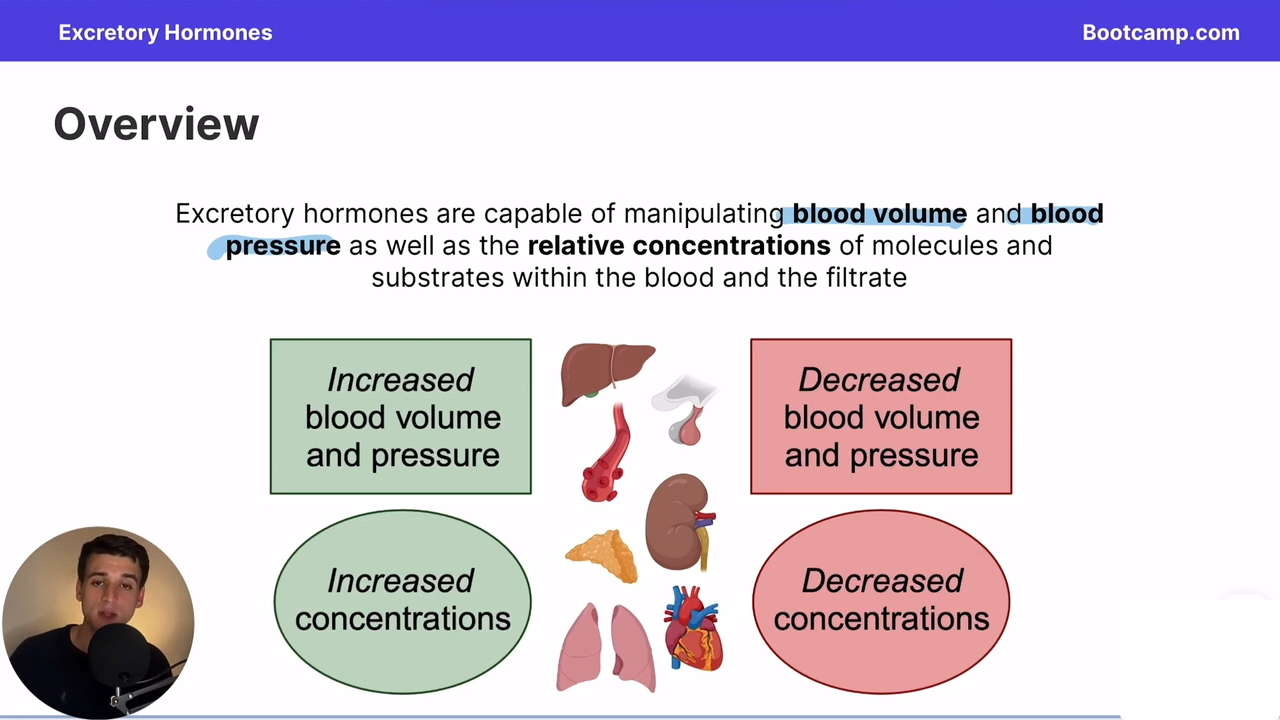
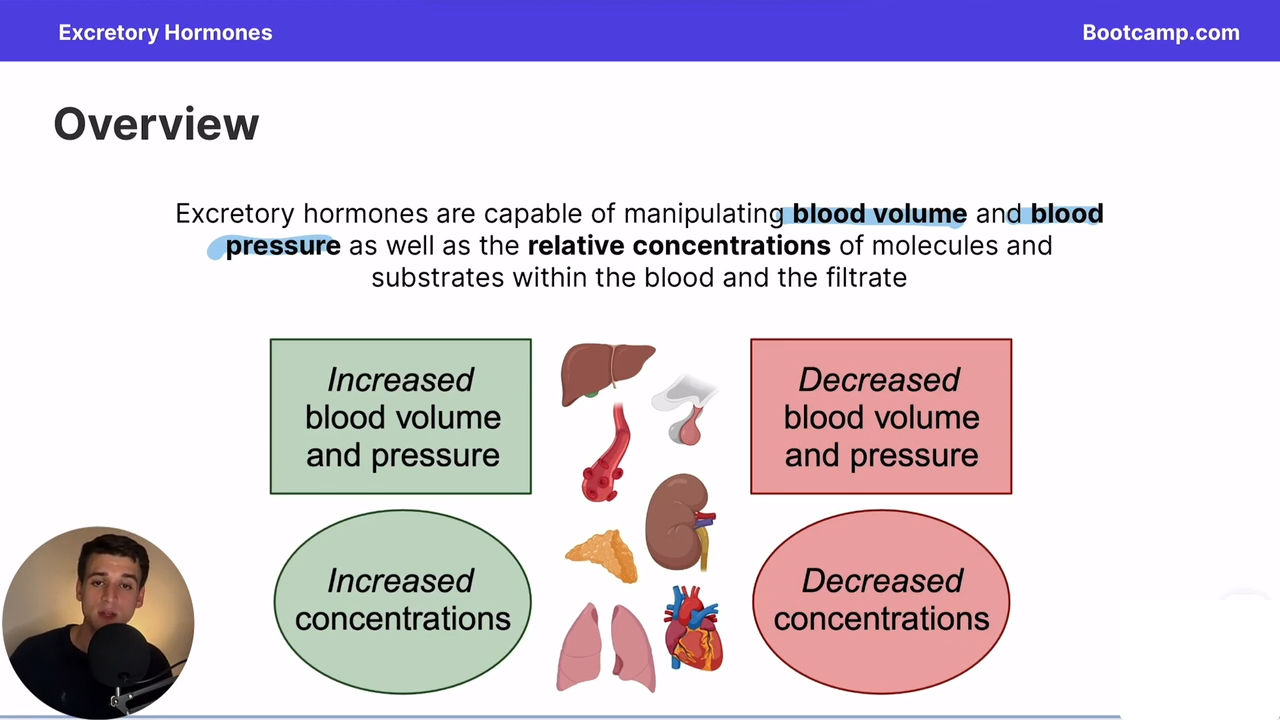
How can excretory hormones affect blood/filtrate?
manipulate blood volume and blood pressure
change conc of molecules and substrates within blood and filtrate
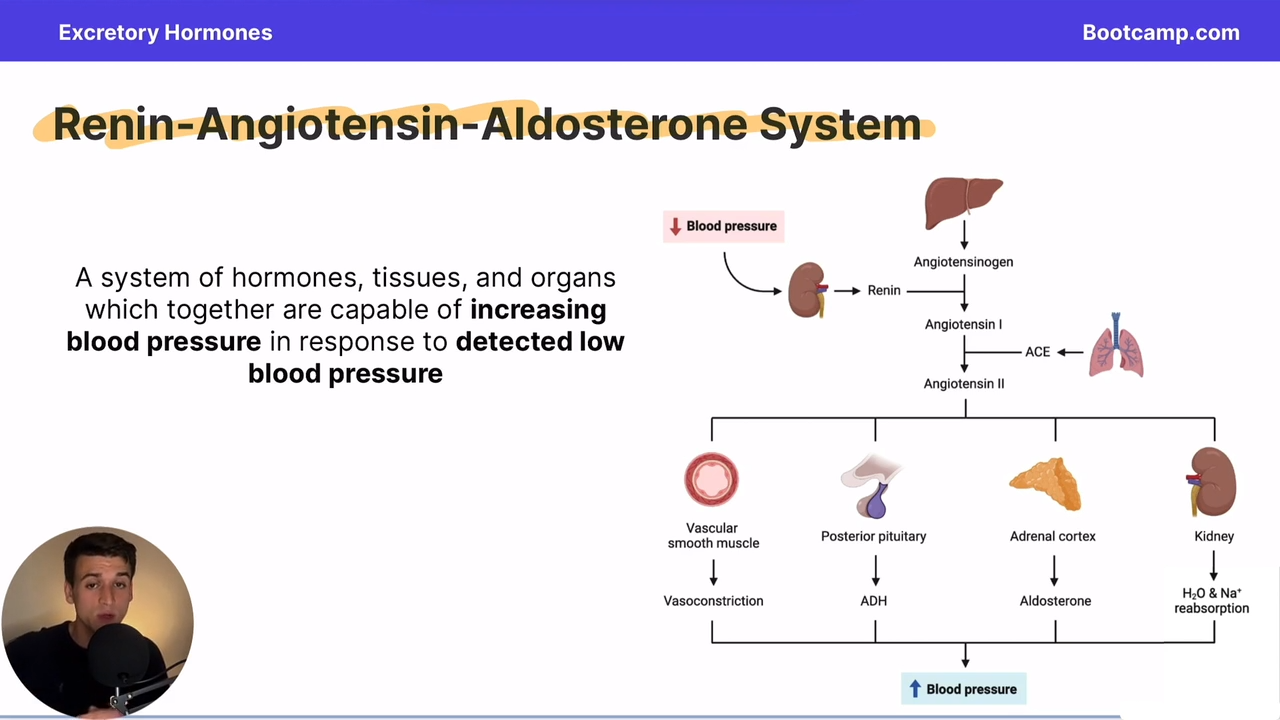
What is the Renin-Angiotensin-Aldosterone (RAS) system?
system of hormones tissues and organs that increase blood pressure in response to low blood pressure
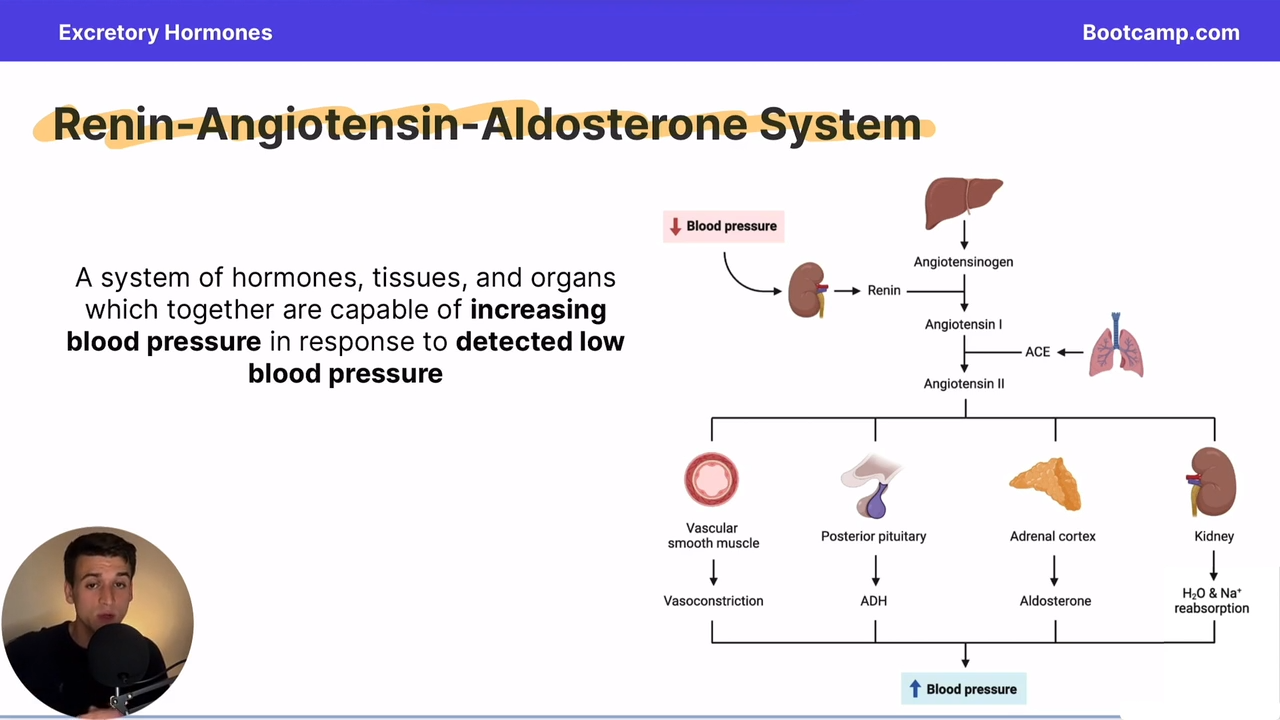
What system increases blood pressure?
Renin-Angiotensin-Aldosterone (RAS) system
What are juxtaglomerular cells?
modified smooth muscle cells associated with the afferent arteriole
detect changes in blood pressure and volume
release renin in times of low blood pressure
What is the afferent arteriole?
brings blood to the glomerulus of the nephron
filtered by podocytes
has juxtaglomerular cells that detect changes in blood pressure and blood volume, and release renin
What releases renin in times of low blood pressure?
juxtaglomerular cells in afferent arteriole
What is renin?
enzyme that converts angiotensinogen into angiotensin 1
released from the liver
made in response to low blood pressure or sympathetic NS
released at juxtaglomerular cells in afferent arteriole
What releases angiotensinogen?
the liver
What is angiotensin converting enzyme (ACE)?
enzyme that converts angiotensin 1 to angiotensin 2
released from walls of blood vessels in the lungs
What is angiotensin 2?
enzyme that increases blood pressure and volume
formed from angiotensin by ACE
What converts angiotensin 1 to angiotensin 2?
angiotensin converting enzyme (ACE)