ceutics 3 suspensions
 Call Kai
 Learn
Learn Practice Test
 Spaced Repetition
 Match
Match Flashcards
 Knowt Play
1/38

There's no tags or description
Looks like no tags are added yet.
Name | Mastery | Learn | Test | Matching | Spaced | Call with Kai | Chat |
|---|
No analytics yet
Send a link to your students to track their progress
39 Terms
what are disperse systems
Liquid preparations containing undissolved or immiscible drug distributed in a vehicle

dispersed phase vs dispersion medium
dispersed phase (discontinuous phase)= substance distributed
dispersion medium (continuous phase)= vehicle

identify the dispersed phase and the medium in the following dispersion systems:
suspensions
emulsions
aerosols
suspensions: insoluble solids in a liquid
emulsions: insoluble liquid in liquid
aerosols: liquid/air in air/liquid
solution vs colloid vs suspension
solution= smallest particle size, clear, homogenous, does NOT SEPARATE
colloid: 1-100nm, cloudy, homo or heterogenous, CAN BE SEPARATED
suspension= >100nm, cloudy, heterogenous, CAN BE SEPARATED/ settles

suspension definition
liquid preparations of non soluble SOLID particles accurately dispersed throughout a LIQUID phase
why are many antibiotics formulated as suspensions
many antibiotics are unstable in solution; suspensions preferred
describe the benefits of using suspensions
1. many drugs unstable in solutions
2. ease of swallowing/masking taste
3. range of doses
4. improved solubility (tablets and capsules first disintegrate before dissolving)
5. FAST and CONTROLLED absorption (drug does not have to disintegrate, already small)
how can you control absorption rate in suspensions
alter particle size and vehicle
desired features of suspensions are
1. constant particle size
2. poured readily and evenly from containers
3. redispersed by gentle shaking
what is the wetting phenomena
complete wetting= contact angle=0 (liquid displaces adsorbed air)
incomplete wetting= contact angle= 90
no wetting= contact angle=180 (liquid does not spread over solid)

sedimentation
rate of settling of particles in suspensions; described by Stoke's Law

Stoke's Law
describes rate of settling of particles in suspensions
*particle diameter SQUARED proportional to rate (so reducing size 10x, reduces rate 100x)
*also affected by particle density, medium density, medium viscosity

how can you adjust physical stability of suspensions
changing properties of dispersed phase (NOT MEDIUM)
EX: changing particle size of dispersed phase
why is changing properties of the dispersion medium not recommended to change the stability of the suspension
changing the medium's viscosity or density affects pouring/redispersing
what usually has greater density? dispersion phase or medium
dispersion phase
2 sedimentation parameters used as semi-quantitative measurements of flocculation
sedimentation volume (F)
degree of flocculation (B)
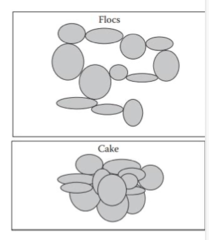
what is flocculation and why is it beneficial
process where particles in a suspension come together to form loose aggregates, called flocs, without fully settling.
helps improve the stability of suspensions by preventing the particles from forming dense sediment that would be harder to redisperse.
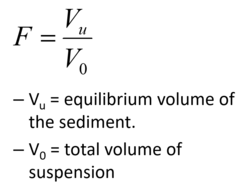
how can sedimentation volume (F) be calculated
what is the F of an ideal suspension?
F= final sediment volume/ original volume of suspension
F=1 is ideal
describe a suspension with a sedimentation volume of 0.5
condensed sediment at the bottom
F= 1/2= 1ml sediment/2ml suspension

describe a suspension with a sedimentation volume of >1
this would mean there is more sediment than original volume of suspension
this is due to flocculation; loose and fluffy sediment expands volume

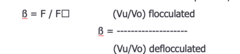
degree of flocculation (B)
(β)= sedimentation volume (F) of the flocculated system/sedimentation volume of a DEflocculated system (F∞)
-so a flocculated suspension would have a LARGE B
highly condensed sediment would have a ______ B and _______ F
small B value (low flocculation)
small F value
what is viscosity
the resistance of a liquid to flow under stress
3 approaches to suspension formulation
1. use of structured vehicle/ thickening or suspending agents
**only for deflocculated suspensions
2. use of controlled flocculation
3. combination of both
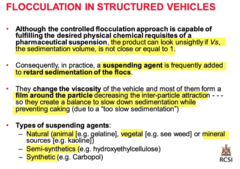
what are structured vehicles
thickening or suspending agents
aqueous solutions of natural and synthetic gums used to INCREASE viscosity therefore lessening sedimentation
*only used in deflocculated suspensions
ex: methyl cellulose, NaCMC, acacia, gelatin, tragacanth
3 disadvantages of structured vehicles
1. difficulty in pouring/redispersion
2. may adsorb onto particles and suppress dissolution/bioavailability
3. not used in parenteral preparations
3 flocculating agents
1. electrolytes (zeta potential=0)
2. polymers (bridges)
3.surfactants (SAA) (bridges)
how do electrolytes contribute to flocculation
reduce particle repulsion by DECREASING zeta potential, therefore forming flocs
what can happen if you add too many electrolytes to a suspension
adding too many electrolytes can change the overall zeta potential to too negative/positive= caking
*ideally you want zero zeta potential= floc formation
caking
Formation of nondispersible sediment within a suspension system

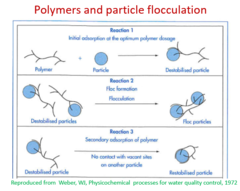
how do polymers contribute to flocculation
part of the polymer is adsorbed onto particle, rest of polymer forms a bridge btwn other polymers= flocc formation
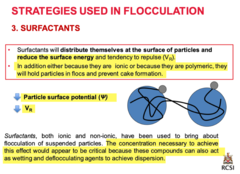
how do surfactants contribute to flocculation
nonionic surfactants (Spans and Tweens) adsorb onto particles and make flocs
dispersing method suspension preparation
1. levigation: drug, wetting agent, dispersion medium
2. uniform dispersion of deflocculated product
3. incorporate structured vehicle (ex: glycerin, water)
or
3.add flocculating agent AND structured vehicle
or
3. add flocculating sgent

disadvantages of dispersing method
1. less accurate dose than tablets/capsules
2.difficult formulation bc of wetting and settling problems
when can other soluble ingredients (such as preservatives or colors) be added in the dispersing method
should be dissolved in a separate portion of the dissolving medium and then added to the smooth paste that has the drug
3 precipitation methods to make suspenions
1. precipitation from water=> water INSOLUBLE drugs dissolved in organic solvent, addition of water
2. precipitation by changing pH (ex: estradiol)
3. double displacement (ex: white lotion)
when are precipitation methods used to make suspensions
useful in sterile suspensions containing drugs which are degraded by heat or irradiation
(more complex, less common)
4 methods of evaluating suspensions
1. sedimentation volume (F) vs time
2. Particle size measurement vs time
3. Rheological properties (viscosity)
4. Ease of redispersability (rotation)
packaging and storing suspensions
1. wide mouth= good pouring
2. airspace= shaking
3. protect from freezing, heating, light