Dr.Elders stupid products class
 Call Kai
 Learn
Learn Practice Test
 Spaced Repetition
 Match
Match Flashcards
 Knowt Play
1/77

There's no tags or description
Looks like no tags are added yet.
Name | Mastery | Learn | Test | Matching | Spaced | Call with Kai | Chat |
|---|
No analytics yet
Send a link to your students to track their progress
78 Terms
Juvenile Wood
Produced in the first year of growth.
Properties of Juvenile Wood
Generally lower quality, More hemicellulose and lignin.
Reaction Wood
Formed in response to non-vertical growth.
Compression Wood
formed in soft wood. Stem shape is eccentric. higher lignin and hemicellulose count
Opposite wood
Occurs opposite to compression wood, high fibril angle. lower lignin than compression wood
Tension wood
Occurs in hardwoods. paper made of tension wood is weak. sawing and machining is difficult with this type of wood.
Branchwood
small diameter, large proportion of bark.
Rootwood
Large amounts of fiber. large amounts of dirt that can cause excessive tool wear
Drying of Wood
removes water from the cell lumens
Greenwood
Moisture in greenwood is important because it adds weight and to the transportation costs
Fiber Saturation Point
Point at which all water is removed from the lumens but the cell wall is still completely saturated
Free Water
Liquid water present in the lumens, removed first in the drying process
Bound Water
Water in the cell wall, as moisture content decreases below the FSP the removal of water becomes more difficult
Moisture Content Calculations- Dry Basis MC
Dry basis MC = (green wt-OD wt/OD wt)*100
Moisture Content Calculations- Wet basis
Wet basis MC = (green wt-OD wt/ green wt) * 100
Measurement of Moisture Content- Oven Drying
Weigh in the wet sample, dry in the oven at 105. weigh dry sample, calc moisture content
Electronic Moisture Content
Fast, but only work below FSP
Resistance moisture meters
Electrical resistance between the pins is measures
Capcitance moisture meters
Capacitance varies with density
Does wood shrink above or below FSP
Below FSP
does wood swell when FSP changes, or when RH and MC change
RH and MC
Shrinkage % formula
(decrease on dimension/original dimension) * 100
Swelling % formula
(increase in dimension/original dimension) * 100
Veneer
Thinner than lumber, moves through a heated chamber
Particles and fibers
because of the volumes needed, these are fast.
Hardwood Structure
More complex than softwood, has multiple different kinds of longitudenal cells
Vessels or Pores
Found in almost all hardwoods, larger in diameter than tracheids but shorter in length
Tyloses
cell membranes from parenchyma,
make wood difficult to dry and treat
impede flow of gases and liquids
Tracheids
two Types
Vasicentric tracheids
Vascular tracheids
Vasicentric tracheids
shorter than fibers but have a larger diameter
Vascular tracheids
these look like latewood vessels
Longitudinal parenchyma
Function in storage
Can have distinct patterns helpful for identification
Rays
Horizontally oriented tissue with variable width
Different Patterns
Upright
Procumbent
Homocellular
Heterocellular
Softwood Anatomy
Relatively simple, Longitudinal cells and Horizontal cells
Longitudinal Cells in a softwood
Tracheids
Parechyma
Epithelial cells
Horizontal cells in a softwood
Ray tracheids
Ray parenchyma
Ray epithelial cells
Longitudinal Tracheids
long and slender
radially arranged
function in support and conduction
Longitudinal parenchyma
Only occurs in certain species
Funciton as a storage site for nutrients
Longitudinal epithelial cells
Function in secretion
Occur in certain genera
Pinus,picea,Larix,Pseudotsuya
Horizontal cells
Only occur in tissues called rays
Ray tissue
Consist of Tracheids, Parenchyma, and Epithial cells
Cross field pits
A semi-bordered pit with connecting ray parenchyma with longitudinal tracheids
Polysaccharides
polymers of sugars
Hexose sugars
Glucose, galactose, and mannose
Pentose sugars
Xylose and arabinose
Cellulose
a polymer of glucose
Linear
cotton is almost entirely made of it
Hemi cellulose
Lower Dp than cellulose
composed of more than just glucose
Lignin
stiffens the cell wall, Hydrophobic, protects against UV light
Crystalline regions
hgihly order parallel arangements
difficult to penetrate with chemicals
Amorphous regions
Less well ordered
Parallel arrangement breaks down
more accessible to chemicals
Pits
Openings in the side of the cell wall
allow liquids to flow between the cells
Earlywood
produced in the early part of the growing season
pale in color
Latewood
Produced in the late growing season
darker in color
smaller cell lumen diameter
Ring porous
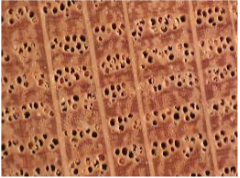
Diffuse Porous

Semi-rig porous

Discontinous Rings
Ring is not complete in cross-section
can cause problems in aging trees
False Growth rings
caused by environmental changes that caused latewood formation
Heartwood
occurs at the center of the tree
darker in color
functions only in support
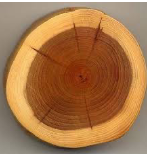
Sapwood
Lighter in color
retains living cells
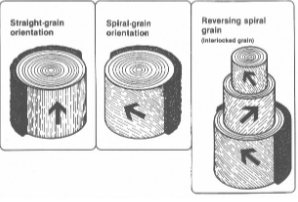
Different types of grain orientation
Wood is made up of
Xylem and Phloem
Wood is
Anisotropic
Hygroscopic
Biodegradable
Combustible
Variable
What sugar is not found in wood
Lyxose
what is cellulose a polymer of
Glucose
what is the function of sapwood
Conduction and support
the darker color of heart wood is due to
the accumulation of extractives
what grain pattern is categorized by fibers twisting around the stem?
spiral grain
wood generally shrinks less in the
Longitudinal direction
the precursor for softwood lignin is
Coniferyl alcohol
The objective of chemical pulping is
the dissolution of lignin
the highest amount of lignin by percentage is found in
the compound middle lamela
The anisotropy of wood is largely influenced by the
S2 layer of the secondary cell wall
what do simple pits do
connect parenchyma cells to parenchyma cells
The flow of liquid through pits is precluded by
Aspirated pits
Diffuse porous hardwood lacks visible growth rings
False
Heartwood contains living cells that actively transport water
False
Sapwood is usually lighter than heartwood
True