Chapter 2.4: The Atomic Theory Today
 Call Kai
 Learn
Learn Practice Test
 Spaced Repetition
 Match
Match Flashcards
 Knowt Play
1/12

Name | Mastery | Learn | Test | Matching | Spaced | Call with Kai | Chat |
|---|
No analytics yet
Send a link to your students to track their progress
13 Terms
Atom
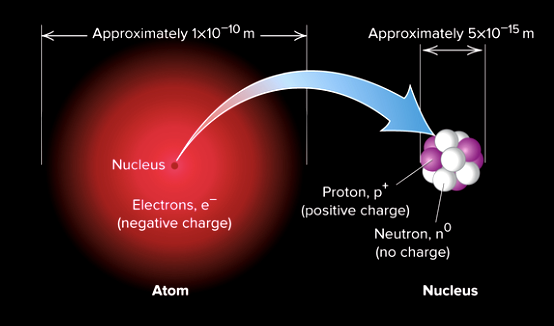
An electrically neutral, spherical entity composed of a positively charged central nucleus, surrounded by one or more negatively charged electrons
Electron
A rapidly-moving, negatively-charged particle held by the attraction of the nucleus
2000 times smaller in terms of mass than a proton or neutron
Nucleus
Protons and neutrons in the center of the atom
Very small; diameter is 20,000 times smaller than the total diameter
Contributes 99.97% of the mass, but only 1 quadrillionth of the volume, creating high density (1014 g/mL)
Proton
A particle within the nucleus with a positive charge
Has the same magnitude of charge of an electron, but with the opposite sign
This always equals the number of electrons
Neutron
A particle in the nucleus with no charge; these are neutral
Mass number (A)
The total number of protons and neutrons in the nucleus of an atom, can be used for simple isotope names
Written as a left superscript, like 12C (carbon-12)
Find neutrons by subtracting N from this
Atomic number (Z)
The number of protons in the nucleus of each of an element’s atoms
Equals the number of electrons
Stays consistent across isotopes
Written as a left subscript: 6C signifies 6 protons (and by extension 6 electrons)
Neutron count (N)
This changes across isotopes
Found by subtracting the constant atomic number (Z) from the mass number (A)
Atomic symbol
A one or two letter abbreviation for the English, Latin, or Greek name of an element
Isotopes
Atoms of an element that have different numbers of neutrons and therefore different mass numbers
These have nearly-identical chemical behavior, even with different masses, due to electrons
Atomic mass unit (amu)
1/12 of the mass of a carbon-12 atom; based on relative mass
Also known as the dalton (Da)
About 1.66054 × 1024 grams
Mass spectrometry
A method for measuring the relative masses and abundances of atomic-scale particles
Electrons collide with an atom’s electron to produce a particle with one positive charge, which are then attracted towards negatively-charged plates and eventually strike a detector to record positions and abundances
Also provides the mass ratio of an isotope to the 12C standard, giving us the isotopic mass
Atomic mass
The weighted average of naturally occuring isotopes according to their abundances; these can sometimes change overtime with ranges provided