Chp 3 Amino Acids, Peptides and Proteins
 Call Kai
 Learn
Learn Practice Test
 Spaced Repetition
 Match
Match Flashcards
 Knowt Play
1/150

There's no tags or description
Looks like no tags are added yet.
Name | Mastery | Learn | Test | Matching | Spaced | Call with Kai | Chat |
|---|
No analytics yet
Send a link to your students to track their progress
151 Terms
Amino acid
Building block of proteins; the 20 common protein amino acids are α-amino acids.
α-amino acid
An amino acid in which the amino group and carboxyl group are attached to the same α-carbon.
α-carbon
The central carbon of an amino acid bonded to an amino group, carboxyl group, hydrogen, and R group.
R group
The variable side chain of an amino acid that determines its chemical properties, polarity, charge, and interactions.
Residue
An amino acid after it has been incorporated into a peptide or protein.
Chiral center
A carbon bonded to four different groups, allowing two different stereoisomers.
Which common amino acid is not chiral?
Glycine; its R group is H, so the α-carbon has two hydrogens.
Stereoisomers
Molecules with the same atoms and bonds but different three-dimensional arrangements.
Enantiomers
Nonsuperimposable mirror-image stereoisomers.
D,L system
System for describing absolute configuration of amino acids and sugars based on glyceraldehyde.
How do you identify an L-amino acid in a Fischer projection?
With COOH/COO− at the top and R group at the bottom, the amino group is on the LEFT.
How do you identify a D-amino acid in a Fischer projection?
With COOH/COO− at the top and R group at the bottom, the amino group is on the RIGHT.
Which configuration is normally found in proteins?
L-amino acids.
Does D or L indicate the direction a molecule rotates polarized light?
No. D/L describes configuration around the chiral carbon, not optical rotation.
Five amino-acid classes
Nonpolar aliphatic; aromatic; polar uncharged; positively charged; negatively charged.
Nonpolar aliphatic amino acids
Gly, Ala, Val, Leu, Ile, Met, Pro.
Main interaction of nonpolar amino acids
Hydrophobic interactions.
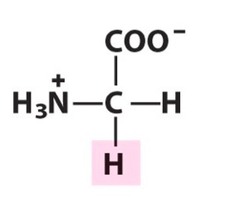
Glycine (Gly, G)
R group = H; smallest amino acid; achiral; contributes little to the hydrophobic effect.
Alanine (Ala, A)
Small nonpolar amino acid with a methyl side chain; participates in hydrophobic interactions.

Valine (Val, V)
Branched nonpolar hydrophobic amino acid.

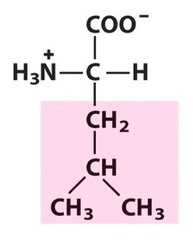
Leucine (Leu, L)
Branched nonpolar hydrophobic amino acid.
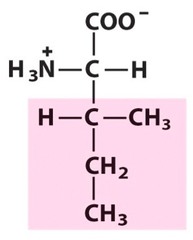
Isoleucine (Ile, I)
Branched nonpolar hydrophobic amino acid.
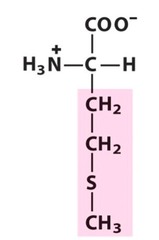
Methionine (Met, M)
Sulfur-containing amino acid with a slightly nonpolar thioether side chain.
Proline (Pro, P)
Nonpolar amino acid with a cyclic side chain that makes the polypeptide backbone rigid and reduces flexibility.

Aromatic amino acids
Phe, Tyr, Trp.
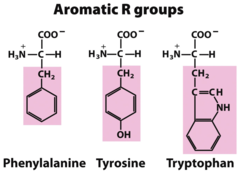
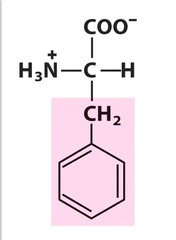
Phenylalanine (Phe, F)
Aromatic and relatively nonpolar; participates mainly in hydrophobic interactions.
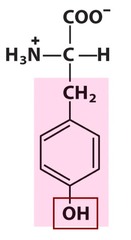
Tyrosine (Tyr, Y)
Aromatic amino acid with an -OH group; participates in hydrophobic interactions and hydrogen bonding.
Tryptophan (Trp, W)
Aromatic amino acid containing an indole ring; can participate in hydrophobic interactions and hydrogen bonding.

Which amino acids are primarily responsible for protein absorbance near 280 nm?
Tryptophan and tyrosine; phenylalanine contributes much less.
Lambert-Beer law
A = εcl; absorbance depends on molar extinction coefficient, concentration, and path length.
Polar uncharged amino acids
Ser, Thr, Cys, Asn, Gln.
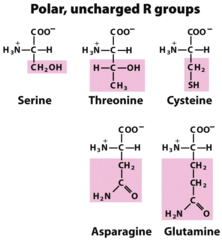
Main interaction of polar uncharged amino acids
Hydrogen bonding.
Serine (Ser, S)
Polar uncharged amino acid with a hydroxyl group; can form hydrogen bonds.

Threonine (Thr, T)
Polar uncharged amino acid with a hydroxyl group; can form hydrogen bonds.

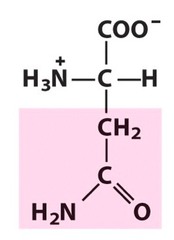
Asparagine (Asn, N)
Polar uncharged amino acid with an amide side chain; can form hydrogen bonds.
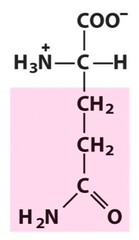
Glutamine (Gln, Q)
Polar uncharged amino acid with an amide side chain; can form hydrogen bonds.
Cysteine (Cys, C)
Contains a sulfhydryl -SH group; weakly polar and can form disulfide bonds.

Disulfide bond
Covalent S-S bond formed by oxidation of two cysteine residues; can stabilize protein structure.
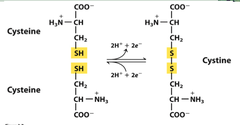
Cystine
Two cysteine residues joined by a disulfide bond.
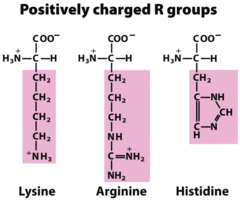
Positively charged amino acids
Lys, Arg, His.
Main interaction of charged amino acids
Ionic interactions or salt bridges with oppositely charged groups.
Lysine (Lys, K)
Basic amino acid with a side-chain amino group; usually positively charged at pH 7.

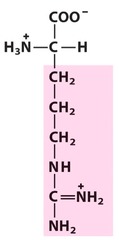
Arginine (Arg, R)
Basic amino acid with a guanidinium group; usually positively charged at pH 7.
Histidine (His, H)
Contains an imidazole side chain with pKa near neutrality; can be positively charged or uncharged near physiological pH.
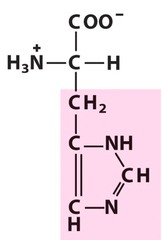
Why is histidine important in enzyme active sites?
Its side-chain pKa is near neutral pH, allowing it to readily donate or accept protons.
Negatively charged amino acids
Aspartate and glutamate.
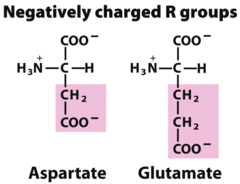
Aspartate (Asp, D)
Acidic amino acid with an extra carboxyl group; negatively charged at about pH 7.

Glutamate (Glu, E)
Acidic amino acid with an extra carboxyl group; negatively charged at about pH 7.
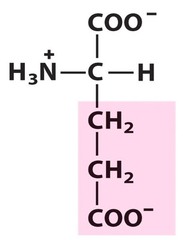
Asp vs Asn
Asp is acidic and negatively charged; Asn is an uncharged polar amide.
Glu vs Gln
Glu is acidic and negatively charged; Gln is an uncharged polar amide.
Salt bridge
Electrostatic attraction between oppositely charged side chains, such as Asp− with Lys+.
Uncommon amino acids
Nonstandard amino acids that may function in metabolism, natural products, or arise from modification of common amino acids.
Ornithine
Uncommon amino acid that is an intermediate in arginine biosynthesis.
Citrulline
Uncommon amino acid that is an intermediate in the urea cycle.
Amino acids as acids and bases
Amino acids are amphoteric; they can donate or accept protons.
Typical α-carboxyl pKa
Approximately 2.2.
Typical α-amino pKa
Approximately 9.6.
pH < pKa rule
The ionizable group is predominantly protonated.
pH > pKa rule
The ionizable group is predominantly deprotonated.
Zwitterion
A molecule containing both positive and negative charges but potentially having a net charge of zero.
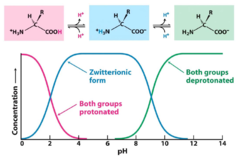
Predominant form of a simple amino acid near neutral pH
NH3+-CHR-COO−, the zwitterion.
Charge of a simple amino acid at very low pH
Usually +1 because both groups are protonated.
Charge of a simple amino acid at intermediate pH
Usually 0 because the amino acid is a zwitterion.
Charge of a simple amino acid at very high pH
Usually −1 after the amino group loses its proton.
General amino-acid charge progression as pH rises
Cation → zwitterion → anion; +1 → 0 → −1.
Isoelectric point (pI)
The pH at which a molecule has a net electric charge of zero.
What happens to an amino acid at its pI?
Net charge is zero, it does not migrate in an electric field, and its solubility is often lowest.
pH below pI
The amino acid or protein tends to have a net positive charge.
pH above pI
The amino acid or protein tends to have a net negative charge.
pI for an amino acid without an ionizable side chain
Average the two pKa values surrounding the neutral zwitterion: pI = (pKa1 + pKa2)/2.
How do you find pI when an amino acid has an ionizable R group?
Find the species with net charge 0 and average the two pKa values that surround that species.
Why do acidic amino acids tend to have low pI values?
Their additional acidic side chains lose protons and produce negative charge at relatively low pH.
Why do basic amino acids tend to have high pI values?
Their basic side chains remain positively charged to relatively high pH.
Glycine titration pKa1
2.34; corresponds to deprotonation of the α-carboxyl group.
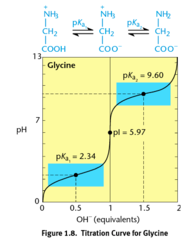
Glycine titration pKa2
9.60; corresponds to deprotonation of the α-amino group.
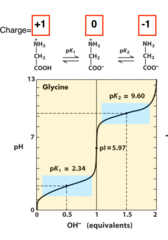
Buffering regions on an amino-acid titration curve
Regions around each pKa where both protonated and deprotonated forms are present.
Which amino-acid side chain buffers near neutral pH?
Histidine because its side-chain pKa is near neutrality.
Chemical environment and pKa
Nearby charged, polar, or electronegative groups can shift the pKa of an ionizable group.
Why can amino acids have altered pKa values inside enzyme active sites?
The local chemical environment can stabilize or destabilize protonated or deprotonated forms.
How do you determine amino-acid net charge at a given pH?
Compare the pH with the pKa of every ionizable group, assign each group a charge, then add the charges.
Peptide bond
Covalent amide linkage between the α-carboxyl group of one amino acid and the α-amino group of another.
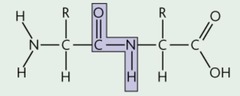
Condensation reaction
Reaction that joins molecules with the loss of a small molecule such as water; peptide bond formation is a condensation reaction.
Hydrolysis reaction
Breaking a bond by addition of water; peptide bonds can be hydrolyzed to release amino acids.
Under standard conditions, does equilibrium favor peptide formation or hydrolysis?
Hydrolysis of the peptide into amino acids.
Why must the carboxyl group be activated for peptide bond formation?
The hydroxyl group is a poor leaving group, so chemical activation is required to make bond formation favorable.
Why are peptide bonds stable even though hydrolysis is thermodynamically favored?
Peptide-bond hydrolysis has a high activation energy and therefore occurs very slowly without a catalyst.
N-terminus
End of a peptide with the free α-amino group.
C-terminus
End of a peptide with the free α-carboxyl group.
Direction peptide sequences are written
N-terminus → C-terminus.
How are peptides named?
Start at the N-terminus and proceed toward the C-terminus.
Oligopeptide
A peptide containing a relatively small number of amino-acid residues.
Polypeptide
A chain containing many amino-acid residues joined by peptide bonds.
Which groups determine the charge of a peptide?
The N-terminus, C-terminus, and any ionizable R groups.
Do internal α-amino and α-carboxyl groups contribute to peptide charge?
No; they are incorporated into peptide bonds and no longer ionize like free amino-acid termini.
How do you determine the net charge of a peptide?
Identify the N-terminus, C-terminus, and all ionizable side chains; determine each charge at the given pH and add them.
Can R-group pKa values change when amino acids are incorporated into peptides?
Yes; the altered chemical environment can shift their pKa values.
Aspartame
A biologically active dipeptide methyl ester used as an artificial sweetener.
Oxytocin
Nine-amino-acid peptide hormone involved in childbirth that contains a disulfide bond.
RiPP
Ribosomally synthesized and posttranslationally modified peptide.
NRP
Nonribosomal peptide synthesized by nonribosomal peptide synthetase enzymes rather than the ribosome.