Human Anatomy Lecture Medical Imaging
 Call Kai
 Learn
Learn Practice Test
 Spaced Repetition
 Match
Match Flashcards
 Knowt Play
1/9

There's no tags or description
Looks like no tags are added yet.
Name | Mastery | Learn | Test | Matching | Spaced | Call with Kai | Chat |
|---|
No analytics yet
Send a link to your students to track their progress
10 Terms
Medical Imaging
Used to view internal organs and look for signs of disease w/o undergoing exploratory surgery.
Conventional radiography
2D X-ray. Short electromagnetic wavelengths. Radiograph produces negative image. Dark = soft organs, less dense, easily penetrated, reveals piece of film behind. Light = bone, denser, absorbs ray. Can use radiopaque contrast dye (heavy elements, barium) for soft tissue visibility. Can scan for tumors or osteoporosis (abnormal density). Denser organs block less dense.
CT scan (Computed Tomography)
3D X-ray. Best for soft tissue, bone, blood vessels. Not good for nervous or joints. Full circumference of multiple transverse cross-sections combined into computer generated image of body section. Fast, inexpensive (good for trauma situations). Some radiation exposure.
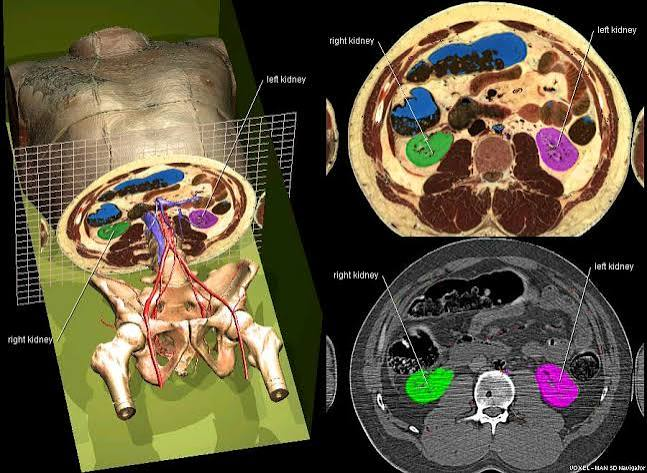
PET Scan (Positron Emission Tomography)
Injected w/ (+) ions, collide w/ (-) electrons in tissue to release gamma rays. Radioactive tag used on sugar/H2O molecules to detect their movement and uptake. Camera detects gamma rays as isotope decays, to identify areas of high metabolic activity or blood flow, tumors.

Nuclear Medical Technology
Radioactive isotopes. Identify regions of high uptake (infection). Thyroid. Lymphatic flow. Produces scintigram.
PET/CT
Combo. Costly.
Sonography
Ultrasound. Uses high frequency sound waves from probe that reflect, or echo, off of tissue. Computer analyzes echo to produce outline of organ and motion. Inexpensive, portable, no radiation.
MRI (Magnetic Resonance Imaging)
High energy magnetic field using radiowaves. Detects hydrogen atoms, based on relative water content. Better for detecting soft tissue (w/ more water) and peering through bone (w/ less water). More costly than CT, but no radiation.
Medical Dosimetry
Work w/ radiation oncologists to determine treatment dosage and plan. Use math, physics, etc. on computer or manual.