Biology 2 The cell of the basis of life
 Call Kai
 Learn
Learn Practice Test
 Spaced Repetition
 Match
Match Flashcards
 Knowt Play
1/35

There's no tags or description
Looks like no tags are added yet.
Name | Mastery | Learn | Test | Matching | Spaced | Call with Kai | Chat |
|---|
No analytics yet
Send a link to your students to track their progress
36 Terms
What are all living organisms made from?
From cells! And all cells are from pre-existing cells
Three principles of cell theory
all living organisms are made of one or more cells (bacteria → one cell, humans → many cells)
Cell is basic structural & functional unit of life (all organs are made from it)
All cells from pre-existing cells
Why are viruses unusual?
Viruses NOT MADE OF CELLS (non-cellular). They contain: genetic material (DNA or RNA), protein coat (capsid) & sometimes lipid envelope → they need a host cell to reproduce
Unlike cells, what are other things viruses don’t have or are not?
no cytoplasm
no ribosomes
no organelles
can’t produce their own energy
not considered living organisms
What must viruses do to reproduce?
To infect a host cell
Viruses and function of their DNA or RNA, capsid protein coat, lipid envelope
DNA&RNA: carries information in oder to make new viruses
Capsid protein coat: surrounds DNA/RNA as protection, helps virus to attach host cell
Lipid envelope (some viruses): outer layer made from lipid membrane & viral proteins (example: Influenza, HIV, Corona)
Process virus reproduction
virus binds to host cell surface (receptors)
virus enters host cell
Cell is used to make viral genomes and parts (replication virus uses ribosomes, enzymes&energy of host cell)
new virus particles are put together inside cell
many newly made viruses spread away from the infected cell
Why do viruses infect specific type of cells?
viral surface proteins must match receptors on the host cell
Example of viruses
Virus | Genetic Material | Disease |
Influenza virus | RNA | Flu |
HIV | RNA | AIDS |
SARS-CoV-2 | RNA | COVID-19 |
Herpesvirus | DNA | Herpes infections |
Bacteriophages | DNA | Infect bacteria |
Multinucleated cells & very large cells
Multinucleated c. : contain multiple nuclei (z.b. skeletal muscle cells)
Very large c. : very large (z.b. nerve cells) → very long extensions
The scientists on cell theory, Letters?
H-S-S-V
Hooke → He named cells
Schleiden → studied plants
Schwann → studied animals
Virchow → vorherige cells create new cells
Why do cells must come from pre-existing cells?
Because they divide (mitosis) that’s how they reproduce
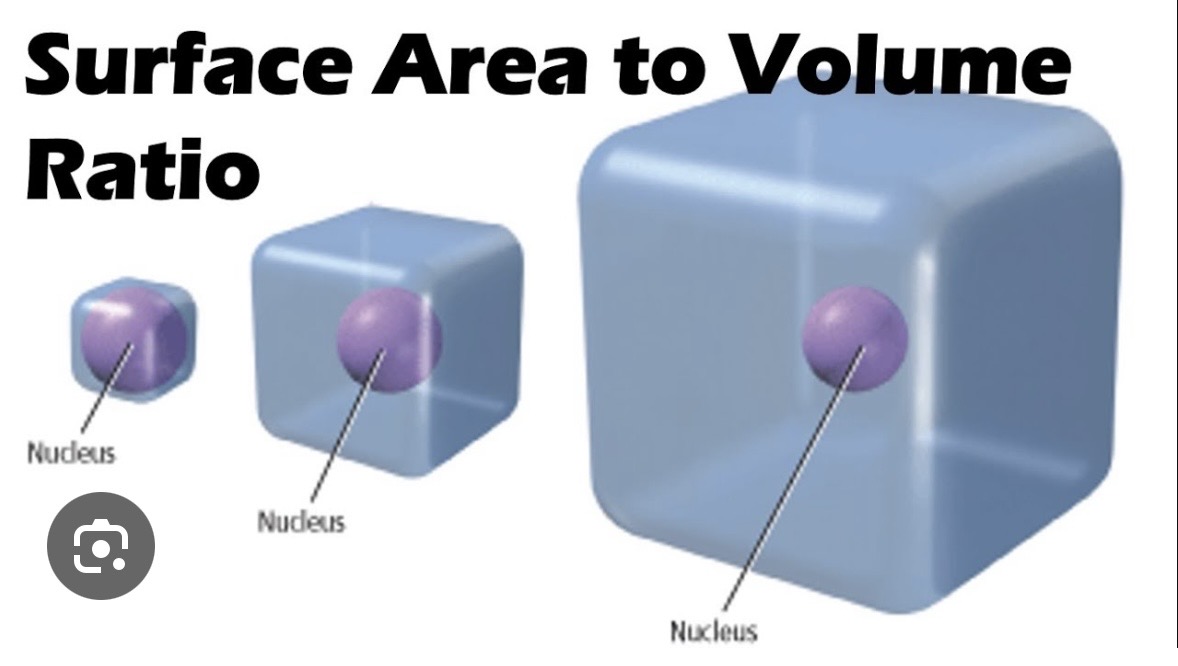
Why are cells mostly small (microscopic)?
Because exchange of materials become less efficient as cells increases
Surface Area-to-Volume Ratio (SA:V):
Small cell has larger surface area compared with its volume
Diffusion more efficient and faster!
Cells are measured in?
Micrometers µm
1 µm = 0,001 mm
Most cells are between: 1-100 μm
Examples of cell size: bacteria, mitochondria, human red blood cell, typical animal cell, human egg cell
Examples of Cell Sizes
Structure | Approximate size |
Bacteria | 1–5 µm |
Mitochondria | 0.5–1 µm |
Human red blood cell | ~7–8 µm |
Typical animal cell | 10–30 µm |
Human egg cell | ~100 µm |
Neurons very long but cell body small!
What is diffusion?
Most substances move through cells by diffusion
is the movement of molecules from:
high concentration→ low concentration
(z.B. oxygen moves from blood into cells)
Efficiency of cell diffusions
The efficiency of diffusion is dependent on cell size! Small cell → good surface area compared→ efficient diffusion
How do cells solve the size problem? (name 3)
remaining small (not growing indefinitely)
changing shape (develop shapes that increase surface area, z.B. Red blood cells: small, flat, biconcave)
developing internal transport systems (blood vessels, circulatory systems)
The volume of a cell determines how quickly substances enter, why is this false?
Because volume alone is not argumentative enough!
It depends on the surface area to volume ratio, both needs to be included!
Procaryotic cells
no nucleus
DNA is not surrounded by membrane
main examples: bacteria, archaea
Structures:
1 cell membrane: controls movement of substances in and out the cell
2 cytoplasm: jelly-like substance with chemical reactions (holds cell together?)
3 DNA region (nucleoid): where DNA is circular and single chromosome
4 ribosomes: protein synthesis (70S ribosomes)
5 cell wall: outside of the membrane for protection & maintaining shape, contains peptidoglycan
6 flagellum (in some bacteria): for movement
7 capsule (in some bacteria): protective outer layer
usually smaller than eukaryotic cells
reproduce by binary fission
Eukaryotic cells
with nucleus
mebrane-bound organelles
examples: animals, plants, fungi, protists
Structures:
1 Nucleus: stores DNA (organized into chromosomes), controls cell activities
2 membrane-bound organelles: structures that perform specific functions: mitochondria, endoplas. Ret., Golgi ap., lysosomes
3 ribosomes: protein synthesis (80S ribosomes)
Main Differences Between Prokaryotic and Eukaryotic Cells
Main Differences Between Prokaryotic and Eukaryotic Cells
Feature | Prokaryotic | Eukaryotic |
Nucleus | ❌ No | ✅ Yes |
DNA | Circular | Linear chromosomes |
Membrane-bound organelles | ❌ No | ✅ Yes |
Size | Smaller | Larger |
Ribosomes | 70S | 80S |
Cell division | Binary fission | Mitosis/meiosis |
Examples | Bacteria | Animals, plants, fungi |
Endosymbiotic Theory
some organelles originated from ancient bacteria that where engulfed by another cell.
Evidence: mitochondria and chloroplasts: have own circular dna, own ribosomes, double membrane, can divide
Similarities between prokaryotic and eukaryotic cells
1 cell membrane
2 cytoplasm
3 dna
4 ribosomes
Are mitochondria only found in animal cells?
No, plant cells also contain mitochondria
Difference between 70S & 80S ribosomes
70S ribosomes: in prokaryotes → smaller ribosomes in eukaryotic organelles
80S ribosomes: in eukaryotes → larger ribosomes in cytoplasm
S stands for Svedberg units (measure of how fast particles settle during a centrifuge spin → reflects size and density)
What have animal and plant cells in common?
Both eukaryotic cells with: nucleus, membrane-bound organelles (z.B. mitochondria for ATP through cellular respiration), 80S ribosomes, linear chromosomes
What additional structures do plant cells have?
perform photosynthesis (chloroplasts)
Maintain their shape (cell wall)
Store water (large central vacuole)
Eukaryotic plant cell structures:
1Cell wall
2Chloroplasts
3Large central vacuole
Definition, function, reason
1Cell Wall:
Definition: rigid layer outside the cell membrane (out of cellulose)
Function: support, maintains structure, no bursting when water enters
Reason: through osmosis (water intake) cell could not hold water or cell swells and ruptures
2Chloroplasts:
Definition: organelles in plant cells for photosynthesis including Chlorophyll (green pigment, absorbs light energy)
Function and reason: light energy→ chemical energy (glucose)
Have their own dna, ribosomes, double membrane,
3Large central vacuole
Definition: large membrane-bound space filled with cell sap
Function: stores water, stores ions & nutrients, maintains pressure in cell (turgor pressure)
Eukaryotic animal cell structures?
(Name
1Centrioles:
Function: help organize microtubules during: cell division, formation of mitotic spindle
2Lysosomes:
Function: contain digestive enzymes, which break down: waste materials, old organelles, foreign substances
Plant Cells vs Animal Cells
Feature | Plant Cell | Animal Cell |
Nucleus | ✅ | ✅ |
Cell membrane | ✅ | ✅ |
Mitochondria | ✅ | ✅ |
Ribosomes | ✅ | ✅ |
Cell wall | ✅ | ❌ |
Chloroplasts | ✅ | ❌ |
Large central vacuole | ✅ | ❌ |
Centrioles | Usually absent | Usually present |
Shape | More fixed | More flexible |
Why do plant cells need to do photosynthesis?
Because plants can’t move to get food
They need chloroplasts to produce glucose with light through photosynthesis
Plants vs. Animal cells
Structure | Function | Found in |
Cell wall | Support and protection | Plants |
Chloroplast | Photosynthesis | Plants |
Vacuole | Storage and pressure | Plants (large) |
Centrioles | Cell division | Mainly animals |
Lysosomes | Digestion/recycling | Mainly animals |
Mitochondria | ATP production | Both |
Membrane transport of cells
Transport | ATP needed? | Direction |
Simple diffusion | ❌ | High → Low |
Facilitated diffusion | ❌ | High → Low |
Osmosis | ❌ | Water movement |
Active transport | ✅ | Low → High |
Endocytosis | ✅ | Into cell |
Exocytosis | ✅ | Out of cell |
Main roles of cell membrane
Controls what enters and leaves the cells
Allows communication between cells
Maintains internal environment of cell
What is the biology word for the description that the cell membrane lets some substances pass through and others don’t?
Selective Permeability