ASA Assembly & Rigging (prepware)
 Call Kai
 Learn
Learn Practice Test
 Spaced Repetition
 Match
Match Flashcards
 Knowt Play
1/79

There's no tags or description
Looks like no tags are added yet.
Name | Mastery | Learn | Test | Matching | Spaced | Call with Kai | Chat |
|---|
No analytics yet
Send a link to your students to track their progress
80 Terms
1-8212. The auxiliary (tail) rotor of a helicopter permits the pilot to compensate for and/or accomplish which of the following?
C- Torque and directional control
2-8213. The vertical flight of a helicopter is controlled by
A- collective pitch changes.
3-8214. A reduction in anti-torque thrust will cause the
B- tail to pivot in the direction of torque rotation around the main rotor axis.
4-8215. In rotorcraft external-loading, the ideal location of the cargo release is where the line of action passes
C- through the center of gravity at all times.
5-8216. The acute angle formed by the chord line of a wing and the relative wind is known as the
C- angle of attack.
6-8217. A helicopter in forward flight, cruise configuration, changes direction by
C- tilting the main rotor disk in the desired direction.
7-8218. The purpose in checking main rotor blade tracking is to determine the
A- relative position of the blades during rotation.
8-8219. In a hovering helicopter equipped with a tail rotor, directional control is maintained by
C- varying the pitch of the tail rotor blades.
9-8220. If a single-rotor helicopter is in forward horizontal flight, the angle of attack of the advancing blade is
C- less than the retreating blade.
10-8221 Main rotor blades that do not cone by the same amount during rotation are said to be out of
C- track.
11-8222. One purpose of the freewheeling unit required between the engine and the helicopter transmission is to
A- automatically disengage the rotor from the engine in case of an engine failure.
12-8223. Which statement is correct concerning torque effect on helicopters?
C- Torque direction is the opposite of rotor blade rotation
13-8224. What is the purpose of the free-wheeling unit in a helicopter drive system?
A- It disconnects the rotor whenever the engine stops or slows below the equivalent of rotor RPM.
14-8225. Movement about the longitudinal axis (roll) in a helicopter is effected by movement of the
B- cyclic pitch control.
15-8226. Movement about the lateral axis (pitch) in a helicopter is effected by movement of the
B- cyclic pitch control.
16-8227. Wing dihedral, a rigging consideration on most airplanes of conventional design, contributes most to stability of the airplane about its
A- longitudinal axis.
17-8228. Other than the manufacturer maintenance manual what other document could be used to determine the primary flight control surface deflection for an imported aircraft that is reassembled after shipment?
A- Aircraft type certificate data sheet.
18-8229. If a pilot reports that an airplane flies left wing heavy, this condition may be corrected by
A- increasing the angle of incidence of the left wing, or decreasing the angle of incidence of the right wing, or both.
19-8230 If the vertical fin of a single-engine, propeller-driven airplane is rigged properly, it will generally be parallel to
B- the vertical axis but not the longitudinal axis.
20-8231. An airplane which has good longitudinal stability should have a minimum tendency to
B- pitch.
21-8232. As the angle of attack of an airfoil increases, the center of pressure will
C- move toward the leading edge
22-8233. The angle of incidence is that acute angle formed by
B- a line parallel to the wing chord and a line parallel to the longitudinal axis of the aircraft.
23-8234. An airplane's center of lift is usually located aft of its center of gravity
B- so that the airplane will have a nose-heavy tendency
24-8235. An airplane is controlled directionally about its vertical axis by the
A- rudder.
25-8236. The elevators of a conventional airplane are used to provide rotation about the
B- lateral axis.
26-8237. Washing-in the left wing of a monoplane, for purposes of rigging corrections after flight test, will have what effect on the lift and drag of that wing?
B- Both drag and lift will increase due to increased angle of attack.
27-8238. What type of flap system increases the wing area and changes the wing camber?
A- Fowler flaps.
28-8239. If the right wing of a monoplane is improperly rigged to a greater angle of incidence than designated in the manufacturer's specifications, it will cause the
A- airplane to be off balance both laterally and directionally.
29-8240. The chord of a wing is measured from
C- leading edge to trailing edge.
30-8241. When the lift of an airfoil increases, the drag will
B- also increase.
31-8242. What physical factors are involved in the aspect ratio of airplane wings?
B- Span and chord.
32-8243. Improper rigging of the elevator trim tab system will affect the balance of the airplane about its
A- lateral axis.
33-8244. An airplane that has a tendency to gradually increase a pitching moment that has been set into motion has
A- poor longitudinal stability.
34-8245. The purpose of wing slats is to
A- reduce stalling speed.
35-8246. The angle of incidence of an airplane at rest
C- does not change when in flight.
36-8247. Buffeting is the intermittent application of forces to a part of an airplane. It is caused by
B- an unsteady flow from turbulence.
37-8248. Movement of an airplane along its lateral axis (roll) is also movement
C- around or about the longitudinal axis controlled by the ailerons.
38-8249. The primary purpose of stall strips is to
B- stall the inboard portion of the wings first.
39-8250. Rigging and alignment checks should not be undertaken in the open; however, if this cannot be avoided, the aircraft should be positioned
C- with the nose into the wind.
40-8251. The correct dihedral angle can be determined by
C- using a dihedral board and bubble level along the front spar of each wing.
41-8252. The dihedral angle of a wing may be measured by placing a straightedge and level protractor on the
A- front spar.
42-8253. Where would you find precise information to perform a symmetry alignment check for a particular aircraft?
C- Aircraft service or maintenance manual.
43-8254. Where is the buttock line or buttline of an aircraft?
C- A width measurement left or right of, and parallel to, the vertical centerline.
44-8255. Where is fuselage station No. 137 located?
B- 137 inches aft of the zero or fixed reference line.
45-8256. Proper wing twist in a sheet metal constructed wing can usually be checked by utilizing a
B- bubble level and special fixtures described by the manufacturer.
46-8257. The vast majority of aircraft control cables are terminated with swaged terminals, that must be
C- checked with a go-no-go gauge before and after, to show compliance with the manufacturer's requirements after the swaging operation.
47-8258. What nondestructive checking method is normally used to ensure that the correct amount of swaging has taken place when installing swaged-type terminals on aircraft control cable?
C- Use a terminal gauge to check the diameter of the swaged portion of the terminal.
48-8259. When inspecting a control cable turnbuckle for proper installation, determine that
C- the safety wire ends are wrapped a minimum of four turns around the terminal end shanks.
49-8260. If all instructions issued by the swaging tool manufacturer are followed when swaging a cable terminal, the resultant swaged terminal strength should be
A- the full rated strength of the cable.
50-8261. Which is an acceptable safety device for a castle nut when installed on secondary structures?
C- Cotter pin.
51-8262. When used in close proximity to magnetic compasses, cotter pins are made of what material?
A- Corrosion resisting steel.
52-8263. When a fiber or nylon insert-type, self-locking nut can be threaded on a bolt or stud through the insert with only the fingers, it should be
B- rejected.
53-8264. The purpose of the vertical fin is to provide
A- directional stability.
54-8265. How are changes in direction of a control cable accomplished?
A- Pulleys.
55-8266. What is the smallest size cable that may be used in aircraft primary control systems?
C- 1/8 inch.
56-8267. After repairing or re-covering a rudder, the surface should be rebalanced
C- to manufacturer's specifications.
57-8268. Placing a piece of cloth around a stainless steel control cable and running it back and forth over the length of the cable is generally a satisfactory method of
B- inspecting for broken strands.
58-8269. The cable-operated control system of an all-metal aircraft, not incorporating a temperature compensating device, has been rigged to the correct tension in a heated hangar. If the aircraft is operated in very cold weather, the cable tension will
A- decrease when the aircraft structure and cables become cold.
59-8270. Very often, repairs to a control surface require static rebalancing of the control surface. Generally, flight control balance condition may be determined by
B- the behavior of the trailing edge when the surface is suspended from its hinge points.
60-8271. Excessive wear on both of the sides of a control cable pulley groove is evidence of
A- pulley misalignment
61-8272. Fairleads should never deflect the alignment of a cable more than
C- 3°
62-8273. Where does the breakage of control cable wires occur most frequently?
A- Breakage usually occurs where cables pass over pulleys and through fairleads.
63-8274. With which system is differential control associated?
B- Aileron.
64-8275. Which statement concerning the 100-hour inspection of an airplane equipped with a push-pull tube-type control system is true? (see book for choices)
C- The threaded rod ends should be checked for the amount of thread engagement by means of the inspection hole provided.
65-8276 If control cables are adjusted properly and the control surfaces tend to vibrate, the probable cause is
A- worn attachment fittings.
66-8277. Aircraft flight control trim systems must be designed and installed so that the
A- pilot can determine the relative position of the trim tab from the cockpit.
67-8278 Stability about the axis which runs parallel to the line of flight is referred to as
B- lateral stability.
68-8279. The purpose of spring tabs or servo tabs is to
A- assist the pilot in moving the control surfaces.
69-8280. If the control stick of an aircraft with properly rigged flight controls is moved rearward and to the left, the right aileron will move
C- down and the elevator will move up.
70-8281. Movement of the cockpit control toward the nosedown position during a ground operational check of the elevator trim tab system will cause the trailing edge of the trim tab to move in which direction?
B- Upward regardless of elevator position.
71-8282. If the control stick of an aircraft with properly rigged flight controls is moved forward and to the right, the left aileron will move
C- down and the elevator will move down.
72-8283. If the travel of an airplane's controls is correct but the cables are rigged exceptionally tight, what probable effect will this have when flying the airplane?
B- The airplane will be heavy on the controls.
73-8284. During inspection of the flight control system of an airplane equipped with differential-type aileron control, side-to-side movement of the control stick will cause
A- each aileron to have a greater up travel (from the streamlined position) than down travel.
74-8285. A universal propeller protractor used to measure the degrees of aileron travel should be zeroed
A- with the aileron in the NEUTRAL position
75-8286. The universal propeller protractor can be used to measure
C- degrees of flap travel.
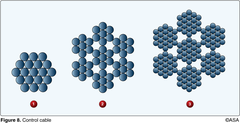
C- 3
76-8287. (Refer to Figure 8.) Identify the cable that is used in primary control systems and in other places where operation over pulleys is frequent.
77-8288. A tension regulator in the flight control cable system of a large all-metal aircraft is used primarily to
C- retain a set tension.
78-8288 (Refer to Figure 9.) When the outside air temperature is 80°F, select the acceptable 3/16 cable tension range.
(B)
117 pounds minimum,
143 pounds maximum.
79-8289. Differential control on an aileron system means that
B- the up travel is more than the down travel.
80-8290. Why is it generally necessary to jack an aircraft indoors for weighing?
---------------------------------------------
81-8291. Which should be accomplished before jacking an aircraft?
B- So that air currents do not destabilize the scales.
------------------------------------
A- Install critical stress panels or plates.