Adaptation and the mind's error - Chapter 8 and 11
 Call Kai
 Learn
Learn Practice Test
 Spaced Repetition
 Match
Match Flashcards
 Knowt Play
1/29

There's no tags or description
Looks like no tags are added yet.
Name | Mastery | Learn | Test | Matching | Spaced | Call with Kai | Chat |
|---|
No analytics yet
Send a link to your students to track their progress
30 Terms
Adaptation: Even the best possible news WHAT
Adaptation: Even the best possible news WEARS OFF
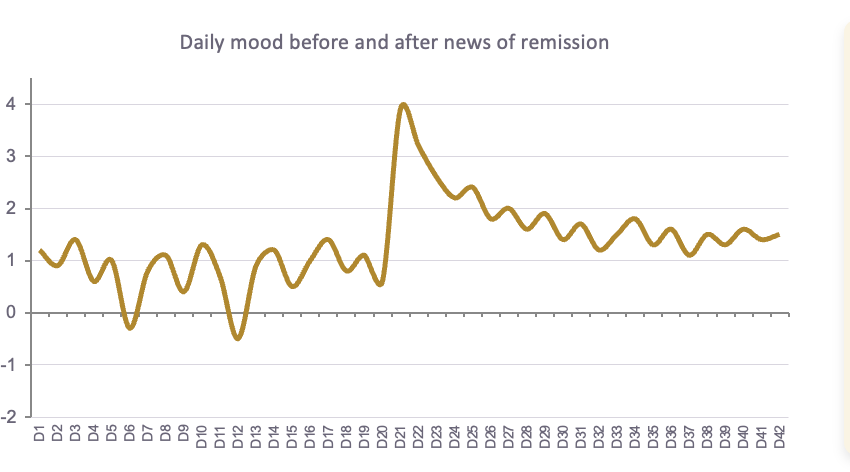
Mood WHAT, mostly in WHAT territory
Day 21: told the cancer is in remission. Mood WHAT sharply
Within days it WHAT back toward the earlier WHAT
The post-event average sits slightly WHAT than before — but only slightly
Mood FLUCTUATES, mostly in POSITIVE territory
Day 21: told the cancer is in remission. Mood SPIKES sharply
Within days it SETTLES back toward the earlier BASELINE
The post-event average sits slightly HIGHER than before — but only slightly
Hedonic adaptation, or the hedonic treadmill: WHAT
Hedonic adaptation, or the hedonic treadmill: people have a set point, a characteristic happiness level they return to whatever happens.
Example:
Marriage is the clearest case. Euphoria at first, then habituation, then a return to baseline. Lucas and colleagues found it takes three to four years.
Almost nobody carries the WHAT through. Some end up slightly happier. Nobody stays ecstatic.
Almost nobody carries the INITIAL EVALUATION through. Some end up slightly happier. Nobody stays ecstatic.
As long as our basic needs are satisfied, we don’t seem to be happier for WHAT due to these events -because we adapt to the spike in happiness and get back to our WHAT or “WHAT” of happiness.
As long as our basic needs are satisfied, we don’t seem to be happier for VERY LONG due to these events -because we adapt to the spike in happiness and get back to our NORMAL or “SET POINT” of happiness.
Individual differences in WHAT rate are large. Some rebound quickly. Others never fully adapt to a bad event.
Individual differences in ADAPTATION rate are large. Some rebound quickly. Others never fully adapt to a bad event.
The useful summary is two asymmetries. Negative events are not as WHAT as we predict, and positive events do not WHAT as long as we predict.
The useful summary is two asymmetries. Negative events are not as BAD as we predict, and positive events do not LAST as long as we predict.
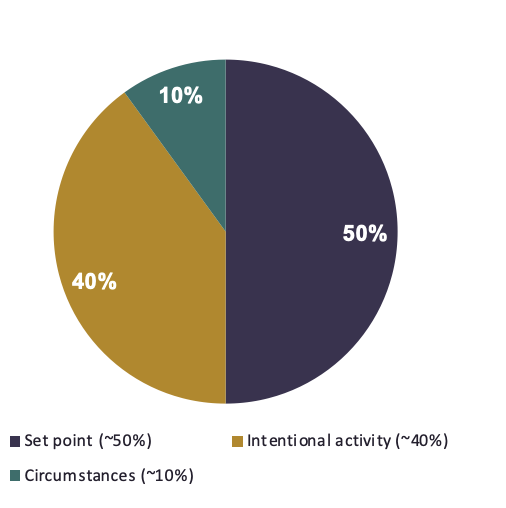
Lyubomirsky's review is presented as showing that about 50% of happiness relates to a WHAT influenced set point, 10% to WHAT, and 40% to the WHAT we make. Students shown this poll consistently expect circumstances to matter far more.
Lyubomirsky's review is presented as showing that about 50% of happiness relates to a GENETICALLY influenced set point, 10% to CIRCUMSTANCES, and 40% to the CHOICES we make. Students shown this poll consistently expect circumstances to matter far more.
Gilbert (200). Humans predict WHAT what will make them happy. The error covers both what we expect to WHAT in the future and how much we expect to WHAT or WHAT it once it arrives.
Gilbert (200). Humans predict INCORRECTLY what will make them happy. The error covers both what we expect to WANT in the future and how much we expect to LIKE or DISLIKE it once it arrives.
Material possessions
Resources meant WHAT. The mind learned to WHAT them.
Material possessions
Resources meant SURVIVAL. The mind learned to PURSUE them.
Status
Standing in a group shaped access to WHAT, WHAT and WHAT
Status
Standing in a group shaped access to FOOD, SAFETY and MATES
Aggression
In some situations it kept our ancestors WHAT
Aggression
In some situations it kept our ancestors ALIVE
Miswanting is rooted in the mind’s job of keeping us WHAT. These preferences were useful. The mind now WHAT them
Miswanting is rooted in the mind’s job of keeping us ALIVE. These preferences were useful. The mind now OVERUSES them
Where the two traditions meet. Buddhism and the empirical literature set the same goal: awareness of the mind's tendency to WHAT and WHAT. Neither asks you to WHAT wanting. Both ask you to WHAT the wanting.
Where the two traditions meet. Buddhism and the empirical literature set the same goal: awareness of the mind's tendency to MISWANT and MISPREDICT. Neither asks you to STOP wanting. Both ask you to NOTICE the wanting.
The mechanism.
Under pressure the mind generates WHAT to its own WHAT.
It draws partly on how the brain resolves WHAT, using WHAT to help a person feel better.
It engages only when it has to.
The mechanism.
Under pressure the mind generates SOLUTIONS to its own PROBLEMS.
It draws partly on how the brain resolves COGNITIVE DISSONANCE, using BIAS to help a person feel better.
It engages only when it has to.
What are the two types of happiness
WHAT
WHAT
What are the two types of happiness
Natural happiness
Synthesized happiness
Natural happiness
What we feel when we get what we wanted. The outcome arrived, and the feeling follows from it.
Synthesized happiness
What the mind manufactures when we do not get what we wanted, or do not get what we thought we wanted. The brain resolves the dissonance and makes the new road as valuable as the one taken away.
Immune neglect
We do not know we have this system, so we overestimate how badly we will feel and for how long. Gilbert's term for the blind spot.
Bronze medallists were rated WHAT than silver, despite the objectively worse result
The explanation is the counterfactual each athlete compares against. Silver compares up, to the gold nearly won. Bronze compares down, to missing the podium.
WHAT comparison in either direction is associated with WHAT happiness. Here the direction alone flips the felt outcome of the same event.
Some comparison is normal and useful for self-WHAT. The finding concerns comparison as a habitual mode.
Bronze medallists were rated HAPPIER than silver, despite the objectively worse result
The explanation is the counterfactual each athlete compares against. Silver compares up, to the gold nearly won. Bronze compares down, to missing the podium.
HABITUAL comparison in either direction is associated with LOWER happiness. Here the direction alone flips the felt outcome of the same event.
Some comparison is normal and useful for self-IMPROVEMENT. The finding concerns comparison as a habitual mode.
Interbeing
Thich Nhat Hanh's term for the WHAT of all things. Looking deeply at a flower, one sees cloud, sunshine, minerals, time and earth in it — the flower is made entirely of non-flower elements and has no WHAT existence.
The chapter's homelier version: drinking a glass of milk, can you taste the grass and the rain? The cow, the grass, the rain, the farmer, the grocer, the worms that aerated the soil.
The golden rule restated: as you do to WHAT, you do to WHAT.
Interbeing
Thich Nhat Hanh's term for the MUTUAL DEPENDENCE of all things. Looking deeply at a flower, one sees cloud, sunshine, minerals, time and earth in it — the flower is made entirely of non-flower elements and has no INDEPENDENT existence.
The chapter's homelier version: drinking a glass of milk, can you taste the grass and the rain? The cow, the grass, the rain, the farmer, the grocer, the worms that aerated the soil.
The golden rule restated: as you do to OTHERS, you do to YOURSELF.
No-self
The Buddha taught that the self WHAT be located in form, sensation, perception, mental activity, or consciousness — and that grasping is mediated by the belief that there is a WHAT which must have WHAT.
Wright's parallel: neuroscience has not located a centre of the WHAT either. On the modularity view the mind is a set of domain-specific systems; the alternative distributes processing across the brain. Neither has found a headquarters.
Wright's suggestion: if you built a public relations module into a brain, it would look a great deal like the conscious self
No-self
The Buddha taught that the self CANNOT be located in form, sensation, perception, mental activity, or consciousness — and that grasping is mediated by the belief that there is a SELF which must have THINGS.
Wright's parallel: neuroscience has not located a centre of the MIND either. On the modularity view the mind is a set of domain-specific systems; the alternative distributes processing across the brain. Neither has found a headquarters.
Wright's suggestion: if you built a public relations module into a brain, it would look a great deal like the conscious self
What are the four things that well-being predicts
WHAT
WHAT
WHAT
WHAT
What are the four things that well-being predicts
Health and longevity
Social relationships
Productivity
Citizenship
Health and longevity
Stronger immune responses and fewer cardiovascular problems. More likely to wear seatbelts and adhere to medical regimens. Longer lives on average.
Social relationships
Happy people are more popular and their relationships are more stable and rewarding. They divorce less, are fired less, support others more, and receive more support in return.
Productivity
Organizations with positive, satisfied members appear more successful, and work units with greater well-being tend to be more productive.
Citizenships
Happy people are more likely to donate time and money to charitable causes and to help others at work.
How it is measured
Primarily WHAT: numbered ratings of satisfaction, positive feeling, and absence of negative feeling. The Diener laboratory's scales, including the Flourishing Scale, are free and openly available.
They have proved reasonably WHAT — but people can lie, deceive themselves, or be swayed by current mood and situation.
Because the scales are imperfect, researchers supplement them with WHAT, WHAT reports from family and coworkers, and WHAT measures. Most of the field still rests on people telling us how happy they are.
How it is measured
Primarily SLEF-REPORT SCALES: numbered ratings of satisfaction, positive feeling, and absence of negative feeling. The Diener laboratory's scales, including the Flourishing Scale, are free and openly available.
They have proved reasonably VALID — but people can lie, deceive themselves, or be swayed by current mood and situation.
Because the scales are imperfect, researchers supplement them with BIOLOGICAL INDICES, INFORMANT reports from family and coworkers, and BEHAVIOURAL measures. Most of the field still rests on people telling us how happy they are.
What chapter 8 says
WHAT produces good outcomes. WHAT predicts health, wealth, relationships, and longevity. Standards, monitoring, capacity and motivation can be arranged deliberately. WHAT beats willpower, and structure is something you can build.
What chapter 8 says
EFFORTFUL CONTROL produces good outcomes. CONSCIENTIOUSNESS predicts health, wealth, relationships, and longevity. Standards, monitoring, capacity and motivation can be arranged deliberately. STRUCTURE beats willpower, and structure is something you can build.
What chapter 11 says
WHAT sets much of the baseline. WHAT returns you to it. You systematically WHAT what will make you happy, and the mind that does the predicting has no WHAT centre. Grasping after outcomes produces the WHAT it was meant to relieve
What chapter 11 says
TEMPERAMENT sets much of the baseline. ADAPTATION returns you to it. You systematically MISPREDICT what will make you happy, and the mind that does the predicting has no RELIABLE centre. Grasping after outcomes produces the DISSATISFACTION it was meant to relieve