3.5 fixed partial dentures
 Call Kai
 Learn
Learn Practice Test
 Spaced Repetition
 Match
Match Flashcards
 Knowt Play
1/40

There's no tags or description
Looks like no tags are added yet.
Name | Mastery | Learn | Test | Matching | Spaced | Call with Kai | Chat |
|---|
No analytics yet
Send a link to your students to track their progress
41 Terms
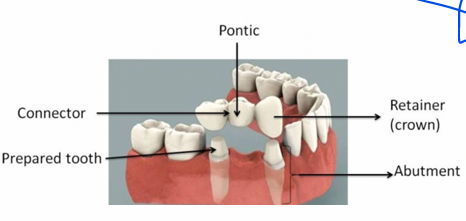
parts of fixed partial dentures and what they do
Retainer - part that seats on the abutment tooth
Pontic - suspended member of FPD that replaces the missing tooth
Connector - provide connection between the retainer and pontic
Abutment tooth - the tooth that provides support for the retainer
what can happen to the structural integrity of the dental arch when a tooth is lost?
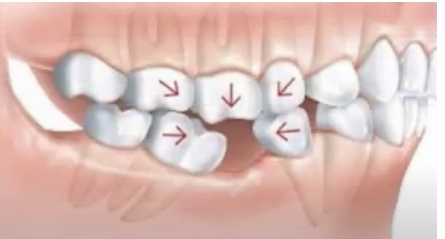
disrupts structural integrity of dental arch
can lead to realignment of teeth as new state of equilibrium is achieved
Adjacent and opposing teeth may move into edentulous space, with some drifting bodily and some tilting.
These changes can affect morphology and cuntion of dentition
what are types of abutments of FPDs?
natural teeth
implant abutments
types of connectors of FPDs
fixed - adhesive and via screw
removable - joint and free
combined - fixed and removable
types of retainers of FPDs
full crown
partial crown
post-crown - cemented in root canal or screwed to the implant
types of pontics of FPDs
hygienic
non-hygienic - saddled
semi-hygienic - convex
types of durations (as per designation) of FPDs
temporary
permanent
types of materials of FPDs
metal - gold, non-precious alloy, precious alloy
composite fibre reinforced
ceramics
combined (metal plastic, metal composite, metal ceramic)
types of manufacturing of FPDs
casting
sintering
modes of retentions of FPDs
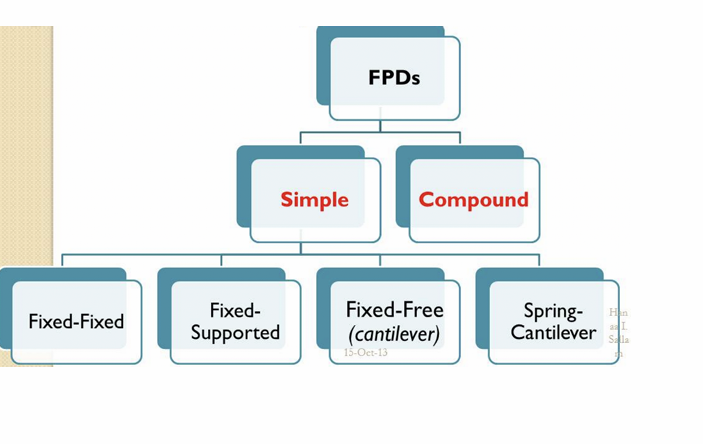
simple - fixed, fixed supported, fixed-free, spring-cantilever
compound - more than one of the simple types
according to site of FPDs
anterior
posterior (uni-lateral (midline), bilateral (canine))
complex
how is a tooth evaluated to be an abutement?
Crown-root ratio: Evaluates the proportion between the height of the tooth's crown and the length of its root. Around 2:3 or 1:1
Root configuration: Considers the shape and structure of the tooth's root for support.
Periodontal ligament area (Ante's law!): The combined surface area of abutment teeth should be equal to or greater than the missing tooth/teeth being replaced.
what is the affect of having longer span on flexing of abutement teeth ?
longer spans, meaning longer sections between abutement teeth are generally less rigid and more prone to flexing (deforming and bending of prosthesis)
To minimise flexing, pontic designs with greater occlusalgingival dimensions (from biting surface to gum line) can be chosen
Excessive flexing under occlusal loads may cause failure of long span FPD
How does material of the prosthesis affect the strength and stability?
using an alloy with higher yield strength, such as nickel-chromium, can provide increased strength and stability
how does arch curvature affect pontics?
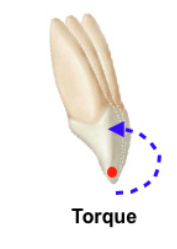
when pontics are positioned outside interabutment axis line (line connecting abutement teeth) they can act as a lever arm.
Can potentially create a torquing movement, which may affect the stresses occurring in the FPD
what is the difference of replacing a maxillary and mandibular canines with FPD?
replacing a maxillary canine with FPD can experience more stress compared to replacing mandibular canine due to outward forces exerted on the maxillary arch
what is the best option when restoring an edentulous space caused by loss of canine and two adjacent teeth?
RPD or implants
In what form is the strength of pontics tripled?
strength of pontics is tripled when its form is convex and oval as opposed to sharp and concave
how is occlusal forces reduced of pontics?
reduce vertical-lingual dimensions
what can canines be secondary abatements for?
Canines can be used as secondary abutements to first premolars primary abutement
But it is unwise to use lateral incisors as secondary abutements to canines
what is non-rigid connectors used for?
they transfer shear stress to supporting bone
prevent stress concentration in connectors
allow some movement in abutements
design helps distribute forced evenly and reduces the risk of complications
helps in tilted FPD abutement
define an abutement
tooth or portion of tooth, or that portion of a dental implant that serves to support/retain a prosthesis
What are complications of tilted molar abutement?
common problem
second molar in lower jaw tilts into space where first molar used to be.
Second molar being tilted makes it difficult or even impossible to create a satisfactory FPD cause the positional relationship is no longer allows for parallel path of insertion without interfering with adjacent teeth
If third molar present, it can further complicate issue. Tipped third molar’s mesial surface can block insertion path of a fixed partial denture
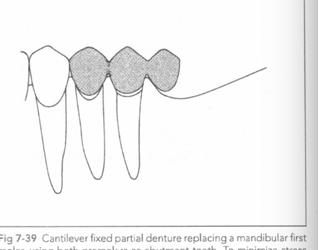
what is a cantilever fixed partial denture?
they replace only one tooth but have at least two abutments
bridge designs
types of FPD depending on number of teeth
Two units FPD
Three units FPD
Fixed-fixed bridges
rigid connectors are present at both ends of pontics
maximum retention and strength
long span bridges
All retainers are major retainers and require extensive preparation reduction of the abutment
one path of insertion, with preparation of both abutments being parallel
entire occlusal surface of both abutements should be covered with the retainer to distribute occlusal forces evenly
All retainers should have approx same degree of retention to minimise risk of dislodging a weak retainer
More tooth structure reduction leads to more destruction and trauma to pulp
Abutement teeth are splinted together which is beneficial for mobile teeth
This type of bridge is cemented as one piece
Fixed free bridges
has rigid connector (major) at distal end of pontic and a mobile connector (minor) mesially
more conservative to tooth structure compared to fixed-fixed because the minor retainer requires less reduction
allows for minor tooth movement, both laterally and vertically
limited to one missing tooth and has span length (distance between abutment teeth) limitation
parts of bridge can be cemented separately, so lab construction is complex and difficult
preparation of abutement does not need to be parallel
Fixed-free is indicated for use in cases of divergent abutment teeth (unparallel), when pier abutment is present (complex bridge) and for aesthetic considerations (such as a class III inlay on distal of canine)
Simple cantilever
this design provides support for the pontic at only one end
pontic can be attached to one or two retainers
abutment tooth is either mesial or distal to the span
most conservative design when only one abutment tooth is available
It’s a successful design for replacing a lateral incisor using the canine as an abutment, especially when the occlusion is favourable
The design can also be used to replace upper or lower first premolars and second molars
Spring cantilever
abutement tooth is usually posterior and should be a tooth that needs restoration
pontic is connected to retainer by long flexible metal bar
design is contraindicated is cases of a V-shaped or narrow palate and is not recommended for the lower arch
Indicated for replacing a missing upper incisor when adjacent teeth are healthy, in cases of midline diastema (gap between the two upper front teeth (maxillary central incisors)) or when posterior teeth need crowns
Not advised for the lower arch due to the stability of the sub-mucosal tissue and potential for plaque and calculus deposition
Combination design (complex or compound bridge)
incorporates two or more conventional bridge designs into one
examples - fixed-fixed with simple cantilever and fixed-fixed with fixed mobile
benefit - easier repair work as only small parts of the bridge may need to be disturbed
Construction steps are simplified and the strain on patient is reduced with shorted, more comfortable visits
FFD (fixed-fixed design) pontics
pontic is part of a fixed partial denture that replaces missing teeth
pontics are usually connected to retaining crowns, which fit onto abutment teeth
factors when making pontic form
edentulous ridge, esthetic considerations and patient homecare + hygiene
edentulous ridge - shape, width and current condition should be taken into account
Estehtic considerations - determining appropriate pontic shape and restorative material
requiremnet of pontics
pontic should challenge the gingiva where indicated by pontic design to prevent food entrapment under the pontic
Pontics should be as smooth as possible especially on the gingival surface to reduced the amount of plaque
what are different pontic designs?
saddle
modified ridge lap
hygienic
ovate
bullet
Pontic design - Saddle
Full contour buccal and lingual to edentulous ridge
+ full contour gives nice facial and lingual esthetics
- difficult patient homecare under pontic
Pontic design - Modified ridge lap
Full contour on buccal side but tissue contact only to one millimetre lingual to the crest of edentulous area
+ provides adequate facial aesthetics and increases buccolingual access to gingival
- decreased lingual contour and increased possibility of food entrapment
Pontic design - Hygienic
Totally open access under the pontic for hygiene
+ 3 mm space gives simple access for hygiene and decreases the possibility of food entrapment
- Esthetics due to lack of facial and lingual contour
Pontic design - Ovate
Egg-shaped end that protrudes into concavity in edentulous tissue
+ super esthetics due to mimicked papillary form which is usually lost post-extraction due to bone deterioration
- Requires a wide ridge, possibly indicating ridge augmentation surgery
Pontic design - Bullet
Comes to a pointy area like the more pointed end of an egg which challenges the tissue
+ increased hygienic access to buccal and lingual surfaces. Can be used against a variety of ridges
- Decreased aesthetics due to lack of full contour on the facial and lingual
Patient homecare for cleaning underneath pontics
Items used commonly - floss, floss threaders and super floss
Floss and floss threader are helpful for cleaning between pontic and adjacent teeth
Superfloss is a specialised floss that has stiff end fro threading underneath pontic
Proxybrushes can also be sued to clean around and underneath the pontic