Module 1: Institutions & the Commons
 Call Kai
 Learn
Learn Practice Test
 Spaced Repetition
 Match
Match Flashcards
 Knowt Play
1/21

Earn XP
Description and Tags
GPH 210
Name | Mastery | Learn | Test | Matching | Spaced | Call with Kai | Chat |
|---|
No analytics yet
Send a link to your students to track their progress
22 Terms
Dominion Thesis
Idea that Humans can use nature however they wish
Idea that
Anthropocentrism
Idea that humans are separate and above nature
Nature only valued if it is useful or beneficial to us
People first mentality
Conservation
idea that we should use nature with sustainability
Ecocentrism
idea that nature should be over humans, use of nature is deemed only right or wrong if it is sustainable to the environment
Ecology
Preservation
idea to not interfere with nature at all
Stewardship
idea that humans are superior and so have an obligation to take care of nature
Utilitarian
Nature is only valued if it benefits people
People had the freedom to use nature to benefit them
Common Property
a resource that is hard to restrain
usually owned by a group
Game Theory Institutions
can be made using boundaries, proportionality (bigger impactors have more rules), collective choice, monitoring, sanctions for violators (should be graduated with low punishments for first-time offenders), conflict resolution (to resolve things on a small level), autonomy
Prisoners Dilemma
idea that people act in for their own best interest but this isnt beneficial to everyone and the people around
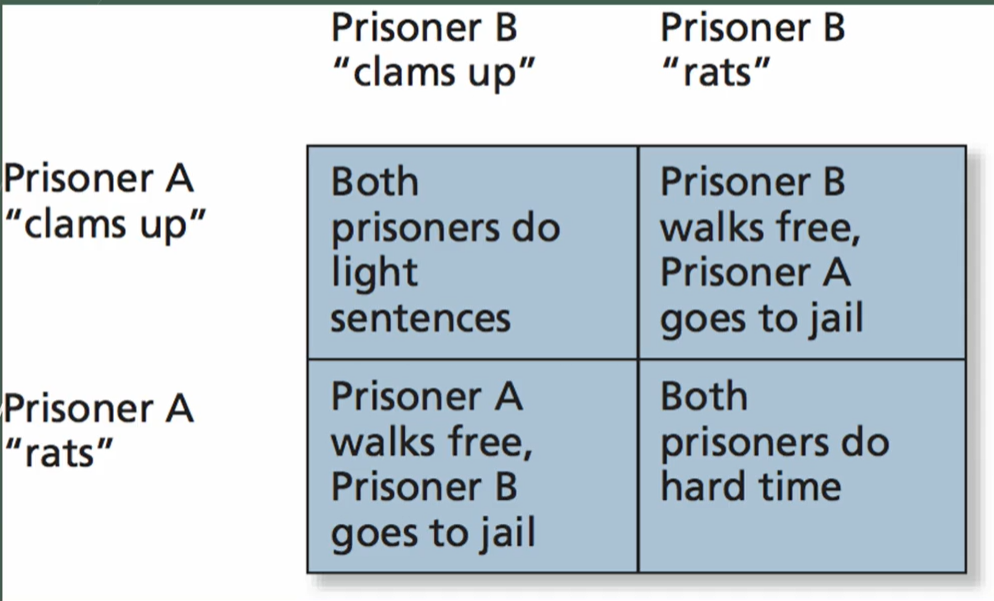
Tragedy of the Commons
how institutions can control human behavior and impact on the environment
also an example of the prisoners dilemma
field and pasture example) farmers benefit when they have more sheep so all farmers add more sheep to a common grazing field. but now theres no grass and no one to regulate the amount of sheep bc its a shared space
the only way to combat this is coercion and enforcement regulations, and privitazation where only the owner would be hurt
Institutions
these are recognized restrictions on behavior
ex) social norms or formal laws
ex) waiting in line or waiting on the traffic lights
What is the biblical tradition?
Can include stewardship and dominion thesis
Gifford Pinchot
Was a utilitarian and conservationist
believed that resources should be used but used responsibility
John Muir
strict preservationist
believed that nature should be left alone 100%
What was the debate over Hetch Hetchy Valley?
pinchot and conservationists believed the river should be dammed so it can provide water to the people
john muir and preservationists believed the river should be left alone so people can enjoy the natural stream, because it had intrinsic value
Aldo Leopold
he included humans in the environment
created moral extensionism
use of the environment is not right or wrong, it is only right or wrong if it is sustainable
Moral extensionism
expands ethics to plants, animals, land, humans, etc.
Examples of successful irrigation
irrigation
wildlife commons and rules around hunters
Problem with the tragedy of the commons
assumes that the people are free and own property
assumes that they are able to execute whatever, make decisions
assumes they can make rules
Global Commons
is it possible to scale up institutions on the global scale