Human Blood and Heart: Anatomy, Physiology, and Clinical Insights
 Call Kai
 Learn
Learn Practice Test
 Spaced Repetition
 Match
Match Flashcards
 Knowt Play
1/195

There's no tags or description
Looks like no tags are added yet.
Name | Mastery | Learn | Test | Matching | Spaced | Call with Kai | Chat |
|---|
No analytics yet
Send a link to your students to track their progress
196 Terms
Monocyte
A type of white blood cell that can differentiate into macrophages and dendritic cells, playing a role in immune response.
Lymphocyte
A type of white blood cell involved in the adaptive immune response, including T cells and B cells.
Eosinophil
A type of white blood cell that fights parasitic infections and is involved in allergic reactions.
Neutrophil
A granulocyte, phagocyte, and the most common white blood cell found in whole blood, primarily responsible for fighting bacterial infections.
Humoral immune response
An immune response that involves the production of antibodies by B cells to neutralize pathogens.
Macrophage
An activated monocyte that engulfs and digests cellular debris and pathogens.
Acute infections
Infections characterized by a rapid onset and often severe symptoms, typically treated by neutrophils.
Plasma osmotic pressure
The pressure exerted by proteins in the plasma that helps to keep fluid in the bloodstream.
Albumin
The main protein in blood plasma, contributing to osmotic pressure and transporting substances.
Fibrinogen
A soluble plasma protein that is converted into fibrin during blood clotting.
Electrolytes
Ions in the plasma, such as sodium, potassium, and chloride, that help maintain fluid balance and nerve function.
Type O blood
The universal donor blood type, which lacks A and B antigens on the surface of red blood cells.
Type AB blood
The universal recipient blood type, which has both A and B antigens and can receive any blood type.
Leukemia
A cancerous condition involving the uncontrolled proliferation of white blood cells.
Anemia
A condition in which blood has abnormally low oxygen-carrying capacity, often due to low red blood cell count.
Thrombocytopenia
A condition characterized by an abnormally low platelet count, leading to increased bleeding risk.
Polycythemia
An abnormal increase in the number of red blood cells, which can increase blood viscosity.
Embolism
The obstruction of a blood vessel by a free-floating thrombus or other material in the bloodstream.
Diapedesis
The process by which white blood cells move out of the bloodstream and into tissues.
Positive chemotaxis
The movement of cells towards higher concentrations of signaling molecules, often in response to infection.
Fibrinolysis
The process of breaking down fibrin in blood clots after healing has occurred.
Hemoglobin
A protein in red blood cells that binds oxygen for transport throughout the body.
Prothrombin activator
An enzyme that catalyzes the conversion of prothrombin to thrombin in the clotting cascade.
Erythropoietin
A hormone produced by the kidneys that stimulates the production of red blood cells in the bone marrow.
Spectrin
A fibrous protein that helps maintain the shape and structure of red blood cell membranes.
Colony-stimulating factors
Proteins that stimulate the production and differentiation of blood cells, particularly white blood cells.
Severe infection
A serious condition caused by the presence of pathogenic microorganisms in the body, leading to systemic inflammation and potential organ failure.
Lipidemia
The presence of excess lipids (fats) in the blood, which can indicate metabolic disorders.
Erythropoietin (EPO) injection effects
You would expect to see increased hematocrit, indicating a rise in red blood cell production.
Colony stimulating factor (CSF) injection effects
You would expect to see increased white blood cell count, as CSF stimulates the production of leukocytes.
Blood viscosity and hematocrit
Viscosity of blood is highest when hematocrit is highest, increasing stress on the heart.
Factors affecting hematocrit percentage
Living at higher altitude would have the least effect on hematocrit percentage compared to other factors.
Sickle cell trait and malaria
People with sickle cell trait have a better chance of surviving malaria, which explains their prevalence in the malaria belt.
Lipids in blood plasma
Lipids are carried in plasma bound to soluble plasma transport proteins, as they are insoluble in water.
Blood type mismatch dangers
A mismatch is dangerous because preformed antibodies in the recipient's blood will bind and agglutinate the donated cells.
Centrifugation of blood
Centrifugation shows that red blood cells have a greater density than white blood cells, causing them to settle at the bottom.
Buffy coat in blood
The buffy coat is thinner than packed red blood cells, reflecting that white blood cells are fewer in number.
Life-threatening blood loss factors
Rapid and substantial blood loss is life-threatening due to loss of blood pressure and loss of oxygen carrying capacity.
Severe dehydration effects
In severe dehydration, you would not expect lower immunity as a direct effect.
Functional characteristics of WBCs
Granulosis is NOT a functional characteristic of white blood cells.
Normal blood pH range
The average normal pH range of blood is 7.35-7.45.
Fetal hemoglobin
The special type of hemoglobin present in fetal red blood cells is hemoglobin F.
Parent cell for blood elements
The parent cell for all formed elements of blood is the hemocytoblast.
Universal donor blood type
The blood type generally called the universal donor is O negative.
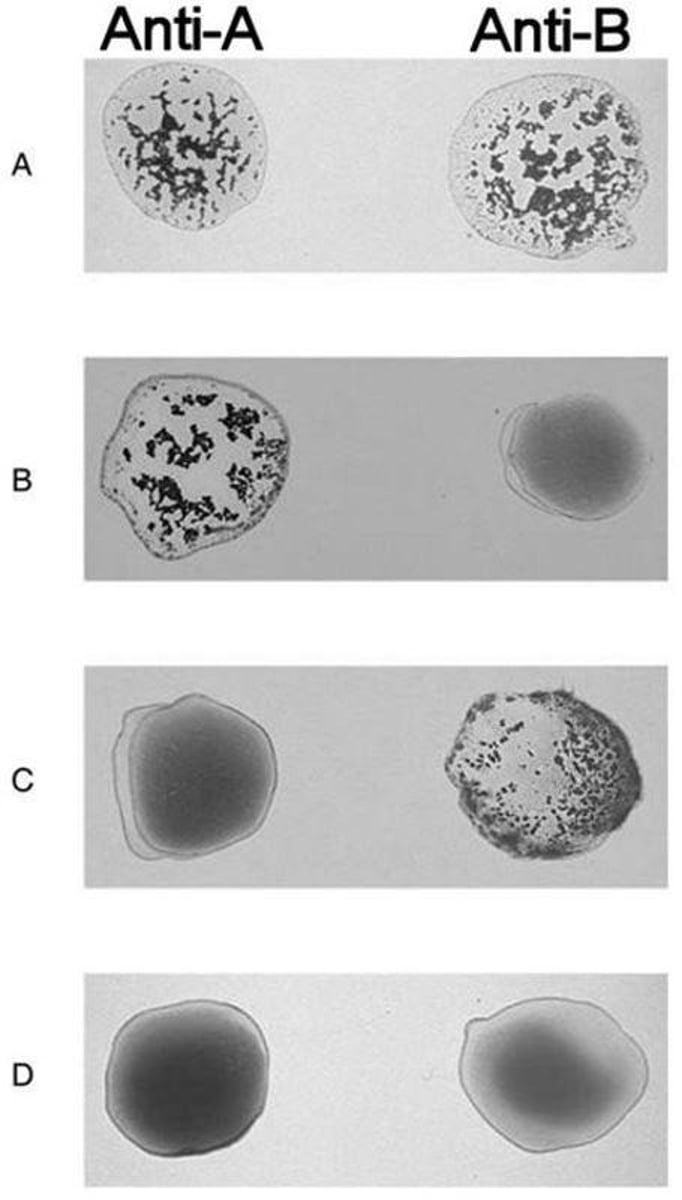
Transfusion reaction in type B blood
If a patient with type B blood receives AB blood, the patient's anti-A antibodies will agglutinate with the A antigens in the donor blood.
Triggers for erythropoiesis
Hypoxia of EPO-producing cells can trigger erythropoiesis.
Blood reticulocyte counts
Blood reticulocyte counts provide information regarding the rate of erythrocyte formation.
Safe blood donation for type A positive
A patient with type A positive blood can safely donate blood to someone with A positive, A negative, O positive, or O negative blood.
Blood type determination
When neither anti-A serum nor anti-B serum clot on a blood plate with donor blood, the blood is type O.
Polycythemia effects
With polycythemia, you would not expect low blood viscosity.
Leukocytes characteristics
Not all leukocytes contain easily recognizable membrane-bound cytoplasmic granules.
What is amoeboid motion?
A type of movement exhibited by certain cells, such as leukocytes, where they extend and retract their cytoplasm to move.
What are membrane-bound cytoplasmic granules?
Granules found within cells that are enclosed by a membrane, often containing enzymes or other substances important for cellular function.
What is the significance of blood volume in transfusions?
Replacing lost blood volume with an isotonic saline solution does not restore the oxygen-carrying capacity of the blood.
What is blood doping?
The practice of increasing red blood cell production or re-injecting stored red blood cells to enhance athletic performance.
What is pernicious anemia?
A type of anemia caused by a lack of intrinsic factor, leading to vitamin B12 deficiency and the production of large pale cells called macrocytes.
What is thrombocytopenia?
A condition characterized by a low number of circulating platelets, which can lead to increased bleeding and bruising.
What are eosinophils?
A type of white blood cell that displays red cytoplasmic granules when stained and is involved in allergic responses and parasitic infections.
What does AB positive blood type mean?
It means the individual has both A and B antigens on their red blood cells and the Rh factor, allowing them to receive blood from any ABO type.
What can cause sickling of red blood cells in sickle-cell anemia?
Factors like high altitude, vigorous exercise, and cold exposure can trigger sickling of red blood cells.
What are megakaryocytes?
Large bone marrow cells responsible for the production of platelets.
What is hemolytic disease of the newborn?
A condition that occurs when an Rh-negative mother has an Rh-positive baby, leading to the mother's immune system attacking the baby's red blood cells.
What organ regulates erythrocyte production?
The kidney produces erythropoietin, which stimulates the production of red blood cells in the bone marrow.
Why is blood considered a connective tissue?
Because it consists of cells suspended in a liquid matrix (plasma) and serves to connect different parts of the body through transportation of nutrients and signals.
What are typical plasma proteins?
Common plasma proteins include albumin, globulins, and fibrinogen, which play roles in maintaining osmotic pressure and immune function.
What blood types can a person with AB blood receive?
A person with AB blood can receive blood from any ABO blood type (A, B, AB, or O).
What happens to monocytes in the interstitial spaces?
Monocytes migrate into interstitial spaces and differentiate into macrophages to fight infection.
What are blood disorders characterized by inadequate oxygen levels called?
These disorders are referred to as anemias.
How many polypeptide chains make up hemoglobin?
Hemoglobin is made up of four polypeptide chains.
What limits normal clot growth?
Factors such as the presence of anticoagulants and the need for clotting to occur only at the site of injury limit normal clot growth.
What are common causes of bleeding disorders?
Common causes include low platelet counts, clotting factor deficiencies, and certain medications.
What are granulocytes?
Granulocytes are a type of white blood cell characterized by the presence of granules in their cytoplasm, including neutrophils, eosinophils, and basophils.
Why is iron not stored in its free form?
Iron is not stored or transported in its free form due to its potential toxicity; it is stored as ferritin and transported bound to transferrin.
What determines the color of blood?
The color of blood is determined by the oxygen saturation; bright red blood indicates high oxygen levels, while dull, dark red blood indicates low oxygen levels.
Why is hemoglobin enclosed in erythrocytes?
Hemoglobin is enclosed in erythrocytes to prevent it from reacting with other substances in the plasma and to facilitate efficient oxygen transport.
What is the buffy coat in centrifuged blood?
The buffy coat is the thin layer of white blood cells and platelets that forms between the plasma and red blood cells after centrifugation.
Why is a red blood cell count important for diagnosing iron deficiency?
A red blood cell count helps assess the number of red blood cells and can indicate anemia, which is often associated with iron deficiency.
What are the extrinsic and intrinsic pathways of blood clotting?
The extrinsic pathway is triggered by external trauma, while the intrinsic pathway is activated by damage to the blood vessel wall.
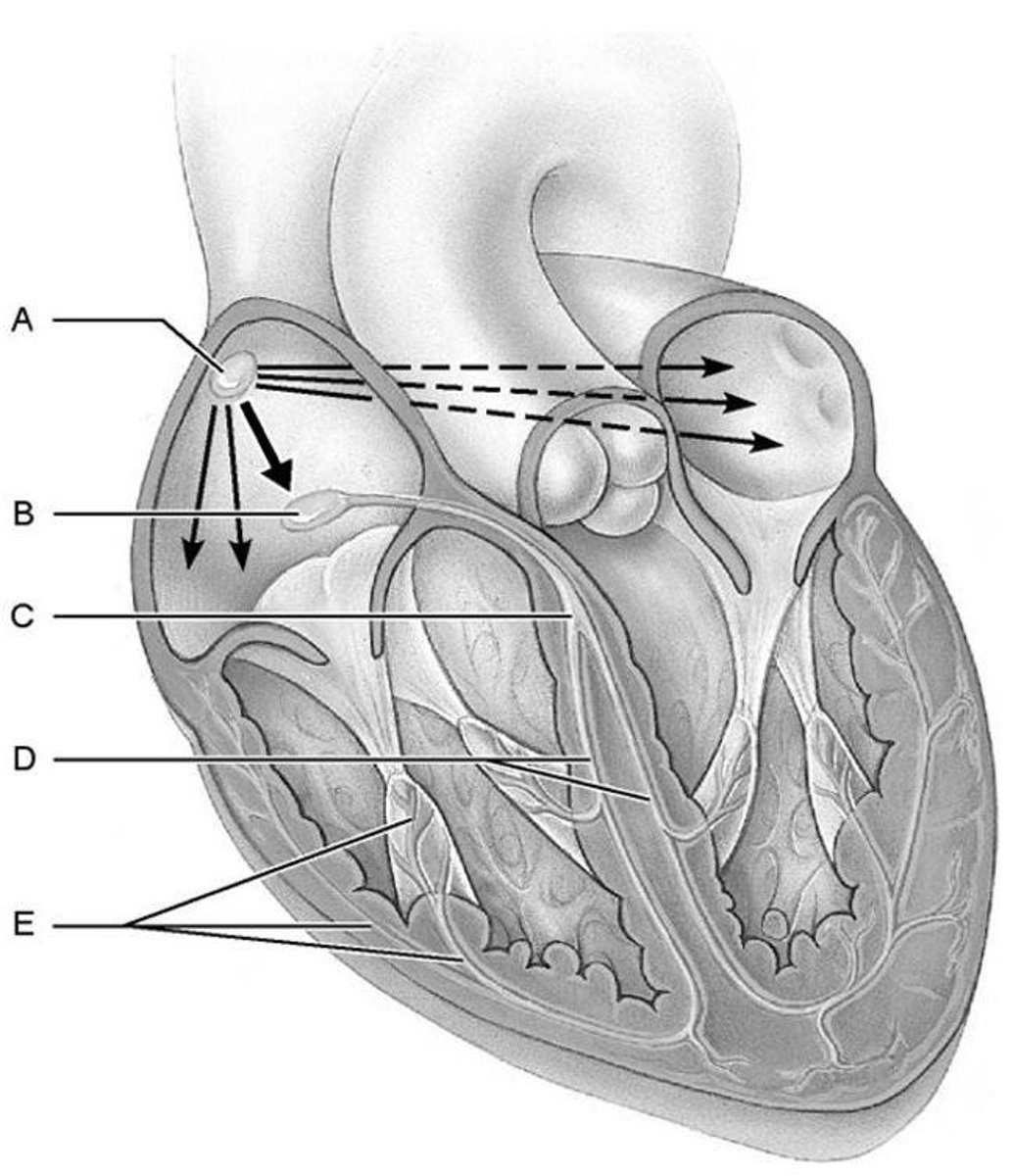
Subendocardial conducting network (Purkinje fibers)
A network of fibers that conduct electrical impulses to the heart muscle, facilitating coordinated contraction.
Sinoatrial (SA) node
The natural pacemaker of the heart, located in the right atrium, responsible for initiating the heartbeat.
Atrioventricular (AV) bundle
A bundle of heart muscle fibers that transmits impulses from the AV node to the ventricles.
Atrioventricular (AV) node
A cluster of cells that receives impulses from the SA node and relays them to the AV bundle.
Bundle branches
The pathways that conduct impulses from the AV bundle to the Purkinje fibers in the ventricles.
Atrial depolarization
The electrical activity that triggers the contraction of the atria.
Point after which pressure begins to rise in the aorta
The point in the cardiac cycle where the left ventricle contracts and blood is ejected into the aorta.
Ventricular repolarization
The process of the ventricles recovering from contraction and preparing for the next heartbeat.
Point that represents the 'dup' sound made by the heart
The closure of the semilunar valves at the end of ventricular systole.
Ventricular fibrillation
A life-threatening heart rhythm that results in uncoordinated contractions of the ventricles.
Second-degree heart block
A condition where some impulses from the atria fail to reach the ventricles, causing dropped beats.
Junctional rhythm
A heart rhythm originating from the AV node when the SA node fails to function.
Normal sinus rhythm
The normal heartbeat rhythm originating from the SA node.
Endocardium
The inner lining of the heart chambers.
Myocardium
The muscular middle layer of the heart responsible for contraction.
Epicardium
The outer layer of the heart wall, also known as the visceral layer of the serous pericardium.
Parietal layer
The outer layer of the serous pericardium that lines the fibrous pericardium.
Bradycardia
An abnormally slow heart rate, typically defined as fewer than 60 beats per minute.
Cardiac reserve
The difference between resting and maximal cardiac output.
Vagal tone
The influence of the vagus nerve on heart rate, promoting a slower heart rate at rest.
Tachycardia
An abnormally fast heart rate, typically defined as more than 100 beats per minute.
Pulmonary semilunar valve
A valve that prevents backflow into the right ventricle from the pulmonary artery.