Endo: IE 1
 Call Kai
 Learn
Learn Practice Test
 Spaced Repetition
 Match
Match Flashcards
 Knowt Play
1/83

There's no tags or description
Looks like no tags are added yet.
Name | Mastery | Learn | Test | Matching | Spaced | Call with Kai | Chat |
|---|
No analytics yet
Send a link to your students to track their progress
84 Terms
What are causes of hyperprolactinemia?
Prolactin-secreting pituitary tumors (adenomas)
Microadenoma <10 mm diameter
Macroadenoma ≥10 mm diameter
Renal insufficiency
Long-term untreated hypothyroidism
Medication induced
Dopamine antagonists
Prolactin stimulators
What are examples of drug-induced hyperprolactinemia?
Dopamine antagonists
Antipsychotics (risperidone/paliperidone)
Metoclopramide (antiemetic)
Promethazine/Prochlorperazine
Methyldopa/reserpine
Benzodiazepines
Opioids
H2 receptor antagonists
Protease inhibitors
Prolactin stimulators
SSRI, TCAs, MAOi
Estrogens/progestin
5-HT1 agonists (Triptans)
Other
Verapamil
What is hyperprolactinemia diagnosis?
Serum prolactin >25 mcg/L
What is hyperprolactinemia medical management?
Medical management
Normalize prolactin level
Restore gonadal function and decrease symptoms
Decrease tumor size
What is drug-induced hyperprolactinemia treatment?
Remove offending agents
Lower risk of antipsychotic-induced hyperprolactinemia with []
Aripiprazole d/t partial D2 agonist effects
→ Switch antipsychotic to aripprazole or ADD aripiprazole
What are dopamine agonists for prolactinoma? What is the dosing?
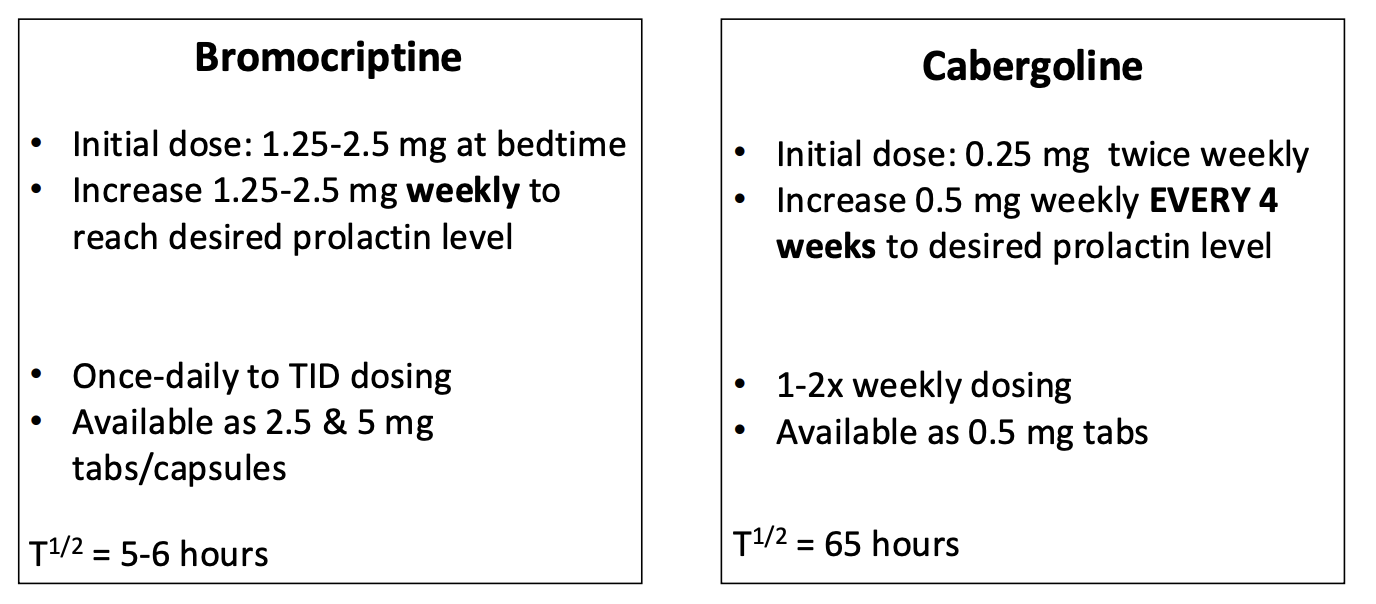
Which dopamine agent for prolactinoma is preferred?
Cabergoline d/t
Better tolerated / fewer side effects
Better efficacy in normalizing prolactin level
Higher frequency of pituitary tumor shrinkage
Restoration of gonadal function / alleviating symptoms of hyperprolactinemia
What are dopamine agonists A.E?
Nausea, constipation, headache, orthostatic hypotension, drowsiness/fatigue
What is baseline monitoring for hyperprolactinemia?
Serum prolactin
Blood pressure (sitting/standing)
Echocardiogram
What monitoring every 4 weeks if for hyperprolactinemia?
Serum prolactin
A.E of medication
Improvement in clinical symptoms
Once there is normal serum prolactin, how often should prolactin be measured?
Every 6-12 months and repeat MRI to measure size of prolactinoma
After 2 years of treatment: normal prolactin; no visible tumor, what should you do?
Discontinue/taper
Repeat serum prolactin every 3 months
Dopamine agonists: Patient counseling
Take with food to reduce GI upset
Take initial dose (bromocriptine) at bedtime due to potential side effect of dizziness, fatigue
Rise slowly (orthostatic hypotension
Do not abruptly discontinue treatment as it may precipitate dopamine agonists withdrawal symptoms (DAWS)
Anxiety/panic attack/insomnia
Depression/fatigue
Sweating
When is surgery indicated for hyperprolactinemia?
Refractory pts or cannot tolerate meds
Large tumors that cause compression of adjacent tissues
What is the most common cause of Cushing’s syndrome?
Exogenous causes
What are endogenous causes of Cushing’s Syndrome?
ACTH dependent → pituitary adenoma → excess ACTH
ACTH independent → adrenal adenomas/carcinomas
Cushing’s syndrome diagnosis
Determine excess cortisol
24 hr urinary free cortisol
Midnight plasma cortisol
Late night salivary cortisol
Dexmethasone suppression test
Determine cause
Serum ACTH lvl
Imaging tests (CT/MRI) for pituitary or adrenal tumor
Preferred treatment for Cushing’s?
Surgical resection of tumor
Drug selection is determined according to []
The etiology of Cushing’s syndrome (ACTH independent or dependent?)
Individual patient factors (gender, ADR of drug, DDI)
Cost
What is the overview of medical management of cushing syndrome?
Steroidogenesis Inhibitors
Ketoconazole
Osilodrostat
Metyrapone
Adrenolytic Agents
Mitotane
Neuromodulator Agents
Cabergoline
Pasireotide
Glucocorticoid Receptor Antagonoists
Mifepristone
Ketoconazole: BBW
Hepatotoxicity
QT prolongation (C/I W/ anti-arrhythmic)
Ketoconazole monitoring frequency
Weekly ALT monitoring
→ Consider discontinuing/decreasing dose if:
ALT values increase above the upper limit of normal (7-56)
ALT values increase 30% above baseline
Patient develops symptoms of liver failure
Ketoconazole: Metabolism
Strong CYP3A4 Inhibitor
DDIs!
Ketoconazole: C/I, Not recommended, Use w/ caution

Ketoconazole AE
Adverse effects:
GI intolerance
Dermatologic reactions (rash/pruritis)
Fatigue; myalgias
Reversible elevation of hepatic transaminases (LFTs)
Anti-androgenic effects (Gynecomastia)
Ketoconazole Monitoring
Cortisol levels (to guide treatment)
Liver function tests
Adverse effects
DDI
Osilodrostat (Isturisa): Indication
Cushing disease treatment
Osilodrostat (Isturisa): ADEs
May cause hypocortisolis
Dose-dependent QTc prolongation
Increased cortisol/aldosterone precursors and androgens
Edema / hypertension / hypokalemia (aldosterone)
Hirsutism / acne (androgen)
Osilodrostat (Isturisa): Monitoring Follow Up
Cortisol (24-hr urinary free cortisol) every 2 weeks until clinical response achieved
Serum potassium and magnesium to prevent HYPOkalemia
EKG (1 week after initiating therapy, as needed afterward)
Blood pressure (may increase so montior!)
Edema
Signs/symptoms of adrenal insufficiency
Pasireotide (Signifor): AE
Hyperglycemia
Bradycardia & QT prolongation
Elevated liver function tests
Cholelithiasis (gallbladder stones)
HA, fatigue
N/V/D
Injection site reactions
Pasireotide: Monitoring at baseline
Blood sugar
Liver function
ECG
Which medications may worsen her elevated BP and lower potassium?
Mifepristone and Olisodrustat
Which medication options to treat Cushing’s Syndrome may increase her blood glucose?
Pasireotide (Signifor)
Pasireotide: Monitoring during treatment
Blood sugar
Liver function
Urine cortisol
Mifepristone (Korlym): Indication
Approved to control hyperglycemia in patients with Cushing’s syndrome who have type 2 diabetes or glucose intolerance
Mifepristone (Korlym): Monitoring
Cushing symptoms
Glucose (is it getting too low?)
Serum potassium (hypoK+)
Pregnancy test
No monitoring of cortisol or ACTH
Mifepristone: DDI
Inhibitor of CYP3A4 > 2C9
Mifepristone: C/I
Lovastatin / simvastatin
Cyclosporine, tacrolimus
Wishing to become pregnant/pregnant
Mifepristone (Korlym): AEs
Adverse effects:
Edema, hypertension, hypokalemia (aldosterone effects)
GI effects
Fatigue, headache, dizziness
Arthralgia
Vaginal bleeding (anti-progesterone effects)
Mifepristone: Counseling
Avoid large amounts of grapefruit juice (due to CYP 3A4)
Hormonal contraception will not work as well while taking this medication; use non-hormonal contraception
Be aware of signs/symptoms of adverse effects:
Hypokalemia (muscle cramps/weakness; irregular heart beat)
Hypoglycemia
Hypofunction of adrenal gland
Primary insufficiency
Addison’s disease
Cortisol/aldosterone deficiency
Secondary insufficiency
Decreased ACTH
HPA-axis suppression from medications
What causes HPA Axis suppression?
Exogenous steroids (Oral, Inhaled, Topical, Intranasal)
Mirtazapine
Progestins (medroxyprogesterone, megestrol)
Adrenal Insufficiency: Diagnosis
Low AM serum cortisol
Elevated serum ACTH
Corticotropin (ACTH) stimulation test
Not affected by diurnal variation
Adrenal insufficiency is when serum cortisol is <[] mcg/dL
18
Adrenal insufficiency treatment
Glucocorticoids
15-25 mg/day hydrocortisone
20-35 mg/day cortisone acetate
3-5 mg/day prednisolone
Mineralocorticoids
Aldosterone deficiency → Fludrocortisione (Florinef)
Once daily in the AM
What is the dosing schedule for adrenal insufficiency?
2 or 3 daily doses
2 doses
2/3 in AM; 1/3 six-eight hours later
15 mg in AM
10 mg in afternoon
3 doses
Decreasing doses
15 mg in AM
5 mg in late AM
2.5 mg in late afternoon
CONTINUE WITH JELENA
What are hormones? What are they secreted by?
Hormones are potent chemical substances secreted by
Specialized organs (glands)
Circulate in blood
Act on specific target cells that are distant from their source of secretion
What are exocrine glands?
Glands that release their secretions into a duct
What are endocrine glands?
Glands that release their secretions directly into blood
T/F: Pancreas and liver mixed glands with both exocrine and endocrine functions
Both exocrine and endocrine functions
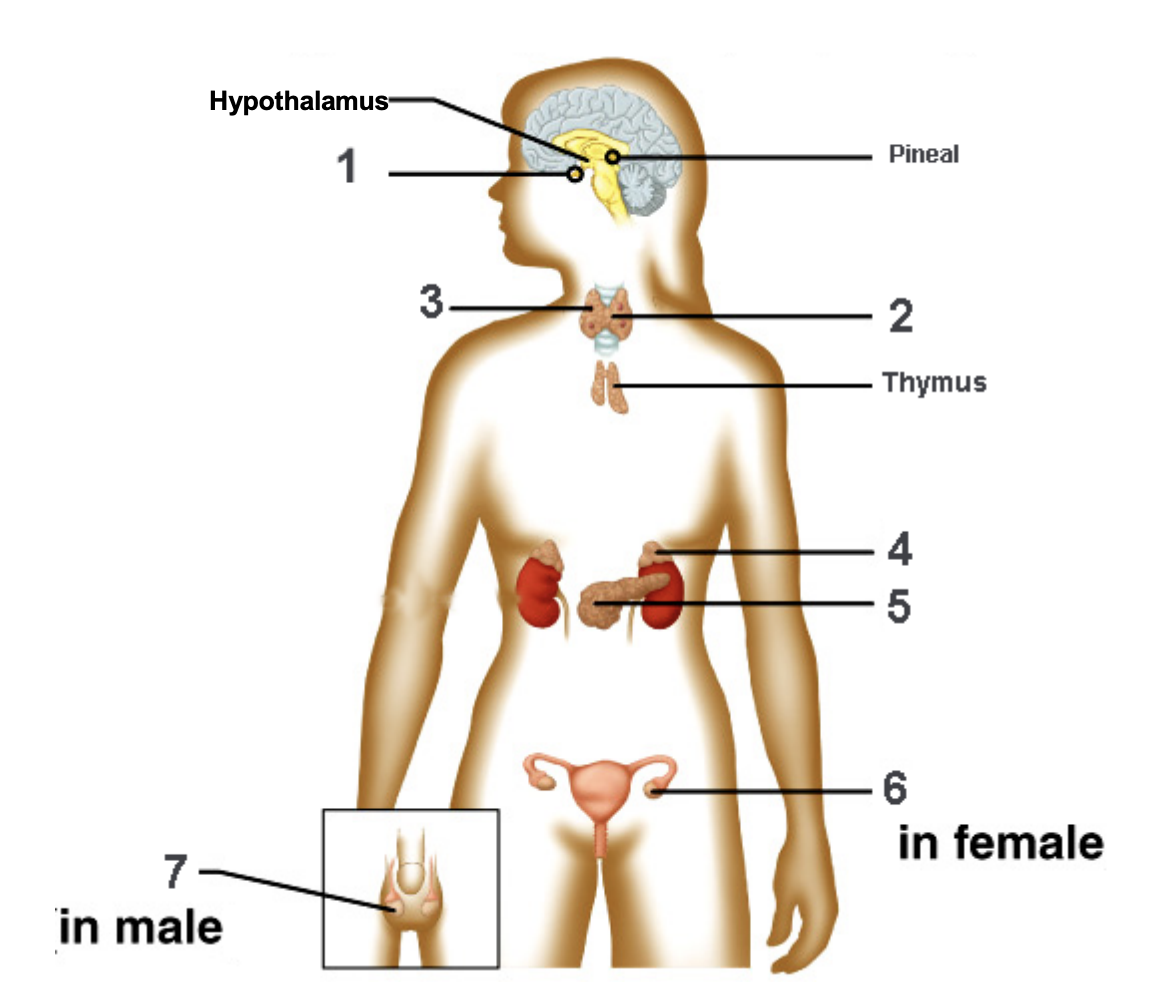
Label these glands, also name the hormones they secrete.
Pituitary gland → GH, ACTH, TSH, FSH, LH, prolactin
Thyroid gland → T3, T4, Calcitonin
Parathyroid gland → PTH
+ 5 Adrenal gland → Cortisol, mineralocorticoid,
Ovaries → Estrogen and progesterone
Testes → Testosterone
[] serves as an interface between neuronal inputs in response to external and internal stimuli and endocrine system. It regulates []
Hypothalamus
Pituitary gland
What does pituitary gland regulate?
Gonads, Thyroid, Mammary gland and Adrenals
GnRH releases []
Gonadotrophs (LH, FSH)
TRH releases []
Thyrotrophs (TSH)
PRH releases [] + GHRH releases []
PRL (Lactotrophs)
GH (Somatrotrophs)
CRH releases []
ACTH (Corticotrophs)
How are hormones categorized based on chemical structures?
Steroid hormones
They contain steroidal nucleus in their structure (e.g. Estradiol, Progesterone, Testosterone, Cortisol, Aldosterone)
Peptides/Proteins hormones
They are made up single or multiple chains of amino acids (e.g. Growth Hormone, FSH, LH, TSH, ACTH, Prolactin, Insulin, Glucagon, Calcitonin, PTH
Amino Acid derivative hormones (e.g Thyroxine, Epinephrine (Tyrosine derivative), Melatonin (Tryptophan derivative))
State where they are hydrophillic or hydrophobic.
Peptides/Proteins hormones
Steroid hormones & Thyroxine
Amino acid derivative thyroxine
Hydrophillic
Hydrophobic
Hydrophobic
Hydrophobic Hormones are []cellular and act via []
Intra
Nuclear receptors → changes in gene expression
Binding of hydrophilic hormones to cell surface receptors can cause activation of:
G-protein, Tyrosine Kinases, Ion Channels thus causing changes in cell signaling to bring about physiological effects
Hydrophobic hormones are bound to []
Plasma proteins e.g steroid binding proteins (SBP), sex hormone-binding globulin (SHBG) thyroxine-binding globulin (TBG)
Only free hormones is available for:
1. []
2. []
Binding to receptor and initiating biological response
Undergoing metabolic inactivation
FINISH SOME SLIDES BEFORE L.O
DONT MEMORIZE ALL PITUITARY HYPOTHALAMUS HORMONES → will come later, not a L.O
Describe the cortex part of adrenal gland histology.
Cortex
Zona Fasciculata which (cells of) secrete…
Glucocorticoid hormones: Cortisol (Hydrocortisone)
Zona Glomerulosa which (cells of) secrete…
Mineralocorticoid hormones: Aldosterone
Zona Reticularis which (cells of) secrete…
DHEA
Describe the medulla part of adrenal gland histology.
Synthesizes and secretes
Epinephrine
Norepinephrine
Describe Physiological Regulation of Glucocorticoid Hormone Cortisol’s Secretion
Hypothalamic Pituitary Adrenal Axis:
Hypothalamus → CRH → ACTH → Acts on Zona fasiculata → Cortisol synthesis + releases
Describe Negative Feedback Loop in HPA Axis
As the plasma cortisol levels increase, cortisol inhibits the release of CRH & ACTH
When are peak plasma levels of ACTH & Cortisol?
In the morning
Lowest at midnight
What are sampling times for diagnostic tests of Cushing syndrome?
Midnight plasma cortisol
Late night salivary cortisol
Cortisol causes its physiological effects by binding to [] receptors. What happens as a result?
Glucocorticoid receptor → conformational change + change in gene expression → Metabolism of glucose, lipids, amino acids → increased blood glucose
Cushing’s Syndrome is [] overproduction
Cortisol + aldosterone
Addison’s Disease is deficiecy of [] + []
Cortisol and aldosterone
What is the etiology of Cushing’s Syndrome
ACTH (ACTH-dependent Cushing’s syndrome) secreting tumors (adenoma)
Cortisol (ACTH-independent Cushing’s syndrome) secreting tumors (adenoma)
Iatrogenic cause of Cushing’s syndrome (caused by steroid intake)
Will the plasma levels of ACTH and cortisol in patients with ACTH-Iindependent Cushing’s syndrome be higher or lower than the normal physiological values?
ACTH: Lower d/t negative feedback loop
Cortisol: Higher
Cushing’s Syndrome: Signs & Symptoms
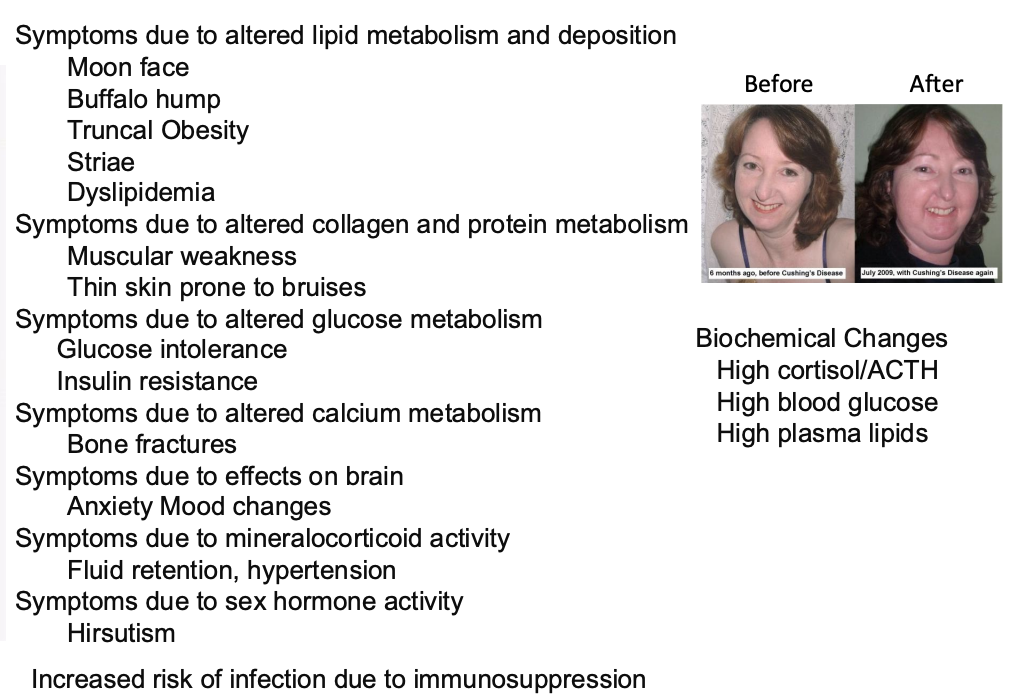
Cushing’s Syndrome Management
If resection is not possible
Preoperative treatment to decrease circulating cortisol levels
Postoperative treatment while waiting for the beneficial effects of surgery
What are the drugs for Cushing’s syndrome?
Steroidogenesis Ihibitors
Osilodrostat, Ketoconazole
Adrenolytics
Mitotane
Glucocorticoid-RA
Mifepristone
Neuromodulators of ACTH release
Cabergoline, Paeriotide
Olisodrostat increases or decreases cortisol?
Decreases
Mifepristone increases or decreases cortisol?
Stays the same
Only inhibits the effects of cortisol
Mitotane MOA
Mitotane → Acyl Chloride → Protein denaturation → Cell death → Less cortisol
Mifepristone AE
Mifepristone also acts as antagonist of progesterone receptors causes endometrial thickening with or without vaginal bleeding abortifacient at high doses (thus pregnancy test before starting) increases ACTH and cortisol levels