STORAGE AND DELIVERY OF MEDICAL GASES (CHAPTER 41)
 Call Kai
 Learn
Learn Practice Test
 Spaced Repetition
 Match
Match Flashcards
 Knowt Play
1/64

There's no tags or description
Looks like no tags are added yet.
Name | Mastery | Learn | Test | Matching | Spaced | Call with Kai | Chat |
|---|
No analytics yet
Send a link to your students to track their progress
65 Terms
Produced by filtering and compressing atmospheric air
How is medical grade air produced?
78% nitrogen, 21% oxygen, and the rest is trace gases
What is the makeup of air?
non-flammable; combustion
Air is ______ (flammable/non-flammable) but supports ______.
False- O2 is slightly heavier than air
True or False: Air is heavier than Oxygen
Hypoxemia
What is the primary use for treatment with O2 therapy?
860x
How much does O2 expand when converted from a liquid to a gas?
1. FD filters, compresses, and boils off everything but O2 to keep it in a liquid state.
2. It allows easy storage of O2 in large quantities.
1. What is fractional distillation?
2. Why is this method used by hospitals?
1. Separated by a molecular sieve and a semipermeable membrane
2. An O2 concentrator
1. How is O2 physically separated?
2. What equipment would be an example of this preparation method?
Cylinders
Bulk Systems
What two ways is compressed air available?
small portable compressors
At home, patients may use ______ ______ ______ to power nebulizers or other respiratory equipment.
1. Sub-ambient oxygen is when O2 levels in atmospheric air has a lower-than-normal oxygen concentration (Ex: high altitudes)
2. Used for certain heart defects
1. What does "sub-ambient" oxygen mean in relation to oxygen and hypoxemia?
2. What condition can sub-ambient oxygen be used for?
1. Fractional distillation and physical separation
2. FD is for preparing and storing larger quantities, while physical separation is for small quantities of O2.
1. What are the methods for preparing O2?
2. What's the difference between them?
1. Used as a calibration gas for blood gas analyzers, transcutaneous monitors, and capnographs.
2. Used to prevent CO2 washout in bypass / ECMO
3. Also used in Pulmonary Function Tests and possibly for hiccups (singultus)
1. What is the most common use for carbon dioxide?
2. How is CO2 used in patients on bypass?
3. List one more use of CO2
Carbon Dioxide does not support life- CO2 must be combined with O2 for patient administration.
What is vital to remember when administering CO2 for patient use?
CO2 is non-flammable and does not support combustion
Is CO2 flammable and/or combustable?
CO2 is 1.5 times heavier than air
How many times heavier is CO2 than air?
Prepared from natural gas or by heating uranium ore
How is Helium prepared?
1. Helium is very light
2. Helium is combined with O2 and can then carry medications past the obstruction
1. What physical property of helium makes it useful in treating severe airway obstructions?
2. How would helium be used to treat a severe airway obstruction?
Also used in pulmonary function testing
Besides its use in severe airway obstructions, how else can Helium be used?
Helium does not support life - must mix with O2 (Heliox)
Before administering Helium to a patient what must be considered?
Nitric Oxide (NO)
Which gas is being described below?
-Can be toxic but is a powerful pulmonary vasodilator
-Nitrogen Dioxide byproduct
-Combined with O2 to use in the treatment of Persistent Pulmonary Hypertension of the Newborn (PPHN) and hypoxic respiratory failure in infants and Adult Respiratory Distress Syndrome (ARDS) (off label)
-Non-flammable but supports combustion
-Expensive
Persistent Pulmonary Hypertension of the Newborn (PPHN)
Nitric oxide is FDA-approved to treat....
Nitric Oxide (NO)
Which gas is a powerful pulmonary vasodilator (can be toxic)?
Anesthesia and pain management
What is the most common use for Nitrous Oxide (NO2)?
Nitrous Oxide (NO2)
Which gas is being described below?
-Used as a mild to moderate anesthetic, induction
-Non-flammable but supports combustion, slightly sweet odor and taste
-Must be combined with O2, does not support life
-Upper exposure limit
2000-2200 psi
*Normal filling pressure is 2000, but is safely exceeded by 10% (2200psi)
*For all sizes!
What is the range for filling pressure of gas cylinders?
High quality carbon steel
Steel alloys
Aluminum
What are the 3 materials that gas cylinders can be made with?
1. Every 5-10 years
2. water ; 5/3
1. How often do gas cylinders need to undergo hydrostatic testing?
2. Hydrostatic testing involves filling the cylinder with ______ and increasing the pressure to ______ of its service pressure.
Air- yellow
Which gas would you presume is in this cylinder?

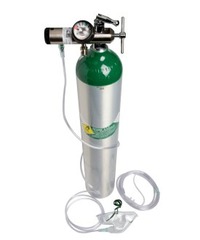
Oxygen- green
Which gas would you presume is in this cylinder?
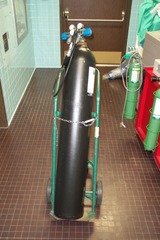
Nitrogen- black
Which gas would you presume is in this cylinder?
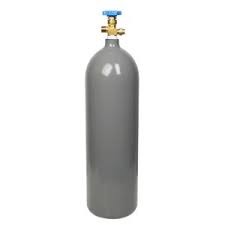
Carbon Dioxide - gray
Which gas would you presume is in this cylinder?
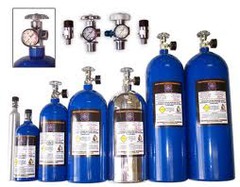
Nitrous Oxide - light blue
Which gas would you presume is in this cylinder?
Helium - brown
Which gas would you presume is in this cylinder?

Nitric Oxide - silver
Which gas would you presume is in this cylinder?
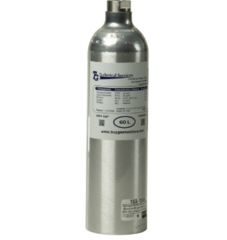
Helium/Oxygen (Heliox)- brown and green
Which gas would you presume is in this cylinder?
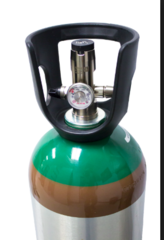
1. Food and Drug Administration (FDA) regulates purity of medical gases
2. National Formulary dictates "recipe"
3. Department of Transportation (DOT) regulates manufacture, storage, and transport of compressed gases
1. Which organization regulates the purity of medical gases for gas cylinders?
2. Which organization dictates the "recipe" for gas cylinders?
3. Which organization regulates manufacture, storage, and transport of compressed gases?
-Always check the label of the cylinder to ensure the contents- never rely on the color
-Cylinders must be properly secured at all times - chained or in a cart or stand
-Full and empty cylinders must be kept separate
-Caps must be in place on large cylinders when being moved
-Valves should be fully open when cylinder is in use, and closed if not in use
Give 5 gas cylinder safety rules
1. All cylinders have a pressure relief valve located in the valve stem that responds to either pressure or heat (fire)
2. Cylinder Connector Safety Systems
CYLINDER SAFETY SYSTEMS:
1. Which safety feature on gas cylinders responds to pressure and/or heat?
2. Which system was developed to prevent the delivery of the "wrong" gas? (Includes ASSS and PISS)
1. American Standard Safety System (ASSS)
2. It utilizes different thread sizes.
1. Which safety system is used for large cylinders (G, H, and K)?
2. How does this safety system prevent error?
1. Pin Index Safety System (PISS)
2. It utilizes yoke connections with pins that fit into indexed holes on the valve stem.
1. Which safety system is used on small cylinders (E and below)?
2. How does this safety system prevent error?
They are used to reduce high pressure gases to a "working" pressure of 50 psi
What do reducing valves do?
regulator
*Typically also allows you to monitor how much gas is in the cylinder
*Include pressure relief "pop-off" as a safety feature
Reducing Valves:
Gases in cylinders must have the pressure reduced to the 50 psi working pressure, and are typically combined with a flowmeter and referred to as a....
Liquid Systems
What is the most common way hospitals store oxygen?
-183 degrees Celsius
Liquid Systems:
At what temperature must oxygen remain in order to stay below its boiling point?
1. Oxygen is easier and cheaper to transport, and it consumes less space in a liquid state.
2. Liquid containers are insulated like a thermos bottle to maintain the liquid state; O2 leaves the container through a series of coils that allow it to become gas.
1. What are the advantages of keeping oxygen in a liquid state?
2. Explain how the anatomy of the liquid container allows for both maintenance as a liquid and for the eventual change to a gas.
1. Portable units are filled from stationary "base" units
2. This system is best for mobile O2 dependent patients or home care patients that require a lot of oxygen
Portable liquid systems may be used in home or for hospital transports.
1. How are these portable systems filled?
2. Which patients would this system benefit?
Piping
______ systems carry gas to the bedside or other areas that utilize gases.
◦ 50 psi maintained to outlets
◦ Analyze gas at station outlets with new construction
1. Zoning
2. ◦Clearly labeled accessible shut-off valves
◦ Alarm panels with audible and visual signals
1. Which component of piping systems allows areas to be isolated in case of a fire?
2. What safety features are utilized for this system?
Station (Wall) outlets
*Each station should be color coded and labeled
Which outlets provide connections for gas delivery devices (flowmeters, ventilators), and have check valves that open when a device is inserted and automatically closes when it is removed?
1. Diameter Index Safety System (DISS) and Quick Connects
2. Both used to prevent connection of incompatible devices.
1. Name 2 safety systems utilized for station/wall outlets.
2. What is the purpose of these systems?
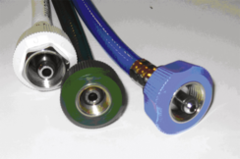
Diameter Index Safety System (DISS)
Which safety system uses non-interchangeable threaded fittings as shown in the picture?
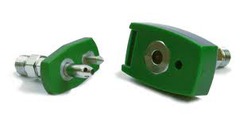
Quick Connects
Which safety system uses a plunger/spring system that are not interchangeable (many types) as shown in the picture?
Flowmeters
____________ further reduce the 50 psi pressure from the wall outlet or reducing valve; as well as provide control of flow rate of gas to the patient or device (liters per minute).
Thorpe Tube flowmeter (most common type)
Bourdon Gauge
Low flow flowmeters
High flow flowmeters
What are the 4 types of Flowmeters?
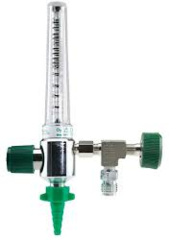
Thorpe Tube flowmeter
Which Flowmeter is being described below?
-Most common
-Uses a vertical tube and a ball float with an adjustable knob (needle valve)
-Gravity dependent meaning it must stay upright
-Standard adjustable from 0-15 L/min in .5 to 1.0 L increments; can achieve 30+ L/min on "flush"
- "pressure compensated" meaning it should be accurate with back pressure
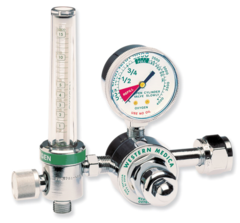
Bourdon-gauge flowmeter
Which Flowmeter is being described below?
-Is not gravity dependent, functions in any position
-Converts a pressure gradient into a flow
-Generally combined with a pressure reducing valve so it comes as a regulator
-Back pressure may result in lower actual flow than reading indicates
Used for precise administration of low flow O2 to patients with chronic lung disease or neonates
What is the purpose of a low flow flowmeter?
Used to power CPAP units or tents
What is the purpose of a high flow flowmeter?
Most common type is the molecular sieve
What is the most common type of O2 concentrator device?
1. To produce oxygen from atmospheric air.
2. They suck in room air and push it through sodium-aluminum silicate pellets to absorb nitrogen.
3. O2 concentrators provide 85-92% oxygen at flows of 1-6 L/min
1. What is the purpose of an oxygen concentrator?
2. How do O2 concentrators work?
3. What is percentage range and flow rate that O2 concentrators provide?
O2 Concentrators Devices
Which type of device is typically used in home care settings and works to produce oxygen from atmospheric air?
1. Size of cylinder, cylinder pressure, and gas flow needed for device
2. Cylinder factor = 3.14
3. Cylinder factor= .3
1. What are the varying factors used when determining how long a cylinder will last?
2. What is the cylinder factor used for H and K cylinders?
3. What is the cylinder factor used for E cylinders?
Cylinder pressure (psi) x Cylinder factor / flow = duration of flow in minutes
What is the equation used for determining how long a cylinder will last?
*You have to know the weight (in lbs.) of the liquid in the system
-1L of liquid O2 weighs 2.5 pounds; produces 860 L of gaseous O2
1. Liquid O2 weight (lbs) x 860 / 2.5 = amount of liquid gas in unit (in liters)
2. Amount of liquid gas in unit (L) / flow rate of device = duration of gas in minutes
How do you determine how long a portable liquid system will last?