Slide Deck 2: Hallmarks of Cancer a Cancer Cell
 Call Kai
 Learn
Learn Practice Test
 Spaced Repetition
 Match
Match Flashcards
 Knowt Play
1/40

There's no tags or description
Looks like no tags are added yet.
Name | Mastery | Learn | Test | Matching | Spaced | Call with Kai | Chat |
|---|
No analytics yet
Send a link to your students to track their progress
41 Terms
What was proposed as a set of functional capabilities acquired by human cells as they transformed from normalcy to neoplastic growth states (crucial for forming malignant tumors)?
Hallmarks of Cancer
Sustain Proliferative Signaling
What is an oncogene?
a gene whose product protein is involved in transforming cells in tissue culture or in inducing cancer in animals
most oncogenes are mutant forms of normal genes in control of cell growth/division
AKA: mutated gene with the potential of causing cancer.
What are two prominent examples of oncogenes?
EGFR (epithelial growth factor receptor) and Ras signaling
What is among the most common genetic alterations detected in human cancer? (also classified as a cancer driver mutation)
Oncogenic (mutant) Ras proteins [hyper-activated forms of Ras]
What is Ras signaling important for?
cell proliferation, survival, and differentiation
Ras represents a gene/protein that when activated, commits a cell to ____-phase (DNA synthesis) of cell cycle when it should normally abort and undergo a____.
S-phase
Apoptosis
What are the three different types of Ras proteins, and what isoform do mutations bias?
H, K, N
K-Ras
Simplified Ras Signaling Pathway
What are the first (of 3) step(s) in the pathway?
EGF binds to EGFR —> triggers signaling through the RAS-BRAF-MEK-ERK/MAPK pathway to several targets —> cell activation processes begin —> oncogene activation

Simplified Ras Signaling Pathway
What are the second (of 3) step(s) in the pathway?
Therapeutic mAbs (anti-EGFR) target the EGFR —> EGF binding is prevented —> EGFR signaling is deactivated in patients with WILD TYPE KRAS
great way to stop Ras signaling
Anti-EGFR mAb examples: cetuximab (Erbitux) and panitumumab (Vectibix)

Simplified Ras Signaling Pathway
Anti-EGFR monoclonal antibodies are not therapeutically efficacious in patients with which mutation?
KRas G12C mutations (one of the most frequent mutations)
position 12 of the protein has changed from glycine (G) —> cysteine (C)
mutated KRas still provides cellular signals (causing unchecked tumor growth) despite EGFR blockade with mAbs
Therapeutics Targeting EGFR-RAS Signaling
P______ (____)
C_____ (____)
Indication for both (hint: same):
Administration:
Not recommended for this patients with:
Why?
Patients receive this in advance before treatment:
Panituximumab (Vectibux)
Certuximab (Erbitux)
colorectal cancer (mCRC)
IV infusion with FOLFOX REGIMEN (Folinic acid, Flurouracil, Oxaplatin)
Mutations (in 40% of patients)
associated with poor prognosis and lack of response to anti-EGFR treatment
Genotype test (tissue biopsy)
True or false: Patients with wild-type KRas respond better clinically to anti-EGFR treatment than mutant KRas patients.
True
KRas Mutation Treatment
What 2 covalent inhibitors of the KRas G12C mutation were approved by the FDA?
Sotorasib (Lumakras)
Adagrasib (Krazati)
Kras Inhibitors
How often are sotorasib and adagrasib dosed?
Which drug was the first-in-class, breakthrough drug?
What are the indications for both (hint: the same)?
Are these first or second line?
Combining what 2 inhibitors results in significant and durable responses?
Sotarasib—>QD; adagrasib—>BID
Sotorasib
as a COMBO for locallly advanced/metastatic CRC in patients who received prior systemic cancer treatment and harbor the G12C mutation (SECOND LINE THERAPY)
EGFR and Kras inhibitors (less chance of resistance to Kras inhibitor, and EGFR gets blocked too)
soto + panit
ada + certux
Kras Inhibitors
Why does sotorasib and adagrasib inhibit G12C and not wildtype Kras?
The C12 Mutation: Wildtype KRAS has a glycine (G) at position 12, a small amino acid that lacks a reactive side chain. The G12C mutation substitutes glycine with a cysteine (C), introducing a nucleophilic thiol group.
The Warhead: Inhibitors feature a reactive chemical group (a Michael acceptor) that specifically attacks and forms a permanent covalent bond with the thiol group of the newly introduced cysteine at position 12. [1, 2]
Lack of Target on Wildtype: Because wildtype KRAS has a glycine instead of a cysteine at this position, the drug cannot form this covalent attachment.
This is the most recent FDA approved drug (as of August 2026) that treats metastatic pancreatic cancer.
Daraxonrasib (Raxonque)
inhibits Ras superfamily proteins
oral RAS(ON) multiselective, tri-complex inhibitor
True or false: Developing a rash while taking EGFR inhibitors is indicative that treatment isn’t working and should be discontinued shortly thereafter.
False - rashes are associated with better outcomes and higher response rates.
Evading Growth Suppressors (Inactivate Tumor Suppressor Genes)
Cancer cells inactivate Retinoblastona suppressor (Rb) protein. What does the tumor suppressor protein Rb do?
acts to control whether cells enter the S phase (DNA synthesis) or stay in a safer resting state
Cyclins and Cyclin Dependent Kinases (CDKs)
What checkpoint is the primary regulator of the cell cycle and is essential for advancement of malignant tumors? What is this checkpoint regulated by (give the protein and enzyme)?
G1/S checkpoint
Protein: cyclin D; Enzyme: (cyclin dependent kinases) CDK 4/6
Kinases are types on enzymes that add chemical pieces (phosphates) to other molecule in the body.

Cyclins and Cyclin Dependent Kinases (CDKs)
Cyclin-CDKs regulate cell cycle by p____ target proteins.
Phosphorylating
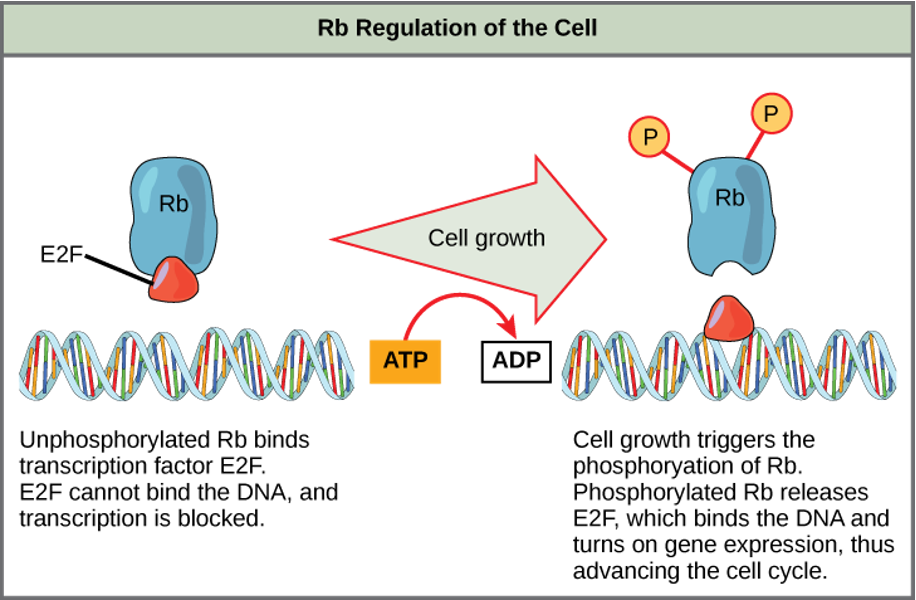
Rb Regulation of the Cell
A primary function of Rb is to act as a tumor suppressor protein and bind to and inactivate ____ transcription factors. These factors are important proteins that bind DNA and activate genes controlling the cell cycle and DNA replication (including cyclins and CDKs specific to G1 and S phases of the cell cycle.
Rb keeps the cell in check by turning gene expression. In cancer cells, hyper-__ of Rb by CDK/cyclin inactivates Rb which releases ___, which acts as a transcriptional activator, and gene expression is turned on.
E2F
phosphorylation
E2F
this is one way a cancer cell turns off tumor suppressor proteins
What drug prevents Rb (retinoblastoma suppressor protein) from undergoing hyper-phosphorylation? What is it’s MOA?
Palbociclib (Ibrance)
first-in-class
selective inhibitor
Indication: breast cancer + others
Inhibits the CDK that catalyzes Rb’s phosphorylation (which deactivates Rb, leading to the release of E2F that activates gene expression)
Resisting Cell Death (Apoptosis)
True or false: Cancer cells turn on apoptotic signals.
False. In many cancers, anti-apoptotic proteins are over-expressed.
Reminder: apoptosis is programmed cell death
We want cancer cells to commit apoptosis. What structural part of the cell does this happen in? (Hint: cytoplasm, vesicles, etc…)
Mitochondria

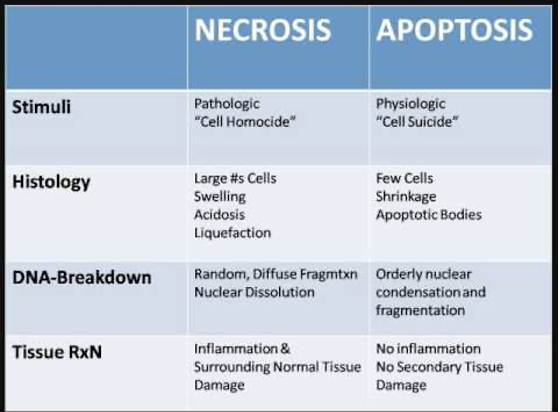
Not a question. These graphics show the differences between cell necrosis and apoptosis.
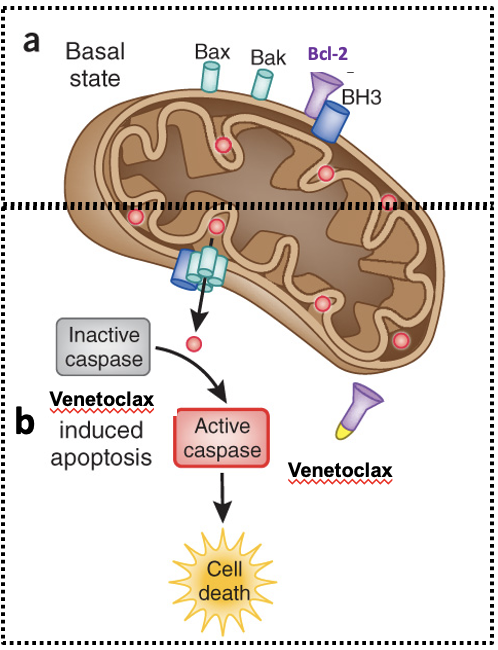
Pro-apoptotic Bcl2 Inhibitor-BH3 Mimetic
Not a question.
(a) Top: in the basal state, pro-apoptotic triggering proteins in the mitochondria outer membrane (Bax and Bak light blue) are monomeric and BH3 proteins (blue) are tied up with Bcl-2 (purple).
Cytochrome c (red circles) is retained in the mitochondria. Bcl-2 is inhibiting apoptosis in this state.
(b) Bottom: in cancer cells Bcl-2 is overexpressed--drugs like Venetoclax (yellow) bind to Bcl-2 causing it to dissociate from BH3 proteins. The BH3-protein now can induce oligomerization of Bax and Bak, leading to large pore formations. Cytochrome c exits mitochondria through the newly created pore and triggers caspase activation, leading to apoptosis.
BCL-2 is a key protein that helps control whether a cell lives or dies by blocking programmed cell death (apoptosis).
Apoptosis Inducer
This drug is approved for treatment of patients with chronic lymphocytic leukemia (CLL) or small lymphocytic lymphoma (SLL) with or without 17p deletion, following at least one PRIOR therapy. This deletion involves the loss of the TP53 tumor suppressor gene.
What is the route and administration suggestion?
What are the 3 warnings/precautions?
Venetoclax (Venclexta)
Oral and with food/water
Tumor Lysis Syndrome (TLS), Neutropenia, Infections
Enabling Replicative Immortality
What does senescent mean? Do cancer cells have this ability? Explain.
Senescent —> lost ability to divide
Cancer cells are not senescent. They never lose their ability to divide. Senescence is caused by a loss of telomerase activity, but cancer cells reactivate telomerase and become immortal.
True or false: Shorter telomere length is associated with immortalized cell lines such as embryonic stem cells and cancer cells.
False. However, as cells divide and differentiate throughout an organism’s lifetime, telomeres progressively shorten.
Random reminder: telomeres are repeating sequences of ds-DNA at the end of chromosomes
What is telomerase?
A reverse transcriptase that lengthens telomeres by adding on repeating sequences of DNA by using a hairpin RNA as a template.
Telomere maintenance and high telomerase activity is a hallmark in over 90% of cancers

What is the MOA of Rytelo (imetelstat)?
Define angiogenesis.
New blood vessel growth; vascularization
Inducing Angiogenesis
What do angiogenesis inhibitors do?
block key growth factors/their receptors involved in promoting angiogenesis or block angiogenic signaling pathways
cancerous tumors seek blood that carries nutrients and oxygen —> therefore, create new blood vessel growth
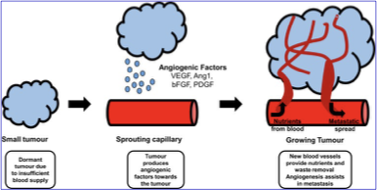

Avastin (b_____) is an angiogenesis inhibitor. It is used off label of AMD. What are the 3 boxed warnings?
Bevacizumab
GI perforation in 3% patients
Surgery/wound healing complications
Hemorrhage
Activating Invasion and Metastasis
Not a question. Just a graphic about the metastatic cascade.
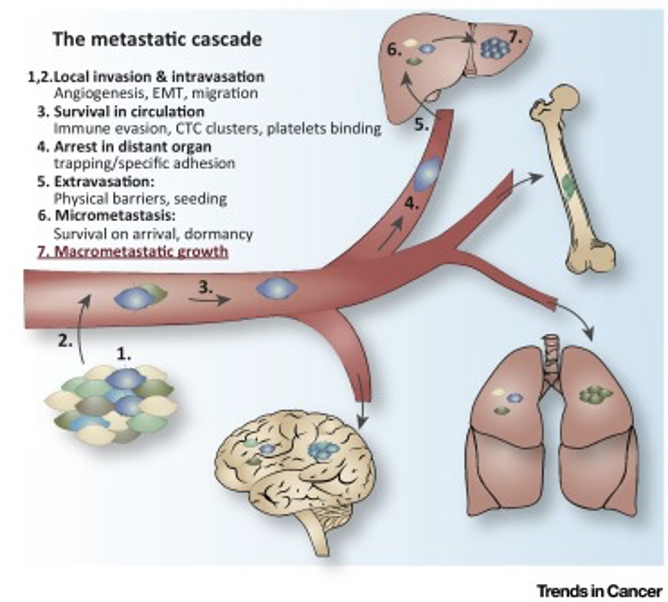
1.2.: Local invasion and intravasation
Survival in circulation
Arrest in distant organ
Extravasation (leakage)
Micrometastasis
Macrometastatic growth
Patterns of Metastatic Spread of Solid Tumors
Which cancer has short latency, aggressive disease course, and multi-organ metastasis?
Which cancer often develops osteolytic bone metastases?
Which cancer has sequential metastasis?
Which cancer has long latency, and a strong preference for bone metastasis?
Lung
Breast
Colon
Prostate

What pathway is strongly associated with metastasis?
HGF/c-Met pathway
over-expressed, activated, amplified, or mutated in a wide variety of solid tumors

This drug is:
indicated for metastatic medullary thyroid cancer (mMTC)
a potent inhibitor of c-Met (anti-metastatic) and VEGFR2 (anti-angiogenic)
marked for boxed warnings like other VEGF blockers
Cometriq (cabozantinib)
Genome Instability and Mutation
What concept (2 words) do PARP inhibitors and BRCA mutations demonstrate? Why?
Synthetic lethality. PARP inhibitors lead to cancer cell death in only BRCA patients (lacking HR repair pathways).
Synthetic lethality: killing two pathways, so that cancer cells cannot find alternative way to repair itself
Avoiding Immune Destruction
What are the two targets of immunotherapy?
CTLA-4 and PD-1
CTLA-4 and PD-1 pathways are immune checkpoint pathways
that play critical roles in controlling T-cell immune responsesT-cells can become unresponsive after CTLA-4 binds B7 molecules on APC (antigen-presenting cell),
or when PD-1 binds PD-L1 or PDL-2 on target cells
Which drugs (2) are PD-1 inhibitors?
Opdivo (nivolumab)
Keytruda (pembrolizumab)
Tumor/tissue agnostic drugs
