Non-Enteric Bacteria
 Call Kai
 Learn
Learn Practice Test
 Spaced Repetition
 Match
Match Flashcards
 Knowt Play
1/39

There's no tags or description
Looks like no tags are added yet.
Name | Mastery | Learn | Test | Matching | Spaced | Call with Kai | Chat |
|---|
No analytics yet
Send a link to your students to track their progress
40 Terms
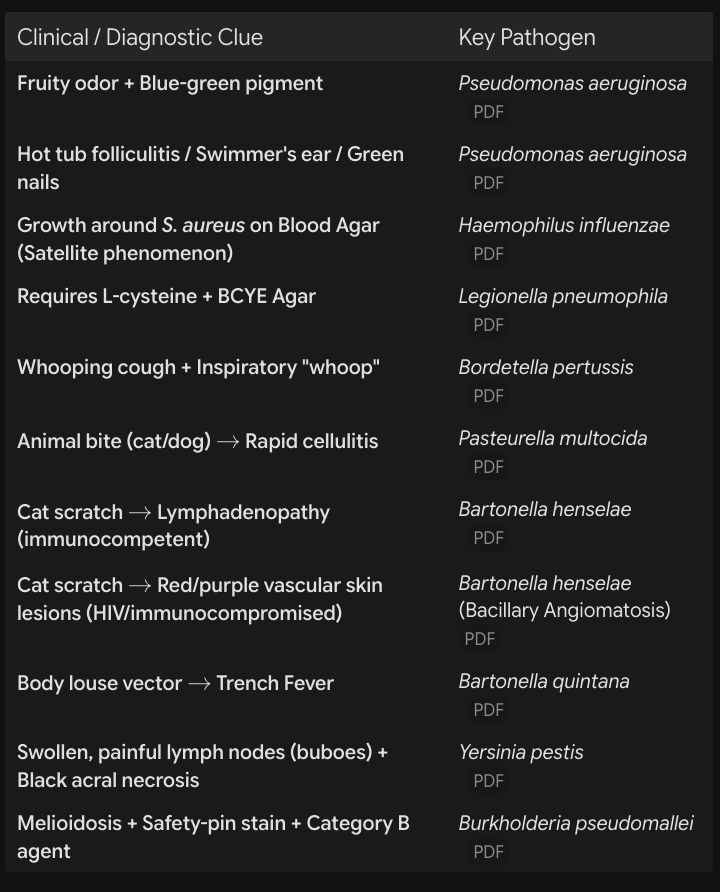
T or F? Pseudomonas aeruginosa is part of normal flora of skin.
True
Most Common Multi-drug resistant (MDR) pathogens?
ESKAPE
E — Enterococcus faecium
S — Staphylococcus aureus
K — Klebsiella pneumoniae
A — Acinetobacter baumannii
P — Pseudomonas aeruginosa
E — Enterobacter spp.
What are the two growth forms of Pseudomonas aeruginosa, and how do they differ in motility?
Free-swimming (single cells): Motile via a single polar flagellum.
Biofilm: A community enclosed in a slime layer attached to surfaces, which periodically releases free-swimming single cells.
Name three water-soluble pigments produced by Pseudomonas aeruginosa and their characteristics.
Pyocyanin: Blue-green pigment; destroys competing microbes and supplies nutrients.
Pyoverdin: Yellow-green fluorescent pigment.
Pyochelin: Red-brown pigment; acts as a siderophore to scavenge iron.
What temperature tolerance and distinctive biochemical/physical features aid in identifying Pseudomonas aeruginosa in the lab?
Grows up to 42°C, non-lactose fermenter on MacConkey agar, produces a fruity odor, Oxidase-positive, and fluoresces under UV light.
Name four classic clinical presentations of Pseudomonas aeruginosa infection.
Burn wound infections (ecthyma gangrenosum / sepsis).
Respiratory infections (ventilator-associated pneumonia or chronic colonization in cystic fibrosis).
Ear/Eye infections (swimmer’s ear with greenish discharge, corneal ulcers).
Skin/Nail infections (hot tub folliculitis, green nail syndrome).
Compare the motility and environmental persistence of Burkholderia cepacia, B. pseudomallei, and B. mallei.
B. cepacia & B. pseudomallei: Both are motile and persist in soil and water.
B. mallei: Non-motile and does NOT persist in the environment.
Which Burkholderia species is a Category B bioterrorism agent, and what disease does it cause?
Burkholderia pseudomallei, which causes Melioidosis.
What distinctive staining appearance is seen with Burkholderia pseudomallei under Wright's stain?
A "safety-pin" or bipolar staining appearance.
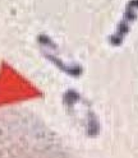
What are the primary laboratory characteristics of Acinetobacter baumannii?
Coccobacillus (Gram-negative short rod/pairs)
Encapsulated
Oxidase-negative
Catalase-positive, and capable of growing at 44°C.
What two nutritional factors are required by Haemophilus influenzae, and what is the "Satellite Phenomenon"?
X factor (Hemin) and V factor (NAD).
Satellite Phenomenon: H. influenzae grows around Staphylococcus aureus colonies on blood agar because S. aureus hemolysins release the required X and V factors.
What capsule type is responsible for >50% of invasive H. influenzae disease, and what is its main antigen?
Type b (Hib), which contains the Polyribitol Phosphate (PRP) capsule.
What is the clinical mnemonic for Haemophilus infections (H.E.M.O.P.)?
Haemophilus, Epiglottitis, Meningitis, Otitis media, Pericarditis
What are the four clinical stages of Whooping Cough and their timeframes?
Incubation: <3 weeks.
Catarrhal Stage (0–2 weeks): Mild cough, sneezing; most contagious stage.
Paroxysmal Stage (2–8 weeks): Paroxysmal cough with inspiratory "whoop" sound.
Convalescent Stage (8–12 weeks): Gradual decline in coughing.
What medium and essential nutrient are required to culture Legionella pneumophila?
Buffered Charcoal Yeast Extract (BCYE) agar requiring L-cysteine.
How does Legionella pneumophila persist in the environment and spread to humans?
Persists endosymbiotically inside aquatic amoebae/protozoa and spreads via inhalation of aerosols from cooling towers, air conditioners, or humidifiers.
Match each Bartonella species to its disease and vector
B. quintana: Trench Fever — Body louse (Pediculus corporis).
B. henselae: Cat-Scratch Disease / Bacillary Angiomatosis — Cats / Cat fleas.
B. bacilliformis: Oroya Fever / Carrion's Disease — Sandflies.
How is Pasteurella multocida transmitted, and what distinct morphological feature does it display?
Transmitted via bites or scratches from domestic animals (cats, dogs); shows a safety-pin appearance (bipolar staining).
What are the primary virulence factors and temperature-dependent features of Yersinia pestis?
Grows optimally at 27°C.
Encapsulated and expresses F1 Antigen at 37°C.
Uses Yop Virulon (Yop A, Yop B) to kill phagocytes and V-W Antigen to prevent intracellular killing.
What are the three clinical forms of Plague?
Bubonic Plague: Swollen, painful lymph nodes (buboes).
Septicemic Plague: Purpura, DIC, and acral gangrene.
Pneumonic Plague: Highly contagious via respiratory droplets; rapidly fatal.
How do you differentiate Pseudomonas aeruginosa from Acinetobacter baumannii using Oxidase and temperature preferences?
P. aeruginosa: Oxidase-positive, grows up to 42°C.
A. baumannii: Oxidase-negative, grows up to 44°C.
Which three organisms in this unit display a characteristic "safety-pin" (bipolar staining) appearance?
Burkholderia pseudomallei (on Wright's stain)
Haemophilus influenzae
Pasteurella multocida (and Yersinia pestis)
What is the key diagnostic media difference between Haemophilus influenzae and Legionella pneumophila?
H. influenzae: Requires Chocolate Agar (supplies X Factor/Hemin and V Factor/NAD).
L. pneumophila: Requires BCYE Agar (Buffered Charcoal Yeast Extract) supplemented with L-cysteine
What is the primary mechanism of action of Exotoxin A produced by Pseudomonas aeruginosa?
It blocks host cell protein synthesis and acts as an antiphagocytic factor.
Which Legionella pneumophila structure prevents phagosome-lysosome fusion inside macrophages?
The Legionella-Containing Vacuole (LCV).
How does Pertussis Toxin (Ptx) differ in function from Dermonecrotic Toxin and Tracheal Cytotoxin in Bordetella pertussis?
Pertussis Toxin / Adenylate Cyclase Toxin: Reduces phagocytosis and impairs immune cell function.
Tracheal Cytotoxin: Directly damages and destroys ciliated respiratory cells and induces IL-1 (fever).
A patient presented with a severe burn wound that developed blue-green pus and a fruity odor. What is the organism, and what is the characteristic skin presentation called if it leads to sepsis?
Pseudomonas aeruginosa: causes Ecthyma gangrenosum (neonate/burn lesions with surrounding erythema without pus).
A patient presents with severe atypical pneumonia, nonproductive cough, and confusion after exposed to a hotel air conditioning system. What special stain is needed to visualize the causative organism?
Silver stain (for Legionella pneumophila, which stains poorly on standard Gram stain).
A patient develops a rapidly spreading cellulitis on their hand 12 hours after being bitten by a stray cat. What is the most likely pathogen?
Pasteurella multocida.
An HIV-positive patient presents with purple, vascular skin lesions. History reveals multiple cats at home. What is the organism and the disease?
Bartonella henselae: causing Bacillary Angiomatosis. (Note: In immunocompetent hosts, it causes Cat-Scratch Disease).
A patient presents with painful, swollen inguinal lymph nodes (buboes) and acral tissue necrosis ("black death"). What vector transmitted this pathogen?
Infected rat fleas carrying Yersinia pestis.
What antibiotic combination is first-line for treating Burkholderia pseudomallei and Burkholderia cepacia?
Trimethoprim-Sulfamethoxazole (TMP-SMX) + Ceftazidime.
Name three antibiotic classes commonly used to treat Acinetobacter baumannii.
Carbapenems
Polymyxins (e.g., Colistin/Polymyxin B)
Aminoglycosides
Oxidase Status of Key Non-Enterics
Oxidase-Positive:
Pseudomonas aeruginosa
Pasteurella multocida
Oxidase-Negative:
Acinetobacter baumannii
Growth Temperatures to Remember
27°C: Yersinia pestis (optimal growth temperature)
42°C: Pseudomonas aeruginosa
44°C: Acinetobacter baumannii
Critical Virulence Factor Profiles
Exotoxin A (P. aeruginosa): Inhibits protein synthesis (similar mechanism to Diphtheria toxin).
Polyribitol Phosphate (PRP) Capsule (H. influenzae type b): Primary antiphagocytic factor and target of the Hib vaccine.
Tracheal Cytotoxin (B. pertussis): Kills ciliated respiratory mucosal cells, directly causing the severe coughing fits.
Legionella-Containing Vacuole (LCV) (L. pneumophila): Prevents phagosome-lysosome fusion, allowing intracellular survival in macrophages.
Yop Virulon (Y. pestis): Injects Yop proteins directly into phagocytes to cause cell death and evade immune clearance.
Scenario C: Outbreak in an Intensive Care Unit
Presentation: Several intubated patients in an ICU develop ventilator-associated pneumonia (VAP). Isolates show Gram-negative coccobacilli that are Oxidase-negative, Catalase-positive, and grow at 44°C.
Primary Suspect: (?)
Key Pearl: One of the ESKAPE multidrug resistant pathogens
Acinetobacter baumannii
Atypical Pneumonia with Gastrointestinal / CNS Signs
Presentation: A patient attending a convention develops a high fever, dry cough, confusion, and diarrhea. Routine Gram stain of sputum shows many neutrophils but no bacteria.
Clue: “Sputum shows many neutrophils (white blood cells) but no visible bacteria.”
Diagnosis: Legionnaires' Disease caused by Legionella pneumophila.
Key Pearl: Requires Silver stain to visualize and BCYE agar with L-cysteine to culture.
Legionella pneumophila is a poorly staining Gram-negative rod. Standard Gram stains fail to pick it up, which is why it requires a Silver stain for visualization. Seeing abundant pus cells (neutrophils) without bacteria on a Gram stain in a pneumonia patient is a classic board exam clue for Legionella.
Summary of the "Legionella Triad" on Exams:
Pneumonia + Hyponatremia/Diarrhea/Confusion
Neutrophils on sputum stain, but NO organisms visible (requires Silver stain)
Exposure to air conditioners, hotel water systems, or cooling towers