biochem test
 Call Kai
 Learn
Learn Practice Test
 Spaced Repetition
 Match
Match Flashcards
 Knowt Play
1/17

There's no tags or description
Looks like no tags are added yet.
Name | Mastery | Learn | Test | Matching | Spaced | Call with Kai | Chat |
|---|
No analytics yet
Send a link to your students to track their progress
18 Terms
functional groups
carbonyl: C double bonded to O; aldehyde if at the end, ketone if in the middle
hydroxyl: OH
carboxyl: COOH
amino: NH2
sulfhydryl: SH
phosphate: PO4
methyl: CH3
carbohydrate functions
fast energy, raw materials, energy storage, structural materials
dehydration synthesis
one monosaccharide loses OH, another monosaccharide loses H → water is formed and the two monosaccharides combine w/ covalent bond
linkage between two monosaccharides = glycosidic linkage
polysaccharides function
energy storage: starch (plants) - easy to digest, glycogen (animals)
structure: cellulose (plants) - hard to digest, chitin (arthopods and fungi)
linear vs branched polysaccharides
linear: starch, slow release of energy
branched: glycogen, fast release of energy
cellulose
herbivores have evolved a mechanism to digest cellulose while carnivores haven’t; bc bacteria live in digestive systems
lipids
-fats, phospholipids, steroids
-do not form polymers (big molecules made of smaller molecules not repeating smaller units)
fats and their function
-glycerol + fatty acid
-dehydration synthesis → ester linkage (between hydroxyl and carboxyl)
-functions: energy storage, cushion organs, insulates body
saturated vs unsaturated fats
Saturated:
-no carbon to carbon double bonds
-long straight chain
-most animal fats
-solid at room temp.
Unsaturated:
-carbon to carbon double bonds in fatty acids
-double bond causes bending
-plant, fish fats + vegetable oil
-liquid at room temp.
phospholipids
-glycerol + 2 fatty acids + PO4 (negatively charged)
-fatty acid tails = hydrophobic, PO4 head = hydrophilic
-in water: head attracted but tails repel; can self-assemble into bubbles (micelle) or form a phospholipid bilayer; heads on the outside while tails in the inside
-phospholipid bilayer: form cell membranes, blocks water soluble molecules + large molecules from entering the layer

steroids
-4 fused C rings + functional group
-different steroids created by attaching different functional groups to rings
-ex. cholesterol: animal cell membranes, helps keep cell membranes fluid and flexible, precursor of all other steroids
-ex. sex hormones
protein structure
monomer = amino acid
polymer = polypeptide
-peptide bond: bonding between amino acids , formed between NH2 of one amino acid and COOH of another, C-N bond, formed by dehydration synthesis
protein = 1 or more poly peptide chains folded and bonded together
-large, complex, 3-D structure
amino acids
-central carbon, amino group (NH2), carboxyl group (COOH), r-group
-r group different for each amino acid; r groups can by non-polar or polar
polar r-groups can be acidic or basic
acidic: aspartate, glutamate, asparagine, glutamine - H+ donors
basic: lysine, arginine, histidine - H+ acceptors
-amino acids w/ sulfur in them: form disulfur bridges (covalent cross links between sulfhydryls, stabilizes 3-D structure, H-S — S-H)
polypeptides
-N terminals = NH2 end
-C terminals = COOH end
N-C-C = polypeptide backbone
different protein structures
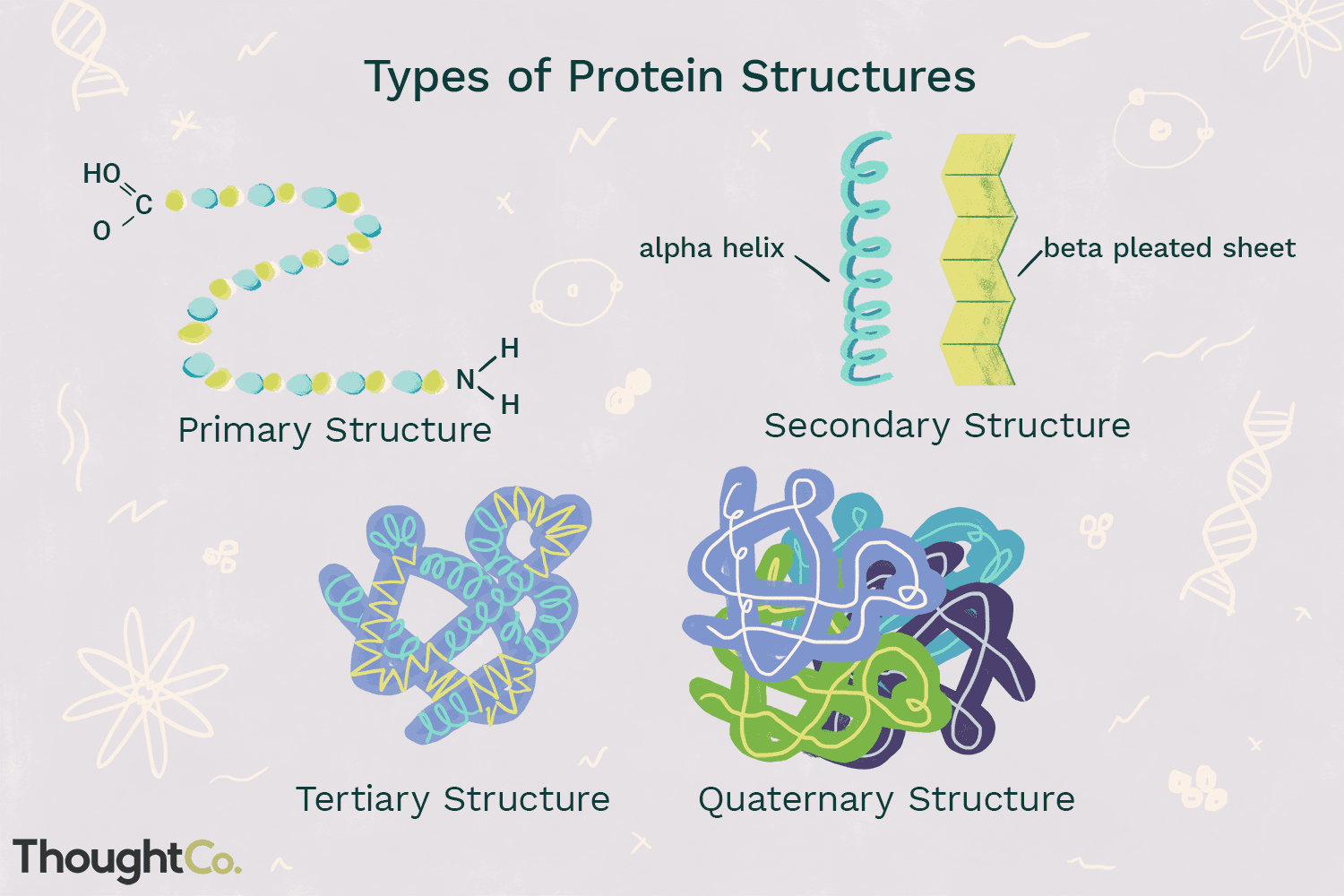
-Primary (1) structure: order of amino acids in chain, dna, slight change in sequence → affect protein structure and function
-Secondary (2) structure: hydrogen bonding (between amine and carbonyl groups) of peptide backbone causes amino acids to fold in a repeating pattern
𝜶 helix vs 𝜷 pleated -sheet
-Tertiary (3) structure: whole molecule folding, 3-D shape, interactions between r-groups of distant amino acids, clustering of hydrophobic groups away from water (nonpolar amino acids), stabilized by H bonds + ionic bonds + disulfide bridges
-Quaternary (4) structure: more than one polypeptide chain bonded together, stabilized by H bonds + ionic bonds + disulfide bridges
ex. hemoglobin (four protein chains), fibrous (long, straight) which includes collagen
protein denaturation
-conditions that disrupt H bonds, ionic bonds, hydrophobic interactions (peptide bonds + disulfide bridges not affected bc covalent)
-temp, pH, salinity
-affect 2, 3, 4 structure and 3-D shape
-destroys functionality (only some can return to functional shape)
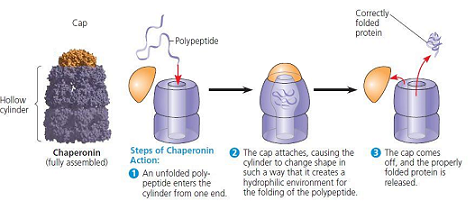
chaperonin proteins
-guide protein folding
-provide shelter for folding polypeptides
-keep new protein segregated from cytoplasmic influences
geometric vs structural isomers
structural: differ in covalent arrangement of atoms, different properties
geometric: differ in spatial arrangement around carbon-carbon double bond
cis = same side of double bond
trans = opposite side of double bond
enantiomer: mirror images but are not the same when overlapped