PHA 361 - Introduction to Ethics L5
 Call Kai
 Learn
Learn Practice Test
 Spaced Repetition
 Match
Match Flashcards
 Knowt Play
1/114

There's no tags or description
Looks like no tags are added yet.
Name | Mastery | Learn | Test | Matching | Spaced | Call with Kai | Chat |
|---|
No analytics yet
Send a link to your students to track their progress
115 Terms
Ethics
The study of moral principles and values that guide behavior and decision-making
Ethical dilemma
A conflict involving clashing values where there is no perfect solution
Right vs. right
A true ethical dilemma involving two morally acceptable choices
Right vs. wrong
A legal or moral issue where one option is clearly incorrect
The four paradigms of ethical dilemmas
Truth vs. Loyalty; Individual vs. Community; Short-term vs. Long-term; Justice vs. Mercy
Truth vs. Loyalty
Conflict between telling the truth and remaining loyal to a person, organization, or ideal
Truth
Conformity with facts or reality
Loyalty
Allegiance or fidelity owed to a person, government, or set of ideals
Individual vs. Community
Conflict between protecting individual rights and promoting the welfare of society
Example of Individual vs. Community
Immunizations and public health measures
Short-term vs. Long-term
Conflict between meeting present needs and planning for future consequences
Justice vs. Mercy
Conflict between fairness/rules and compassion/case-by-case consideration
Justice in ethical dilemmas
Following rules and fairness regardless of personal circumstances
Mercy in ethical dilemmas
Showing compassion and benevolence toward individuals
Ends-based thinking
Doing whatever produces the greatest good for the greatest number
Rules-based thinking
Following moral principles or duties regardless of consequences
Care-based thinking
Treating others the way you would want to be treated
Principles of Western Ethics
Autonomy, Veracity, Fidelity, Avoid Killing, Justice
Autonomy (Western ethics)
Respecting the independent choices of others
Veracity
Telling the truth
Fidelity
Keeping promises, commitments, contracts, and covenants
Avoid killing
The principle that taking human life is wrong
Justice (Western ethics)
Fair distribution of goods and harms
Clinical ethics
A structured approach to ethical questions in healthcare practice
Bioethics
The study of ethical issues in medicine and healthcare
The two major focuses of bioethics
Protection of life and transmission of life
Examples of protection of life issues
Abortion, organ transplants, stem cell research, addiction, mental health, death and dying
Examples of transmission of life issues
Fertility control, artificial insemination, IVF, sterilization, genetic counseling, genetic screening
Clinical ethics in practice
The ability to identify and analyze an ethical question and reach a reasonable conclusion and recommendation for action
Four principles of biomedical ethics
Beneficence, Nonmaleficence, Respect for patient autonomy, Justice
Beneficence
Actions required to provide benefit and promote patient welfare
Nonmaleficence
Actions required to prevent harm; “do no harm”
Respect for patient autonomy
Respecting a patient’s right to make their own healthcare decisions
Justice (Biomedical ethics)
Fair and equitable distribution of healthcare burdens and benefits
Beneficence examples
Removing harm, promoting welfare, balancing risks and benefits of therapy
Nonmaleficence and negligence
The professional must have a duty, breach the duty, harm occurs, and harm is caused by the breach
The four requirements for negligence
Duty; Breach of duty; Harm experienced; Harm caused by breach
Respect for patient autonomy includes
Informed consent, self-determination, avoiding paternalism
Paternalism
Acting like a parent by making decisions for the patient without their input
Justice and drug shortages
Fair distribution and allocation of limited healthcare resources
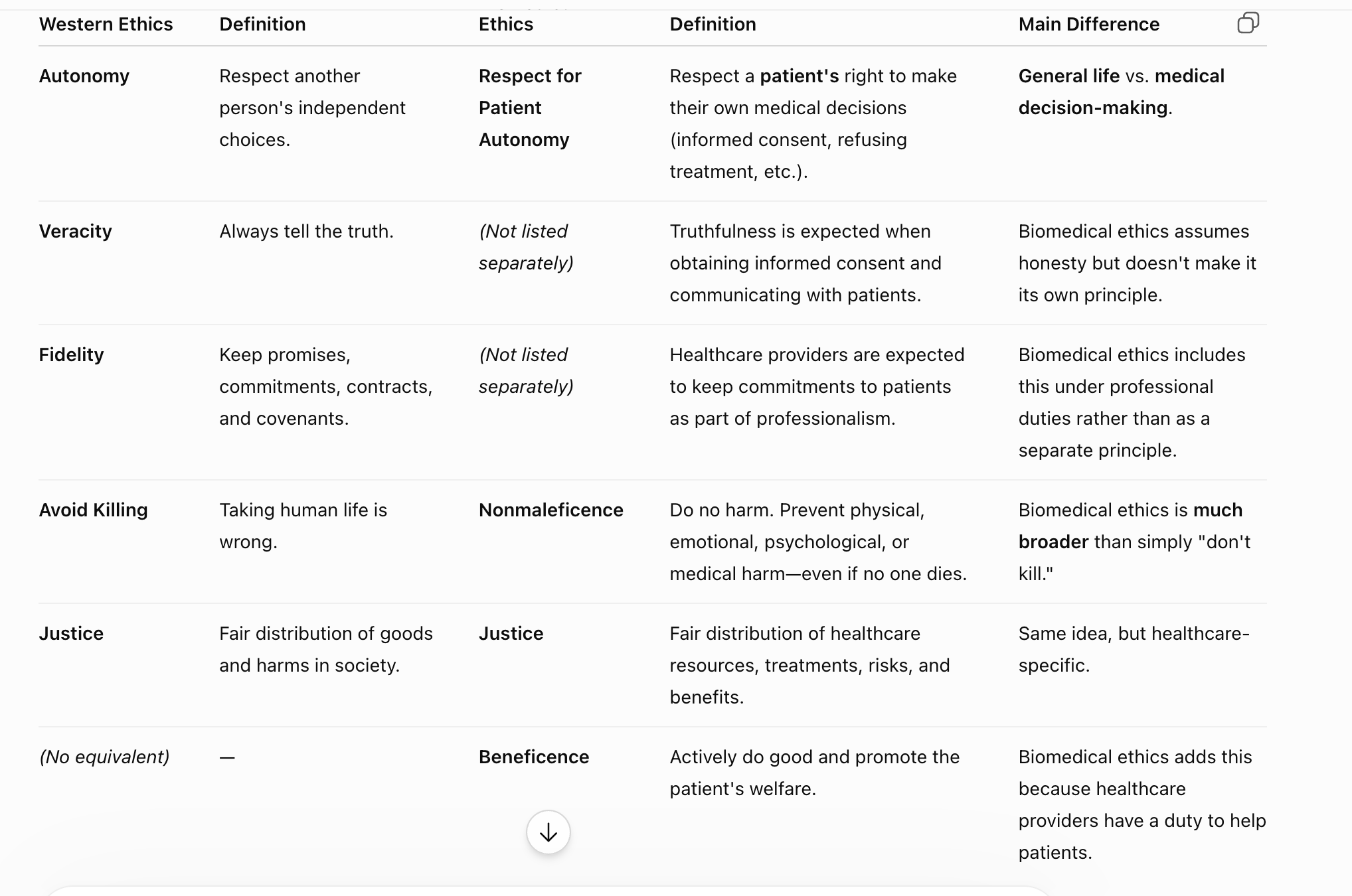
Western ethics vs biomedical ethics
Biomedical ethics replaces veracity/fidelity with beneficence and nonmaleficence
Hierarchy of decision making in pharmacy
Legal Duty → Principles of Western Ethics → Principles of Biomedical Ethics → Professional Duty (Covenant)
Legal duty
Laws and regulations governing pharmacy practice
Professional duty (covenant)
The pharmacist’s professional promise and obligation to the patient
Covenantal relationship
A professional promise between pharmacist and patient involving trust and responsibility
Patient role in the covenantal relationship
Providing health information and payment for services/products
Pharmacist role in the covenantal relationship
Providing pharmaceutical care to the patient
Oath of a Pharmacist
A pledge to devote oneself to lifelong service through pharmacy
Primary concerns in the Oath of a Pharmacist
Welfare of humanity and relief of suffering
What pharmacists must protect according to the oath
Personal and health information
What pharmacists must improve according to the oath
Professional knowledge, expertise, and self-awareness
What pharmacists should advocate for according to the oath
Justice and health equity
Code of Ethics for Pharmacists
Professional ethical standards adopted by APhA in 2007
A pharmacist respects the covenantal relationship
Principle I of the Code of Ethics
A pharmacist promotes the good of every patient
Principle II of the Code of Ethics
A pharmacist respects patient autonomy and dignity
Principle III of the Code of Ethics
A pharmacist acts with honesty and integrity
Principle IV of the Code of Ethics
A pharmacist maintains professional competence
Principle V of the Code of Ethics
A pharmacist respects colleagues and health professionals
Principle VI of the Code of Ethics
A pharmacist serves societal needs
Principle VII of the Code of Ethics
A pharmacist seeks justice in health resource distribution
Principle VIII of the Code of Ethics
Ethical dilemmas commonly faced by pharmacists
Conflicts between patient needs and societal needs, confidentiality issues, scarce resources, religious/cultural conflicts, and research conflicts
Example of pharmacist ethical conflict
A pharmacist refusing to fill a medication due to personal religious beliefs
Patient confidentiality ethical conflict
Balancing privacy with protecting others from harm
Research ethical conflict
Balancing patient needs with research protocol requirements
The Four Topics Chart
Medical Indications; Patient Preferences; Quality of Life; Contextual Features
Medical Indications
Facts about the patient’s condition that guide treatment decisions
Biomedical ethics principles linked to Medical Indications
Beneficence and Nonmaleficence
Patient Preferences
The tests and procedures the patient has consented to receive
Another term for Patient Preferences
Informed consent
Biomedical ethics principle linked to Patient Preferences
Autonomy
Quality of Life
The patient’s satisfaction with physical, mental, and social wellbeing
Biomedical ethics principles linked to Quality of Life
Autonomy, Beneficence, Nonmaleficence
Contextual Features
Outside factors influencing healthcare decisions
Examples of contextual features
Religious, legal, familial, institutional, and financial factors
Biomedical ethics principles linked to Contextual Features
Justice and Autonomy
Advance Directive for Health Care (ADHC)
A legal document allowing patients to appoint a healthcare agent and direct end-of-life care
What the ADHC replaces in Georgia
Durable Power of Attorney for Health Care and the Living Will
DNR order
Do Not Resuscitate; no CPR during cardiac or respiratory arrest
Organ donation documentation
A document expressing wishes regarding organ donation
Statement of personal values
A written expression of beliefs and healthcare wishes
Medical Indications principle connection
Beneficence and Nonmaleficence
Patient Preferences principle connection
Autonomy
Quality of Life principle connection
Autonomy, Beneficence, Nonmaleficence
Contextual Features principle connection
Justice and Autonomy
The pharmacist should act in a manner that helps others
Beneficence
The pharmacist should avoid actions that hurt others
Nonmaleficence
The pharmacist should tell the truth and act with integrity
Veracity and Fidelity
The pharmacist should respect rights and choices
Autonomy
The pharmacist should be faithful in relationships
Fidelity
The pharmacist should be fair
Justice
The pharmacist should be kind
Mercy and compassion
What principle is associated with “do no harm”?
Nonmaleficence
What principle is associated with promoting patient welfare?
Beneficence
What principle is associated with informed consent?
Respect for patient autonomy
What principle is associated with fairness in healthcare?
Justice
What ethical thinking asks “What is good for most people?”
Ends-based thinking
What ethical thinking asks “What is my duty?”
Rules-based thinking
What ethical thinking asks “How would I want to be treated?”
Care-based thinking
What does autonomy mean?
The moral right to choose and follow one’s own plan of life and action