Clinical Skills - Exam 5 (Neuro)
 Call Kai
 Learn
Learn Practice Test
 Spaced Repetition
 Match
Match Flashcards
 Knowt Play
1/109

There's no tags or description
Looks like no tags are added yet.
Name | Mastery | Learn | Test | Matching | Spaced | Call with Kai | Chat |
|---|
No analytics yet
Send a link to your students to track their progress
110 Terms
paresthesia
pins and needles
like feet are falling asleep
dysesthesia
pain without reason
TIA
mini stroke with full recovery
CVA
full stroke
lethargic
drowsy but arousable
obtunded
open eyes, but slow and confused
stuporous
require painful stimulation to arouse
comatose
unarousable
dysarthria
defective articulation
aphasia
disorder of speech
hesitancies, gaps, disturbed inflection
aphonia
loss of voice
nerve problems in larynx
dysphonia
less severe impairment in volume, quality, pitch of voice
causes of dysphonia
laryngitis
tumors
unilateral vocal cord paralysis
what is dysarthria
defect in muscular control of speech apparatus
what does dysarthria sound like
words slurred, nasal, or indistinct
central symbolic aspect of language remains
causes of dysarthria
lesion in CNS or PNS
Parkinson's
Cerebellar disease
broca aphasia
slow, non-fluent
meaningful
lesion of posterior inferior frontal lobe
wernicke aphasia
loud and fluent
lacks meaning
lesion of posterior superior temporal lobe
disorientation
problems with memory or attention
cognitive function testing
digit span (repeat #s)
serial 7s (count back from 100 by 7)
spell WORLD backwards
remote memory
birthday, anniversary, SSN
low in late stage dementia
recent memory
events of day, meals, weather
low in dementia, delirium, anxiety, depression
conditions that cannot draw a clock
dementia
visual or motor problems
mental slowness
CN III function
pupil constriction and reaction to light
-opening eye
-most EOMs
CN IV function
down and inward eye movement
extra-ocular superior oblique
CN VI function
lateral eye movement
lateral rectus
CN XI function
motor SCM and trap
if damage is above crossover in medulla problem is...
contralateral side
if damage is below crossover in medulla problem is...
ipsilateral side
3 pathways thru anterior horn cells
pyramidal tract
basal ganglia system
cerebellar system
pyramidal tract function
voluntary movement
delicate, skilled movement
inhibits muscle tone
damage to pyramidal tract results in
weakness
paralysis
poor delicate movement
increased muscle tone
increased DTRs
basal ganglia system function
maintains muscle tone
gross movement
damage to basal ganglia system results in
changed muscle tone
problems w/ posture, gait
bradykinesia
involuntary movements
cerebellar system function
coordination
equilibrium
posture
damage to cerebellar system results in
poor coordination
problems w/ gait, equilibrium
decreased muscle tone
muscle tone
resistance to passive stretch
0/5 muscle strength
no contraction
1/5 muscle strength
visible/palpable muscle contraction w/ no movement
2/5 muscle strength
movement against gravity eliminated
3/5 muscle strength
movement against gravity only
4/5 muscle strength
movement against gravity with some resistance
5/5 muscle strength
movement against gravity with full resistance
cerebellar system in coordination
rhythmic movement and steady posture
vestibular system in coordination
balance and coordination
sensory system in coordination
position sense
spastic muscle tone
increase tone
worse w/ motion extremes
-easy and then hard to move
rigid muscle tone
same difficulty thru ROM
flaccid muscle tone
limp, no strength or tone
paratonia
inability to relax muscle
unrelated to tone
pronator drift
on side w/ lesion
lesion in upper motor neurons
-pronators stronger than supinators
spastic hemiparesis gait
arm immobile and in flexion "posturing"
leg extended and plantar flexed, toes drag, circular motion
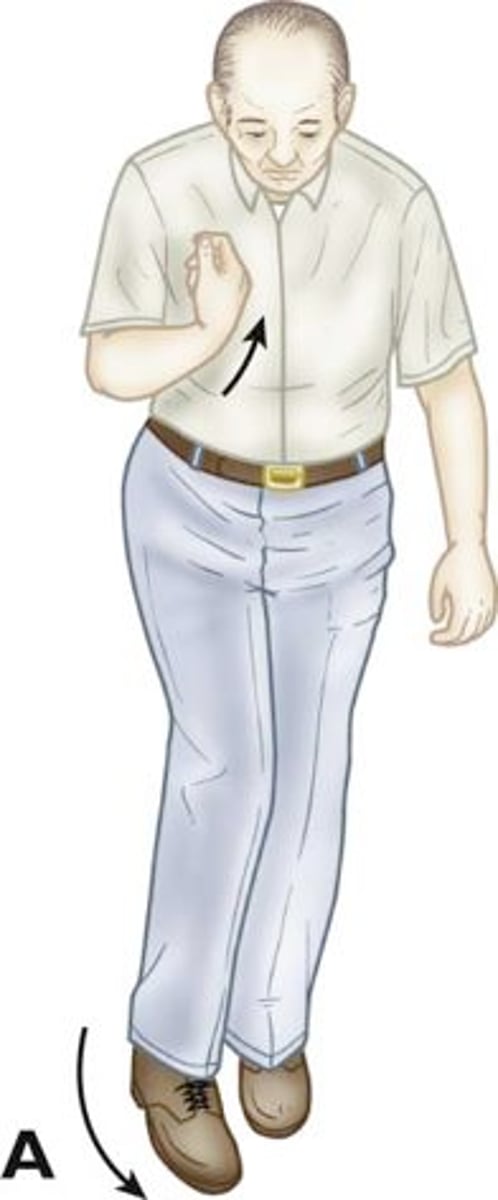
cause of spastic hemiparesis
unilateral hemispheric disease
stroke pt
scissor gait
spastic paresis
b/l stiff gait - adductors
short steps, look like walking thru water
steppage gait
foot drop from paralyzed dorsiflexors
-drags foot and lifts it high
-slaps foot down
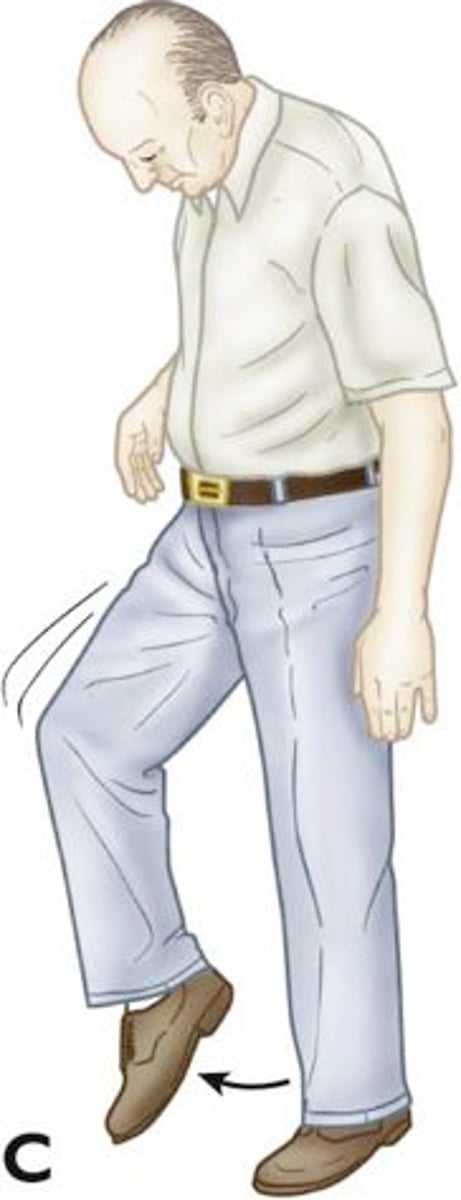
cause of steppage gait
lower motor neuron disease
neuropathy and polio
sensory ataxia gait
unsteady and wide
loss of position sense
throw feet forward, heel then toe
double tapping sounds
sensory ataxia gait sign
positive romberg with eyes closed
causes of sensory ataxia gait
polyneuropathy or posterior column damage
cerebellar ataxia gait
unsteady, wide base, staggering
difficulty turning
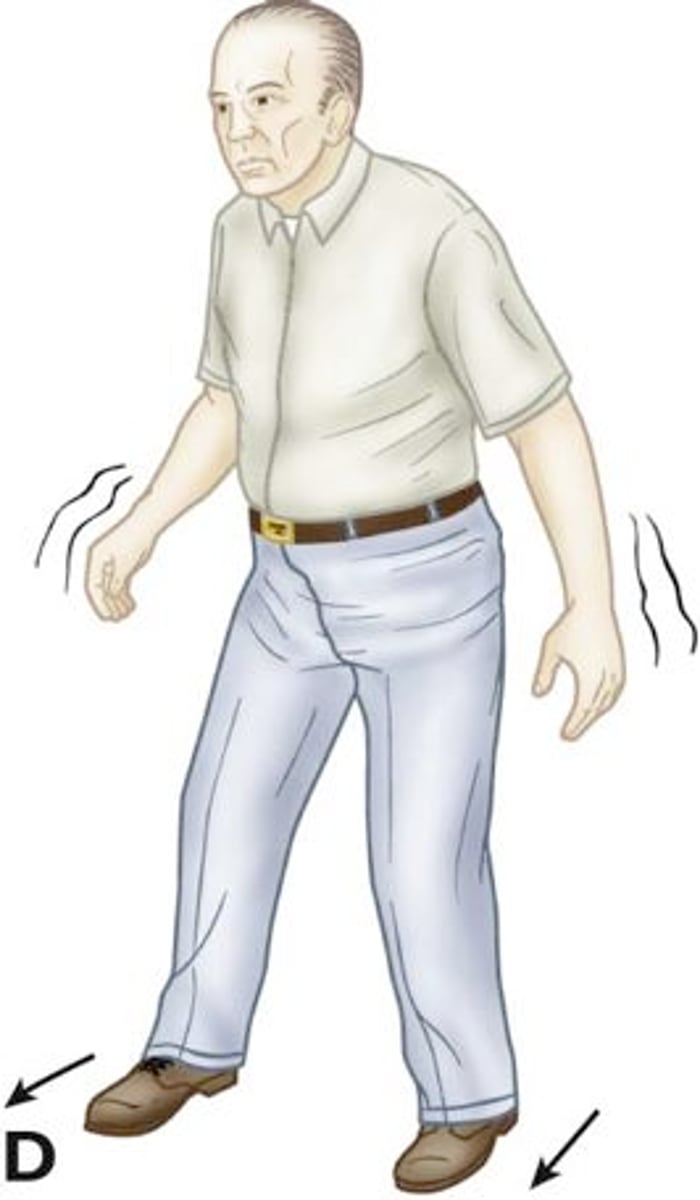
sign of cerebellar ataxia gait
positive Romberg eyes open or closed
causes of cerebellar ataxia gait
cerebellar disease (MS)
parkinsonian gait
fenesterating gait
stooped appearance, falling forward
loss of arm swing, stiff and flexed
short shuffling steps
turns whole body at once
cause of festinating gait in parkinsonian gait
basal ganglia defect
senses of spinothalamic tract
pain (sharp v. dull)
temperature
crude touch
senses of posterior columns
position
vibration
fine touch
senses of sensory cortex
localization
discriminatory
analgesia
absence of pain sensation
hypalgesia
decreased sensitivity to pain
hyperalgesia
increased sensitivity to pain
anesthesia
absence of touch sensation
hypesthesia
decreased sensitivity to touch
hyperesthesia
increased sensitivity to touch
paresthesia
peculiar sensation without stimulation
dysesthesia definition
distorted sensation in response to stimulation
ex: soft feels painful
stereognosis
sensing of familiar objects
graphesthesia
sensing number or letter recognition
point localization
where was the patient touched?
discriminative sensations
extinction
discriminative sensation
stimulate b/l and point to spot
4 DTR
brisk, hyperactive with clonus
CP or MS
clonus
extra beats of a muscle
3 DTR
above average
may or may not be associated w/ disease
2 DTR
average
NORMAL
1 DTR
low normal
0 DTR
absent
bicep nerves
C5 and C6
tricep nerves
C6 and C7
brachioradialis nerves
C5 and C6
quadriceps (patellar) nerves
L2, L3, L4
achillies (ankle) nerves
S1
nerves above umbilicus
T8, T9, T10
nerve below umbilicus
T10, T11, T12
plantar reflex nerves
L5 and S1
Brudzinski's sign
meningeal irritation
positive - hips and knees flex after neck
Kernig's sign
meningeal irritation
positive - pain behind knee when extended
decorticate response to pain
flexor response
arms are like "Cs"
cause of decorticate response to pain
cervical spinal tract
cerebral hemisphere
decerebrate response to pain
extensor
arms like "e's"
cause of decerebrate pain response
problems with midbrain or pons
structural coma pupils
no response
brain bleed