Patient Assessment (The First Step of Nursing Process)
 Call Kai
 Learn
Learn Practice Test
 Spaced Repetition
 Match
Match Flashcards
 Knowt Play
1/16

There's no tags or description
Looks like no tags are added yet.
Name | Mastery | Learn | Test | Matching | Spaced | Call with Kai | Chat |
|---|
No analytics yet
Send a link to your students to track their progress
17 Terms
Identifying a Framework for Care: The Nursing Process
A systematic framework used to identify a patient’s health care needs, determine priorities of care goals and expected outcomes, and establish a nursing plan of care to meet these patient-centered needs.
Five interrelated steps (The nursing process):
Assessment (covered here)
Diagnosis
Plan
Intervention/Implementation
Evaluation/Reassessment
Assessment
General Health Assessment
Physical: Inspection, palpation, percussion, auscultation, review of diagnostic data
Psychosocial (Emotional)
Cultural
Spiritual
Patient Assessment in Detail
All contained in Washington Chapter 3:
Patient Assessment
Please review all tables, boxes and charts!
Patient Information from systematic assessment allows the health care provider to:
Determine the problem
Select an Intervention
Evaluate the effectiveness of the intervention
Establishing a Therapeutic Relationship
Communication:
Verbal
Non-verbal
Helpful
Non-Helpful
Reflective Listening
The Multidisciplinary Approach to the Assessment of Cancer Patients
General Health Assessment
Physical Assessment includes:
Nutrition
Pain
Biochemical Balance (Blood counts)
Nutritional Assessment
Anorexia
Cachexia
Protein-caloric malnutrition
Marasmus
Kwashiorkor
All pain is real – most feared consequence of CA
Combination of physiologic and psychogenic factors:
SIX dimensions to assess and manage the experience of cancer pain:
Physiologic: organic cause of pain
Sensory: intensity, location and quality
Affective: depression and anxiety
Sociocultural: effects of cultural, social and demographic factors that deal with the experience of pain – cultural background and family dynamics
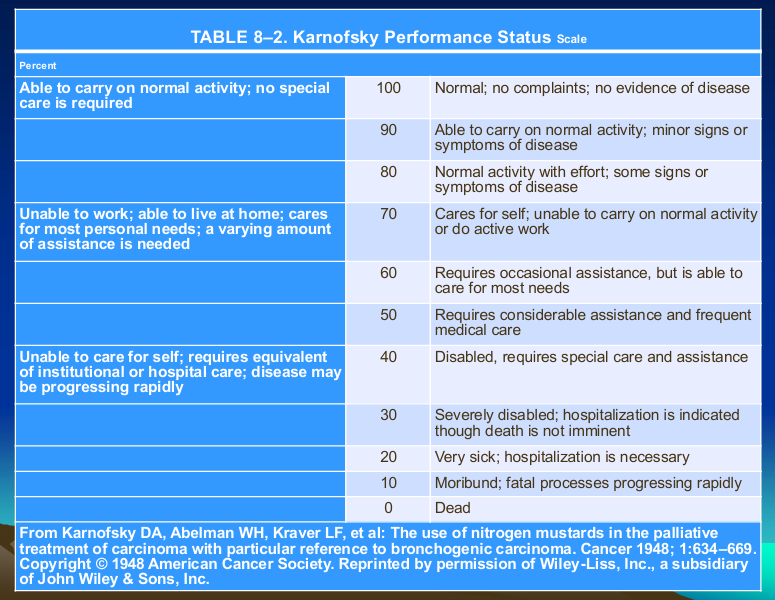
Behavioral: pain-related behaviors such as medication intake and activity level (Karnofsky Performance Status)
Cognitive: the manner in which pain influences a person’s thought processes and the way people view themselves of the meaning of pain
Blood Assessment
Biochemical Balance:
Blood \ Hematologic Changes
Myelosuppression: reduction in bone marrow function.
These may occurs as a result:
Anemia
Leukopenia
Thrombocytopenia
Quality of Life Assessment (Psychosocial Assessment)
Quality of Life Index (QLI), Functional Living Index – Cancer (FLIC)–
Functional Assessment of Cancer Therapy Scales (FACT & FACT-G), Coping Strategies and Responses – Patient •
Anxiety –
State-Trait Anxiety Inventory (STAI): –
Coping strategies: Wash pg 52, box 13.8 •
Depression –
Beck Depression Inventory (BDI)
Coping Strategies and Responses – Family • Family Functioning Index (FFI)–
Rehabilitation
Four Objectives are:
Psychological support
Optimal physical functioning
Early vocational counseling
Optimal social functioning
Cultural Assessment
The systematic appraisal of the cultural beliefs, values and practices of individual and communities.
Spiritual Assessment
Holistic assessment
A person’s need to find answers
Spiritual Support brings comfort
Hope
Special Cases In Assessment
Children - Pediatrics
Assessment of child’s primary caregivers
Multi-dimensional task–
Determine the developmental level of child
Adolescents
Self-esteem issues
Elderly
Sensory and cognitive impairment that may be present
Lesbian, Gay, Bisexual, Transgender
Demonstrate Care and Consideration
Palliative and End of Life
Karnofsky Performance Scale