Lesson 2: Data Collecting Techniques
 Call Kai
 Learn
Learn Practice Test
 Spaced Repetition
 Match
Match Flashcards
 Knowt Play
1/30

There's no tags or description
Looks like no tags are added yet.
Name | Mastery | Learn | Test | Matching | Spaced | Call with Kai | Chat |
|---|
No analytics yet
Send a link to your students to track their progress
31 Terms
Data
is various kinds of information formatted in a particular way
Data collection
is the process of gathering, measuring, and analyzing accurate data from a variety of relevant sources to find afind answers to research problems, answer questions, evaluate outcomes, and forecast trends and probabilities.
Primary Data
Secondary Data
Sources of Data
Primary data
is original information collected firsthand by a researcher specifically to address a current research question or objective.
Primary data
refers to information gathered directly from the source for a specific study or research purpose, rather than relying on previously collected or published data. It is original, fresh, and tailored to the research objectives, ensuring high relevance and specificity to the study at hand. Unlike secondary data, which is pre-existing and collected for other purposes, primary data is generated to answer the current research question, making it more precise and directly applicable to the investigation.
Collected firsthand from the source
Can be qualitative, quantitative, or mixed
Generated through direct interaction, observation, or measurement
Tailored to the specific objectives of the research
Requires ethical safeguards, quality control, and valid sampling to ensure reliability
Key Characteristics of Primary Data
Secondary data
is pre-existing information reused for a research purpose different from, or additional to, the purpose for which it was originally collected.
Existed before the current analysis
Their original purpose may differ from the new purpose
The current researcher has limited control over their creation
Require contextual documentation
Quality is purpose - dependent
Key Characteristics of Secondary Data
Primary Data
Source: Collected firsthand by researcher
Primary Data
Purpose: Specific to current research
Primary Data
Time: Takes longer to collect
Secondary data
Source: Collected by others
Secondary data
Purpose: May have different original purpose
Secondary data
Time: Quickly available
Case studies
Digsite
Oral Histories
Questionnaire
Documents and Records
Interviews
Observations
Polls
Experiments
Focus Groups
Primary Data Collection Methods
Literature Review
Online Database WBS
Government Reports and Statistics
Industry Reports and Market Research
Historical Records
Previous Research Studies
Secondary Data Collection Methods
Indirect Method
Direct Method
Methods of Data Collection
Direct method
involves collecting data straight from the source, providing firsthand, original information. This method is often used to obtain primary data and ensures high accuracy and reliability.
Indirect method
involves collecting data through intermediaries or existing sources, rather than directly from the original subject. This method often uses secondary data or relies on third-party information.
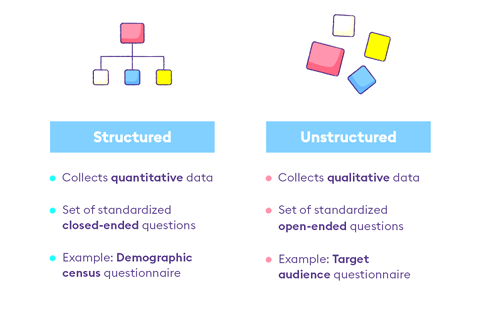
Structured
Collects quantitative data
Set of standardized closed-ended questions
Example: Demographic census questionnaire
Unstructured
Collects qualitative data
Set of standardized open-ended questionnaire
Example: Target audience questionnaire
The Difference between a Structured and Unstructured Questionnaire
Simple Random Sampling
In this technique, every item in the population has an equal and likely chance of being selected in the sample. Since the item selection entirely depends on the chance, this method is known as “Method of chance Selection”. As the sample size is large, and the item is chosen randomly, it is known as “Representative Sampling”
Systematic Sampling
In this method, the items are selected from the target population by selecting the random selection point and selecting the other methods after a fixed sample interval. It is calculated by dividing the total population size by the desired population size
Stratified Sampling
In this method, the total population is divided into smaller groups to complete the sampling process. The small group is formed based on a few characteristics in the population. After separating the population into a smaller group, the statisticians randomly select the sample
Clustered Sampling
In tthis method, the cluster or group of people are formed from the population set. The group has similar significatory characteristics. Also, they have an equal chance of being a part of the sample. This method uses simple random sampling for the cluster of population.
Nature of the Research Study
Objective of the Study
Population Characteristics
Sample Size
Accuracy and Precision Requirements
Available Resources
Accessibility of the Population
Ethical Considerations
Level of Bias Acceptable
Statistical Requirements
Need for Comparisons or Subgroup Analysis
Generalizability of the Results
Criteria for Choice of Sampling Technique
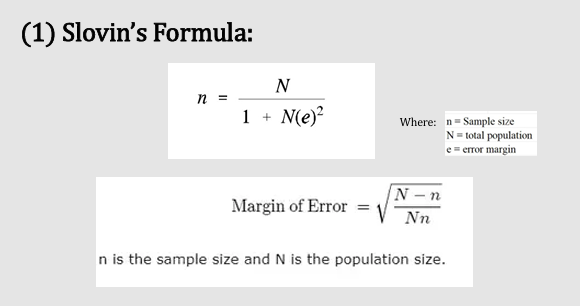
Slovin’s Formula
98.76 or 99
A group of student researchers is conducting a survey to find out the opinion of the residents of a particular barangay regarding the Pax Silica Initiative. If there are 8,000 residents in that barangay and the student researchers decided to use a sample with 10% margin of error, what should be the sample size?
381
Suppose in the first situation, the student researchers would like to use only a 5% margin of error, what should the sample size be?
14%
From a population of 800, a researcher of limited resources decided to use only a sample of 50 respondents, estimate the measure of margin of error?